AI Implementation Services

Put Your AI Pilot to Work in Everyday Operations

Your AI pilot has shown promise. Now it needs to work with real data and support the people using it. eSparkBiz, an AI-native software and product engineering company, connects and strengthens existing AI applications for daily operations, with clear release criteria and support responsibilities.

  • 15+ Years of Experience
  • 400+ Engineers
  • 4.9/5 Clutch Rating
  • ISO 27001 & ISO 9001
  • 1,000+ Projects Delivered
Core Objective

Turn a working AI pilot into a supported application that helps employees or customers complete real business tasks.

Business ROI

Assess completed tasks and staff effort against today’s workflow. Include implementation investment, model usage, infrastructure, human review, and maintenance when judging value.

Tech Stack We Evaluate
  • Amazon Bedrock
  • Apache Airflow
  • FastAPI
  • OpenTelemetry
Service Scope

AI Implementation Connects a Working Pilot to Daily Operations

AI implementation services prepare an existing AI application for use in a live business environment. The work connects production data and systems, addresses application weaknesses, validates behavior, and establishes the deployment controls and operating responsibilities needed for an agreed rollout.

This service fits an existing pilot moving toward production. Choose AI Consulting when use-case selection remains open, or AI Integration Services when connecting systems is the main requirement.

What this can include Connected delivery workstreams

  • 01. ASSESS

    Production Readiness

    Assess the pilot against intended usage, then prioritize the gaps that could block a responsible release.

  • 02. CONNECT

    Data and System Connections

    Connect approved data sources and business applications with defined permissions, validation rules, and handling for failed requests.

  • 03. VALIDATE

    Evaluation and Release Controls

    Test representative tasks and failure cases, then define acceptance criteria, human approvals, and a controlled deployment path.

  • 04. HANDOVER

    Monitoring and Handover

    Establish operational alerts, recovery procedures, and user guidance so named owners can support the application after rollout.


Implementation Challenges

What Keeps an AI Pilot From Going Live

A successful demonstration does not show whether AI will help people complete their work. Resolve the gaps that hold back useful, dependable operation.

  • Demo Results Do Not Hold

    The pilot performs well on selected examples but struggles with actual requests. Representative test cases expose quality gaps before users depend on its answers.

  • Production Data Is Hard to Access

    Live records change, fields arrive inconsistently, and users have different permissions. Resolve freshness and access boundaries before unreliable inputs or unintended data exposure disrupt the workflow.

  • The Workflow Still Needs Manual Handoffs

    Staff copy AI output between applications because the pilot cannot complete the next step. Connect the surrounding task and handle failed updates so useful answers become completed work.

  • Release Approval Has No Clear Basis

    Engineering and business teams disagree on what counts as ready. Representative tests, clear failure thresholds, and named decision makers give the release owner a basis for approval.

  • Operating Costs Are Unclear

    A small pilot hides the effect of real usage and repeated requests. Test expected traffic and review effort before committing to a wider rollout.

  • Nobody Owns the Live Application

    The project reaches deployment without an agreed support owner or recovery process. Establish responsibilities and user guidance so problems have a clear route to resolution.


Implementation Services

Engineering Services for Your AI Production Rollout

Put your existing AI application to work where employees and customers need it. Select the engineering services below around the production gaps identified during assessment.

  • Production Readiness Assessment

    Make the next investment decision with a clear view of release blockers. We assess the pilot’s architecture and dependencies against its intended users and workload.

    • Pilot architecture and dependency review
    • Production gap and risk register
    • Prioritized remediation scope
  • Production Data Pipelines

    Reduce manual data preparation by replacing fragile feeds with validated pipelines. Freshness checks and recovery procedures help the application keep working as source records change.

    • Source mapping and data contracts
    • Freshness and schema checks
    • Failed-record recovery and replay
  • Business Application Integration

    Reduce copying between systems by placing AI output inside the business workflow. We connect approved applications and handle request failures, record updates, and exceptions at each interface.

    • API contracts and authentication
    • Timeouts and duplicate-request protection
    • Write-back validation and exception routing
  • Model Serving and Application Hardening

    Keep the application responsive under expected demand. We validate inputs and outputs, tune runtime behavior, and test resource limits while checking the effect on quality and cost.

    • Model endpoint and runtime configuration
    • Concurrency limits and request queues
    • Technical Feasibility
  • AI Evaluation and Testing

    Give release reviewers evidence of acceptable behavior. We build task-specific evaluations that cover routine requests, difficult inputs, and the consequences of incorrect outputs.

    • Representative datasets and acceptance thresholds
    • Regression and failure-case testing
    • Human review of consequential outputs
  • Deployment and Release Engineering

    Make application changes repeatable and recoverable. We establish versioned deployment workflows with approval points and a tested route back to the previous working release.

    • Versioned application and model configuration
    • Staged deployment and release approvals
    • Rollback testing and release records
  • Monitoring and Cost Controls

    Help operators investigate failures before expanding usage. We connect service and task-quality signals to cost tracking, redact sensitive trace data, and route alerts to responsible responders.

    • Service health and quality monitoring
    • Usage budgets and cost attribution
    • Alert thresholds and response routing
  • User Enablement and Operational Handover

    Help staff complete tasks with AI and recognize its limits. Practical guidance covers uncertain outputs and escalation. Support teams rehearse recovery before accepting operational responsibility.

    • Role-specific usage and review guidance
    • Runbooks and troubleshooting walkthroughs
    • Ownership and escalation handover
Deliverables and Outcomes

What You Receive and How to Assess Its Value

Define the outputs and success measures before implementation begins. Acceptance checks confirm what was delivered; workflow measurements show whether it is useful.

Expected Deliverables

Inspectable Outputs for Release and Handover

Your scope identifies the artifacts you receive and the evidence needed to accept them. Each package should help your team make a release decision or maintain the application.

  • Prioritized Remediation Backlog

    A documented list of production gaps, dependencies, and acceptance criteria that lets your team approve scope and distinguish essential fixes from later improvements.

  • Integrated Deployment Package

    Versioned application configuration, tested interfaces, and deployment instructions, with evidence that agreed data flows and failure paths work in the target environment.

  • Evaluation and Release Record

    Representative test cases, results, and unresolved limitations tied to agreed thresholds, giving the release owner a documented basis for approval.

  • Operational Handover Package

    Monitoring definitions, recovery runbooks, and named escalation paths, checked through a walkthrough in which designated operators practice the agreed support tasks.

Intended Outcomes

Measure Improvement in the Working Process

Compare the live workflow with its baseline over a defined review period. Include review and support effort when judging improvement. These measures do not promise a particular result.

  • More Tasks Completed Successfully

    Track accepted task completion and exception rates together, so increased automated throughput does not conceal more incorrect results or unresolved work.

  • Less Manual Handling

    Measure staff effort across the full task, including review and corrections, to establish whether automation actually reduces the work people perform.

  • Clearer Operating Economics

    Compare cost per accepted task with the prior workflow, including model usage, infrastructure, human oversight, and an agreed treatment of implementation costs.

  • More Manageable Production Support

    Track incident frequency, recovery time, and repeat failures to assess whether monitoring and handover help the assigned team maintain the application.


Project Evidence

AI Implementation in Practice

Review the starting application, the production gaps addressed, and the evidence used to assess release readiness and operational performance.

Case study
  • Industry : eCommerce
  • Solution : AI Development

SmackDab is an AI-enabled Customer Relationship Management (CRM) platform engineered by eSparkbiz to help businesses build stronger customer relationships, optimize sales workflows, and drive sustainable.

  • Dedicated Product Team Engagement Model
  • 40 + Team Member
  • 48+ Months Partnership Duration
  • Live & Scaling Market Stage
Client outcomes

Rated 4.9 across 70 Reviews Verified on Clutch

Our clients value our technical expertise, clear communication, and commitment to quality. Read their feedback on working with eSparkBiz and see how our engineering teams support their business goals.
Michael Heiser

Michael Heiser

Cofounder & CTO of Vault 721

eSparkBiz built an auction platform MVP for a Miami events company in about five weeks, covering frontend, backend and smart contracts, ahead of a February 2022 event. The reviewer liked the QA, the way the team accommodated the time zone, the daily stand-ups and the agile process, and called them incredibly talented, agile developers.

Kristen Marcoe

Kristen Marcoe

Sr. Director, People, Credo AI

eSparkBiz provided AI engineering talents to Credo AI, an AI governance platform, to help with the development of their product and integrations. The 2-5 person team helped a lean startup to work faster to meet a high internal bar. The team was great at project management with excellent and timely communication. The team always met delivery expectations.

Workflow Use Cases

Where an AI Pilot Can Support Daily Work.

The following examples illustrate how an existing pilot can support a complete business task. Scope and success measures depend on the users, data, and operating conditions.

  • Customer Service

    Customer Support Assistance

    Help support agents prepare replies without switching between tools. Bring a response-drafting pilot into the service desk with approved account context, agent review, and escalation for unresolved questions. Measure resolution quality alongside handling time.

  • Knowledge · Workplace

    Internal Knowledge Search

    Employees need guidance they can check and are authorized to see. Connect an existing assistant to maintained knowledge sources and workplace tools, preserve document permissions, and show supporting references. Provide a clear fallback when the sources cannot answer.

  • Finance

    Invoice Intake and Review

    Reduce invoice re-entry while preserving finance checks. Connect extraction results to purchasing records, validate proposed fields before posting, and route uncertain matches to reviewers. Duplicate detection and recovery paths help prevent incorrect or repeated submissions.

  • Operations

    AI-Assisted Business Actions

    Put a tested agent into a bounded task, such as preparing a business-record update. Separate recommendations from execution, require approval for specified actions, and verify completion. Users can then intervene before an unintended change affects downstream work.

  • Supply Chain

    Demand Forecasting for Planners

    Give planners current forecasts in the tools they already use. Connect the existing model to scheduled data refreshes, show forecast error against the baseline, and record planner overrides so replenishment decisions can reflect events the model cannot anticipate.

  • Manufacturing

    Visual Inspection Assistance

    Help inspectors focus on items needing attention. Deploy the image-classification pilot with checks for actual camera conditions, product variants, and line speeds. Compare missed defects and false alerts, and retain manual inspection when image capture or inference is unavailable.

  • IT Service

    IT Service Request Triage

    Connect a ticket-classification pilot to the service management queue so requests reach the right team with relevant context. Validate routing against agreed categories and retain manual reassignment when ambiguous requests would otherwise delay resolution.

  • Finance · Analytics

    Management Report Preparation

    Bring a reporting assistant into the monthly review process using approved metrics and traceable source data. Analysts review drafted commentary and investigate discrepancies before distribution, reducing preparation work while retaining responsibility for the published report.


Industries

Industries We Serve with AI Implementation Services

eSparkBiz provides AI implementation services for regulated industries, including healthcare, fintech, edtech, and more. We help companies connect existing AI pilots to business systems, test them on real tasks, and hand over live applications with named owners.

AI Implementation That Moves Your SaaS Assistant Past Beta Accounts

Your in-product assistant goes from a few beta accounts to every eligible customer with eSparkBiz handling the release work. We test tenant isolation, plan entitlements and usage limits together, then add account-level monitoring for support load and cost.

What We Implement:
  • Beta Account Rollout
  • Tenant Isolation Tests
  • Plan Entitlement Checks
  • Usage Limits per Account
  • Account-Level Monitoring
  • Feature Release Controls
Compliance & Security:
  • SOC 2 controls
  • GDPR and CCPA user data
  • Customer data isolated per tenant
  • Assistant access follows user roles
Success Metrics:

Assistant rollout stays tenant-safe, within plan limits, and cost-controlled across accounts.

Cost & Timeline:

Starting Budget: From $10,000, shaped by beta account count and permission models.
Initial Delivery Phase: 8 to 12 weeks, allowing for plan tiers and monitoring depth.
Drivers: Beta account count, permission models, plan tiers, request volume and monitoring depth set the price.

FAQs
What uptime can we promise customers for an AI feature in our SaaS SLA?
Base the promise on your weakest dependency, usually the model provider. eSparkBiz load-tests the assistant, sets a fallback for when the provider is slow or down, and measures real availability during beta, so you commit to a figure backed by your own data.
Can our SaaS assistant answer from help docs and the customer’s own account data in one reply?
Yes, as long as the two sources stay separate underneath. Help content is shared across tenants, while account data is fetched live with the user’s own permissions. eSparkBiz tests mixed questions during beta to confirm one customer’s records never appear in another customer’s answer.
What happens to our margins if the model provider raises prices after launch?
We plan for that from the start. Model calls go through one service layer, so moving to a cheaper model or adding response caching is a configuration change, not a rebuild. Cost-per-account dashboards show the impact early, before it eats into subscription margins.

Delivery Process

How We Scope and Deliver Your AI Implementation

Start by checking what the pilot proves, then scope the engineering and operating costs. Each stage identifies the evidence and decision owners needed to move forward.

Step 01 · Baseline

Confirm the Pilot’s Purpose and Starting Point

Review what the pilot already demonstrates and where evidence is missing. The business owner confirms the target workflow and baseline before implementation scope is proposed.

Share Your Pilot’s Current Stat
WHAT’S INCLUDED
  • Inspect pilot code and existing results
  • Identify users and consequential decisions
  • Record current effort and task quality
  • Approve the initial workflow boundary
Outcome : Confirmed workflow, baseline measures.
Technology Ecosystem

Technology Choices That Fit Your Existing AI Application

Keep useful parts of the pilot’s stack. Evaluate the following technology candidates against task quality, data restrictions, operating cost, and the skills available to maintain them.

Managed Endpoints or Controlled Model Hosting

Managed endpoints suit teams minimizing serving administration; self-hosting offers runtime control but adds infrastructure duties. Select against task quality, data restrictions, latency, and full operating cost.

  • Amazon Bedrock
  • Amazon SageMaker AI
  • vLLM

Proposal Comparison

Compare AI Implementation Proposals on Delivery Responsibilities

Use the same questions with every provider. The proposed eSparkBiz provisions below should be confirmed in your scope and agreement before work begins.

What to Check in Any Proposal eSparkBiz Proposed Approach
Scope and Reuse
Does the proposal distinguish reusable pilot components from necessary repairs? A rebuild should have a clear justification beyond a preference for different tools.
Assess existing work first and document what stays, changes, or needs replacement. Scope the initial workflow and separate required repairs from optional enhancements.
Integration Responsibility
Who resolves source-data issues, changes upstream interfaces, and handles failed updates? A connector-only scope fits when your team owns the surrounding workflow.
Assign client and delivery responsibilities at each interface. Include exception paths, downstream-action checks, and client dependencies in the scope and acceptance evidence.
Release Acceptance
Are task-quality thresholds, failure limits, and release authority explicit? A limited rollout provides feedback but needs monitoring before access expands.
Define representative evaluations, recovery checks, and an approval owner. Expand access against documented results, with clear pause and rollback decisions.
Operating Cost and Ownership
Does pricing cover model usage, infrastructure, human review, and maintenance? Confirm who pays, operates the application, and responds to incidents.
Separate implementation fees from recurring costs and support. Document handover acceptance, operator responsibilities, coverage, and demand assumptions that could change the estimate.

Agreed Before Kickoff

  • Bounded scope
  • Named owners
  • Release thresholds
  • Itemized costs
Why eSparkBiz

AI Implementation Supported by Product Engineering

eSparkBiz combines AI and software engineering capabilities around the application you already have. The following capabilities and proposed working arrangements help you assess whether our team fits the implementation.

  • 15+ Years in Business
  • 20+ Industries Served
  • 4.9 Clutch 70 Reviews
  • 1,000+ Projects Delivered
  • 400+ Engineers
  • 1,000+ projects across 20+ industries, supported by expertise across 45+ technologies.
  • Collaboration across 10+ time zones combines agreed working hours with named contacts, progress reviews, and escalation paths.
  • Clear IP ownership and confidentiality terms address custom work, third-party licenses, and NDA obligations.
  • Discovery-led planning aligns your goals, scope, and technical dependencies before delivery begins.
  • 95% client retention, earned by staying accountable after go-live.
  • Ranked #1 in DesignCoral’s Top Indian AI Solutions Companies list.
  • Cross-functional engineering teams assess the right approach, including where AI adds value.
  • Flexible engagements with planned continuity define responsibilities, replacement arrangements, and knowledge transfer.
  • Featured among Clutch’s Top AI Code Generation Companies in India.
  • Pre-launch checks cover monitoring, rollback, and fallback before every release.
  • Evaluation results, not demo impressions, guide every launch decision.
  • Transparent scope and costs require approval of budget and schedule changes before additional work begins.
  • Phased delivery with quality and security reviews provides checkpoints and clear release accountability.
  • Defined access, handover, and support options help your team maintain continuity during and after the engagement.
  • Ongoing technical support options help you maintain your systems and respond to changing business needs.
  • Bring your pilot, deployment constraints, and unresolved questions. We can discuss the engineering coverage and working arrangements needed to move the application forward.

    Find the Right Implementation Support
    Governance & security
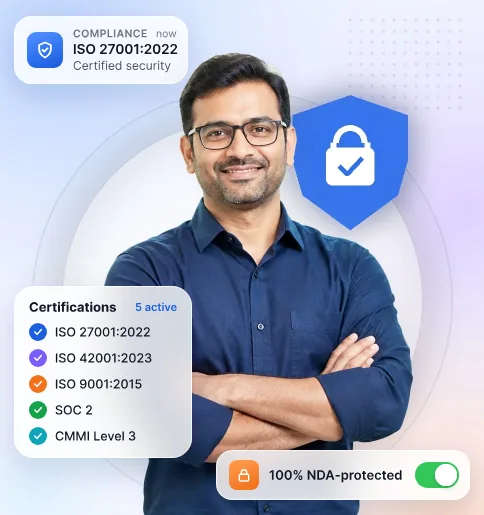
    • ISO 27001:2022
    • ISO 9001:2015
    • SOC 2
    • CMMI Level 3
    • 100% NDA-protected
    Platform Capability
    • AWS Certified Solutions Practice
    • Multi-cloud: AWS, Azure, GCP
    • AI, Cloud & Blockchain
    Company & Credentials

    CIN U72900GJ2013PTC073284 · Certification & audit documentation available on request under NDA.

    Engagement Models

    Choose How Implementation Work Is Managed

    Choose according to who will lead implementation and how well the work can be scoped. Confirm prioritization, delivery management, acceptance, and change authority in the agreement.

    01 / 03

    Staff Augmentation

    Add engineers to your existing implementation team for defined skill gaps. Your delivery lead directs their work and coordinates dependencies, while your business and technical owners retain acceptance responsibility.
    Discuss Your Implementation Skill Gaps
    • Roles matched to identified engineering gaps
    • Your lead sets priorities and tasks
    • Your team manages delivery and dependencies
    • Engineers follow agreed review practices
    • Your owners accept completed work
    • Allocation and changes agreed commercially

    FAQs

    Frequently Asked Questions

    Plain answers on AI implementation cost, partner selection, deployment, cloud setup and post-launch support, plus how to book a scoping call with eSparkBiz to move your AI pilot into production.

    How should a small business choose an AI implementation partner?

    Start with one task that already costs your team hours every week, and ask partners to scope only that. eSparkBiz works from a $10,000 minimum at rates under $25 per hour, which fits a small first release. Choose the partner that explains running costs clearly and tells you what your staff must do after launch.

    Which companies offer end-to-end AI implementation services?

    End-to-end should mean assessment, data connections, testing, deployment, monitoring and handover under one team. eSparkBiz, founded in 2010 with 400+ engineers, covers every one of those stages for pilots moving into production. When comparing firms, ask which stages they subcontract and who answers when the live application fails after handover.

    What are the typical costs for enterprise AI implementation and integration?

    Enterprise projects cost more because of security reviews, several connected systems and staged rollouts across teams. At eSparkBiz, work starts from $10,000, and larger rollouts are priced by milestone after we assess the pilot. Budget separately for model usage, hosting, monitoring and support, since those costs recur every month after launch.

    Where can I find companies that specialize in custom AI solution development?

    Cloud partner directories are a sensible place to start, since listed partners have passed vendor reviews. eSparkBiz is an AWS Advanced Tier Partner listed on AWS Marketplace and has built custom software since 2010. Shortlist firms with case studies close to your use case, then ask each to review your pilot before quoting.

    What is the typical cost range for eSparkBiz AI implementation services?

    eSparkBiz projects start at $10,000, with rates under $25 per hour. A pilot that only needs hardening and deployment sits near the low end, while rebuilt data pipelines, several system connections and regulated data push the price higher. Ask any provider to list build costs and monthly running costs separately before you compare quotes.

    What are the best practices for selecting an AI consulting or implementation firm?

    Decide first whether you need advice or delivery. Consulting suits teams still choosing a use case, while implementation suits a pilot that already works. Either way, check that the firm names its team, shares sample deliverables, writes acceptance criteria into the contract and explains who supports the application once it is live.

    What should I look for in an AI implementation service?

    Look for deliverables you can inspect: a prioritized gap list, a tested deployment package, an evaluation and release record, and a handover package. eSparkBiz includes all four in its implementation scope. Also check for staged rollouts, cost monitoring and access controls, because those decide whether the application stays useful after launch.

    Which providers offer AI strategy and implementation support together?

    Some firms stop at strategy and others only build. eSparkBiz offers AI consulting for choosing use cases and implementation for taking a working pilot live, so one team can carry the work from plan to production. Combined support helps most when your pilot looks promising but nobody has agreed how to measure its value.

    What questions should I ask an AI service provider before hiring them?

    Ask what they will reuse from your pilot, how they test failure cases, who approves release, what monthly running costs to expect and who owns the code. eSparkBiz signs an NDA before you share data and answers each of these in its written proposal, which makes providers easier to compare side by side.

    Can eSparkBiz deploy our custom machine learning model?

    eSparkBiz deploys custom models as managed endpoints or self-hosted services, depending on your data rules, response-time needs and the skills your team has to maintain them. Deployment includes versioned configuration, load tests, a fallback path and monitoring. Models trained by your data scientists can usually be kept, with changes only where testing shows gaps.

    How do I book a consultation with eSparkBiz about AI implementation?

    Use the eSparkBiz contact form and describe what your pilot does, where it needs to run and what is blocking release. We read it before the call, sign an NDA before you share code or data, and you leave with a list of production gaps and what an estimate needs.

    Which AI implementation services provide cloud-based deployment?

    Most do, so check whether they deploy in your cloud account or their own. eSparkBiz works inside your approved AWS, Microsoft Azure or Google Cloud account, and as an AWS Advanced Tier Partner can also support the surrounding cloud and data setup. Containers or Kubernetes are added only when isolation or recovery needs justify them.

    Does eSparkBiz provide managed support after an AI application goes live?

    Yes. eSparkBiz offers post-launch support as a separate scope covering monitoring, incident response, model and prompt updates, and cost reviews. Coverage hours and response times are agreed in writing. If your own team takes over instead, operators rehearse recovery tasks with us before handover so they can run the application with confidence.

    Does eSparkBiz offer AI consulting and support packages?

    Packages at eSparkBiz are built from separate parts: an assessment, implementation through staff augmentation, a dedicated team or fixed price, and a support agreement. Keeping support as its own contract lets you change it later without reopening delivery terms. Many buyers start with an assessment and choose the delivery model afterwards.

    Which companies help move AI models from testing into live deployment?

    Favor firms that handle release engineering, not only hosting: staged rollouts, approval points, rollback testing and monitoring. eSparkBiz, certified to ISO 27001 and ISO 9001 and appraised at CMMI Level 3, deploys models through versioned workflows with a tested route back to the last working release, so a bad update can be reversed quickly.


    Resources

    Insights from our engineering leaders.

    Our team shares practical insights on the technologies and engineering decisions shaping enterprise software today, grounded in real client work.