AI Integration Services

Bring AI Into the Applications Your Teams Already Use

Put AI to work inside your existing software. eSparkBiz, an AI-native software and product engineering company, connects models with business data and application actions so teams can complete tasks in familiar tools, with permissions and validation built into each connection.

  • 15+ Years of Experience
  • 400+ Engineers
  • 4.9/5 Clutch Rating
  • ISO 27001 & ISO 9001
  • 1,000+ Projects Delivered
Core Objective

Make AI useful in an existing workflow by connecting relevant business information with the actions users need to complete.

Business ROI

Measure task time and rework against today’s baseline. Weigh realized benefits against implementation costs, model usage, infrastructure, and ongoing review.

Tech Stack We Evaluate
  • Amazon Bedrock
  • MCP
  • pgvector
  • GitHub Actions
What is AI Integration Services?

AI Integration Connects Models With Your Business Systems

AI integration services connect AI models with existing applications, business data, and workflows. The work covers interfaces, access permissions, output validation, and failure handling so people can use AI within the software they already depend on.
Choose integration when a defined AI use case needs system connectivity. AI Consulting addresses use-case selection; AI Workflow Automation covers broader process redesign. Systems Integration fits rules-based connections.

What this can include Connected delivery workstreams

  • 01. Interfaces

    Application Connections

    Connect hosted or internal models to application interfaces, with request formats and responses the receiving software can process.

  • 02. Data

    Authorized Business Context

    Supply relevant records and documents while preserving source permissions, data freshness, and boundaries between customer accounts.

  • 03. Governance

    Controlled Business Actions

    Validate AI requests against business rules and approval requirements before authorized systems update records or trigger work.

  • 04. Reliability

    Testing and Operational Handover

    Test complete tasks and failure paths, then document monitoring, recovery, and ownership for the integration.


Integration Challenges

What Gets in the Way of Useful AI Integration?

The value of AI integration depends on what happens around the model: how data arrives, where results appear, and whether the task finishes correctly.

  • AI Requires Manual Copying

    Employees copy information between business tools and a separate AI interface. Embedding the task in its source application can reduce duplicate entry and context switching.

  • Existing Systems Resist Connection

    Limited APIs or undocumented legacy behavior can delay integration. Check supported interfaces and adapter options before changing connections that core transactions depend on.

  • Answers Miss Current Business Context

    Outdated documents or missing account changes make answers less useful. Identify authoritative sources and refresh requirements before users depend on the information.

  • Permissions Stop at the Interface

    Signing in does not establish permission to every record. Carry user identity and account boundaries through retrieval and downstream actions to prevent unintended access.

  • System Updates Become Unreliable

    An invalid record reference can cause a wrong update; a timeout can hide a completed one. Apply business validation, approval gates, status checks, and duplicate prevention.

  • Live Usage Changes the Economics

    Long requests and frequent retries can increase model costs while users wait. Test representative traffic, set usage limits, and measure cost per completed task.


Our Capabilities

AI Integration Services We Offer.

Connect AI with the systems your teams use, from the first interface assessment through deployment. Choose the capabilities needed for your workflow.

  • Integration Assessment and Architecture

    Identify the connection work before committing a budget. We map interfaces, application changes, and data dependencies, then compare native connectors with custom integration.

    • System and interface inventory
    • Data flows and ownership map
    • Native connector and custom adapter assessment
  • AI Model API Integration

    Put generation, classification, or predictions inside existing applications. We connect hosted or internal endpoints and adapt model responses for downstream validation and display.

    • Request and response schema mapping
    • Streaming, asynchronous responses, and error handling
    • Output validation and usage metering
  • CRM and ERP Integration

    Reduce manual updates between AI tools and business records. We connect CRM and ERP interfaces while preserving record relationships and platform validation rules.

    • Record matching and field mapping
    • Webhook and event processing
    • Validated updates and status reconciliation
  • Knowledge and RAG Integration

    Give users answers grounded in accessible business information. We connect approved sources to retrieval-augmented generation, or RAG, with source references and content refresh controls.

    • Source connectors and metadata mapping
    • Document permission and deletion synchronization
    • Retrieval checks and source references
  • Legacy System Integration

    Keep useful software in service when standard connectors fall short. We build adapters around supported interfaces, accounting for transaction boundaries and the load legacy systems tolerate.

    • Interface wrappers and protocol adapters
    • Batch scheduling and load controls
    • Transaction boundaries and compatibility tests
  • Agent Tools and MCP Integration

    Let AI assistants request specific business operations. We define tools through direct APIs or Model Context Protocol, or MCP, with explicit inputs and execution responses.

    • Tool definitions and input schemas
    • Restricted operations and approval hooks
    • Execution status and error responses
  • Identity and Access Integration

    Keep AI access aligned with user roles and customer boundaries. Identity checks extend from application entry points through retrieved context to downstream operations.

    • User and service identity mapping
    • Account isolation and permission enforcement
    • Credential rotation and access audit events
  • Integration Testing and AI Evaluation

    Give release owners evidence that the connected task works. We test AI output quality alongside permissions, application behavior, and recovery from incomplete transactions.

    • Contract tests and failure simulations
    • Task datasets and output acceptance criteria
    • Permission tests and regression checks
  • Deployment and Operational Integration

    Make the integration easier to operate after launch. We connect deployments and monitoring to existing practices, with recovery guidance and visibility into usage costs.

    • Deployment configuration and rollback procedures
    • Request tracing and failure alerts
    • Usage dashboards and support runbooks
Deliverables and outcomes

What You Receive and How Success Is Measured

Define what your team receives and how it will be accepted. Measure business improvements separately against the workflow’s current performance.

Expected deliverables

Engineering Outputs Your Team Can Review

The scope specifies the assets delivered, their dependencies, and the evidence needed to accept, maintain, or extend the integration.

  • Integration Design and Interface Contracts

    Document data flows, interface contracts, dependencies, and system owners so application teams can assess compatibility before implementation.

  • Working Connectors and Access Controls

    Working connections demonstrate permitted reads, validated updates, and rejected requests, with configuration and access controls available for review.

  • Evaluation and Acceptance Results

    Test scenarios, quality criteria, failure results, and unresolved defects give release owners a clear basis for their decision.

  • Operating Guide and Recovery Procedures

    Runbooks explain deployment, alerts, credentials, and recovery. Named owners investigate failed tasks and verify completion through an agreed recovery exercise.

Intended Outcomes

Operational Improvements You Can Evaluate

Compare equivalent tasks after users adopt the integration. Include corrections, exceptions, and operating costs when assessing whether performance has improved.

  • Less Manual Transfer Work

    Compare time spent copying information and completing records, including any new checking or correction work.

  • More Useful AI Responses

    Check source relevance and response correctness on representative tasks. Track corrections and requests for missing information.

  • Fewer Unresolved Workflow Failures

    Track failed or duplicated actions and recovery time to assess whether teams can complete interrupted work more reliably.

  • Clearer Cost per Completed Task

    Divide model, infrastructure, maintenance, and review costs by completed tasks. Include allocated implementation costs when assessing the investment over time.


Case Studies

AI Integration in Practice

A useful integration case study connects the original system constraint with the work delivered, acceptance evidence, and observed operational results.

Case study
  • Industry : eCommerce
  • Solution : AI Development

SmackDab is an AI-enabled Customer Relationship Management (CRM) platform engineered by eSparkbiz to help businesses build stronger customer relationships, optimize sales workflows, and drive sustainable.

  • Dedicated Product Team Engagement Model
  • 40 + Team Member
  • 48+ Months Partnership Duration
  • Live & Scaling Market Stage
Client outcomes

Rated 4.9 across 70 Reviews Verified on Clutch

Our clients value our technical expertise, clear communication, and commitment to quality. Read their feedback on working with eSparkBiz and see how our engineering teams support their business goals.
Tawfik Hussein

Tawfik Hussein

Tech Lead, Food & Beverage Company

eSparkBiz took over mobile app development for a Saudi food and beverage company, fixing errors left from earlier work on the iOS and Android apps and re-architecting the Android app. The tech lead liked the speed, quality and flexibility, along with the suggestions the team offered on their own, and noted they are available even on weekends. The team was also commended for sticking to best practices.

Paul Fletcher

Paul Fletcher

Founder, UGC Social Platform

eSparkBiz handles frontend and backend development for a user-generated content social platform, offering advice, recommendations and creative solutions using the latest technology. The founder had been let down by earlier vendors, so the hands-on management, quick delivery and smooth communication over Slack and Asana really stood out. The founder described the team as friendly, reliable and highly proficient.

What Can We Build with AI?

Where AI Fits Into Existing Business Workflows?.

These examples illustrate tasks AI can support within existing software. Each needs suitable interfaces, approved data access, and clear success measures.

  • Customer Support

    Customer Support Assistance

    Support staff can review suggested replies beside helpdesk tickets and authorized account records. The integration brings context into their workspace while refunds and account changes retain existing approvals. Measure handling time alongside corrections.

  • Procurement · Operations

    Document Intake and Record Creation

    Supplier onboarding can start with extracted document fields rather than manual rekeying. Map those fields to onboarding records and send missing or conflicting information to reviewers before saving.

  • Knowledge

    Internal Knowledge Search

    Employees can search accessible policies and operational guides from their portal or collaboration tool. Answers include source references; questions the content cannot resolve go to the responsible team.

  • Sales

    Meeting Notes to CRM Updates

    Turn approved meeting transcripts into draft CRM notes and follow-up tasks. Sales staff confirm contacts, dates, and commitments before saving, reducing administration while retaining ownership of customer records.

  • Finance

    Invoice Exception Routing

    Compare extracted invoice fields with purchase orders and receipts, then route mismatches to the right reviewer. Payment approval remains separate. Measure exception resolution time to see whether the connection improves accounts payable work.

  • E-commerce · Product

    Product Recommendations Within Applications

    Display eligible suggestions from an existing recommendation model where customers choose products. Use permitted interaction data and check availability before showing results, then evaluate whether the suggestions help users find relevant options.

  • Planning · Supply Chain

    Forecasts in Planning Systems

    Planners can review outputs from an approved forecasting model inside inventory or capacity planning software. Show the forecast period and assumptions so they can compare alternatives before changing orders or resource allocations.

  • IT Operations

    Operational Alert Triage

    Bring anomaly scores from an existing model into monitoring and incident tools. Add system context and route alerts to responsible owners so teams can prioritize investigation and track false alarms or missed events.


Industries

Industries We Serve with AI Integration Services.

eSparkBiz delivers AI integration services for several industries, including financial services, healthcare, education, and logistics. We connect AI to your existing systems and data, with built-in security and governance.

AI Integration for SaaS Copilots that Respect Every Tenant Boundary

Inside your product, eSparkBiz connects an AI copilot to your application APIs so customers can ask about their workspace and run supported actions. Tenant permissions and plan entitlements decide what it can touch, and usage metering shows running costs.

What We Connect:
  • Workspace Question Answering
  • Supported In-App Actions
  • Tenant Permission Checks
  • Plan Entitlement Rules
  • Usage Metering
  • Copilot Action Logs
Compliance & Security:
  • SOC 2 controls
  • GDPR and CCPA for user data
  • Tenant data kept separate
  • Actions limited to each user’s role
Success Metrics:

Billing and product usage data now reach support agents in one view.

Cost & Timeline:

Starting Budget: From $10,000, reflecting number of product integrations and API complexity.
Initial Delivery Phase: 6 to 10 weeks, allowing for sandbox testing and release alignment.
Drivers: Number of product APIs, supported actions, tenant permission models and expected usage volume set cost.

FAQs
Can customer admins see what the AI copilot did inside their workspace?
Yes. eSparkBiz can add an admin view listing each copilot request, the action it ran, the user behind it and the result. Admins filter by user or date and export the log, which helps when an enterprise customer’s security team asks how the feature behaves.
Can the same AI copilot support multiple platforms?
Yes. The copilot logic runs through a shared backend service that different client applications can access. Permissions, entitlements, and usage limits remain consistent across connected platforms, while responses can be adapted to each interface and its performance requirements.

Delivery Process

How We Plan and Deliver AI Integrations?

The proposed process starts with one useful task and expands as evidence supports it. Each stage identifies the decision, output, and responsible owner.

Step 01 · Scope

Define the Workflow and Its Limits

Start with one user task and its business owner. Record today’s baseline, the intended AI contribution, and actions that must remain under human control.

Frame Your Integration Requirements
WHAT’S INCLUDED
  • Map inputs, outputs, and affected systems
  • Record baseline handling time and errors
  • Set task boundaries and excluded actions
  • Business owner approves the workflow brief
Outcome : One clear task, firm boundaries
AI Models, Technologies & Tech Stack

Technology Choices That Fit Your Existing Environment

Select technologies around your interfaces, workload, and operating constraints. The following are evaluation candidates, not a predetermined stack or claims of delivery history.

Connect Suitable Model Endpoints

Evaluate existing endpoints before adding a provider. Compare hosted and internal options on task quality, response time, data handling, and operating cost.

  • Amazon Bedrock
  • Vertex AI
  • Existing Model Endpoints

Proposal Evaluation

How to Compare AI Integration Proposals

Compare proposals against the same workload, responsibilities, and costs. The eSparkBiz column identifies provisions to agree during scoping.

What to check in any proposal eSparkBiz proposed approach
Native Connector or Custom Integration
Does a supported connector meet the required actions, permissions, and recovery needs? Custom work adds control but also code to maintain.
Assess native options first. Propose custom adapters for documented gaps; use conventional rules when AI interpretation is unnecessary.
Responsibility Across Systems
Who changes applications, fixes data, approves access, and coordinates vendors? Identify dependencies and ownership beyond the AI component.
Name an owner for each interface and dependency. Scope application changes explicitly and define recovery for partially completed business actions.
Acceptance and Release Evidence
Does acceptance cover a completed task, output quality, denied access, and failure recovery? A model response alone is insufficient.
Agree representative tasks and measurable criteria before building. Provide evaluation and integration test results for named business, technical, and release approvers.
Implementation and Operating Cost
Does pricing separate engineering from licenses, model usage, infrastructure, human review, and maintenance? Compare expected volumes and recurring charges.
Estimate scope with dependency assumptions and client-paid charges identified. Compare operating scenarios and reassess economics using completed tasks and review effort.

Agreed Before Kickoff

  • Bounded scope
  • Named owners
  • Release thresholds
  • Itemized costs
Why Choose eSparkBiz for AI Development?

AI Expertise With the Engineering Your Applications Need

Choose eSparkBiz when AI has to work inside live products, data pipelines, and daily workflows. Our team handles the engineering that makes integration hold up in production.

  • 15+ Years in Business
  • 20+ Industries Served
  • 4.9 Clutch 70 Reviews
  • 1,000+ Projects Delivered
  • 400+ Engineers
  • 1,000+ projects across 20+ industries, supported by expertise across 45+ technologies.
  • Collaboration across 10+ time zones combines agreed working hours with named contacts, progress reviews, and escalation paths.
  • Clear IP ownership and confidentiality terms address custom work, third-party licenses, and NDA obligations.
  • Discovery-led planning aligns your goals, scope, and technical dependencies before delivery begins.
  • 95% client retention, earned by staying accountable after go-live.
  • Featured in Clutch’s Global Summer 2026 NLP recognition.
  • Integration points are audited before any model touches production systems.
  • Dedicated crew pairs 2-3 integration engineers with a compliance reviewer.
  • Cross-functional engineering teams assess the right approach, including where AI adds value.
  • Listed among RevenueBase’s Top AI Workflow Automation Services in India.
  • Flexible engagements with planned continuity define responsibilities, replacement arrangements, and knowledge transfer.
  • APIs and connectors are designed to fit your current architecture.
  • Transparent scope and costs require approval of budget and schedule changes before additional work begins.
  • Phased delivery with quality and security reviews provides checkpoints and clear release accountability.
  • Defined access, handover, and support options help your team maintain continuity during and after the engagement.
  • 24/7 Ongoing technical support options help you maintain your systems and respond to changing business needs.
  • Bring the task you want to improve and the systems it touches. We can discuss the engineering coverage and responsibilities your integration needs.

    Talk About your Integration Priorities
    Governance & security
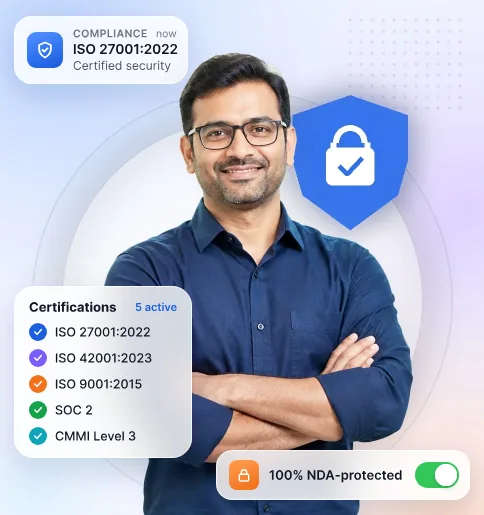
    • ISO 27001:2022
    • ISO 9001:2015
    • SOC 2
    • CMMI Level 3
    • 100% NDA-protected
    Platform Capability
    • AWS Certified Solutions Practice
    • Multi-cloud: AWS, Azure, GCP
    • AI, Cloud & Blockchain
    Company & Credentials

    CIN U72900GJ2013PTC073284 · Certification & audit documentation available on request under NDA.

    AI Development Engagement Models

    Choose Who Leads Your AI Integration Delivery

    Choose according to your management capacity and scope certainty. Agree access dependencies, acceptance ownership, and support responsibilities before delivery begins.

    01 / 03

    Staff Augmentation

    Add integration engineers to a team you manage. Your lead prioritizes work and coordinates dependencies; eSparkBiz contributes the agreed skills within your development and review practices.
    Get Vetted Integration Engineers
    • You set priorities and assign tasks
    • Your lead manages day-to-day delivery
    • Engineers follow agreed development practices
    • You coordinate system access and dependencies
    • Your designated owners accept completed work
    • You approve scope and task changes

    FAQs

    Frequently Asked Questions

    Before you sign anything, you should know what AI integration really costs, where projects stall, and what a scoped proposal from eSparkBiz includes. Here is how we answer those questions.

    How long does eSparkBiz take to deliver an AI integration?

    A first integration from eSparkBiz typically takes 4 to 16 weeks, depending on how many systems are involved, whether their APIs are documented and how quickly test access arrives. A single connection to a documented API sits at the short end. Older systems, write access and sensitive data take longer because they need more testing.

    Which AI integration options work best for customer service automation?

    Most help desk platforms now ship AI features, and those suit teams with simple ticket volumes. eSparkBiz builds custom integrations when replies need data from order, billing or account systems, or when refunds and account changes must keep their current approvals. Compare options on how they handle account permissions, not only on reply quality.

    How do I find a top AI integration consulting firm near me?

    Since most AI integration work happens remotely, judge firms on working-hour overlap, response times and named contacts rather than distance. eSparkBiz, founded in 2010, agrees meeting hours and a single point of contact during scoping. Shortlist two or three firms and ask each to walk you through handover documents from a past integration.

    What is the typical cost structure for an AI integration project?

    Costs split into the build and the ongoing running costs. At eSparkBiz, builds start at $10,000 with rates under $25 per hour, priced by interfaces, data preparation and testing. Running costs cover model usage, hosting, monitoring and support. Ask every vendor to list both so you can compare the total cost per completed task.

    How should we compare AI integration platforms and their features?

    Judge platforms on the task you actually need. eSparkBiz checks native connectors first, then compares which actions they support, how they carry user permissions, what happens on a timeout and how usage is billed. Feature lists look alike on paper; the real differences appear when a connection fails or volume grows.

    How do I request a proposal from eSparkBiz for AI integration into our CRM?

    Send eSparkBiz the name of your CRM, the task you want AI to handle, such as lead summaries, rough monthly volume and any access limits. We sign an NDA before you send sample records. After a scoping call, you get a written proposal covering build cost, timeline, assumptions and expected running costs.

    Can AI integration be done with no-code tools?

    For simple, low-volume tasks, yes. eSparkBiz uses no-code or low-code connectors where they meet the need and adds custom code only for the gaps, such as complex permissions, older systems or safe retries. Before you commit, check how a no-code tool handles failed steps, audit logs and per-run pricing at your expected volume.

    What expertise should an AI integration partner have?

    You need application engineers as much as AI specialists. eSparkBiz brings software, data, cloud, QA and UI/UX skills into the same engagement, because most integration problems sit in APIs, permissions and older systems rather than the model itself. Ask any partner for examples of failure handling, access control and handover documents from past work.

    How do AI integration services for marketing automation compare?

    Some providers only switch on AI features inside one marketing tool, while others connect AI across your CRM, content library and analytics. eSparkBiz does the second kind and keeps brand and legal reviews before anything publishes. Compare providers on which systems they connect, who approves content and how campaign data stays within consent rules.

    Why hire a third-party AI integration specialist like eSparkBiz instead of building in-house?

    A specialist team has already dealt with timeouts, permission gaps and adapters for older systems, so your engineers avoid learning those lessons in production. eSparkBiz offers staff augmentation, a dedicated team or fixed price, and you keep ownership of the roadmap. In-house suits teams whose engineers have spare time and know the systems well.

    How do I choose the right vendor for AI integration services?

    Give each shortlisted vendor the same task, sample data and success measure, then compare their written proposals. eSparkBiz suggests checking who changes your applications, who fixes data issues, how acceptance is tested and what running costs look like after launch. A paid discovery phase helps when your systems are short on documentation.

    Which AI integration services offer strong API support?

    Good API support means documented contracts, versioning, clear error responses and safe retries, not just a working endpoint. eSparkBiz delivers interface contracts and contract tests with every integration, and can expose AI features through direct APIs or the Model Context Protocol. Ask each vendor how they handle rate limits and breaking changes from model providers.

    Which AI integration providers are affordable for startups?

    Affordable usually means a narrow first scope, not the lowest hourly rate. eSparkBiz offers rates under $25 per hour and a $10,000 minimum, which suits a startup connecting AI to one product feature. Keep model usage costs visible from day one, because they grow with your user base and can overtake the original build cost.

    What are the best AI integration services for small businesses?

    For a small business, the best option connects AI to a tool you already pay for, such as your help desk or accounting software, instead of adding another platform. eSparkBiz scopes small projects around one task and clearly states when a built-in feature or plug-in would do the job.

    Is it safe to let eSparkBiz connect AI to systems with sensitive data?

    eSparkBiz is certified to ISO 27001 and signs an NDA before any data is shared. Integrations carry each user’s identity through to data and actions, use the least access needed, rotate credentials and log every request. You decide where data is processed, which model providers are allowed and which actions always need a person’s approval.


    Resources

    Insights from our engineering leaders.

    Our team shares practical insights on the technologies and engineering decisions shaping enterprise software today, grounded in real client work.