AI Transformation Services

Put AI to Work Across Your Products and Business Operations

When AI pilots stall or useful tools sit outside daily workflows, eSparkBiz connects investment priorities with software engineering. We help you build, integrate, and evaluate AI around existing systems, then prepare teams to use and operate it.

  • 15+ Years of Experience
  • 400+ Engineers
  • 4.9/5 Clutch Rating
  • ISO 27001 & ISO 9001
  • 1,000+ Projects Delivered
Core Objective

Decide which AI initiatives deserve investment, then connect business priorities, implementation dependencies, and accountable owners in a phased delivery plan.

Business ROI

Compare cost per completed task with today’s baseline, including implementation, model usage, human review, and maintenance. Distinguish released capacity from cash savings.

Tech Stack We Evaluate
  • Amazon Bedrock
  • FastAPI
  • Docker
  • MLflow
Service Scope

AI Transformation Connects Business Change With Engineering

AI transformation services coordinate changes to business workflows, digital products, data, and operating practices so an organization can put AI to practical use. The work connects investment decisions with implementation, evaluation, employee adoption, and ownership of the resulting systems.

This service fits connected initiatives requiring shared priorities and controls. Choose AI Consulting for strategy alone, or AI Development Services for a defined application build.

What this can include Connected delivery workstreams

  • 01. Planning

    Investment and Delivery Planning

    Assess readiness, prioritize use cases, and map dependencies into a delivery plan with decision owners and measurable objectives.

  • 02. Infrastructure

    Data and Technology Foundations

    Prepare relevant data, permissions, architecture, and integrations for the AI workloads selected for implementation.

  • 03. Engineering

    Workflow and Product Engineering

    Build or adapt AI capabilities around user tasks, including review interfaces, exception handling, and fallback behavior.

  • 04. Operations

    Governance and Operating Practices

    Define approval responsibilities, prepare users, evaluate performance, and establish monitoring and support for the agreed rollout.


Challenges We Address

What Holds AI Transformation Back

AI initiatives stall when priorities, systems, and operating responsibilities do not align. Address these gaps before expanding a promising pilot.

  • Competing Pilots Without Shared Priorities

    Departments test overlapping ideas without a shared investment case. Compare task value, feasibility, and dependencies to decide what to fund, combine, or stop.

  • Data Without Usable Context

    Conflicting records and missing permissions leave AI with incomplete context. Identify authoritative sources, access rules, and quality fixes before relying on its outputs.

  • AI Outside the Workflow

    Employees copy information between AI tools and business applications, adding work and errors. Connect useful capabilities to the systems where tasks are completed.

  • Unclear Approval and Accountability

    Teams disagree about who can approve AI actions or accept mistakes, delaying release. Assign decision owners, review requirements, and escalation paths before expanding automation.

  • Tools Employees Do Not Adopt

    Staff return to familiar processes when AI adds review effort or misses task requirements. Test workflows with users and adjust guidance, handoffs, and responsibilities.

  • Savings That Do Not Materialize

    Faster tasks do not automatically lower operating costs. Measure completed work, rework, usage charges, and review effort before extending an initiative across departments.


Our Services

AI Transformation Services We Offer

Select the planning, engineering, and adoption work your program needs. Each capability addresses a different part of getting AI into daily use.

  • AI Strategy and Investment Planning

    Give leadership a basis for AI spending. Assess business value, readiness, and delivery constraints, then sequence initiatives around shared dependencies.

    • Use-case assessment and prioritization
    • Business cases with cost assumptions
    • Phased roadmap and funding decisions
  • AI Workflow Design

    Redesign how work moves between people and systems. Preserve business rules and clarify where AI assists, where people decide, and how exceptions reach them.

    • Current and proposed workflow maps
    • Human review and escalation design
    • Role-based prototypes and usability checks
  • AI Data Foundations

    Prepare records and documents for the selected tasks. Reconcile business definitions, address source quality, and establish permissions without assuming every source needs migration.

    • Source quality and ownership assessment
    • Data preparation and retrieval pipelines
    • Permissions, freshness, and lineage checks
  • AI Solution Engineering

    Configure existing software when it fits the task and data requirements. Build custom AI when product or workflow needs justify the additional ownership.

    • Predictive and generative AI features
    • Model adaptation and application development
    • Task interfaces and correction controls
  • Enterprise AI Integration

    Connect AI with applications employees and customers already use. Account for identity, permitted actions, transaction failures, and recovery across system boundaries.

    • API and business-system connections
    • Identity and permission enforcement
    • Retries, duplicate prevention, and reconciliation
  • AI Platform Engineering

    Establish shared foundations when several initiatives have common requirements. Reuse model access, deployment patterns, and environment controls where a shared platform is justified.

    • Shared model access and policies
    • Reusable application deployment templates
    • Usage metering and environment controls
  • AI Governance and Evaluation

    Translate policies into responsibilities and release criteria. Test representative tasks, failure cases, and permission boundaries so reviewers can assess deployment readiness.

    • AI inventory and risk ownership
    • Quality, security, safety, and bias evaluations
    • Acceptance thresholds and approval records
  • AI Adoption and Enablement

    Help employees use the changed workflow effectively. Pair practical training with operating guidance and feedback that reveals where the process still needs adjustment.

    • Role-specific training and onboarding
    • Reviewer guidance and escalation procedures
    • Adoption measures and feedback backlog
  • MLOps and LLMOps

    Keep deployed AI maintainable as models, data, and usage change. Establish repeatable releases, monitoring, and recovery procedures; scope ongoing support separately.

    • Versioned deployment and evaluation pipelines
    • Quality, latency, and cost monitoring
    • Incident response and rollback runbooks
Deliverables and Outcomes

What You Receive and How Progress Is Measured

Define the work to deliver and the improvements to evaluate. Your business and technical owners review the evidence before accepting each phase.

Expected Deliverables

Outputs Your Team Can Review and Use

The agreed scope determines which outputs you receive. Each identifies its owner, intended use, and the evidence needed for acceptance.

  • Prioritized Transformation Roadmap

    A sequenced initiative plan with business cases, dependencies, cost assumptions, and decision owners, reviewed against funding priorities and readiness.

  • Integrated AI Workflows

    Application changes and data connections, with permissions, human review, and failure handling tested against the tasks users need to complete.

  • Evaluation and Governance Records

    Versioned test cases, acceptance thresholds, risk decisions, and results that show reviewers what was evaluated and which limitations remain unresolved.

  • Adoption and Operating Materials

    Runbooks, role-specific guidance, ownership records, and monitoring definitions, checked with the people responsible for daily use, support, and future changes.

Intended Outcomes

Improvements to Validate in Daily Operations

These are goals to evaluate, not promised results. Set targets before implementation and account for workload differences, adoption, and operating costs.

  • More Focused AI Investment

    Track whether funding follows value and readiness criteria, including initiatives deferred when dependencies or operating costs undermine the business case.

  • Better Workflow Throughput

    Compare completion time and backlog for equivalent work, including human review and rework, to assess whether AI removes bottlenecks.

  • Acceptable Task Quality

    Measure task success, consequential errors, and escalation rates against acceptance thresholds. Investigate failures before extending automation to more users.

  • Sustained Use and Ownership

    Monitor use within eligible workflows, support demand, and exception resolution to see whether teams can operate the changes without avoidable friction.


Case Studies

From Business Requirements to AI Delivery

Project context matters: the workflow, the systems involved, the engineering contribution, and the evidence used to assess the result.

Case study
  • Industry : eCommerce
  • Solution : AI Development

SmackDab is an AI-enabled Customer Relationship Management (CRM) platform engineered by eSparkbiz to help businesses build stronger customer relationships, optimize sales workflows, and drive sustainable.

  • Dedicated Product Team Engagement Model
  • 40 + Team Member
  • 48+ Months Partnership Duration
  • Live & Scaling Market Stage
Client outcomes

Rated 4.9 across 70 Reviews Verified on Clutch

Our clients value our technical expertise, clear communication, and commitment to quality. Read their feedback on working with eSparkBiz and see how our engineering teams support their business goals.
Nathan Veal

Nathan Veal

Technical Lead at Imagine AI

eSparkBiz provides ongoing development for recruitment SaaS company Imagine, fixing bugs and building small features. The technical lead said the team picked up the existing codebase quickly, delivered on time, stayed well organized and showed strong technical skills. It is still early days, but the client has had a very good experience.

Jarrick Cooper

Jarrick Cooper

Director of Web Strategy

eSparkBiz works as the website development team for digital marketing agency Kuno Creative, building HubSpot CMS and WordPress sites and integrating APIs. Their work helped client sites reach a score of 90 or above on Google PageSpeed Insights. The Director of Web Strategy valued their broad technology knowledge, quick problem-solving and availability during US hours.

Business Use Cases

Where AI Can Change Everyday Work.

These potential applications connect AI capabilities with the surrounding workflow. Their value depends on useful data, workable integrations, and task performance.

  • Customer support

    Customer Support Resolution

    Support agents need account context and relevant answers inside their service tools. Combine approved knowledge with suggested next steps, keeping consequential actions subject to review. Assess resolution quality and repeat contacts alongside handling time.

  • Knowledge

    Enterprise Knowledge Access

    Help employees find guidance across policies, project records, and technical documents. Preserve document permissions and source references so answers can be checked. Content owners remain responsible for correcting outdated guidance and resolving conflicting information.

  • Operations

    Document Intake and Routing

    Incoming forms, emails, and attachments can become structured work queues. Validate extracted fields against source documents, route uncertain entries to reviewers, and connect accepted records to downstream systems to reduce repeated data entry.

  • Sales

    Sales Proposal Preparation

    Assemble proposal drafts from approved product information, prior responses, and opportunity requirements. Reviewers retain control of pricing and commitments, allowing sellers to spend less time gathering context without generated text creating unauthorized promises.

  • Finance

    Finance Exception Handling

    Give accounts payable teams a consolidated view of invoice discrepancies, purchase orders, and receiving records. AI can summarize mismatches for investigation while deterministic matching rules and payment approvals stay in place. Evaluate turnaround and correction effort.

  • Product · Research

    Product Feedback Analysis

    Group feedback from support tickets, interviews, and reviews to identify recurring needs. Link themes to source evidence and customer segments, then check priorities against usage data so comment volume is not mistaken for demand.

  • Supply chain · Planning

    Demand and Capacity Planning

    Combine historical demand, current orders, and operating signals to compare planning scenarios. Show forecast uncertainty and preserve planner overrides before inventory, staffing, or production commitments. Track forecast error against existing planning methods as conditions change.

  • Engineering

    Software Change Analysis

    Relate change requests to code, tests, and technical documentation so developers can investigate dependencies. Protect repository access and retain developer review. Assess whether investigation becomes faster without weakening the checks required for release.


Industries

Industries We Serve with AI Transformation Services.

eSparkBiz provides AI transformation services for 20+ industries, including financial services, insurance, healthcare, and logistics businesses. We help companies plan AI priorities, connect AI to existing systems, automate daily workflows, and prepare teams to adopt it responsibly.

AI Transformation for SaaS Products Adding Guided Onboarding and Activation

eSparkBiz builds guided onboarding that helps customers configure accounts and finish setup inside your product. Assistance reads live product state, respects tenant boundaries and asks for confirmation before changing anything. We track activation and support effort per account.

What We Build:
  • Guided Onboarding Assistant
  • Product State Connections
  • Tenant Boundary Controls
  • Confirmation Before Account Changes
  • Activation Measurement
  • Cost to Serve Per Account
Compliance & Security:
  • SOC 2 controls
  • GDPR and CCPA compliance
  • Tenant data kept separate
  • Account change confirmation
Success Metrics:

Product intelligence connects AI investments with user demand and measurable business returns.

Cost and timeline

Starting Budget: From $10,000, determined by project requirements.

Initial Delivery Phase: 8 to 12 weeks, subject to project scope and technical complexity.

Drivers: Product areas, tenant permission rules, onboarding steps, usage data quality and assistant volume set pricing.

FAQs
Can AI transformation help a SaaS company pass enterprise customers’ AI security reviews?
eSparkBiz documents what enterprise buyers usually ask about an AI feature: which data it reads, where that data is processed, who can switch the feature off and how outputs are logged. Your sales and security teams get written answers taken from the real system, which cuts the back and forth on security questionnaires without promising any customer’s approval.
How do we handle SaaS customers who want AI features switched off for their accounts?
eSparkBiz builds per-account controls so an admin can turn AI features off, limit them to certain users or keep their data out of model calls. Onboarding still works without AI for those accounts. We test both paths before release, so an opt-out never breaks setup or support flows for the customers who choose it.

Delivery Process

From AI Priorities to Supported Operations

Start at the phase your existing work supports. Each step produces evidence for a business or technical decision before the scope expands.

Step 01 · Discover

Agree on the Business Decision

Define the task to improve and the decision AI should support. Your sponsor confirms the problem, baseline, and accountable process owner.

Share Your Starting Point
WHAT’S INCLUDED
  • Map users, tasks, and constraints.
  • Record volume, effort, and error costs.
  • Identify competing initiatives and shared dependencies.
  • Approve the objective and initiative brief.
Outcome : Clear business goals and ownership
Technology Options

Technologies We Evaluate for Your AI Environment

These are evaluation candidates, not a required stack or a claim of project experience. Selection follows your workflows, existing environment, and operating constraints.

Model Access and Development

Compare managed services with custom model development using task results, data restrictions, latency, tuning needs, and operating effort. Benchmark representative workloads before selection.

  • Amazon Bedrock
  • Amazon SageMaker AI
  • Microsoft Foundry

Partner Evaluation

How to Compare AI Transformation Proposals

Compare the work, responsibilities, and trade-offs behind each proposal. The eSparkBiz provisions below are proposed terms to confirm during scoping.

What to Check in Any Proposal eSparkBiz Proposed Approach
Program scope
Does the proposal justify coordinated change, or would one application project meet the need with less organizational effort?
Start with a bounded initiative and shared dependencies. Add coordinated workstreams when cross-team decisions justify the planning and governance involved.
System ownership
Who provides access, changes connected systems, and resolves failures? Does platform replacement justify its migration cost?
Map interface owners, dependencies, and exception handling. Retain suitable systems and price material remediation or replacement explicitly when required.
Release evidence
What task results and failure tests support release? Who can reject deployment when acceptance criteria are unmet?
Agree representative tests and named approvers before building. Use staged release where uncertainty remains, accepting slower expansion for stronger operational evidence.
Operating economics
Does the estimate include model usage, licensing, hosting, human review, maintenance, and adoption? What remains your responsibility?
Separate delivery from recurring costs, including monitoring and human review. Define internal ownership or contracted support, then reassess economics using actual usage.

Agreed Before Kickoff

  • Model approach
  • Accuracy targets
  • Data ownership
  • Running costs
Why eSparkBiz

AI Transformation with Product Engineering Behind It

Choose eSparkBiz when AI priorities require changes to existing products, applications, and operating workflows. Our scope brings those engineering disciplines into the same engagement.

  • 15+ Years in Business
  • 20+ Industries Served
  • 4.9 Clutch 70 Reviews
  • 1,000+ Projects Delivered
  • 400+ Engineers
  • 1,000+ projects across 20+ industries, supported by expertise across 45+ technologies.
  • Collaboration across 10+ time zones combines agreed working hours with named contacts, progress reviews, and escalation paths.
  • Clear IP ownership and confidentiality terms address custom work, third-party licenses, and NDA obligations.
  • Discovery-led planning aligns your goals, scope, and technical dependencies before delivery begins.
  • 95% client retention, earned by staying accountable after go-live.
  • Legacy processes are mapped before AI automation replaces manual steps.
  • Listed among DesignRush’s Top AI ERP Consultants for automation-led transformation.
  • Transformation KPIs link every AI initiative to measurable business outcomes.
  • Featured among Clutch’s Top AI Code Generation Companies in India.
  • Change management and training make AI adoption stick across teams.
  • Responsible AI controls are built into workflows, not bolted on.
  • Cross-functional engineering teams assess the right approach, including where AI adds value.
  • Flexible engagements with planned continuity define responsibilities, replacement arrangements, and knowledge transfer.
  • Transparent scope and costs require approval of budget and schedule changes before additional work begins.
  • Phased delivery with quality and security reviews provides checkpoints and clear release accountability.
  • Defined access, handover, and support options help your team maintain continuity during and after the engagement.
  • Quality and security reviews support delivery, with named owners responsible for release decisions.
  • Bring one priority workflow and the systems it depends on. We can discuss engineering scope, required business involvement, and a practical starting engagement.

    Discuss Your Engineering Needs
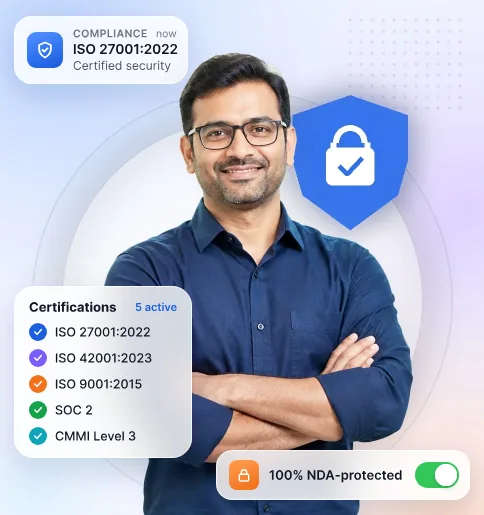
    Governance & security
    • ISO 27001:2022
    • ISO 9001:2015
    • SOC 2
    • CMMI Level 3
    • 100% NDA-protected
    Platform Capability
    • AWS Certified Solutions Practice
    • Multi-cloud: AWS, Azure, GCP
    • AI, Cloud & Blockchain
    Company & Credentials

    CIN U72900GJ2013PTC073284 · Certification & audit documentation available on request under NDA.

    Engagement Models

    Choose How Your AI Work Is Delivered

    Choose by the delivery responsibility you want to retain. Use discovery when data quality, access, or workflow uncertainty prevents a responsible implementation estimate.

    01 / 03

    Staff Augmentation

    Add specialists to your delivery organization. Your leads prioritize work, manage execution, and accept outputs; eSparkBiz supplies engineering capacity for the skills and responsibilities in scope
    Get Specialist Support
    • Roles matched to the agreed backlog
    • Your team owns architecture decisions
    • Your leads manage tasks and reviews
    • Your reviewers accept completed work
    • Capacity changes agreed with eSparkBiz
    • Access and onboarding responsibilities defined

    FAQs

    Frequently Asked Questions

    Clear answers on what AI transformation costs, how long the first workflow takes, how to compare providers and how to request a scoped proposal from eSparkBiz.

    How do I choose an AI transformation service provider or consulting firm?

    Ask each firm to walk you through a system it puts into daily use, not a slide deck. Then compare who owns integration and support after launch, how results are measured against today’s numbers, whether recurring model and hosting costs appear in the estimate, who can stop a release and whether you can end the work after the first phase.

    Which AI platforms work for business automation, and when do you need custom AI transformation work?

    eSparkBiz often recommends starting with software you already pay for when it fits the task and data, and building custom only where it falls short. A platform works well when the whole process lives inside it. You need transformation work when the task crosses several systems, needs approval steps the platform cannot enforce, or per-user licences would cost more than a build.

    Can we start with an AI transformation pilot before committing to a full program?

    Yes, and eSparkBiz usually recommends it. A fixed-price pilot on one workflow, with acceptance checks agreed before building starts. If results meet the targets, the next phase is scoped using real usage and cost data. If they fall short, you can stop, narrow the task or change the approach without having funded a full program up front.

    Can eSparkBiz take over an AI project that another vendor started?

    Yes, eSparkBiz starts a takeover with a short review of the existing code, data pipelines, prompts, test results and open issues. We then tell you what can be kept, what needs fixing and what it will cost to reach release. Whatever already runs keeps running while we take over in stages, so users see no sudden gaps.

    How much time does our team need to give an AI transformation project?

    Most projects need a business owner who makes decisions, a technical contact for system access, and a few people who do the task today to test drafts. Their time goes mainly into early workshops and reviews. eSparkBiz lists each role and timing in the proposal, so the work fits around daily duties.

    Where can I find AI transformation consulting services near me?

    A local firm helps when the work depends on frequent site visits. Still, most AI transformation work runs remotely through video workshops, shared workspaces and controlled access to your systems, which is how eSparkBiz works, so location rarely limits the choice. Time zone overlap, response times and named contacts matter more than distance, so ask about those on the first call.

    What does AI implementation typically cost for a mid-sized business?

    Mid-sized companies usually begin with one workflow rather than a full program. At eSparkBiz, projects start at $10,000, with engineering billed at under $25 an hour. Cost grows with the number of systems to connect, the amount of data cleanup, and the testing and training the rollout needs. Budget separately for recurring model usage, hosting and support.

    What pricing models and packages does eSparkBiz offer for AI transformation services?

    AI transformation work is priced in three ways. Fixed price suits a bounded assessment, pilot or build with clear scope. A dedicated team suits programs where priorities move. eSparkBiz also offers staff augmentation when your own leads run delivery. Proposals separate one-time delivery cost from recurring hosting and model usage.

    Can eSparkBiz integrate AI transformation work with our cloud environment?

    eSparkBiz is an AWS Advanced Tier Partner, and we build on the cloud accounts and hosting your team has already approved rather than moving you somewhere new. Integration covers identity and permissions, API connections to business systems, deployment pipelines and cost monitoring. Where a different hosting setup makes sense, the proposal explains why and prices the move separately.

    How do I request a quote from eSparkBiz for AI-powered customer experience improvements?

    Send eSparkBiz the customer journey you want to improve, the support or service tools your team uses, rough contact volumes and any pilots already running. We reply with questions, then a written proposal covering scope, exclusions, what we need from your team, milestones, price and acceptance checks. If customer records are involved, say so early so access can be planned into the schedule.

    Are AI transformation services worth it for small and medium businesses?

    Often yes, if you start small. eSparkBiz projects start at $10,000, so a smaller company can fix one costly workflow, check the results and then decide on the next step. The best first picks are tasks your team repeats daily with clear rules and records. If review effort cancels out the time saved, narrow the task before spending more.

    Can eSparkBiz integrate generative AI into our marketing workflows?

    Yes, eSparkBiz builds generative AI into the marketing tools your team already uses, drafting campaign copy, briefs and email variants from approved brand and product content. Reviewers keep control of claims, pricing and anything published. We connect drafts to your content systems and track editing time and correction rates, so you can see real speed gains.

    How long does an AI transformation program take before the first workflow is live?

    The first workflow is usually live in 6 to 20 weeks, depending on industry and scope, as the tabs above show. Access approvals, data cleanup and reviewer availability set most of that schedule. A wider program then expands in stages, with each release approved on results from the previous one rather than on a fixed calendar.

    Does eSparkBiz sign an NDA, and who owns the AI systems built during the engagement?

    eSparkBiz signs an NDA before any data is shared and works under ISO 27001 certified security practices. Ownership of code, prompts, model configurations and documentation is written into the contract before work starts, so you know exactly what transfers to your team at handover. Ask any provider to name which parts are reusable tools of theirs and which are built for you.

    Which companies offer end-to-end AI transformation services for an enterprise digital upgrade?

    Enterprise programs often stall at the handoff between a strategy firm and a separate build team, so check that one team owns every step. eSparkBiz, founded in 2010 with 400+ in-house engineers, covers use case priorities, data preparation, integration, release testing, user training and support after launch.


    Resources

    Insights from Our Engineering Leaders

    Our team shares practical insights on the technologies and engineering decisions shaping enterprise product today, grounded in real client work.