DevOps Consulting Services

Release Software More Reliably With Less Manual Deployment Work

Release delays make delivery commitments harder to keep and pull engineers away from product work. eSparkBiz, an AI-native software and product engineering company, helps you assess bottlenecks, automate deployment workflows, and establish release controls your team can maintain.

  • 15+ Years of Experience
  • 400+ Engineers
  • 4.9/5 Clutch Rating
  • ISO 27001 & ISO 9001
  • 1,000+ Projects Delivered
Core Objective

Identify the release bottlenecks worth fixing first, then prioritize changes that support delivery commitments and fit your architecture and operating responsibilities.

Business ROI

Measure release effort and failure-related rework against your baseline, including implementation and recurring costs. Distinguish recovered engineering capacity from cash savings.

Tech Stack We Evaluate
  • GitHub Actions
  • AWS CloudFormation
  • Kubernetes
  • Playwright
Scope and Fit

DevOps Consulting Connects Software Delivery With Operational Needs

DevOps consulting assesses how code reaches production and identifies improvements across workflows, infrastructure, and team responsibilities, producing a prioritized plan with clear ownership. Implementation adds tested workflows with documented release controls.

Choose it when the bottleneck is unclear. If your technical lead already owns an approved backlog, additional DevOps engineers may be sufficient. Ongoing production support requires a separate operating scope.

Cost depends on applications, environments, pipelines, and controls, with assessment, implementation, and operation estimated separately. Access and reviews affect timing.

What this can include Connected delivery workstreams

  • 01. Define

    Assessment and Priorities

    Trace release delays and failure points, then rank improvements by business impact, dependencies, and implementation effort.

  • 02. Build

    Pipelines and Environments

    Design repeatable builds and deployments, with versioned infrastructure and configuration that reduce avoidable differences between environments.

  • 03. Connect

    Security and Release Controls

    Define approval gates and recovery checks, including database changes that cannot be reversed through application rollback alone.

  • 04. Validate

    Observability and Team Ownership

    Connect release health to actionable monitoring, recovery procedures, and named responsibilities for maintaining the delivery workflow.


Delivery Challenges

DevOps Problems That Put Release Commitments at Risk.

Release problems often begin before deployment. We examine the handoffs, environments, and controls behind recurring delays to identify changes worth making.

  • Releases Wait on Manual Steps

    Engineers rebuild packages or copy files between environments, delaying customer updates. Repeatable pipelines can remove routine work while retaining approvals where business risk requires them.

  • Testing and Production Behave Differently

    A release passes testing but fails after deployment because configurations differ. Versioned environment definitions and configuration checks make those differences visible before customers encounter them.

  • Recovery Depends on One Engineer

    When a deployment fails, the team waits for the person who knows how to recover it. Tested recovery procedures reduce that dependency and clarify escalation.

  • Security Reviews Arrive Too Late

    Release approval stalls when vulnerable dependencies or exposed credentials surface at the end. Earlier checks give teams time to resolve findings before the deployment window.

  • Alerts Miss the Customer Impact

    Dashboards look healthy while users struggle after a release. Service-level signals and release annotations help teams connect technical changes with the workflows customers rely on.

  • Automation Is Expensive to Maintain

    Duplicated pipelines and idle environments consume budget without improving delivery. Reviewing reuse, resource lifecycles, and maintenance ownership helps distinguish useful automation from avoidable operating overhead.


Our DevOps Services

DevOps Consulting and Implementation Services

Focus on the engineering work that addresses your delivery constraints. Assessment findings guide the choice of capabilities and the extent of implementation.

  • DevOps Assessment and Strategy

    Direct investment toward the constraints affecting delivery most. We trace work from code review to production and rank improvements by business impact, dependencies, and effort.

    • Release workflow and bottleneck mapping
    • Delivery baseline and maturity findings
    • Prioritized backlog with dependencies and effort assumptions
  • CI/CD Pipeline Engineering

    Make routine releases easier to execute and trace. We design automated build and deployment workflows that promote tested artifacts through the appropriate environments.

    • Build automation and artifact versioning
    • Environment promotion and approval rules
    • Pipeline access and failure handling
  • Infrastructure as Code

    Make environments easier to reproduce and changes easier to review. We version infrastructure and configuration separately from secrets, keeping environment differences intentional and visible.

    • Reusable infrastructure modules and environment parameters
    • Change plans, state protection, and access controls
    • Drift detection and environment validation
  • Containerization and Deployment Architecture

    Package applications consistently without adding unnecessary operational complexity. We assess container suitability and select deployment patterns around workload requirements and your team’s operating capacity.

    • Container images and registry workflows
    • Runtime and orchestration option assessment
    • Resource limits and health checks
  • Automated Test Integration

    Give developers credible feedback before changes reach production. We integrate the selected automated tests and identify failures that block promotion, with clear ownership of unreliable tests.

    • Test stages and execution triggers
    • Failure reports and quality gates
    • Flaky-test handling and ownership
  • DevSecOps and Secrets Management

    Address security findings before they disrupt a release. We integrate checks with remediation workflows and manage credential access and rotation according to your existing security requirements.

    • Source, dependency, image, and infrastructure scanning
    • Secret detection, retrieval, rotation, and audit records
    • Severity gates, remediation owners, and exception approvals
  • Observability and Release Monitoring

    Connect release activity to the experience users receive. We correlate application telemetry with deployment events and route actionable alerts to the team responsible for investigation.

    • Logs, metrics, and trace correlation
    • Release markers and service dashboards
    • Alert thresholds and escalation routing
  • Release and Recovery Engineering

    Limit the disruption from unsuccessful changes. We design controlled rollout and recovery procedures around application behavior, data compatibility, and the consequences of failure.

    • Phased rollout and stop conditions
    • Database change compatibility checks
    • Rollback and forward-recovery rehearsals
  • DevOps Enablement and Handover

    Give maintainers the knowledge to operate what has changed. We document decisions and practice routine tasks with the people responsible for changes, exceptions, and upkeep.

    • Runbooks and architecture decision records
    • Paired operation and maintenance walkthroughs
    • Ownership matrix and handover checks
Deliverables and Outcomes

What You Receive and How Progress Is Measured

Define acceptance evidence before work begins. Review the delivered engineering assets first, then measure their operational effect against the starting baseline.

Expected deliverables

Engineering Assets Your Team Can Inspect

Assessment work produces findings and recommendations. Implementation adds working configurations and validation evidence for the systems in scope, with acceptance checks for each applicable output.

  • Prioritized Improvement Plan

    A ranked backlog links constraints to dependencies, effort assumptions, owners, and acceptance criteria. Your technical lead validates the sequence against business priorities.

  • Validated Delivery Workflows

    Pipeline configurations include test gates and promotion rules, supported by successful execution records and evidence that agreed failure conditions stop deployment.

  • Versioned Environment Definitions

    Infrastructure code documents required configuration and access boundaries. Validate it by provisioning an agreed environment and reviewing the resulting change records.

  • Operational Handover Package

    Runbooks cover monitoring, escalation, recovery, and maintenance. Receiving engineers demonstrate the required tasks with appropriate access before accepting ownership.

Expected outcomes

Delivery Improvements to Measure Against Your Baseline

These are intended improvements, not promised results. Compare the same service over a defined period, accounting for release volume, workload differences, and automation maintenance costs.

  • Less Manual Release Effort

    Compare hands-on deployment and maintenance time with the baseline, including added tooling and infrastructure costs. The report freed engineering capacity separately from realized cash savings.

  • Shorter Change Lead Time

    Measure elapsed time from code commit to production. Examine approval queues and test delays to identify where delivery still stalls.

  • Fewer Failed Deployments

    Track the proportion of deployments requiring immediate intervention, alongside deployment frequency, so a lower release volume does not obscure continuing instability.

  • More Predictable Deployment Recovery

    Measure recovery time after failed deployments and review rehearsal results separately. Document remaining manual dependencies that could delay the next response.


AI Development Case Studies

DevOps Project Scope and Delivery Evidence

Review the starting delivery problem, the changes made, and the evidence used to assess progress. Scope and operating constraints matter alongside any reported result.

Case study
  • Industry : eCommerce
  • Solution : AI Development

SmackDab is an AI-enabled Customer Relationship Management (CRM) platform engineered by eSparkbiz to help businesses build stronger customer relationships, optimize sales workflows, and drive sustainable.

  • Dedicated Product Team Engagement Model
  • 40 + Team Member
  • 48+ Months Partnership Duration
  • Live & Scaling Market Stage
Client outcomes

Rated 4.9 across 70 Reviews Verified on Clutch

Our clients value our technical expertise, clear communication, and commitment to quality. Read their feedback on working with eSparkBiz and see how our engineering teams support their business goals.
Mihai-Eduard Iordache

Mihai-Eduard Iordache

eSparkBiz integrated frontend functionality with an existing design and backend for the client of a Romanian web agency, working with a CTO, a project manager and two developers over Skype. Deadlines were met and the end client was satisfied. The manager was impressed by the team’s communication and industry knowledge.

Kenn Palm

Kenn Palm

CEO of StillWaters Technologies, Inc

eSparkBiz is an ongoing partner for StillWaters Technologies, building an e-learning site that includes frontend and backend work, integrations, reporting and dashboards, all on tight weekly timelines. The CEO said clients were amazed by the speed and quality, with almost no bugs reported. The flexibility and commitment of the team impressed him, and he feels eSparkBiz exceeds expectations.

DevOps Use Cases

Where DevOps Consulting Fits Your Delivery Priorities.

These scenarios show when consulting and scoped implementation can help. Start with the workflow causing difficulty, then define the system dependencies and operating constraints.

  • Mobile & Backend

    Coordinating Mobile and Backend Updates

    A mobile team needs backend changes to work with app versions already installed. Test supported API combinations and stage feature activation, accounting for app distribution timing instead of assuming every user updates at once.

  • Legacy Systems

    Legacy Application Release Automation

    An established application still relies on manually assembled release packages. Automate packaging and environment checks around the existing architecture, preserving required approvals. A microservices rewrite is unnecessary when the immediate problem is inconsistent deployment execution.

  • Multi-Team Delivery

    Coordinated Releases Across Teams

    Several teams contribute services to one customer journey. Define interface checks and compatible release sequences so each team understands downstream effects. Independent deployment is appropriate only where service contracts and data changes support it.

  • Product Engineering

    Temporary Environments for Feature Review

    Developers and product reviewers compete for a shared test environment. Create isolated environments for selected changes, with controlled test data and automatic cleanup. This supports parallel review while keeping provisioning access and resource costs bounded.

  • Data & Databases

    Database Changes During Active Use

    A new feature changes a schema while older application instances remain active. Plan compatible migration stages and verify behavior across versions. Release sequencing must account for data changes that cannot safely be undone.

  • M&A Integration

    Pipeline Consolidation After an Acquisition

    An engineering organization inherits separate repositories, deployment tools, and access practices. Compare the workflows before standardizing shared controls. Preserve necessary product differences so consolidation reduces maintenance work without forcing every application into the same pipeline.

  • SaaS & Vendors

    Supporting Customer Specific Deployments

    A software vendor maintains separate environments for customers with different configurations. Use a common deployment definition with controlled variations and traceable release records, while preserving each customer’s access boundaries and update schedule.

  • Governance & Audit

    Release Evidence for Internal Review

    Engineering leads need to explain what changed, who approved it, and which checks passed. Link commits, artifacts, and deployment records into a traceable history, applying the organization’s retention periods and access rules to that evidence.


Industries

Industries We Serve with DevOps Consulting Services

eSparkBiz provides DevOps consulting services for varied industries, from SaaS and healthcare to fintech and insurance. We tailor every engagement to your pipelines, compliance requirements, and release approvals, and verify results before wider rollout.

SaaS DevOps Consulting for Multi-Tenant Releases That Ship Every Week

Weekly releases get risky when one tenant’s settings break another’s. eSparkBiz sets up pipelines that test tenant variations, switch features on by customer group and read usage signals before a rollout reaches every account.

DevOps Work In Scope:
  • Tenant-Aware Test Stages
  • Feature Flags by Plan Tier
  • Preview Environments Per Pull Request
  • Shared Dependency Checks
  • Release Health Dashboards
  • Pipeline Spend Review
Compliance & Security:
  • SOC 2 Deployment Audit Records
  • Production Data Excluded From Testing
  • GDPR/CCPA Log and Backup Compliance
  • Product-Approved Rollback Procedures
Proof:

Faster weekly releases, fewer tenant disruptions, and quicker rollback recovery.

Cost and timeline:

Typical Cost: From $10,000, shaped by multi-tenant pipeline complexity.

MVP Timeline: 6 to 10 weeks, planned around weekly release cycles

Drivers: Service count, tenant variations, test coverage, release frequency and cloud accounts.

FAQs
How many DevOps engineers does a growing SaaS team need from a partner?
eSparkBiz usually starts a SaaS pipeline rebuild with one senior DevOps engineer and part-time QA support, then scales up only if your repository review shows more services than expected. Headcount drops once your developers own routine changes, which keeps the monthly bill in line with real need.
Can eSparkBiz set up preview environments for every pull request?
eSparkBiz can spin up a short-lived copy of your app for each pull request, seeded with fake tenant data, then remove it on merge. We cap how many run at once so preview costs stay predictable.
Should a SaaS company move to Kubernetes during a DevOps engagement?
Only when service count and scaling needs justify the extra operating work. Plenty of SaaS products run well on managed container services. Compare both against your team’s skills and hosting bill before anyone recommends a switch.

Delivery Process

From Delivery Assessment to Operational Handover

Assessment engagements end with reviewed findings and recommendations. Implementation continues through a representative pilot, failure testing, production rollout, and handover to the receiving team.

Step 01 · Discover

Trace the Current DevOps Release Path

Follow a representative application through a recent release. Your technical lead validates where work waits or fails, establishing a credible baseline for the next decisions.

Review Your Release Process
WHAT’S INCLUDED
  • Review repositories, pipelines, and deployment records
  • Map dependencies and current approval responsibilities
  • Confirm permitted access and data boundaries
  • Accept documented findings with your technical lead
Outcome : Documented release path with validated baseline
Technology Ecosystem

DevOps Tools Evaluated for Your Delivery Environment

Evaluate these tools against workload needs, existing investments, and team capacity. Selection should address a demonstrated constraint and account for the cost of migration and ongoing administration.

Build and Release Workflow Platforms

Keep your existing platform when it supports the required controls. Compare repository integration, execution isolation, approval features, and operating costs before recommending migration.

  • GitHub Actions
  • Azure Pipelines

Proposal Comparison

How to Compare DevOps Consulting Proposals

Compare equivalent scopes and the evidence behind each proposal. Use these criteria to agree the responsibilities, acceptance checks, and commercial terms for an eSparkBiz engagement.

What to check in any proposal eSparkBiz proposed approach
Assessment and implementation scope
Does the fee cover recommendations, implementation, or ongoing operation? A lower assessment fee does not make different scopes equivalent.
Separate assessment outputs from implementation and support. Name the applications, environments, exclusions, and acceptance owner before estimating work.
Tool reuse and operating complexity
Which evidenced constraint warrants replacing a tool? Include migration effort, licensing, and maintenance when comparing alternatives.
Retain suitable tools. Compare replacement benefits with migration and operating costs; add orchestration only when the workload and team capacity justify it.
Release acceptance and recovery
Which checks must pass, who approves production changes, and how is recovery tested? A successful deployment alone does not establish readiness for failure.
Define workload-specific acceptance checks and recovery rehearsals. Record database constraints, unresolved risks, and who can stop a rollout or authorize recovery.
Total cost and ongoing ownership
Does pricing include pipeline execution, environments, telemetry, internal effort, and maintenance? Continuing support needs explicit coverage and service terms.
Itemize implementation and recurring costs separately. Assign maintenance owners, validate handover, and quote any ongoing support against defined responsibilities.

Agreed Before Kickoff

  • Bounded scope
  • Named owners
  • Release thresholds
  • Itemized costs
Why Choose eSparkBiz for AI Development?

Software Engineering Depth for DevOps Decisions

Release problems can cross application, testing, and infrastructure boundaries. eSparkBiz brings these service capabilities into the discussion, supported by the engagement provisions below.

  • 15+ Years in Business
  • 20+ Industries Served
  • 4.9 Clutch 70 Reviews
  • 1,000+ Projects Delivered
  • 400+ Engineers
  • 1,000+ projects across 20+ industries, supported by expertise across 45+ technologies.
  • Collaboration across 10+ time zones combines agreed working hours with named contacts, progress reviews, and escalation paths.
  • Clear IP ownership and confidentiality terms address custom work, third-party licenses, and NDA obligations.
  • Discovery-led planning aligns your goals, scope, and technical dependencies before delivery begins.
  • 95% client retention, earned by staying accountable after go-live.
  • Recognized in Clutch’s Leaders Matrix for Cloud Consulting in India.
  • Cross-functional engineering teams assess the right approach, including where AI adds value.
  • Pipelines ship with monitoring, rollback paths, and alerting built in.
  • Flexible engagements with planned continuity define responsibilities, replacement arrangements, and knowledge transfer.
  • Ranked #2 by GeeksforGeeks among Indian product development firms.
  • Engineers onboard within 48-72 hours after SLA terms are finalized.
  • Infrastructure-as-code, runbooks, and IP ownership transfer to you at handover.
  • Transparent scope and costs require approval of budget and schedule changes before additional work begins.
  • Phased delivery with quality and security reviews provides checkpoints and clear release accountability.
  • Defined access, handover, and support options help your team maintain continuity during and after the engagement.
  • Quality and security reviews support delivery, with named owners responsible for release decisions.
  • Bring a recent release problem and its constraints. We can discuss the engineering skills involved and the evidence needed to define a useful first engagement.

    Bring Us Your Delivery Bottleneck
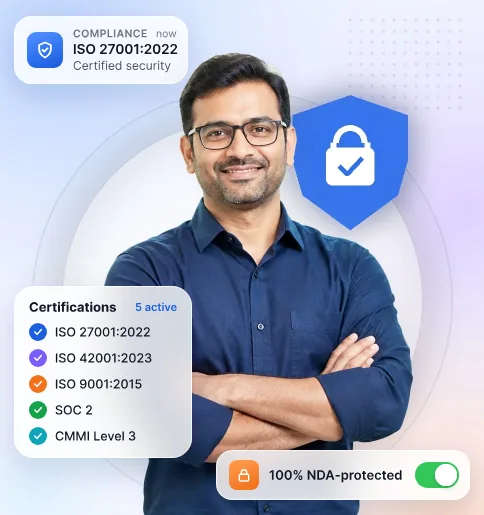
    Governance & security
    • ISO 27001:2022
    • ISO 9001:2015
    • SOC 2
    • CMMI Level 3
    • 100% NDA-protected
    Platform Capability
    • AWS Certified Solutions Practice
    • Multi-cloud: AWS, Azure, GCP
    • AI, Cloud & Blockchain
    Company & Credentials

    CIN U72900GJ2013PTC073284 · Certification & audit documentation available on request under NDA.

    AI Development Engagement Models

    Choose the Right DevOps Delivery Responsibility

    Choose a model based on who directs the work and how well the scope is understood. Keep delivery ownership distinct from ongoing operational support.

    01 / 03

    Staff Augmentation

    Add DevOps engineers to a backlog your technical lead owns. Your team sets priorities, directs daily work, and accepts results; eSparkBiz supplies capacity matched to the role and system requirements.
    Add DevOps Engineering Capacity
    • Client-led backlog and daily coordination
    • Role requirements agreed before staffing
    • Client control of architecture decisions
    • Engineers follow approved access policies
    • Client review and acceptance of work
    • Allocation and commercial terms agreed separately

    FAQs

    Frequently Asked Questions

    Direct answers on DevOps consulting costs, CI/CD setup, security scanning, startup packages and picking a provider. Weigh eSparkBiz against other firms on facts, and know what a good DevOps proposal must include.

    How can we evaluate DevOps consulting firms for our business?

    eSparkBiz suggests one test before any sales pitch: ask each firm to trace a recent release of yours from commit to production and name where it stalls. Good consultants find waiting time, not just slow builds. Then confirm which engineers are actually staffed, how handover runs and whether assessment is priced apart from implementation.

    Who are the leading providers of DevOps transformation services?

    Leading providers range from global consultancies and cloud vendors’ own services arms to delivery-focused shops like eSparkBiz, whose 400+ engineers follow CMMI Level 3 appraised processes. The right fit depends on scope and budget. A company-wide change in how teams work suits larger advisors, while pipeline and infrastructure delivery suits engineering-led teams.

    What does DevOps consulting cost when it is part of a cloud migration?

    With eSparkBiz, DevOps work inside a migration begins at $10,000 and usually means pipelines and infrastructure code for the new environment. Cost rises with application count, environments and approval rules. Building automation during the move costs less than adding it after cutover, when the same engineers are busy stabilizing production.

    Which DevOps consulting services specialize in cloud automation?

    Holding AWS Advanced Tier Partner status, eSparkBiz automates provisioning with Terraform and AWS CloudFormation, the infrastructure code work worth looking for. Shortlist firms that also script environment builds and tie cost alerts to pipelines. Request a sample module from each and ask how it gets reviewed, since unreviewed automation spreads mistakes quickly.

    Can a DevOps consulting service help with CI/CD pipeline setup?

    Pipeline setup is the most common way eSparkBiz engagements begin, using tools you already run, such as GitHub Actions or Azure Pipelines. We add build, test and deploy stages, plus approval gates where risk calls for them. Your team receives the pipeline code, a runbook and a working walkthrough before handover.

    Where do buyers read reviews of DevOps experts focused on CI/CD?

    Independent B2B review sites publish verified client comments, but filter for projects that mention pipelines rather than general development. Then ask shortlisted firms for two references whose CI/CD work resembles yours, and call them. Ask whether deployment got faster, whether failures dropped and whether the internal team could run everything afterward.

    How much do DevOps consulting services usually cost in the US?

    US clients pay eSparkBiz from $10,000 per project, at rates under $25 hourly. A focused assessment lands near that floor, while pipelines, infrastructure code and monitoring spread across several applications cost noticeably more. Many onshore consultancies charge higher hourly rates, so compare what each quote includes, not only the rate.

    Which companies offer DevOps assessments and roadmaps?

    Most DevOps consultancies offer some kind of assessment, and eSparkBiz runs one as a fixed-scope engagement ending in a ranked improvement backlog. A useful roadmap lists each change with effort, dependencies and a named owner in your team. Be wary of assessments that end with a maturity score but never say what to fix first.

    What are the best DevOps consulting packages for startups?

    Strong startup packages, like those eSparkBiz scopes starting at $10,000, are small and fixed: one product, one cloud account, automated deployments, basic monitoring and a handover session. That suits teams without a full-time DevOps hire. Skip packages that bundle Kubernetes by default, because most early products do not need it yet.

    Can DevOps consulting shorten our software release cycle?

    It can, but only once the consultant finds where finished work actually waits. The delay often sits in manual approvals, a shared test environment or flaky tests rather than the build itself. Track commit-to-production lead time before and after, alongside failed deploy rate, so quicker releases do not bring more rollbacks.

    Does eSparkBiz offer DevOps security consulting and DevSecOps integration?

    eSparkBiz, an ISO 27001 certified company, adds dependency, container image, secret and infrastructure scans to your pipeline, each with a named owner for fixes. Severity rules decide which findings block a release and which simply open tickets. An NDA is signed before anyone opens your repositories, and we follow your existing security policies.

    How do we choose between DevOps consulting proposals that look alike?

    eSparkBiz lists assumptions and exclusions in every proposal, which makes a four-point comparison easy: what the fee includes, which current tools stay, how failed releases are tested and who maintains the setup afterward. Hold every bidder to those same points. The cheapest bid often leaves out monitoring, handover or recurring cloud charges.

    Which firms specialize in infrastructure as code consulting?

    Specialists include cloud-focused consultancies and hands-on engineering teams; eSparkBiz, for one, writes Terraform, AWS CloudFormation and Ansible code with peer review and drift checks. Ask any candidate how they protect state files, split modules by team and keep credentials out of version control. Firms that copy console settings into templates rarely save you effort later.

    Can eSparkBiz build custom automation beyond standard pipelines?

    eSparkBiz writes custom automation when ready-made steps fall short, for example release note generation, cleanup of idle environments, database migration checks or approval bots in your chat tool. Each script lives in version control with tests and an owner. We build custom pieces only when an existing tool cannot do the job cleanly.

    Can eSparkBiz handle end-to-end DevOps work, from assessment through handover?

    eSparkBiz covers assessment, pipeline and infrastructure implementation, monitoring setup and handover, staffing each project with engineers from its 400+ person bench. Ongoing operation is scoped as a separate agreement so responsibilities stay clear. If you already know what needs building and only lack capacity, you can add DevOps engineers under your own technical lead instead.


    Resources

    Insights from our engineering leaders.

    Our team shares practical insights on the technologies and engineering decisions shaping enterprise software today, grounded in real client work.