NLP Development Services

Make Business Text Usable Across Your Products and Workflows

eSparkBiz, an AI-native software and product engineering company, builds NLP capabilities for teams working with unstructured text. Turn messages, documents, and customer feedback into useful information through classification, extraction, and language analysis connected to your software.

  • 15+ Years of Experience
  • 400+ Engineers
  • 4.9/5 Clutch Rating
  • ISO 27001 & ISO 9001
  • 1,000+ Projects Delivered
Core Objective

Give your applications usable information from unstructured text, with outputs matched to the decisions your users need to make.

Business ROI

Assess whether reduced text handling outweighs implementation and operating costs. Compare review time and corrections, including the human work that remains.

Tech Stack We Evaluate
  • spaCy
  • Hugging Face Transformers
  • PyTorch
  • Amazon Comprehend
Service Scope

NLP Development for Business Text and Language

NLP development services build software that processes human language to classify content, extract information, identify patterns, or produce summaries. The work combines text preparation, suitable rules or models, task-specific evaluation, and integration so results can support an application or operational workflow.

Choose NLP for bounded language tasks. Stable patterns may need only rules. Retrieval components can support search; complete RAG systems, conversational experiences, and document-capture applications require additional scope.

What This Can Include Connected Delivery Workstreams

  • 01. Prepare

    Text Preparation and Labeling

    Prepare representative text and consistent labels, keeping evaluation examples separate so testing reflects the language your users actually use.

  • 02. Analyze

    Language Analysis and Extraction

    Classify messages, identify relevant entities, and analyze themes using methods selected for your task and available data.

  • 03. Retrieve

    Search and Summarization

    Match queries to relevant content or condense long text, with checks for retrieval relevance and summary faithfulness.

  • 04. Integrate

    Integration and Quality Controls

    Deliver results through APIs or batch pipelines, with validation, exception handling, and monitoring suited to the consuming system.


Challenges

Where Business Text Processing Breaks Down

Text automation becomes useful when it handles your terminology and fits the work around it. Address these gaps before expanding its use.

  • Too Much Text to Review

    Incoming messages outpace manual sorting, leaving requests waiting in the wrong queue. Classification can help prioritize work, with ambiguous cases routed to a reviewer.

  • Industry Terms Lose Their Meaning

    Abbreviations and product names can confuse a general model, creating incorrect records. Domain examples and entity-level testing reveal where adaptation is worth the effort.

  • Labels Mean Different Things

    Teams assign different categories to similar messages, weakening both training data and reporting. Shared labeling guidelines establish what each category means before model development.

  • Average Scores Hide Costly Errors

    A model can look strong overall while missing rare, urgent requests. Evaluate each category separately and agree which errors require human review before release.

  • Sensitive Text Travels Too Far

    Customer messages may contain personal or confidential details that should not enter every model or log. Define permitted processing locations, access, and retention upfront.

  • Model Outputs Create More Rework

    Extracted values that do not match application fields force staff to repair records. Output schemas and validation checks help keep downstream workflows usable.


NLP Capabilities

NLP Development Services We Offer

Select the NLP capabilities your workflow needs. Each combines a business task with defined outputs and tests, so the scope can cover individual components or their application integration.

  • Text Classification and Intent Detection

    Route incoming text to the right workflow by identifying its category or intent. We develop classifiers around your taxonomy, including messages with multiple purposes.

    • Category definitions and labeling guides
    • Single-label and multilabel classifiers
    • Uncertain-case routing and fallback rules
  • Entity and Relationship Extraction

    Replace repeated copying from text with structured fields your systems can use. Extract relevant entities and relationships while preserving source references for review.

    • Entity types and relationship schemas
    • Extraction pipelines with source spans
    • Field normalization and validation rules
  • Sentiment and Topic Analysis

    See which issues drive customer feedback through topic discovery and sentiment analysis. Domain reviewers assess the themes and ambiguous opinions before findings inform product priorities.

    • Topic discovery, stability checks, and category mapping
    • Aspect-level sentiment classification
    • Negation and ambiguity evaluation
  • Semantic Search Development

    Help users find relevant text despite differences in wording. Develop retrieval components with semantic matching, exact terms, and reranking; scope a complete search application separately.

    • Text embeddings and index preparation
    • Hybrid retrieval and result reranking
    • Query relevance and misleading-similarity tests
  • Text Summarization

    Shorten the reading needed to understand long records or conversations. Develop summaries with source references and checks for omitted details or unsupported statements.

    • Task-specific summary formats
    • Source linking and factual checks
    • Review rules for consequential outputs
  • Multilingual NLP Development

    Extend text workflows to selected languages without assuming equal performance across them. Define language coverage and test local terminology with qualified reviewers.

    • Language detection and processing routes
    • Language-specific datasets and terminology
    • Per-language quality and fallback checks
  • Domain-Specific Model Adaptation

    Improve task fit when a baseline misses specialized language. Prepare domain examples and adapt suitable models only where testing supports the additional investment.

    • Corpus cleaning, deduplication, and annotation guidance
    • Task-specific training or fine-tuning
    • Baseline comparisons and versioned configurations
  • NLP Evaluation and Validation

    Give release owners evidence they can inspect. Evaluate independent examples by category and consequence, alongside response time, processing cost, and the workload passed to reviewers.

    • Held-out test sets and error analysis
    • Precision, recall, and task-specific checks
    • Review thresholds and acceptance reports
  • NLP Integration and Monitoring

    Put language outputs into daily use through interfaces your applications can consume. Add operational checks so failed requests and changing input patterns reach an owner.

    • API contracts and batch processing
    • Output validation and retry handling
    • Quality monitoring and update triggers
Deliverables and Outcomes

NLP Deliverables and the Results to Measure

Define what your team will receive before implementation. The selected scope determines the deliverables; success depends on their effect on the working process.

Expected deliverables

Deliverables Your Team Can Inspect

The delivery package should let your team inspect the implementation, reproduce its evaluation, and understand its limits. Confirm the applicable assets and ownership terms in scope.

  • Task and Data Specification

    Representative text, labeling guidance, dataset splits, permitted uses, and output fields give business reviewers and engineers a shared implementation reference.

  • Implemented NLP Component

    Versioned code, model references, and configuration connect the task to documented interfaces, with output validation and tests for unsuccessful processing.

  • Evaluation and Acceptance Pack

    Held-out results, error examples, and acceptance thresholds show quality by relevant category or language. Report rejected inputs and human corrections separately.

  • Operating and Handover Guide

    Deployment instructions, recovery steps, and monitoring responsibilities explain how to operate the component, investigate quality changes, and assess updates.

Intended Outcomes

Measure the Change in Daily Work

Compare results with the original workflow. Include review and correction effort, so time saved at one step does not hide extra work at another.

  • Less Manual Sorting

    Measure routing time, reassignment rates, and the share of items needing review to assess whether classification reduces avoidable handling.

  • More Usable Extracted Data

    Track field acceptance and correction rates to establish whether extracted information reaches downstream systems with less manual repair.

  • Faster Access to Relevant Information

    Compare time spent finding or reviewing information, while checking relevance and missed details, to assess search or summarization usefulness.

  • Clearer Operating Economics

    Track cost per accepted result, including model usage, infrastructure, maintenance, and review. Assess implementation costs over the agreed evaluation period.


Project Evidence

Evaluate NLP Work in Its Business Context

Review the starting workflow, implementation scope, and evaluation evidence to judge how closely a project matches your requirements and the constraints your team faces.

Case study
  • Industry : eCommerce
  • Solution : AI Development

SmackDab is an AI-enabled Customer Relationship Management (CRM) platform engineered by eSparkbiz to help businesses build stronger customer relationships, optimize sales workflows, and drive sustainable.

  • Dedicated Product Team Engagement Model
  • 40 + Team Member
  • 48+ Months Partnership Duration
  • Live & Scaling Market Stage
Client outcomes

Rated 4.9 across 70 Reviews Verified on Clutch

Our clients value our technical expertise, clear communication, and commitment to quality. Read their feedback on working with eSparkBiz and see how our engineering teams support their business goals.
Stefan H.

Stefan H.

CTO at IT Company

eSparkBiz supports an energy-management IT solutions company with design, development and testing, including frontend adjustments, small web apps, NPM packages and serverless Node.js APIs. The CTO said the team solved more problems in less time, built three new components and communicates well, with helpful staff. Testing expectations needed to be clarified early.

Mihai-Eduard Iordache

Mihai-Eduard Iordache

eSparkBiz integrated frontend functionality with an existing design and backend for the client of a Romanian web agency, working with a CTO, a project manager and two developers over Skype. Deadlines were met and the end client was satisfied. The manager was impressed by the team’s communication and industry knowledge.

Workflow Applications

Where NLP Can Reduce Repetitive Work.

Start with a language task that slows your team down. These examples show possible applications, with results assessed against current handling effort and quality.

  • Operations

    Shared-Inbox Triage

    A shared inbox can become a structured work queue. Classify messages by request type while retaining the original text. Operations staff handle uncertain or urgent exceptions, helping reduce reassignment and keeping unresolved requests visible.

  • Procurement

    Information Extraction for Business Records

    Procurement teams can extract product references and delivery terms from supplier correspondence instead of copying each field. Check proposed values against existing records before updates, and retain source passages so staff can resolve disputed details.

  • Product · Support

    Customer Feedback Prioritization

    Survey responses and support comments can reveal recurring product problems. Group feedback by topic and feature-level sentiment, then inspect representative comments. Product teams can weigh frequent complaints alongside less common issues with serious consequences.

  • Knowledge

    Internal Knowledge Search

    Help employees locate guidance when they use different wording from the source. Retrieval components combine semantic matching with exact identifiers and permission filters. Test realistic queries with each user group; a complete search application needs separate scope.

  • Support

    Case Handover Summaries

    Service teams can review a handover summary covering the issue, actions taken, and unresolved questions. Links to source messages support checks of consequential details. Test chronology and omissions so shorter reading still gives the next shift sufficient context.

  • Data · Privacy

    Sensitive Text Review

    Before text enters analytics or model development, data teams can flag or mask likely personal and confidential details. Tests must include missed detections. The resulting review queue supports screening without implying that every sensitive passage has been found.

  • Trust · Safety

    Content Moderation Queues

    Moderators can prioritize submitted text using categories tied to an explicit content policy. Keep context available and preserve an appeal route for disputed decisions. Model labels organize the review queue; moderators remain responsible for final judgments.

  • Support

    Multilingual Request Routing

    Route requests by language and intent to the appropriate service team. Evaluate each supported language separately and keep the original text available. Unclear requests go to qualified reviewers, helping prevent avoidable transfers and unsuitable automated responses.


Industries

Industries We Serve with NLP Development Services

eSparkBiz provides NLP development services for diverse industries, including SaaS, healthcare, FinTech, insurance, and more. We help companies classify requests, extract fields, analyze feedback, and connect results to their existing systems.

NLP Development That Puts Text Intelligence Inside Your SaaS Product

Your users add tickets, notes and reviews to your product every day. eSparkBiz adds tools that help sort text, improve search and summarize conversations, all within your product and kept separate for each customer.

What We Build:
  • In-App Auto-Tagging
  • Intent-Based Ticket Labels
  • Hybrid Product Search
  • Thread and Call Summaries
  • Churn Signals from Feedback
  • Text Feature APIs
Compliance & Security:
  • Tenant text kept apart
  • Training needs customer consent
  • Deletion reaches search indexes
  • EU data stays local
Success Metrics:

Text features stay accurate, isolated per customer, and fast inside the product.

Cost & Timeline:

Starting Budget: From $10,000, depending on feature scope and tenant volume.
Initial Delivery Phase: 6 to 10 weeks, allowing for language coverage and label validation.
Drivers: Feature count, tenant volume, languages, label quality and in-app latency targets decide what you pay.

FAQs
Is it smarter for a SaaS startup to staff NLP internally or outsource it?
Outsource when your current engineers haven’t labeled training data, run model evaluations or pushed a model to production before. eSparkBiz can place NLP engineers in your sprints for less than $25 hourly, while your product manager keeps the roadmap and your engineers own every merged pull request.
How does eSparkBiz keep NLP feature costs predictable as SaaS usage grows?
eSparkBiz prices each feature per thousand requests before launch. We cache repeated inputs, run compact task models wherever they match a large model’s quality and send only hard cases to an LLM. A per-tenant spend view then lets you fold the cost into pricing tiers.

Delivery Process

How We Scope Build and Release NLP

NLP development cost depends on data preparation, language coverage, model adaptation, integration, and evaluation effort. Timing also depends on access approvals and reviewer availability. Separate the initial build estimate from recurring model, infrastructure, maintenance, and review costs.

Step 01 · Scope

Define the First Phase and Estimate

Bring sample text, processing volumes, and system requirements. Where feasibility is uncertain, scope discovery around the largest data or quality question. Your product owner approves the first-phase outputs and estimates assumptions.

Clarify Your NLP Scope
WHAT’S INCLUDED
  • Target task and error consequences
  • Sample text, languages, and monthly volume
  • System interfaces and deployment constraints
  • First-phase outputs, exclusions, and estimate assumptions
Outcome : Approved first-phase scope, estimate assumptions.
Technology Choices

Choose Technology That Fits Your NLP Task

These are candidates for evaluation. Choose tools around task quality, data restrictions, existing infrastructure, and operating capacity; their inclusion does not imply a partnership or specific project history.

Prepare Reviewable Text and Labels

Choose preparation and annotation tools around data sensitivity, reviewer workflows, and export needs. Keep source identifiers and labeling decisions traceable throughout dataset revisions.

  • Python
  • pandas
  • Label Studio

Proposal Comparison

How to Compare NLP Development Proposals

Compare the same task, sample data, and acceptance requirements. Check what the estimate covers, what your team must supply, and what it will cost to operate the result.

What to Check in Any Proposal eSparkBiz Proposed Approach
Task Fit and Model Choice
Does the proposal explain when rules, a managed service, or custom adaptation is sufficient? Check what an existing product already meets and what evidence supports additional development.
Benchmark suitable options on representative text. Explain rejected alternatives and trade-offs. Recommend additional modeling when quality gaps or control requirements justify the data, evaluation, and maintenance effort.
Data and Acceptance Evidence
Who supplies and labels the data? Are tests independent and broken down by important category and language? Check whether scores exclude rejected inputs or human corrections.
Agree data responsibilities and held-out evaluation examples. Report consequential errors and rejected cases separately. Include review workload and integration failures in acceptance, with a named owner approving results.
Application Integration and Responsibility
Does the scope stop at a model endpoint or include the receiving application? Who owns interfaces, exception handling, data approvals, and acceptance of the complete workflow?
Specify included interfaces and failure tests. Name provider and client responsibilities, including domain judgments and release approval. Identify downstream changes that require separate pricing before committing to them.
Ownership and Ongoing Cost
Compare API usage, hosting, licenses, review, maintenance, and updates. Check code and component ownership, repository access, exit arrangements, and the effort required to replace model dependencies.
Document ownership and access under agreed terms, separating custom work from third-party components. Compare deployment trade-offs: managed services reduce hosting work; self-hosting needs operating capacity. Scope support and future changes separately.

Agreed Before Kickoff

  • Selection criteria
  • Acceptance evidence
  • Named owners
  • Itemized costs
Why eSparkBiz

NLP Engineering Connected to Your Product and Team

eSparkBiz combines AI engineering with software delivery disciplines. That breadth matters when a language component needs application changes, usable review tools, and people who understand your domain.

  • 15+ Years in Business
  • 20+ Industries Served
  • 4.9 Clutch 70 Reviews
  • 1,000+ Projects Delivered
  • 400+ Engineers
  • 1,000+ projects across 20+ industries, supported by expertise across 45+ technologies.
  • Collaboration across 10+ time zones combines agreed working hours with named contacts, progress reviews, and escalation paths.
  • Clear IP ownership and confidentiality terms address custom work, third-party licenses, and NDA obligations.
  • Discovery-led planning aligns your goals, scope, and technical dependencies before delivery begins.
  • 95% client retention, earned by staying accountable after go-live.
  • Featured in Clutch’s Leader Matrix for Top Natural Language Processing Companies.
  • Data readiness checks precede model development, reducing costly mid-project surprises.
  • Cross-functional engineering teams assess the right approach, including where AI adds value.
  • Listed among The Manifest’s Top Natural Language Processing Companies.
  • Annotation quality reviews and label verification strengthen model accuracy.
  • Flexible engagements with planned continuity define responsibilities, replacement arrangements, and knowledge transfer.
  • Domain-trained pipelines handle regional terminology and industry vocabulary across languages.
  • Transparent scope and costs require approval of budget and schedule changes before additional work begins.
  • Phased delivery with quality and security reviews provides checkpoints and clear release accountability.
  • Defined access, handover, and support options help your team maintain continuity during and after the engagement.
  • Quality and security reviews support delivery, with named owners responsible for release decisions.
  • Ongoing technical support options help you maintain your systems and respond to changing business needs.
  • Bring one text-heavy workflow and the decision it needs to support. We can discuss the NLP component, surrounding software, and roles needed to make it useful.

    Discuss Your NLP Priorities
    Governance & security
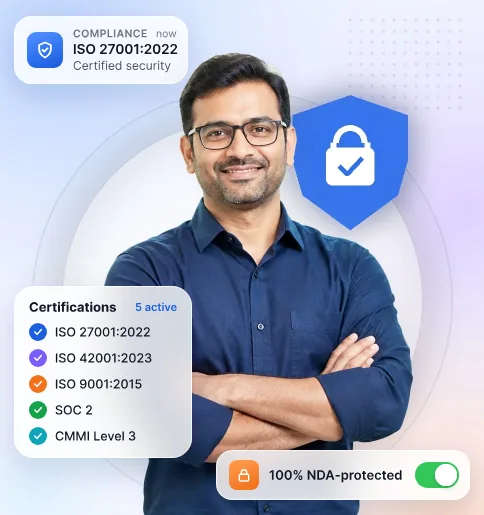
    • ISO 27001:2022
    • ISO 9001:2015
    • SOC 2
    • CMMI Level 3
    • 100% NDA-protected
    Platform Capability
    • AWS Certified Solutions Practice
    • Multi-cloud: AWS, Azure, GCP
    • AI, Cloud & Blockchain
    Company & Credentials

    CIN U72900GJ2013PTC073284 · Certification & audit documentation available on request under NDA.

    Engagement Options

    Choose How Your NLP Work Is Delivered

    Choose the delivery responsibility your team needs. When data quality or achievable performance is uncertain, define a discovery phase and its outputs before committing to implementation pricing.

    01 / 03

    Staff Augmentation

    Add NLP engineers to a team you already manage. Your lead sets priorities and accepts work, while agreed specialists contribute within your architecture, delivery routines, and review process.
    Discuss NLP Engineering Support
    • Client-led backlog and daily direction
    • Skills matched to the selected task
    • Client-owned architecture and release decisions
    • Agreed access and data permissions
    • Documented allocation and time-based billing assumptions
    • Client approves task and priority changes

    FAQs

    Frequently Asked Questions

    Plain answers on providers, pricing, timelines, multilingual support, cloud integration and ownership, making it easier to set eSparkBiz beside other NLP vendors before booking a call.

    What are the best NLP development companies for small businesses?

    The best fit for a small business is a team that starts with one narrow task and a managed API before proposing custom models. eSparkBiz takes NLP projects from $10,000 at hourly rates under $25, which suits firms needing email sorting or review analysis without enterprise overhead or long contracts.

    Which companies offer custom NLP development services for enterprises?

    Enterprises should shortlist firms that can staff data, modeling and integration work together and still pass a security review. eSparkBiz backs custom NLP builds with a 400+ strong in-house engineering team, ISO 27001 certification and CMMI Level 3 maturity, wiring entity extraction or multilingual classification into the ERPs, CRMs and data platforms you already run.

    What is the cost of hiring an NLP development team?

    Your bill is driven by how much text needs labeling, how many languages you need and how deep the integration goes. Pricing at eSparkBiz begins at $10,000, and each engineer costs less than $25 per hour. Model hosting and API usage appear as a separate monthly line, so ongoing costs are visible before you commit.

    How should I pick an NLP service provider?

    Give every shortlisted provider the same sample of your real text and a clear pass mark, then compare results per category rather than one average score. eSparkBiz welcomes that comparison and adds a written breakdown of labeling effort, integration scope, running costs and code ownership, details most proposals leave vague or skip entirely.

    Which NLP solution providers specialize in legal documents?

    Specialist legal AI vendors sell ready products for contract review, while custom builders suit firms whose documents or workflows don’t fit those tools. eSparkBiz builds clause extraction, contract comparison and obligation tracking on your own templates, keeping files in your cloud under NDA. Lawyers review every flagged clause; the software only speeds up finding them.

    Who are the top NLP consulting firms in the United States?

    US buyers usually weigh large consultancies with high day rates against engineering firms that advise and then build. Since 2010, eSparkBiz has delivered software now running in 800+ US healthcare facilities, and it pairs NLP consulting with hands-on development, so advice turns into working code for less than $25 an hour.

    How long does custom NLP software development usually take on average?

    Expect four to eight weeks to prove one text task works, and three to six months for a production release with integration and monitoring. eSparkBiz shortens the early phase when labeled data already exists; most delays come from data access approvals and slow reviewer schedules, not from model training itself.

    Which companies offer NLP services for sentiment analysis?

    Packaged sentiment tools handle broad positive or negative scores, while custom NLP suits teams needing feature-level opinions in their own product language. eSparkBiz builds aspect-based sentiment models trained on your reviews, tickets or surveys, tests sarcasm and negation separately and sends results into the dashboards your product team already checks every week.

    How can I check reviews of leading NLP development agencies?

    B2B review sites and analyst platforms carry verified client feedback, but a conversation with a past client tells you more about delivery. eSparkBiz publishes case studies with reported outcomes, such as 92% transcription accuracy on a dental AI platform, and each portfolio page lays out the scope, tech stack and results.

    Which NLP development services support multi-language text analysis?

    Favor providers that measure each language on its own, because English accuracy rarely carries over evenly. eSparkBiz builds multilingual pipelines covering language detection, classification and entity extraction on multilingual transformer models, adding native-speaker review where local terms run heavy. You receive an accuracy table for every language before anything goes live.

    Why hire professional NLP developers, and what benefits do they bring?

    Professional builders pay off when generic tools misread your terminology, can’t reach your systems or cost more per call at your volume than a tuned model would. eSparkBiz begins with a free first consultation to check whether a managed API already covers the task, and if it does, we say so before quoting custom work.

    Are there cloud-based NLP development services with easy integration?

    Yes. Amazon Comprehend and Google Cloud Natural Language are the quickest to plug in when their built-in tasks fit. Holding AWS Advanced Tier status and an AWS Marketplace listing, eSparkBiz deploys custom and managed NLP behind REST APIs inside your cloud account, so applications call one endpoint whatever model sits behind it.

    Can I hire dedicated NLP developers from eSparkBiz?

    You can. eSparkBiz lets you add individual NLP engineers to your team, take a dedicated squad steered by our delivery lead or commission a fixed-price build for a clearly bounded task. Rates begin below $25 hourly, developers work inside your standups, repositories and tools, and a risk-free trial of 15 days is offered when needed.

    Who owns the NLP models and code eSparkBiz builds?

    Ownership of the code, trained model weights, labeled datasets and evaluation scripts passes to your company under the agreed contract terms, and eSparkBiz puts a signed NDA in place ahead of receiving your files. ISO 27001-certified processes govern delivery, while third-party models keep their own licenses, which we list in writing before development starts.

    How does eSparkBiz prepare a quote for an NLP project?

    eSparkBiz starts with a free consultation call, then reviews a sample of your text, the outputs you expect and the systems involved. You then receive a fixed-scope estimate or a team plan listing labeling effort, integration work and monthly running costs. When data quality is uncertain, we price a brief discovery phase before the build.


    Resources

    Insights from our engineering leaders.

    Our team shares practical insights on the technologies and engineering decisions shaping enterprise software today, grounded in real client work.