Machine Learning Development Services

Put Predictive Models to Work in Your Products and Operations.

Add forecasting, recommendations, or automated classification to your products and operations. eSparkBiz, an AI-native software and product engineering company, prepares data, develops models, and connects predictions to working software so teams can plan, prioritize, and act on the results.

  • 15+ Years of Experience
  • 400+ Engineers
  • 4.9/5 Clutch Rating
  • ISO 27001 & ISO 9001
  • 1,000+ Projects Delivered
Core Objective

Help product and operations teams use predictions to plan work, prioritize reviews, and offer relevant choices within their everyday workflows.

Business ROI

Measure fewer costly errors or better recommendations against today’s process, accounting for development, infrastructure, human review, and ongoing model maintenance.

Tech Stack We Evaluate
  • scikit-learn
  • XGBoost
  • PyTorch
  • TensorFlow
Service overview

Machine Learning Development Connects Data, Models, and Business Workflows.

Machine learning development services turn relevant data into models that predict outcomes, classify information, recommend actions, or detect unusual patterns. The work covers data preparation, model training and evaluation, and software integration, with monitoring and maintenance defined for the deployment.

Custom ML fits when representative data exists and repeatable predictions can improve a meaningful decision. Use business rules for stable, explicit logic; scope generative AI assistants and broader data-platform work separately.

What this can include

  • 01. Prepare

    Data and Feature Preparation

    Check data access and quality, define usable model inputs, and prepare training and evaluation datasets.

  • 02. Evaluate

    Model Development and Validation

    Compare suitable algorithms against a baseline, test on unseen data, and document performance limits before deployment.

  • 03. Deploy

    Prediction Services and Integration

    Connect model outputs to applications through APIs or batch jobs, with agreed response times and fallback behavior.

  • 04. Maintain

    Monitoring and Model Updates

    Define performance checks, alert ownership, and retraining conditions so model changes follow an agreed review and release process.


Challenges we address

What Prevents Machine Learning From Delivering Business Value.

A promising experiment can still fail in everyday use. We address the data gaps, misleading test results, and operating constraints that keep predictions from improving decisions.

  • Incomplete Training Examples

    Historical records may omit outcomes or overrepresent certain users. Review coverage and labeling needs before training so the model addresses the population it will serve.

  • Test Results That Mislead

    Information unavailable at prediction time can inflate test scores. Separate training and evaluation data, and check feature availability before using results to justify rollout.

  • Accuracy Without Business Value

    A high overall score can hide costly missed cases. Choose evaluation measures and decision thresholds around error costs, review capacity, and the action being supported.

  • Models Stuck in Notebooks

    An experiment can produce predictions without fitting an application’s data flow. Define interfaces and failure handling so product teams can use the model in practice.

  • Predictions That Arrive Too Late

    A model may be too slow or expensive for each transaction. Compare batch processing with live inference against decision timing and expected usage.

  • Performance Changes After Launch

    New products or changing customer behavior can weaken earlier results. Monitor inputs and outcomes, with an assigned owner to investigate deterioration before approving model updates.


ML Development Capabilities

Machine Learning Services From Data Preparation to Deployment.

Build a first predictive feature or improve a model already in use. Choose the data, modeling, and integration work needed to make its predictions useful.

  • ML Feasibility and Data Preparation

    Check whether the available data can support a worthwhile investment. We assess the prediction task, compare simpler alternatives, and prepare representative examples with repeatable feature transformations.

    • Target, baseline, and data profiling
    • Labeling guidance and dataset preparation
    • Reusable feature preparation pipelines
  • Predictive Model Development

    Improve planning inputs and work prioritization with forecasts, scores, or categories. We compare statistical methods, tree-based models, and neural networks against the task’s baseline.

    • Classification and regression models
    • Time-series training and backtesting
    • Documented model selection results
  • Recommendation Systems

    Make relevant products or content easier to find. Ranking methods use available interaction data, with fallback recommendations for new users and items.

    • Candidate selection and ranking models
    • Cold-start and fallback logic
    • Offline relevance evaluation
  • Anomaly Detection

    Direct investigation toward unusual activity without overwhelming reviewers. We develop detection models and tune alert thresholds against available examples and the team’s review capacity.

    • Statistical and learned anomaly scoring
    • Threshold testing and alert prioritization
    • Investigator feedback capture
  • Computer Vision Development

    Support visual inspection and image-based workflows with models trained or adapted for the task. Evaluate performance across the lighting, viewpoints, and image quality expected in use.

    • Image classification and object detection
    • Annotation guidance and dataset curation
    • Testing across operating conditions
  • NLP Model Development

    Make text easier to route and analyze. Build classification and extraction models around your terminology, with evaluation that checks important categories and ambiguous examples.

    • Text classification and entity extraction
    • Domain-specific training data preparation
    • Confidence thresholds and review routing
  • Model Evaluation and Optimization

    Find out which model improvements are worth the added cost. We examine business-relevant errors alongside latency, compute needs, and maintenance effort before recommending changes

    • Held-out and segment-level evaluation
    • Error analysis and explanation methods
    • Latency and resource-use benchmarks
  • ML Integration and Deployment

    Put model outputs within reach of the people and systems that need them. Implement prediction interfaces with access controls, input checks, and defined fallback behavior.

    • Batch jobs and prediction APIs
    • Input contracts and integration tests
    • Versioned deployment and rollback configuration
  • Model Monitoring and Retraining

    Help operating teams recognize when a model needs attention. Establish monitoring and an update workflow that requires evaluation before a replacement model reaches users.

    • Data quality and prediction monitoring
    • Retraining triggers and approval gates
    • Model versions and recovery procedures
Deliverables and Outcomes

What Your Team Receives and How to Judge Progress

Know what your team will receive and how to judge it. Agree on the delivery package, acceptance checks, and business measures before development begins

Expected Deliverables

Inspectable Models and Working Integrations

Inspect the model, understand its limits, and operate the integration. The delivery package connects each artifact to its intended use and the checks needed for acceptance

  • Data and Feature Specification

    Document source permissions and feature definitions alongside preparation code. Check that model inputs can be reproduced using information available at prediction time.

  • Model and Evaluation Package

    Provide reproducible training code and versioned model artifacts with baseline comparisons, test results, and known limitations. Review important operating segments against acceptance criteria.

  • Integrated Prediction Service

    Deliver the agreed batch job or API with input validation and fallback behavior, verified through integration tests and representative load checks.

  • Operating and Handover Guide

    Document monitoring responsibilities, update approvals, and recovery steps. Confirm the receiving team can follow the agreed release and rollback procedures.

Intended Outcomes

Business Improvements You Can Measure

Set the baseline and measurement period before rollout. Review business results alongside model behavior to decide whether to expand, adjust, or stop, accounting for adoption and external changes.

  • More Useful Planning Inputs

    Compare forecast errors with the current planning method, then track whether planners use results to improve replenishment or staffing decisions.

  • Better Use of Review Capacity

    Measure how many actionable cases reach reviewers and how many important cases are missed, alongside time spent handling unnecessary alerts.

  • More Relevant User Choices

    Assess whether recommendations help users complete the intended task. Use controlled comparisons where feasible, with safeguards for important user segments.

  • Manageable Operating Effort

    Compare realized benefit with implementation and operating costs, including infrastructure, human review, and retraining. Track reliability and intervention time as usage changes.


Project Evidence

Machine Learning Delivery in Context

See how the business problem shapes the model, the integration work, and the measures used to judge its usefulness.

Case study
  • Industry : eCommerce
  • Solution : AI Development

SmackDab is an AI-enabled Customer Relationship Management (CRM) platform engineered by eSparkbiz to help businesses build stronger customer relationships, optimize sales workflows, and drive sustainable.

  • Dedicated Product Team Engagement Model
  • 40 + Team Member
  • 48+ Months Partnership Duration
  • Live & Scaling Market Stage
Client outcomes

Rated 4.9 across 70 Reviews Verified on Clutch

Our clients value our technical expertise, clear communication, and commitment to quality. Read their feedback on working with eSparkBiz and see how our engineering teams support their business goals.
Stefan H.

Stefan H.

CTO at IT Company

eSparkBiz supports an energy-management IT solutions company with design, development and testing, including frontend adjustments, small web apps, NPM packages and serverless Node.js APIs. The CTO said the team solved more problems in less time, built three new components and communicates well, with helpful staff. Testing expectations needed to be clarified early.

Matt Stellwagen

Matt Stellwagen

CEO of 540 Design Studio LLC

eSparkBiz built WordPress sites, mobile apps and web applications for design agency 540, and helped with project management and resource allocation as well. The owner said this helped the agency meet and even exceed client expectations, which led to repeat business and referrals. The clean code, strong designs, daily communication and easy access to senior staff were all appreciated.

Practical ML Applications

Where Machine Learning Can Support Everyday Decisions.

Start with a recurring decision and a way to measure improvement. These potential applications show how a prediction connects to the work people need to do

  • Planning

    Demand and Inventory Forecasting

    Help planners estimate demand by product and location, then use forecasts when setting replenishment quantities. Account for promotions and stockouts during evaluation, and retain planner overrides when upcoming events differ from the historical record.

  • Customer Success

    Customer Retention Prioritization

    Before renewal, account-level risk scores can help customer success teams prioritize outreach. Use behavior available at the scoring date and explain relevant signals. Measure outreach effectiveness separately from the model’s ability to identify at-risk accounts.

  • E-commerce

    Product and Content Recommendations

    Present relevant options within a catalog, feed, or customer portal. Rank candidates using permitted interaction data, provide sensible defaults when history is limited, and evaluate whether recommendations help users complete the intended task.

  • Intelligent Automation

    AI-assisted workflows that read, route and act on requests across email, forms and back-office systems to cut manual handling time.

  • Finance

    Transaction Exception Detection

    Unusual transaction scores help operations teams prioritize investigations. Combine them with existing controls and route flagged activity to reviewers. Keep alert volume manageable and record investigation outcomes to assess which signals deserve attention.

  • Maintenance

    Equipment Maintenance Prioritization

    Use equipment readings and maintenance records to help reliability teams prioritize inspections. Evaluate warning usefulness against confirmed events, account for sparse failure history, and keep maintenance decisions with staff who understand operating conditions.

  • Manufacturing

    Visual Quality Inspection

    Assist inspectors by flagging visible defects in production images. Test against representative product variations and capture conditions, then route uncertain results for review so inspection speed does not come at the expense of missed defects.

  • Operations

    Document Classification and Routing

    Help service teams sort incoming documents into the right work queues. Train classification models on approved examples, check performance for less common document types, and send ambiguous submissions to a person for routing.

  • Logistics

    Delivery Arrival Estimates

    Dispatchers need arrival estimates when customers or warehouse teams can still act on them. Use shipment milestones and available operating data, handle missing tracking events, and show uncertainty where practical. Evaluate accuracy at those decision points.


Industry Applications

Industries We Serve with Machine Learning Development Services

Each model draws only on data your rules allow. eSparkBiz follows that principle across SaaS, healthcare, fintech, insurance and other industries, then reviews test results with your team before launch.

Machine Learning Development for SaaS Churn, Usage and Lead Scoring

Most SaaS teams start with a churn score or a lead score. eSparkBiz trains these models on per-tenant usage data, serves predictions through a versioned API and keeps one customer’s records out of another customer’s results.

What we build
  • Churn Risk Scoring
  • Lead Conversion Scoring
  • Usage and Capacity Forecasts
  • In-App Ranking Models
  • Prediction API Endpoints
  • Per-Tenant Score Monitoring
Compliance & Security
  • SOC 2 log retention
  • Tenant data never pooled
  • Erasure requests reach retraining
  • Opted-out accounts excluded
Success Metrics

Earlier churn warnings, better-ranked leads, and fewer surprise capacity spikes..

Cost and timeline

Starting Budget: From $10,000 reflecting per-tenant feature isolation and erasure-aware retraining.
Initial Delivery Phase: 10 to 18 weeks, shaped by usage data cleanup and shadow-mode scoring against live accounts.
Drivers: Tenant count, event history depth, score refresh frequency, in-app placement and retraining cadence shape pricing.

FAQs
Does each SaaS tenant need its own machine learning model?
Rarely. eSparkBiz usually trains one shared model with tenant-level features, then adds separate models only for your largest accounts if their behavior differs enough. Fewer models mean lower hosting cost and a single retraining job, while strict data boundaries keep each customer’s records out of other scores.
Can eSparkBiz show predictions inside our SaaS UI without slowing page loads?
Yes. eSparkBiz typically precomputes scores in a nightly batch and caches them, so a dashboard reads a stored value instead of calling the model on every view. Live scoring is saved for moments that need fresh inputs, such as a trial user’s first session.

Delivery Process

How We Develop and Deploy Machine Learning Models

The proposed process makes progress visible through working artifacts and review decisions. Existing evidence determines the starting point; new builds begin with discovery of the decision, data, and integration needs.

Step 01 · Decision

Define the Decision and Success Criteria

Identify who will use the prediction and what action it supports. The business sponsor approves a problem brief with measurable goals and acceptable error trade-offs.

Define Your ML Goal
WHAT’S INCLUDED
  • Current workflow and decision owner
  • Existing rules or model baseline
  • Business measures and error costs
  • Approved problem brief and success criteria
Outcome : Clear goals and error limits
Technology Ecosystem

Machine Learning Technologies Selected for Your Workload

Select tools around your data, application constraints, and operating capacity. These are candidates to evaluate, not a prescribed stack or a claim of certification.

Prepare Data at the Right Scale

Choose preparation tools around data volume, transformation complexity, and the existing platform. Favor reproducible pipelines that keep training and production inputs consistent.

  • Python
  • pandas
  • Apache Spark

Proposal Evaluation

How to Compare Machine Learning Development Proposals

Compare proposals on the choices that affect value, delivery risk, and ongoing cost. Ask each provider to make its assumptions, acceptance evidence, and responsibilities explicit.

What to check in any proposal eSparkBiz proposed approach
Need for Custom Modeling
Does a rules-based approach, existing product, or pretrained model already meet the need? Custom development brings flexibility but requires suitable data and continuing evaluation.
Compare practical alternatives against agreed criteria. Recommend custom work where baseline evidence, integration needs, or control requirements justify the added development and maintenance.
Evidence for Acceptance
Does the proposal define representative test data and task-specific acceptance criteria? A single aggregate score can obscure errors that matter to particular users or workflows.
Agree on baseline comparisons, relevant evaluation segments, and release thresholds. Give business and technical owners the evidence to accept limitations or request further work.
Integration and Serving
Who owns the application changes, permissions, and failure handling? Online predictions can support immediate decisions, while batch processing may meet the need with less operational complexity.
Specify model and application responsibilities, interface behavior, and serving requirements. Compare batch with online predictions, include load and recovery tests, and identify excluded infrastructure or application work.
Lifecycle Cost and Ownership
Are labeling, infrastructure, review effort, and model updates included in the cost model? Internal operation requires available owners; external support needs a defined scope.
Separate discovery and implementation estimates from recurring infrastructure, licensing, human review, and model-update costs. Define monitoring, recovery, and approval owners; agree support coverage and change handling contractually.

Agreed Upfront

  • Baseline evidence
  • Evaluation segments
  • Recovery tests
  • Monitoring owners
Why eSparkBiz

An Engineering Partner for Models and the Software Around Them

eSparkBiz combines AI/ML capability with software engineering. The proposed engagement can bring product, business analysis, and QA perspectives into decisions that would otherwise sit with model developers alone.

  • 15+ Years in Business
  • 20+ Industries Served
  • 4.9 Clutch 70 Reviews
  • 1,000+ Projects Delivered
  • 400+ Engineers
  • 1,000+ projects across 20+ industries, supported by expertise across 45+ technologies.
  • Collaboration across 10+ time zones combines agreed working hours with named contacts, progress reviews, and escalation paths.
  • Clear IP ownership and confidentiality terms address custom work, third-party licenses, and NDA obligations.
  • Discovery-led planning aligns your goals, scope, and technical dependencies before delivery begins.
  • 95% client retention, earned by staying accountable after go-live.
  • Time-boxed proofs of concept test your data, stopping if infeasible.
  • Featured in RevenueBase’s 25 Largest India Machine Learning Development Companies.
  • ML Stack Expertise spans scikit-learn, PyTorch, Prophet, MLflow, and Triton.
  • Listed among Clutch’s Top Natural Language Processing Companies.
  • Cross-functional engineering teams assess the right approach, including where AI adds value.
  • Flexible engagements with planned continuity define responsibilities, replacement arrangements, and knowledge transfer.
  • Named in Codementor Machine Learning Companies Roundup.
  • Transparent scope and costs require approval of budget and schedule changes before additional work begins.
  • Phased delivery with quality and security reviews provides checkpoints and clear release accountability.
  • Defined access, handover, and support options help your team maintain continuity during and after the engagement.
  • Quality and security reviews support delivery, with named owners responsible for release decisions.
  • Bring your use case and the constraint holding it back. We can discuss the engineering coverage and decision responsibilities your next phase requires.

    Discuss Your ML Engineering Needs
    Governance & security
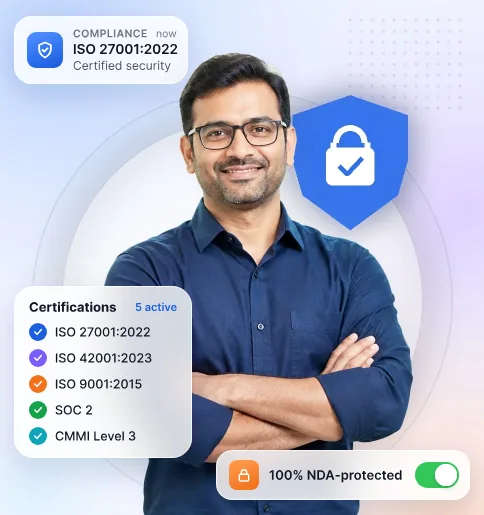
    • ISO 27001:2022
    • ISO 9001:2015
    • SOC 2
    • CMMI Level 3
    • 100% NDA-protected
    Platform Capability
    • AWS Certified Solutions Practice
    • Multi-cloud: AWS, Azure, GCP
    • AI, Cloud & Blockchain
    Company & Credentials

    CIN U72900GJ2013PTC073284 · Certification & audit documentation available on request under NDA.

    Engagement Models

    Choose How Your ML Work Will Be Managed

    Choose based on who will lead the work, how much coordination you need, and how clearly the scope can be defined. Confirm commercial and support terms before starting

    01 / 03

    Staff Augmentation

    Add ML or supporting engineers to a team you already manage. Your technical lead directs the backlog and reviews the work; eSparkBiz supplies the agreed engineering roles.
    Discuss ML Team Augmentation
    • Modeling, data, or integration roles
    • Client manages day-to-day delivery
    • Engineers follow agreed development standards
    • Client reviews and accepts contributions
    • Client prioritizes scope changes
    • Access and staffing terms agreed

    FAQs

    Frequently Asked Questions

    Learn what an ML project costs, how to pick a vendor, how startups can budget, where models run, how your data stays private and how hiring works, then compare eSparkBiz with other providers.

    What are the typical costs for custom machine learning project development?

    eSparkBiz starts ML projects at $10,000, which typically covers a feasibility check and a baseline model on your data. Across the market, one production model with integration often lands between $40,000 and $150,000, while computer vision or real-time scoring costs more. Labeling, hosting and retraining belong in the estimate too.

    Which reputable firms specialize in creating AI models for businesses?

    Reputation shows in evidence you can verify: certifications, audited processes and clients willing to take a call. eSparkBiz, for example, is certified under ISO 27001 for security and ISO 9001 for quality, with a CMMI Level 3 appraisal. Beyond paperwork, request a past model’s evaluation report and check whether its stated limits held up.

    How do you choose the best machine learning development partner?

    Hand two or three finalists the same small data sample and one prediction task. Compare their baselines, how they separate test data and what they say could go wrong. eSparkBiz welcomes this kind of side-by-side test, and the first consultation is free, so judging fit costs you very little before signing.

    Does eSparkBiz offer affordable machine learning development for startups?

    Yes. With hourly rates starting at less than $25 and a minimum project size of $10,000, eSparkBiz can be a suitable fit for a startup validating a single prediction feature before its next funding round. We typically begin with a simple model that outperforms your existing rules, adding complexity only when revenue or user data justifies the additional development and hosting costs.

    Which machine learning development companies rank best in the US?

    Shortlists usually pair large consultancies for company-wide programs with delivery-focused firms like eSparkBiz, where 400+ engineers serve US clients under AWS Advanced Tier Partner status. Rank candidates on models still running in production, not demos, and have each one walk you through its monitoring setup and a model it had to retrain.

    Can machine learning development services handle cloud integration?

    Good ones should, since a model only helps once it runs where your application lives. eSparkBiz, whose services are also listed on AWS Marketplace, deploys models to managed options like Amazon SageMaker AI or to containers in your current cloud setup, sizing compute to real traffic so serving costs stay predictable.

    Which companies offer MLOps and deployment support after a model launches?

    Pick vendors that quote monitoring, retraining and rollback as named deliverables, not extras. eSparkBiz sets up alerts for slipping prediction quality, versioned releases and a runbook your team can follow, then supports the model under agreed terms. Ask any provider who responds when predictions degrade and how quickly a bad release is reversed.

    What is the process for outsourcing machine learning development to eSparkBiz?

    It begins with a free consultation where eSparkBiz learns which decision the model should support and what data exists. After an NDA, our engineers profile a data sample, propose a fixed-scope first phase, build a baseline, then integrate and pilot it. You approve each stage before the next starts, so spending follows evidence.

    How can we check reviews of top machine learning development providers?

    Start with independent B2B review platforms that verify clients, then read case studies showing image types close to yours. eSparkBiz has shipped vision features for a KYC platform, including liveness checks and matching faces against ID photos. Ask each provider how its model coped with poor lighting or new camera angles after launch.

    Who provides consulting for adding machine learning to existing software?

    Firms that build software as well as models are the safest fit, because integration work usually outweighs modeling. eSparkBiz reviews your application, data flows and response-time limits, then recommends batch or live scoring. You get a written plan covering interfaces, fallback behavior and running costs that your product team can approve before any build.

    Which machine learning companies handle end-to-end development, from data to deployment?

    eSparkBiz covers the whole path, from data preparation and model training to application integration, monitoring and handover, with QA engineers testing how the product behaves around each prediction. End-to-end only helps if the handover is real, so confirm you will receive training code, data pipelines and a runbook your own team can operate.

    What does eSparkBiz do to keep ML projects compliant with data privacy rules?

    Your data reaches eSparkBiz only once both sides sign an NDA, and our ISO 27001 controls govern who can see it. We train on masked or de-identified records where possible, keep processing within a cloud account you own and document every data source. Your compliance team signs off the data list before training begins

    Who can help us build a recommendation system?

    Start with teams that have shipped ranking features to real users and can show the lift they measured. Our engineers build recommendation engines with fallback logic for new users and items, then compare them with your current bestseller lists. Ask any provider how it will run a controlled A/B test before full rollout.

    How do machine learning development prices compare across vendors?

    Hourly rates run from under $25 at eSparkBiz to well over $150 at many US and Western European firms, but rate alone misleads. Compare total cost for the same scope, covering data preparation, labeling, integration, testing, hosting and the first year of retraining. A cheap quote that skips monitoring often costs more after launch.

    Where can companies hire specialized machine learning engineers?

    Freelance marketplaces suit short, well-defined tasks, while staffing partners suit longer work that needs vetted, managed engineers. eSparkBiz places ML, data and integration engineers into your team or runs a dedicated squad, and you can open with a 15-day risk-free trial to see their output on real tasks before committing to a longer contract.


    Resources

    Insights from our engineering leaders.

    Our team shares practical insights on the technologies and engineering decisions shaping enterprise software today, grounded in real client work.