MVP Development Services

Build a Focused MVP and Decide Where to Invest Next

eSparkBiz helps founders and product teams build web and mobile MVPs around a clear customer need. Our AI-native software and product engineering team defines the first release, builds reliable workflows and measures early use so you can decide what deserves further investment.

  • 15+ Years of Experience
  • 400+ Engineers
  • 4.9/5 Clutch Rating
  • ISO 27001 & ISO 9001
  • 1,000+ Projects Delivered
Core Objective

Give early users a complete core workflow, then use observed behavior to decide what to improve, expand or stop building.

Business ROI

Stage investment around evidence of demand. Compare activation and repeat use with development, acquisition, infrastructure and support costs before funding expansion.

Tech Stack We Evaluate
  • ASP.NET Core
  • PostgreSQL
  • GitHub Actions
  • OWASP ASVS
Service Scope

MVP Development Turns Product Assumptions Into Working Software

MVP development services cover planning, designing, building and releasing a minimum viable product: a working first version with enough functionality for a defined user group to complete a valuable task. Usage data and feedback help determine whether further product investment is justified.

Choose an MVP when people need working software to test its value. Use a prototype to test interactions or a proof of concept to resolve technical uncertainty. Existing software or low-code may be sufficient when the workflow needs little customization.

What this can include Connected Delivery Workstreams

  • 01. Define

    Product Definition

    Define the target user, essential workflow, release boundaries and evidence needed to decide whether the product merits further investment.

  • 02. Shape

    Experience and Architecture

    Design the core journey and technical foundation around expected usage, essential integrations, data sensitivity and likely changes.

  • 03. Deliver

    Development and Release

    Build the agreed features, test critical paths and prepare deployment with access controls and recovery procedures appropriate to the release.

  • 04. Validate

    Measurement and Iteration

    Instrument key actions and review early feedback to distinguish usability problems from missing value before prioritizing the next changes.


MVP Challenges

What Can Keep an MVP From Proving Its Value

A first release needs a clear learning goal and enough reliability for meaningful use. We address the obstacles that can undermine both.

  • Too Many First-Release Features

    Every stakeholder adds a must-have, pushing launch further away. Separate the core user task from later enhancements so the initial build stays tied to one testable proposition

  • Interest Without Real Commitment

    Positive interviews leave willingness to use or pay unresolved. Define an observable commitment, such as completing a trial workflow, before treating enthusiasm as demand.

  • A Demo That Cannot Operate

    The demo works with sample data but fails on real transactions. Check permissions, API access, vendor approvals and failure recovery before committing to an estimate or launch date.

  • Shortcuts That Block the Pilot

    Missing access controls or unreliable core flows can prevent customer pilots. Set release checks around the data handled and the consequences of a failed task.

  • Usage Without Useful Evidence

    Sign-ups increase, but the team cannot explain where users abandon the product. Track the core journey and pair behavior data with feedback before adding features.

  • No Owner After Launch

    An MVP needs people ready to use it and a team ready to respond. Assign pilot recruitment, support, feedback review and the next investment decision before launch.


Our Services

MVP Development Services From Discovery Through Launch

We help you shape the first release, build its essential workflows and learn from early use. Select the capabilities that match your product’s unresolved questions.

  • Product Discovery and Scoping

    Make the first development investment easier to evaluate. We turn the customer problem into a prioritized release scope, with exclusions, dependencies and measurable learning goals.

    • User problem and assumption mapping
    • Feature priorities and scope exclusions
    • Acceptance criteria and dependency register
  • UX Design and Prototyping

    Find confusing interactions before they become expensive code changes. We map the main task, test prototypes with representative users and address accessibility considerations during design.

    • User flows and interaction designs
    • Clickable prototypes for priority tasks
    • Usability findings and accessibility considerations
  • MVP Architecture

    Resolve technical uncertainty before it dictates the budget. We assess critical integrations and data boundaries, then choose an architecture proportionate to pilot usage and likely changes.

    • Application boundaries, data models and trade-offs
    • Build-versus-buy and hosting decisions
    • Integration and AI feasibility checks where relevant
    • Architecture Planning
  • Web MVP Development

    Put the core product experience within reach through a browser. We build responsive interfaces and backend workflows around the tasks your first users need to complete.

    • Responsive screens and application logic
    • Authentication and role-based access
    • Core transactions and input validation
  • Mobile MVP Development

    Test product value in its mobile context. We build the essential app experience around device capabilities, connectivity conditions and distribution requirements for the intended users.

    • Native or cross-platform implementation
    • Device permissions and connectivity handling
    • Test builds and distribution preparation
  • API and System Integration

    Let early users finish tasks across connected systems. We define interface contracts and handle service failures so unavailable APIs or duplicate events do not silently corrupt a workflow.

    • API contracts and access configuration
    • Webhook validation and duplicate handling
    • Timeouts, retries and integration failure tests
  • MVP Testing and Security

    Give the release decision a concrete basis. We test critical journeys, relevant security controls and expected pilot loads, with unresolved defects visible to the release owner.

    • Critical-path and regression test coverage
    • Access controls, input handling and dependency checks
    • Defect evidence and release recommendations
  • Cloud Deployment and Handover

    Put the MVP into an environment its owner can operate. We prepare deployment and recovery procedures, with documentation and account access included in the handover scope.

    • Environment configuration and deployment automation
    • Monitoring, backups, restoration checks and rollback
    • Runbooks, access records and knowledge transfer
  • Product Analytics and Iteration

    Turn early usage into a practical backlog. We validate tracking, examine task completion and retention and combine those findings with feedback to prioritize subsequent changes.

    • Event definitions and consent requirements
    • Task funnels, activation and retention reporting
    • Feedback analysis and iteration backlog
Deliverables and Outcomes

What You Receive and How to Evaluate Your MVP

Define the delivery package before development begins. Acceptance checks whether the software meets its requirements; customer behavior shows whether further investment makes sense.

Expected deliverables

A Release Package Your Team Can Inspect

Review the product definition alongside working software and supporting records. These outputs help your team accept the release, operate it and assess the next investment.

  • Prioritized Release Backlog

    User stories with acceptance criteria, exclusions and dependencies; check that each included feature supports the agreed core task or learning goal.

  • Design and Architecture Records

    Interaction designs, data models and documented technical choices; review how the proposed experience handles the main task and important exceptions.

  • Working MVP and Handover Package

    The application, test evidence, versioned source, configuration guidance and runbook support acceptance and operation. Demonstrate critical workflows and recovery; repository access and IP ownership follow the contract.

  • Measurement and Iteration Plan

    Event definitions, reporting views and follow-up priorities support a usage baseline. Verify tracking against test actions and separate observed behavior from assumptions.

Intended Outcomes

Evidence for Your Next Product Decision

Set targets before the pilot and review results over an agreed period. Look for evidence of useful behavior, alongside the cost of delivering that experience.

  • Clearer Evidence of User Value

    Assess whether target users complete the core task and return when the need recurs, using a frequency appropriate to the product.

  • More Focused Feature Investment

    Compare proposed enhancements with observed friction and customer requests, then assess whether released changes improve the selected task or adoption measure.

  • A More Understandable Cost to Serve

    Track hosting, third-party usage, support and manual effort per active customer or completed transaction. Compare operating cost with the value the product delivers.

  • Better-Informed Expansion Decisions

    Use adoption evidence, unresolved defects and support demand to decide whether to widen the pilot, revise the proposition or pause further development.


AI Development Case Studies

AI Engineering, Focused on Real Business Outcomes.

AI development should be measured by the business problem it solves—not simply by the model or framework used.

Case study
  • Industry : eCommerce
  • Solution : AI Development

SmackDab is an AI-enabled Customer Relationship Management (CRM) platform engineered by eSparkbiz to help businesses build stronger customer relationships, optimize sales workflows, and drive sustainable.

  • Dedicated Product Team Engagement Model
  • 40 + Team Member
  • 48+ Months Partnership Duration
  • Live & Scaling Market Stage
Client outcomes

Rated 4.9 across 70 Reviews Verified on Clutch

Our clients value our technical expertise, clear communication, and commitment to quality. Read their feedback on working with eSparkBiz and see how our engineering teams support their business goals.
Paul Fletcher

Paul Fletcher

Founder, UGC Social Platform

eSparkBiz handles frontend and backend development for a user-generated content social platform, offering advice, recommendations and creative solutions using the latest technology. The founder had been let down by earlier vendors, so the hands-on management, quick delivery and smooth communication over Slack and Asana really stood out. The founder described the team as friendly, reliable and highly proficient.

Tawfik Hussein

Tawfik Hussein

Tech Lead, Food & Beverage Company

eSparkBiz took over mobile app development for a Saudi food and beverage company, fixing errors left from earlier work on the iOS and Android apps and re-architecting the Android app. The tech lead liked the speed, quality and flexibility, along with the suggestions the team offered on their own, and noted they are available even on weekends. The team was also commended for sticking to best practices.

Product Use Cases

Product Questions a Focused MVP Can Help Answer.

Choose a first release around a decision you need to make. These examples show how a bounded workflow can produce evidence for that decision.

  • User Activation

    Self-Service Product Onboarding

    Can customers reach the first useful result without a sales walkthrough? An onboarding MVP connects account creation to one complete task. Track where setup stalls and distinguish independent use from assisted pilot sessions before interpreting activation.

  • Two-Sided Markets

    Marketplace Matching

    A marketplace needs participation from both buyers and suppliers. Start with a narrow request-to-match workflow, recording supply gaps and manual matching effort. Use the findings to decide whether better matching, more supply or a different proposition needs attention first.

  • Payments & Pricing

    Paid Digital Services

    Test willingness to pay through one purchase and fulfillment journey. Define payment failures, cancellations and refunds before launch. Successful checkout is one signal; the effort required to deliver the service helps show whether the business model can work.

  • Ops Automation

    Internal Approval Workflows

    Replace one spreadsheet handoff with a request form, routing rules and a decision record. Compare completion time and exception handling with the current process, including approvals or data entry that still happen outside the MVP.

  • RAG & Search

    AI Knowledge Assistance

    Let a selected team search approved documents and check answers against source references. Evaluate source support, access permissions and unanswered questions alongside usefulness. Those checks determine whether the assistant is ready for the intended users to rely on it.

  • Support & Retention

    Customer Self-Service Portals

    Customers should be able to submit and track one service request without chasing support. Pilot that journey with status linked to the underlying system. Measure completion and support contacts, keeping a clear route to human help when exceptions occur.

  • Logistics & Trades

    Mobile Field Workflows

    A job update captured on-site is useful only if the record reaches the office intact. Test capture, device permissions, interrupted connectivity and later synchronization with field staff before expanding the mobile product to more workflows.

  • Market Intelligence

    Data Subscription Products

    A recurring data product must support a recurring customer decision. Give a small group access to one dataset or analytical view, making source permissions, refresh frequency and missing records visible. Evaluate usefulness before introducing paid subscriptions.


Industry Applications

Industries We Serve with MVP Development Services

From SaaS and healthcare to fintech and insurance, eSparkBiz delivers MVP development services across varied industries. Every MVP is scoped to your compliance requirements, user roles and data access, then validated before wider rollout.

SaaS MVP Development for Feature Pilots Inside Existing Customer Workspaces

Testing a new feature on a few existing accounts beats guessing at demand. eSparkBiz ships the pilot behind a feature flag, keeps each workspace’s permissions intact and tracks repeat use before anyone approves a wider rollout.

What We Launch
  • Feature Flag Pilots
  • Workspace Permission Checks
  • Issue Triage Screens
  • Owner Assignment Flows
  • Repeat Use Tracking
  • Tenant Isolation Tests
Compliance & Security
  • SOC 2 change logs
  • Tenant data kept separate
  • GDPR erasure still works
  • Audit logs
  • Pilot accounts opt in
Success Metrics

Wider rollouts follow proven repeat use in pilot workspaces.

Cost and timeline

Starting Budget: From $10,000 shaped by workspace roles and integrations
Initial Delivery Phase: 8 to 12 weeks, with pilot accounts chosen before sprint one
Drivers: Pilot account count, permission model, existing APIs, feature flag setup and analytics depth shape pricing.

FAQs
Where do we read reviews of MVP development providers that built SaaS products?
Independent B2B review directories and founder communities carry SaaS-specific feedback and you can ask eSparkBiz or any shortlisted vendor for a SaaS client you can phone. Read reviews for comments on missed estimates and post-launch fixes, then call one reference whose product had subscription billing or multi-tenant accounts like yours.
Can eSparkBiz build a SaaS MVP that charges customers from the first release?
Yes. eSparkBiz can wire a payment provider’s hosted checkout and a simple plan structure into the first release, so you learn whether people pay, not just sign up. Usage-based pricing, coupons and invoicing usually wait until the first paying accounts show what they need
Which enterprise features can a B2B SaaS MVP safely skip at launch?
Single sign-on, custom roles and detailed admin reporting can usually wait, unless your first buyers are large companies whose security teams demand them. Ask two target customers what their procurement checklist requires, then build only those items into the pilot.

Delivery Process

How We Plan, Build and Evaluate Your MVP

Each stage produces something your team can review. The engagement model sets delivery responsibility; your product owner retains the business decisions and acceptance authority.

Step 01 · Discovery

Define the Product Test

dentify who will use the MVP and what the first release needs to establish. Your product owner approves a brief connecting the main task to observable evidence.

Define Your MVP Goal
WHAT’S INCLUDED
  • Review customer evidence and existing alternatives
  • Identify pilot users and recruitment responsibility
  • Define success measures and review period
  • Approve the learning goal and boundaries
Outcome : Approved learning goal with success measures
Technology Choices

Technology Choices for Your MVP

Choose technology around the user task, existing systems and operating owner. The tools below are candidates for evaluation; the product requirements determine the final stack.

Interfaces That Fit the User Task

Consider a browser-first release for straightforward access. Evaluate mobile frameworks when device integration, connectivity conditions or app distribution materially shape the experience being tested

  • REACT
  • React Native
  • Flutter

Proposal Comparison

How to Compare MVP Development Proposals

Compare proposals against the same pilot objective and assumptions. The lowest build price can exclude essential work, while broader scope can also delay the learning you need.

What to check in any proposal eSparkBiz proposed approach
Scope and Build Approach
Does the release test a complete customer task? Could a prototype, packaged software or low-code answer the question at lower implementation effort? Check customization limits.
Define the first audience, complete workflow and exclusions. Compare existing tools with custom development; resolve usability or feasibility questions before committing to a build.
Acceptance and Handover
What test evidence supports release? Confirm source access, configuration guidance, data export and recovery documentation. Check ownership terms and the effort of moving to another provider.
Set task-based acceptance criteria with failure and permission checks. Include a source and operating handover in scope; document IP, access and portability terms in the contract.
Delivery and Support Ownership
Who supplies users, data and third-party access? Identify who prioritizes work, accepts the release and supports it afterward. Compare these responsibilities across engagement models.
Name client and delivery owners for product decisions, implementation and acceptance. Define support coverage and escalation separately; development does not imply indefinite support.
Build Cost and Ongoing Expense
Does the estimate include design, testing, deployment and changes? Compare hosting, licenses, external API usage, support and manual work. Check volume assumptions and platform exit costs.
Separate discovery, implementation and recurring expenses. Record dependencies and buyer inputs, distinguish effort from elapsed time and identify changes that would require a revised estimate.

Agreed Before Kickoff

  • Pilot scope
  • Release tests
  • Named owners
  • Total cost
Why eSparkBiz

Why Choose eSparkBiz for MVP Development

Work with an AI-native software and product engineering company that connects product design with implementation. Assess our capabilities and credentials alongside the specific provisions proposed for your MVP.

  • 15+ Years in Business
  • 20+ Industries Served
  • 4.9 Clutch 70 Reviews
  • 1,000+ Projects Delivered
  • 400+ Engineers
  • 1,000+ projects across 20+ industries, supported by expertise across 45+ technologies.
  • Collaboration across 10+ time zones combines agreed working hours with named contacts, progress reviews, and escalation paths.
  • Clear IP ownership and confidentiality terms address custom work, third-party licenses, and NDA obligations.
  • Discovery-led planning aligns your goals, scope, and technical dependencies before delivery begins.
  • 95% client retention, earned by staying accountable after go-live.
  • Dependency mapping sequences dependent systems so migrations avoid cascading failures.
  • Listed among Clutch’s Top System Integration Companies in India.
  • Delta synchronization keeps source and target aligned until final cutover.
  • Featured in IEEE Computer Society’s Leading U.S. Software Development Roundup.
  • Cross-functional engineering teams assess the right approach, including where AI adds value.
  • Listed in IPLocation among Trusted Software Development Companies.
  • Flexible engagements with planned continuity define responsibilities, replacement arrangements, and knowledge transfer.
  • Post-migration tuning optimizes indexes, queries, and storage costs on targets.
  • Named among Most Trusted Software Development Companies by ProjectManagers.net.
  • Transparent scope and costs require approval of budget and schedule changes before additional work begins.
  • Phased delivery with quality and security reviews provides checkpoints and clear release accountability.
  • Defined access, handover, and support options help your team maintain continuity during and after the engagement.
  • Quality and security reviews support delivery, with named owners responsible for release decisions.
  • Ongoing technical support options help you maintain your systems and respond to changing business needs.

Bring your product idea and the decision it needs to support. We can discuss the scope, technical uncertainties and ownership arrangements for your first release.

Assess Your MVP Starting Point
Governance & security
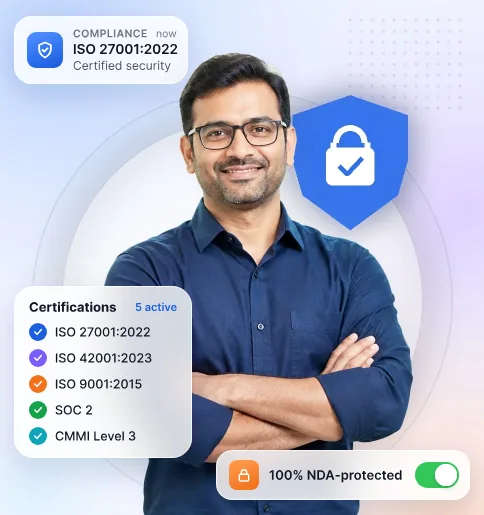
  • ISO 27001:2022
  • ISO 9001:2015
  • SOC 2
  • CMMI Level 3
  • 100% NDA-protected
Platform Capability
  • AWS Certified Solutions Practice
  • Multi-cloud: AWS, Azure, GCP
  • AI, Cloud & Blockchain
Company & Credentials

CIN U72900GJ2013PTC073284 · Certification & audit documentation available on request under NDA.

Engagement Models

Choose the Right MVP Engagement Model

Choose according to your internal leadership and how clearly the release is defined. A dedicated team suits an evolving backlog; fixed price needs stable scope and acceptance criteria.

01 / 03

Staff Augmentation

Add engineering skills to a team you manage. Your product and technical leaders set priorities, direct daily work, control scope and release decisions and accept contributions within your existing workflow.
Find Your MVP Skills
  • Skills matched to identified backlog gaps
  • Your team directs tasks and priorities
  • Your leads manage reviews and acceptance
  • Engineers follow agreed development practices
  • Capacity changes require mutual agreement
  • Repository access and IP terms agreed

FAQs

Frequently Asked Questions

Plain and direct answers on MVP costs, prototypes, remote teams, launch support, free trials and picking a partner. Weigh eSparkBiz against other firms on facts and know what a good MVP proposal must include.

What are the top companies offering MVP development services in the US?

US buyers usually compare local product studios, larger digital agencies and offshore engineering firms with US clients, with eSparkBiz in that third camp, running 400+ engineers since 2010. Shortlist firms that shipped MVPs like yours, ask who will actually build it and compare how each proposal defines the first release.

How do minimum viable product development agencies compare?

Line up agencies on the same brief, as eSparkBiz recommends: one user group, one core task and one decision the pilot should inform. Then compare discovery depth, exclusions, test evidence, handover contents, support terms and how each uses AI-assisted coding with human review. Price gaps often trace back to work one proposal quietly leaves out.

How should a tech startup pick its MVP development partner?

Pick the partner that pushes back on scope, not the one that agrees to everything. eSparkBiz opens with a discovery that names your riskiest assumption, then quotes a build around testing it. Check that the team has shipped products in your category, explains trade-offs in plain terms and leaves you owning code and cloud accounts.

Which companies offer rapid prototyping for software products?

Design studios, product agencies and product engineering teams like eSparkBiz build clickable software prototypes within a few weeks. Physical products need 3D printing or machining shops instead. For software, choose a firm that tests the prototype with representative users and can carry what it learns straight into a working MVP without starting over.

Which providers offer affordable MVP development services?

Freelance marketplaces cost least but leave project management to you, while offshore engineering firms balance price with accountability. At eSparkBiz, rates sit under the $25 hourly mark and no project starts below $10,000. Scope matters as much as rate, so a tightly defined first release usually saves more than shaving dollars off the hourly price.

How do I find MVP development agencies with strong portfolios and genuine client reviews?

Begin with independent B2B review directories, then confirm reviewers are real founders or product leads at companies you can verify. Ask eSparkBiz, like any shortlisted firm, for a reference call to sit alongside its published case studies. In portfolios, look for launched products and what happened after release, not only polished design screens.

Which firms are highly rated for building the first version of a software product?

Well-rated firms show long client relationships, repeat projects and frank reviews about how problems were handled. eSparkBiz has served startups and enterprises since 2010 and is certified to ISO 9001 for quality and ISO 27001 for security. Weigh ratings against how closely each firm’s past first releases resemble the product you plan.

Where can founders find expert teams for startup product validation?

Validation needs product thinking as much as code, so look for teams that run user interviews, prototype tests and usage tracking. Strong teams pair product designers with engineers and agree what evidence counts before building. Avoid teams that measure success by features shipped rather than whether target users finished the core task.

How do MVP development pricing models and packages compare in the US?

Three models cover most deals: fixed price for stable scope, a dedicated delivery team when the backlog keeps shifting and staff augmentation when you lead the work. All three are available at eSparkBiz, each beginning at $10,000. US agencies often sell tiered packages, so check what each tier omits, such as testing or analytics.

Which MVP development services have experience with mobile app startups?

Favor firms that have taken apps through app store review and handled push notifications, offline use and device permissions. eSparkBiz builds native and cross-platform MVPs, often with React Native or Flutter. Ask each candidate how it dealt with an app store rejection, because that answer reveals genuine launch experience quickly.

Can I hire a remote eSparkBiz team for MVP development in the US?

Yes. eSparkBiz works remotely with US founders and product teams, with meeting times agreed around your time zone. You can place engineers inside your own team, hand the build to a dedicated squad or fix the price of a well-defined release. Nobody sees your product details until an NDA is signed.

Is there a directory of companies offering lean startup solutions?

B2B review directories list product development firms with filters for budget, location and reviews and accelerator networks often keep vetted vendor lists. eSparkBiz is among the firms worth comparing for build-measure-learn work. Favor vendors who talk about experiments, evidence and stopping rules, not only how fast they can deliver code.

Does eSparkBiz include post-launch support and updates for MVPs?

eSparkBiz scopes post-launch support as its own agreement, covering bug fixes, monitoring, small updates and the next round of changes based on usage data. Support hours and fix windows get settled on paper before release. Compare this carefully across vendors, because many MVP quotes stop the moment the product goes live.

How much do MVP software development services cost on average?

Platforms, integrations, compliance needs and the number of user roles drive most of the price. A narrow single-platform MVP from eSparkBiz sits near our $10,000 starting point, helped by hourly rates below $25. Add a second platform, payments or regulated data and the estimate climbs. Hosting, paid APIs and support are budgeted separately.

Can we try eSparkBiz before signing a full MVP contract?

You can. The opening call is free and eSparkBiz can run a 15-day risk-free trial where needed, so you see our engineers at work first. Bring the idea, the users you want to reach and any designs or code and we will sketch a first-release scope and the open questions behind an estimate


Resources

Insights from our engineering leaders.

Our team shares practical insights on the technologies and engineering decisions shaping enterprise software today, grounded in real client work.