LLM Fine-Tuning Services

Help Your LLM Get Specialized Business Tasks Right.

When prompts still produce inconsistent results, eSparkBiz helps adapt language models to your task. Our AI-native software and product engineering team prepares training examples, tunes supported models, and tests whether the result reduces corrections enough to justify deployment and ongoing costs.

  • 15+ Years of Experience
  • 400+ Engineers
  • 4.9/5 Clutch Rating
  • ISO 27001 & ISO 9001
  • 1,000+ Projects Delivered
Core Objective

Improve how reliably your model completes a defined business task, with representative examples and clear acceptance criteria guiding the release decision.

Business ROI

Measure review time and cost per accepted output against your current system, including data preparation, training, hosting, maintenance, and ongoing evaluation.

Tech Stack We Evaluate
  • Amazon SageMaker AI
  • Hugging Face Transformers
  • PEFT
  • PyTorch
Service Scope

LLM Fine-Tuning Adapts an Existing Model to Your Task

LLM fine-tuning is additional training that adjusts an existing language model’s parameters, or added adapter parameters, using task-specific examples. It aims to improve behaviors such as classification, response style, or instruction following without training a foundation model from scratch.

Fine-tuning suits recurring behavior gaps backed by reliable examples. Try clearer prompts first. Use retrieval-augmented generation (RAG) when answers need current documents or traceable sources.

What this can include Connected Delivery Workstreams

  • 01. Qualify

    Feasibility and Model Selection

    Compare existing performance with task requirements, then assess model eligibility, deployment constraints, and whether training is warranted.

  • 02. Curate

    Training Data Preparation

    Review data permissions, resolve conflicting labels, and separate training examples from validation and final test data.

  • 03. Tune

    Model Adaptation

    Apply supervised or preference-based training where supported, selecting adapter-based or full fine-tuning according to task needs and available compute.

  • 04. Package

    Evaluation and Deployment Handover

    Compare task quality and operating costs, document limitations, and prepare approved model artifacts with release and rollback guidance.


Challenges we address

Why a Model Can Still Create Extra Work

A model that performs well in a demo can still create extra work. We assess the failure patterns before choosing a training approach.

  • Inconsistent Task Outputs

    The same request produces different labels or incomplete fields, leaving staff to correct results. Define acceptable outputs and test whether training improves consistency.

  • Unreliable Training Examples

    Historical responses contain conflicting instructions or outdated decisions. Resolve these differences with domain reviewers before they become patterns the model is trained to repeat.

  • Misleading Evaluation Scores

    Near-duplicate examples in training and testing can inflate accuracy. Separate related records and examine rejected outputs so release decisions reflect performance on genuinely unseen work.

  • Sensitive Data in Training

    Support logs and internal documents can contain information that should not enter training. Review data permissions, remove unnecessary sensitive content, and agree handling controls.

  • Uncertain Operating Economics

    A successful experiment can still be expensive to run. Compare inference and review costs alongside preparation, training, and maintenance before committing to deployment.

  • Regressions After Adaptation

    Better results on the target task can hide weaker behavior elsewhere. Test important existing capabilities and refusal behavior before approving a model replacement.


Our Services

LLM Fine-Tuning Services We Offer

Build a model that fits the task and the application around it. Our services cover data preparation, training, evaluation, integration, and ongoing maintenance, with responsibilities defined for your engagement.

  • Feasibility and Model Selection

    Identify whether adaptation is worth funding. We compare simpler alternatives and candidate models, then review training support, licensing, and hosting requirements before recommending an approach.

    • Prompt and retrieval baseline review
    • Model eligibility and license checks
    • Training feasibility and cost assumptions
  • Training Dataset Preparation

    Give the model consistent examples to learn from. We resolve conflicting labels with your reviewers and improve coverage of the unusual inputs that cause errors.

    • Annotation guidelines and reviewer decisions
    • Deduplication and sensitive-data screening
    • Separate training, validation, and test sets
  • Supervised Fine-Tuning

    Train a supported model on examples of the responses your workflow requires. We compare training configurations and validation results while checking for overfitting.

    • Instruction and response example formatting
    • Training configuration and experiment tracking
    • Checkpoint comparison against validation criteria
  • Parameter-Efficient Fine-Tuning

    Adapt eligible models with LoRA or QLoRA where suitable. We assess compute and memory requirements, then check that the resulting adapters work with your serving configuration.

    • Adapter configuration and target-layer selection
    • Compute and memory requirement assessment
    • Adapter packaging and compatibility checks
  • Preference Optimization

    Help the model distinguish acceptable responses from better ones. Direct preference optimization uses reviewed response pairs where domain experts can consistently explain their preference

    • Preferred and rejected response pairs
    • Preference criteria and disagreement resolution
    • Preference gains and regression checks
  • Model Evaluation and Regression Testing

    Find out which improvements survive realistic testing. We compare task results on held-out examples, inspect critical omissions, and check capabilities that must remain intact.

    • Task metrics and error categories
    • Baseline comparisons on unseen examples
    • Regression results by workflow segment
  • Privacy and Safety Testing

    Check for disclosure and misuse risks that ordinary task scores can miss. Testing identifies remaining weaknesses and the application controls needed alongside the model.

    • Sensitive-information disclosure test cases
    • Unsafe-request and refusal behavior checks
    • Unsafe-request and refusal behavior checks
  • Model Deployment and Integration

    Bring an accepted candidate into your application. We connect the model endpoint, test serving compatibility, and prepare release controls for the complete workflow.

    • Endpoint and model-version integration
    • Load, latency, and fallback checks
    • Release configuration and rollback procedures
  • Fine-Tuned Model Maintenance

    Keep the model useful as tasks and examples change. Within the support scope, we define monitoring and update triggers, including when an application fix is preferable to retraining.

    • Quality monitoring and issue triage
    • Dataset and model version tracking
    • Retraining criteria and release revalidation
Deliverables and Outcomes

What You Receive and How We Measure Progress

Your team receives the assets needed to inspect the work and decide what to release. The scope identifies each deliverable, its owner, and its acceptance check.

Expected deliverables

What You Receive and How We Measure Progress

Your team receives the assets needed to inspect the work and decide what to release. The scope identifies each deliverable, its owner, and its acceptance check.

  • Artifacts Your Team Can Inspect

    The handover explains what was trained, how it was tested, and how to operate it. Model access and export rights depend on the platform and license.

  • Versioned Training and Evaluation Data

    Prepared datasets include documented sources, labeling rules, and split definitions. Your reviewers approve representative examples and the permitted use of data.

  • Model Artifacts and Training Records

    Receive permitted model or adapter exports where supported, or hosted model identifiers, with training configurations, dataset versions, and relevant license restrictions.

  • Evaluation Scorecard

    Review baseline and candidate results by task category, including failure examples, regressions, response times, cost assumptions, and unresolved issues affecting acceptance.

  • Deployment and Operating Guide

    For deployment scope, receive endpoint settings, access requirements, monitoring thresholds, fallback behavior, and rollback instructions. Confirm responsibilities through a release and recovery check.

Intended Outcomes

Improvements to Validate in Your Workflow

These are intended improvements to validate, not promised results. Compare equivalent workloads and include the human effort needed to keep outputs usable.

  • Improvements to Validate in Your Workflow

    These are intended improvements to validate, not promised results. Compare equivalent workloads and include the human effort needed to keep outputs usable.

  • More Accepted Outputs

    Track the share of responses that meet your rubric without correction, using representative production samples rather than training examples.

  • Less Manual Rework

    Compare review and correction time for the same task categories. Check whether fewer edits actually free capacity for other work.

  • Better Cost per Completed Task

    Include model usage, hosting, retries, and human review in operating comparisons. Assess these alongside the separate investment in preparation and training.

  • More Consistent Task Behavior

    Measure instruction adherence and required-field completion across ordinary inputs and edge cases, while monitoring refusal errors and retained capabilities.


Case-study

LLM Fine-Tuning Work in Context

Assess the starting problem, training approach, and evaluation evidence behind a model adaptation project, including its deployment constraints and remaining limitations.

Case study
  • Industry : eCommerce
  • Solution : AI Development

SmackDab is an AI-enabled Customer Relationship Management (CRM) platform engineered by eSparkbiz to help businesses build stronger customer relationships, optimize sales workflows, and drive sustainable.

  • Dedicated Product Team Engagement Model
  • 40 + Team Member
  • 48+ Months Partnership Duration
  • Live & Scaling Market Stage
Client outcomes

Rated 4.9 across 70 Reviews Verified on Clutch

Our clients value our technical expertise, clear communication, and commitment to quality. Read their feedback on working with eSparkBiz and see how our engineering teams support their business goals.
Hussein Badr

Hussein Badr

Product Manager at Robusta Studio

Within two months, eSparkBiz delivered the primary version of a cross-platform mobile app for an Egyptian software agency, built to validate its business value proposition. The app had not launched at the time of the review. The client found the quality, speed and responsiveness very impressive and only suggested clearer progress reports.

Jarrick Cooper

Jarrick Cooper

Director of Web Strategy

eSparkBiz works as the website development team for digital marketing agency Kuno Creative, building HubSpot CMS and WordPress sites and integrating APIs. Their work helped client sites reach a score of 90 or above on Google PageSpeed Insights. The Director of Web Strategy valued their broad technology knowledge, quick problem-solving and availability during US hours.

Use case

Where LLM Fine-Tuning Can Support Everyday Work.

Fine-tuning can help when a repeatable task has clear examples of acceptable output. These potential applications illustrate where to test it and what useful performance would mean.

  • Support

    Support Ticket Classification

    Misrouted tickets delay the right response. Support teams can train on reviewed requests to apply their routing categories more consistently, then measure errors within each category. Ambiguous requests still need an escalation path instead of a forced label.

  • Documents

    Structured Document Extraction

    Recurring forms and documents often use specialist terms that baseline extraction handles inconsistently. Training examples can teach the required fields and common variations. Validate values against the source and flag missing information; training cannot recover details absent from the input.

  • Operations

    Case Handoff Summaries

    A useful handoff preserves decisions, unresolved issues, and the next action. Reviewed examples can teach that structure so staff spend less time reconstructing a case. Evaluation checks material details and whether the summary separates confirmed facts from assumptions.

  • Brand

    Brand-Aligned Response Drafting

    Customer-facing teams can use approved examples to teach tone, phrasing, and escalation language. Measure whether drafts need fewer edits while checking factual accuracy separately. Current offers and policies belong in supplied context so the model’s learned style does not embed outdated facts.

  • Analytics

    Natural-Language Query Generation

    For recurring analyst questions, approved question-query pairs can teach internal database conventions. Test query correctness in a restricted environment before production use. Supply the relevant schema and enforce data access outside the model, regardless of how plausible the generated query looks.

  • Localization

    Domain-Specific Translation

    Specialist terminology can lose its meaning in an otherwise fluent translation. Approved bilingual examples can help a model follow domain conventions. Qualified reviewers still need to check meaning, numerical values, and critical instructions in each language before accepting the output.

  • Automation

    Tool Selection and Argument Formatting

    Application tools need the right choice of action and correctly formed arguments. Reviewed interaction traces can train supported models for that task. Test ambiguous instructions and missing inputs; application code must validate arguments and enforce authorization before consequential actions execute.

  • Knowledge

    Answers From Retrieved Evidence

    An assistant may retrieve the right passage and still answer poorly. Question-context-answer examples can teach it to use supplied evidence and acknowledge missing information. Evaluate source fidelity separately from retrieval quality, with document freshness and access permissions maintained in the retrieval system.


Industry Applications

Industries We Serve with LLM Fine-Tuning Services.

Fine-tuning starts with the task your model must improve and the data rules around its training examples. eSparkBiz tunes models for SaaS, healthcare, fintech, insurance and many more sectors, then reviews held-out results with your team before any pilot.

LLM Fine-Tuning for SaaS Teams Drafting Release Notes from Tickets

Resolved engineering tickets rarely read like customer copy. eSparkBiz adapts a model to your approved release notes, so drafts follow one audience, structure and product vocabulary, and product owners still confirm each listed change shipped.

What We Fine-Tune:
  • AI Release Note Drafting
  • Product Glossary Adherence
  • Internal Detail Filtering
  • Changelog Tone Matching
  • Feature Flag Awareness
  • Adapters per Product Line
Compliance
  • Source code never trained
  • Tenant records never mixed
  • Customer identifiers stripped first
  • Model access role-based
Proof

Release notes reach editors needing light edits, not rewrites

Cost and timeline

Starting Budget: From $10,000, scoped by ticket volume and products
Initial Delivery Phase: 6 to 8 weeks, beginning on your flagship product line
Drivers: Ticket history size, product line count, glossary depth, reviewer availability and hosting choice affect pricing.

FAQs
Should a SaaS company fine-tune an LLM or just improve its prompts?
eSparkBiz tests prompts first, because a clear prompt with a few examples often closes the gap at little cost. Fine-tuning earns its budget when the same formatting or tone mistakes keep returning across hundreds of outputs and you hold enough approved examples to show the model what good looks like.
Can one fine-tuned model serve several SaaS customers with different terminology?
Usually yes, because eSparkBiz can build a lightweight adapter per customer or product line on one shared base model. We check that adapters load correctly in your serving setup and that one tenant’s vocabulary never appears in another’s output, which costs far less than hosting separate full models.
What keeps an eSparkBiz-tuned SaaS model useful when the product changes every sprint?
eSparkBiz ties retraining triggers to your release cadence, such as a renamed feature or a new plan tier. Newly approved notes join a versioned dataset, and each retrained adapter must beat the current one on held-out examples before it replaces anything in production.

Our Process

How We Take Fine-Tuning Into Your Application

The work moves from task assessment to training, application testing, and handover. Your team owns business requirements and release approval; the engagement defines our delivery responsibilities.

Step 01 · Scope

Define the Task and Baseline

Start with representative failures and the behavior your users need. Compare the current model with prompt improvements or better retrieval, then decide whether training addresses the remaining gap.

Define the Task You Need Improved
WHAT’S INCLUDED
  • Document target tasks and exclusions
  • Capture current quality and operating cost
  • Agree metrics with domain reviewers
  • Record the decision to proceed
Outcome : Task, baseline and metrics agreed
Technology Ecosystem

Technology Choices for Training and Operating Your Model

We evaluate tools against the task, data restrictions, and operating environment. The options below are candidates, with exact model eligibility, licensing, and configuration compatibility checked before selection.

Base Models and Adaptation Options

Compare supported model variants on task performance, context requirements, and usage rights. Confirm regional availability and deployment options for the exact model before committing to a platform.

  • Llama
  • Mistral
  • Qwen

Proposal Evaluation

How to Compare LLM Fine-Tuning Proposals

Compare the evidence, responsibilities, and exclusions behind each offer. A lower training quote is useful only if it covers the work your application actually needs.

What to check in any proposal eSparkBiz proposed approach
Reason to Train
Does the proposal identify a recurring behavior gap and explain why prompting or retrieval is insufficient? Training adds data preparation and maintenance work.
Establish a task baseline and document the case for training. Recommend retaining a simpler approach when it meets requirements, with retrieval work separately scoped.
Data and Acceptance Evidence
Are data rights, reviewer duties, test-set separation, and acceptance thresholds defined? Training scores alone do not establish performance on unseen work.
Agree labeling standards with your domain owners. Compare the candidate with the baseline on held-out tasks, showing failure examples and regressions alongside gains.
Deployment and Ownership
Which artifacts can you access, and who runs the endpoint? Managed models can reduce infrastructure work while limiting exports; self-managed models require operating capacity.
Specify permitted exports or hosted access, integration boundaries, and operating responsibilities. Document rollback arrangements, license restrictions, and contractual ownership terms before work begins.
Total Cost and Change Control
Does pricing cover data preparation, unsuccessful experiments, evaluation, and deployment? Include hosting, human review, and future retraining when judging the investment.
Separate project phases from recurring charges. Set experiment limits and a change-approval process, with ongoing support and model updates explicitly included or excluded.

Agreed Before Kickoff

  • Documented case
  • Held-out tasks
  • Permitted exports
  • Experiment limits
Why eSparkBiz

Why Work With eSparkBiz on Fine-Tuning

eSparkBiz combines AI-native product engineering with cloud delivery capabilities. That scope connects model adaptation to the application, the people reviewing its outputs, and the team that will maintain it.

  • 15+ Years in Business
  • 20+ Industries Served
  • 4.9 Clutch 70 Reviews
  • 1,000+ Projects Delivered
  • 400+ Engineers
  • 1,000+ projects across 20+ industries, supported by expertise across 45+ technologies.
  • Collaboration across 10+ time zones combines agreed working hours with named contacts, progress reviews, and escalation paths.
  • Clear IP ownership and confidentiality terms address custom work, third-party licenses, and NDA obligations.
  • Discovery-led planning aligns your goals, scope, and technical dependencies before delivery begins.
  • 95% client retention, earned by staying accountable after go-live.
  • Listed as India’s Leading AI Code Generation Directory by Clutch.
  • LoRA and QLoRA adapters cut training cost versus full fine-tuning.
  • Tracked within RevenueBase’s India AI Workflow Automation Services Directory.
  • Annotation workflows and dataset audits remove noisy examples before training.
  • Included among The Manifest’s Top NLP Companies for language AI.
  • Benchmark suites catch hallucinations and regressions before fine-tuned models ship.
  • Hybrid architectures pair fine-tuned models with RAG for current knowledge.
  • Cross-functional engineering teams assess the right approach, including where AI adds value.
  • Flexible engagements with planned continuity define responsibilities, replacement arrangements, and knowledge transfer.
  • Transparent scope and costs require approval of budget and schedule changes before additional work begins.
  • Phased delivery with quality and security reviews provides checkpoints and clear release accountability.
  • Defined access, handover, and support options help your team maintain continuity during and after the engagement.
  • Quality and security reviews support delivery, with named owners responsible for release decisions.
  • Ongoing technical support options help you maintain your systems and respond to changing business needs.
  • Bring a representative failure example and your target workflow. We can discuss the engineering support and collaboration your team needs to improve model performance.

    Talk Through a Fine-Tuning Engagement
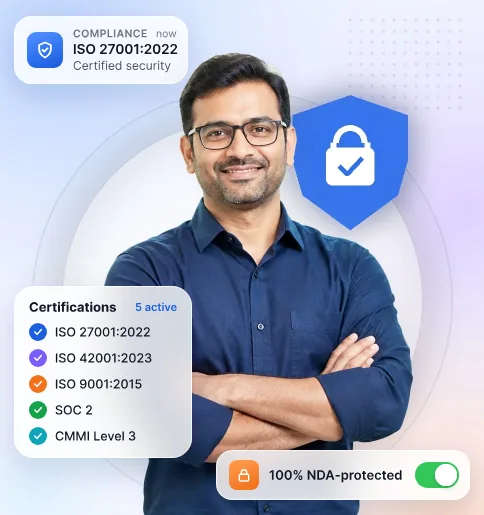
    Governance & security
    • ISO 27001:2022
    • ISO 9001:2015
    • SOC 2
    • CMMI Level 3
    • 100% NDA-protected
    Platform Capability
    • AWS Certified Solutions Practice
    • Multi-cloud: AWS, Azure, GCP
    • AI, Cloud & Blockchain
    Company & Credentials

    CIN U72900GJ2013PTC073284 · Certification & audit documentation available on request under NDA.

    Engagement Models

    Choose How Your Team Works With Ours

    Choose the engagement around your internal capacity and how clearly the work is defined. Where data readiness or acceptance criteria are uncertain, start with an assessment before committing to implementation.

    01 / 03

    Staff Augmentation

    Add fine-tuning engineers to an initiative led by your team. Your ML lead directs experiments and priorities; our engineers work within your existing security, review, and release practices.
    Discuss the Expertise Your Team Needs
    • You prioritize the engineering backlog
    • Your lead manages daily delivery
    • Specialists work within agreed assignments
    • You provide data and reviewer access
    • Your team accepts completed work
    • You approve assignment and scope changes

    FAQs

    Frequently Asked Questions

    Find simple answers on what fine-tuning costs, how much data you need, when to choose RAG instead, who owns the model and where it runs. Then compare providers before you request a quote.

    1. Which platforms provide the best LLM fine-tuning tools?

    For open models, eSparkBiz typically builds with PEFT, TRL and Hugging Face Transformers on PyTorch, adding Amazon SageMaker AI when you want managed training jobs. The best toolset depends on whether you need exported weights, where data may live and which models your license allows, so pick the platform after defining the task.

    Where do I find firms offering specialized LLM training services?

    Firms like eSparkBiz, which appears on AWS Marketplace, are one place to look, alongside cloud partner directories and B2B review sites. Shortlist firms that show evaluation results on held-out data, explain when not to train, and can integrate the tuned model into your application, not only run a training job.

    Is a free trial available for eSparkBiz LLM fine-tuning services?

    Yes. eSparkBiz bills nothing for the first consultation, and a 15-day risk-free trial can follow on request, giving you time to judge the collaboration before a longer contract. Bring a few failure examples without sensitive data, since that session usually shows whether fine-tuning, better prompts or retrieval is the cheaper route for your task.

    What does professional LLM fine-tuning typically cost?

    Projects with eSparkBiz begin at $10,000, usually enough for a scoped assessment plus a training pilot on one task. Total cost depends on dataset cleanup, model size, number of experiments, evaluation depth and integration work. Budget separately for recurring hosting, human review and retraining, since those often outweigh the training run itself.

    Which platforms support custom large language model adaptation?

    eSparkBiz weighs two routes, drawing on AWS Advanced Tier Partner experience: managed services like Amazon SageMaker AI that run training for supported models, and open libraries like PEFT for adapting Llama, Mistral or Qwen variants on infrastructure you control. The right choice follows your data rules, export needs, expected traffic and in-house operating skills.

    How should we choose an LLM fine-tuning provider?

    Ask each finalist whether your task even needs training, a question eSparkBiz answers in its first scoping call. Then compare how they keep test data apart, who approves labels, which artifacts you receive, and whether pricing covers failed experiments, hosting and retraining. Vague answers on evaluation are the clearest warning sign during selection.

    Who offers consulting for bespoke AI model development?

    eSparkBiz offers consulting and delivery for custom AI models, from fine-tuning open models to building the application around them, with 400+ engineers working since 2010. Good consultants test simpler options first and commit to training only when the data and expected savings justify it. Ask for that reasoning in writing before signing.

    Which vendors handle LLM fine-tuning and deployment end to end?

    eSparkBiz handles every step: task assessment, data preparation, supervised or preference training, evaluation, endpoint integration and post-launch maintenance. When comparing vendors, check whether deployment includes load and latency testing, fallback and rollback procedures, and monitoring, because many training-only firms hand over model files and leave production work to your team.

    How do I get an LLM fine-tuning quote from eSparkBiz for my industry?

    Share the task, the model you use now, a few representative failures without sensitive data, and your deployment limits, and eSparkBiz returns a phased estimate. It separates assessment, training and evaluation, integration and recurring operation, with experiment limits stated up front, so your sponsor sees exactly what each phase funds.

    Do LLM fine-tuning services support multi-language models?

    eSparkBiz fine-tunes models that already support the languages you need, provided approved examples exist in each one. Quality is measured per language rather than as one average, since a model can excel in English and drift in others. Domain terms and numbers still get checked by qualified reviewers in every language before release

    How do you evaluate the quality of an LLM fine-tuning service?

    eSparkBiz judges fine-tuning work by evidence, not training scores: a scorecard comparing the tuned and original models on unseen examples, with failures, regressions, response times and cost per accepted output. A credible service also documents data splits and labeling rules, and lets your reviewers calibrate automated scoring against their own judgment.

    Should we pay for LLM fine-tuning or build RAG instead?

    Fine-tuning changes how a model behaves, such as format, tone or labeling, while RAG supplies current facts from your documents. eSparkBiz recommends RAG for answers tied to changing information, fine-tuning for recurring behavior errors, and both when you need fixed behavior plus fresh content. Better prompts sometimes solve either problem first.

    Who owns the fine-tuned model after eSparkBiz completes the project?

    Contract terms agreed with eSparkBiz before work begins set ownership, and trained adapters, datasets and evaluation records are typically assigned to you. Limits come from the base model license and platform, since some managed services allow hosted use without weight exports. We confirm those restrictions during model selection, not after training.

    Can we hire eSparkBiz fine-tuning engineers to work under our ML lead?

    Yes. With staff augmentation, eSparkBiz places engineers in your initiative at an hourly rate below $25, following your security, review and release practices while your ML lead directs experiments and priorities. Teams lacking that lead usually pick a delivery team we manage, or a fixed-price pilot with agreed acceptance criteria.

    How long does an LLM fine-tuning project take?

    A first eSparkBiz fine-tuning phase usually runs 5 to 14 weeks, shaped more by data readiness, reviewer availability and platform access than by training itself. Cleaning and approving labels frequently takes more time than training. Integration, a controlled pilot and rollback testing add time when the model must reach production.


    Resources

    Insights from our engineering leaders.

    Our team shares practical insights on the technologies and engineering decisions shaping enterprise software today, grounded in real client work.