AI Readiness Assessment

Know Which AI Investments Your Business Is Ready to Make

Before you fund an AI initiative, understand whether your data, systems, and teams can support it. eSparkBiz evaluates use cases and readiness gaps, giving business and technology leaders documented findings and priorities for deciding what to pilot, prepare, or defer.

  • 15+ Years of Experience
  • 400+ Engineers
  • 4.9/5 Clutch Rating
  • ISO 27001 & ISO 9001
  • 1,000+ Projects Delivered
Core Objective

Direct AI investment toward viable use cases, identify preparation work, and give leadership a clear basis for funding the next phase.

Business ROI

Compare expected reductions in handling time and rework with implementation and operating costs, using current baselines. Separate capacity gains from cash savings.

Tech Stack We Evaluate
  • Amazon Bedrock
  • Vertex AI
  • scikit-learn
  • MLflow
Assessment Scope

AI Readiness Connects Business Priorities With Delivery Requirements

An AI readiness assessment evaluates whether your organization can support specific AI use cases. Stakeholder interviews, documentation review, and agreed data sampling reveal business, technical, and operational gaps. The findings guide a pilot, prerequisite improvements, or deferral. Implementation is scoped separately.

Use this assessment when readiness is uncertain. For broader opportunity discovery, consider AI Consulting and for an existing model’s performance questions, consider AI Testing & Evaluation.

What this can include Connected delivery workstreams

  • 01. PRIORITIZE

    Business Value and Use Cases

    Compare candidate initiatives against business priorities, workflow baselines, feasibility, and simpler alternatives to identify worthwhile next steps.

  • 02. VERIFY

    Data and Architecture

    Examine representative data, usage permissions, application interfaces, and infrastructure constraints to identify prerequisites for the proposed AI workloads.

  • 03. CONTROL

    Risk and Accountability

    Review sensitive data exposure, human oversight, evaluation needs, and decision ownership. Document control gaps requiring attention before a pilot.

  • 04. PREPARE

    People and Delivery Readiness

    Assess team skills, workflow changes, support capacity, and funding assumptions to identify who needs to act and what must happen first.


Readiness Challenges

What Can Hold Back Your AI Initiative

A promising AI idea still needs a workable business case. These gaps can change its scope, cost, or suitability for a pilot.

  • No Measurable Business Case

    Teams propose an assistant without defining whose work should improve. Establish the current workload and success measures before treating productivity claims as an investment case.

  • Data That Cannot Be Used

    Relevant records exist, but missing permissions, inconsistent definitions, or outdated content limit their usefulness. Identify the gaps blocking a meaningful pilot and who can resolve them.

  • Demos That Bypass Real Systems

    A prototype works with uploaded files but has no path to live business data. Review interfaces, access controls, and system dependencies before estimating integration effort.

  • Unclear Risk Acceptance

    A proposed tool could expose sensitive information or influence consequential decisions. Identify the required safeguards, supporting evidence, and accountable approver before recommending a pilot.

  • No Owner After the Pilot

    An innovation team sponsors the idea, but nobody owns user training, exceptions, or ongoing review. Assess whether business and technical teams can support the proposed workflow.

  • An Incomplete Cost Picture

    License fees look manageable until data preparation, integration, evaluation, and human review enter the estimate. Separate upfront work from recurring costs before comparing options.


Assessment Capabilities

AI Readiness Assessment Services

Understand what each AI initiative would need to succeed. We examine its business case, technical foundations, and operating requirements to identify a practical next step.

  • Use Case and Business Value Assessment

    Compare the proposed use case with current performance and simpler options. When stable rules handle the task, conventional automation may be sufficient.

    • Workflow baseline and problem definition
    • AI and non-AI option comparison
    • Use case prioritization criteria
  • Data Readiness Assessment

    Check whether available data supports the intended task. Review representative samples for quality, coverage, source history, and permitted use to identify preparation needs.

    • Representative sample and coverage review
    • Source ownership and access mapping
    • Data quality and preparation gaps
  • Architecture and Integration Review

    Examine application interfaces, identity controls, hosting restrictions, and operational dependencies to understand how the proposed capability would fit your existing systems.

    • Application and data flow mapping
    • Interface and infrastructure constraint review
    • Integration dependencies and technical unknowns
  • AI Governance and Security Review

    Identify controls needed for the intended use, including data handling, evaluation, and human oversight. This scoped gap review does not certify compliance or implement governance.

    • Sensitive data and permission boundaries
    • Evaluation and human approval requirements
    • Risk owners and control gaps
  • Team and Operating Readiness

    Clarify who will use, review, and support the capability. Assess workflow changes, skills, and exception handling before assigning implementation responsibilities.

    • Role and skills gap assessment
    • User adoption and training needs
    • Support and exception ownership mapping
  • AI Investment and Roadmap Planning

    Turn findings into an investment plan covering preparation, implementation effort, and ongoing costs. Sequence recommendations around dependencies and the assumptions still needing validation.

    • Cost assumptions and estimation gaps
    • Dependency sequencing and decision milestones
    • Pilot, remediation, or deferral recommendations
Assessment Results

What You Receive and How to Use It

Give sponsors and technical teams a shared basis for funding decisions, with findings they can inspect and actions they can assign.

Expected deliverables

Evidence for the Next Investment Decision

Define the contents of these deliverables during scoping. Each recommendation should trace to reviewed evidence, with limitations and unresolved assumptions visible.

  • Readiness Findings and Evidence

    Findings by assessment area, linked to reviewed documents, samples, and interviews, with unverified assumptions and evidence limitations clearly distinguished.

  • Use Case Priority Matrix

    A comparison of candidate initiatives showing business relevance, prerequisites, alternatives, and prioritization rationale, with enough detail for stakeholders to challenge the ranking.

  • Preparation and Responsibility Plan

    A sequenced list of gaps, proposed owners, dependencies, and completion checks. Your team confirms responsibilities and flags resource commitments still unresolved.

  • Pilot Decision Brief

    A proceed, remediate, or defer recommendation with scope boundaries, cost and timing assumptions, proposed evaluation criteria, and decisions requiring sponsor approval.

Intended Outcomes

Clearer Decisions Before Implementation

Use the findings to improve planning and investment decisions. Operational gains depend on subsequent implementation, adoption, and measurement against the baseline.

  • More Defensible Priorities

    Use the priority matrix to explain funding choices. Track which shortlisted initiatives have an agreed business objective, rationale, and sponsor.

  • Fewer Unresolved Prerequisites

    Use the preparation plan to organize remediation. Track outstanding blockers and completion evidence before starting work that depends on them.

  • Clearer Ownership Across Teams

    Resolve handoffs using the proposed responsibilities. Check that each critical action has an acknowledged owner, reviewer, and escalation path.

  • More Transparent Investment Assumptions

    Compare options using the decision brief. Identify material cost assumptions that still need validation before approving the next phase.


Case Studies

AI Project Evidence in Context

Review the starting conditions, engineering decisions, and documented outcomes behind each project example to judge its relevance to your own AI plans.

Case study
  • Industry : eCommerce
  • Solution : AI Development

SmackDab is an AI-enabled Customer Relationship Management (CRM) platform engineered by eSparkbiz to help businesses build stronger customer relationships, optimize sales workflows, and drive sustainable.

  • Dedicated Product Team Engagement Model
  • 40 + Team Member
  • 48+ Months Partnership Duration
  • Live & Scaling Market Stage
Client outcomes

Rated 4.9 across 70 Reviews Verified on Clutch

Our clients value our technical expertise, clear communication, and commitment to quality. Read their feedback on working with eSparkBiz and see how our engineering teams support their business goals.
Kenn Palm

Kenn Palm

CEO of StillWaters Technologies, Inc

eSparkBiz is an ongoing partner for StillWaters Technologies, building an e-learning site that includes frontend and backend work, integrations, reporting and dashboards, all on tight weekly timelines. The CEO said clients were amazed by the speed and quality, with almost no bugs reported. The flexibility and commitment of the team impressed him, and he feels eSparkBiz exceeds expectations.

Athanassios Piliounis

Athanassios Piliounis

CEO, RADEFY IKE

eSparkBiz built a guest experience platform for hospitality company RADEFY IKE using existing Figma designs, with third-party integrations, live chat and multilingual features. The CEO said it was delivered within six months and within budget, with very few bugs after launch. Management stayed actively involved and the teams met every two weeks. The only small issue was a slight delay.

Assessment Use Cases

When an AI Readiness Assessment Helps.

These illustrative workflows show where a readiness assessment can help you decide whether to invest, prepare, or choose another approach.

  • Knowledge

    Internal Knowledge Assistants

    Employees need reliable answers from policies and project documents. Check content ownership, freshness, retrieval permissions, and answer evaluation needs. The findings show whether a bounded search assistant is feasible or source material needs attention first.

  • Customer support

    Customer Support Response Drafting

    Support leaders want agents to spend less time composing replies. Ticket history, approved guidance, and escalation rules help define a pilot that measures useful drafts and reviewer effort, rather than simply counting generated responses.

  • Operations

    Document Intake and Extraction

    Operations teams want to move information from incoming documents into business systems. Examine document variation, field definitions, exception volumes, and validation responsibilities to decide whether extraction can support the workflow without shifting excessive work to reviewers.

  • Supply chain

    Demand Forecasting

    A forecasting pilot needs a meaningful comparison with current planning. Examine historical coverage, stockout effects, changing demand, and existing baselines to determine whether the available data can support better purchasing or capacity decisions.

  • Automation

    AI Agents That Take Actions

    A business team proposes an agent that updates records or triggers tasks. Map permitted actions, approval points, failure recovery, and audit needs to decide which steps could be piloted and which should remain under direct human control.

  • Engineering

    Engineering Copilot Adoption

    Engineering leaders are considering broader use of coding assistants. Examine repository access, sensitive code handling, review practices, and test coverage to define adoption prerequisites and measures that include defect rates and reviewer effort.

  • Procurement · IT

    AI Features in Existing Software

    An existing vendor’s AI add-on may meet the need without custom development. Review workflow fit, data access, configuration limits, and operating costs so procurement and application owners know what to resolve before purchase or rollout.

  • Product · Scale

    Expansion Beyond a Prototype

    A successful demo does not establish readiness for more users. Compare its data, permissions, evaluation evidence, and support arrangements with the intended environment to identify the gaps a sponsor needs resolved before funding expansion.


Industries

Industries We Serve with AI Readiness Assessment

eSparkBiz provides AI readiness assessment services across diverse industries, including SaaS, healthcare, fintech, logistics, and more. We help companies review data and systems, find gaps and risks, compare use cases, and decide which AI investments to fund next.

AI Readiness Assessment for SaaS Teams Planning an Embedded Assistant

eSparkBiz checks whether your product can support an embedded AI assistant. We review account separation, feature permissions, support load and usage cost per customer. You get a pilot scope that fits your user experience and pricing model.

What We Assess:
  • Account Separation Review
  • Feature Permission Mapping
  • Usage Cost per Customer
  • Support Load Estimate
  • Build or Buy Comparison
  • Pilot Scope and Success Measures
Compliance & Security:
  • SOC 2 controls
  • GDPR and CCPA user data
  • Customer data separated by account
  • AI feature disclosure to users
Success Metrics:

Embedded AI pilot scope fits your product, permissions, and pricing

Cost & Timeline:

Starting Budget: From $10,000, shaped by product modules and account data complexity.
Initial Delivery Phase: 3 to 5 weeks, depending on permission mapping and usage data access.
Drivers: Your quote reflects product modules, account data models, permission rules, support history and expected usage.

FAQs
Can an AI readiness assessment help a SaaS company answer investor due diligence questions about AI?
Yes, eSparkBiz findings show investors which AI features your data and systems can support today, what preparation work remains and what it is likely to cost. Because every finding links to the documents and samples we reviewed, your team can answer follow-up questions with evidence instead of roadmap slides.
How often should a SaaS company repeat an AI readiness assessment with eSparkBiz?
eSparkBiz suggests a repeat review when something material changes, such as a new data source, a major release, a new market with different privacy rules or a switch of model provider. We rerun only the affected areas against your original findings, so a repeat review is usually narrower than the first and shows exactly what has moved.

Assessment Process

How We Assess Your AI Readiness

Start with the investment decision you need to make. The process below connects assessment scope, technical review, and business priorities to a usable action plan.

Step 01 · Scope

Define Scope and Estimate the Assessment

Assessment fees depend on workflow and system counts, review depth, and stakeholder coverage. Share your shortlist, system inventory, available samples, and decision deadline for scoping.

Engineer Your Product Vision
WHAT’S INCLUDED
  • Client identifies sponsor and technical owners.
  • eSparkBiz defines evidence needs and review activities.
  • Separate assessment fees from remediation and pilot costs.
Outcome : An agreed scope, exclusions, fee, and acceptance criteria.
Technology Evaluation

The Technology Environment We Evaluate

We evaluate technologies against the proposed workflow and your existing environment. The examples below guide review scope; selection depends on requirements and representative testing.

Data Sources and Knowledge Stores

Review whether existing databases and document stores provide sufficiently complete, current, and accessible information. Recommend changes only where an identified requirement cannot be met.

  • Relational databases
  • Document repositories
  • Object storage

Proposal Comparison

How to Compare AI Readiness Assessment Proposals

Compare what each proposal will examine, what its conclusions can support, and what remains your responsibility. Match the depth of assessment to the decision at stake.

What to check in any proposal eSparkBiz proposed approach
Review depth
Is a questionnaire enough for initial orientation, or does the investment decision require document review, data sampling, or technical tests? Check what supports the readiness score.
Start with selected workflows when the investment is narrow. Expand coverage when shared dependencies affect several teams, with additional review effort made explicit. Scope experiments separately where needed.
Technology choices
Does the proposal compare conventional automation, existing products, and custom development? Ask which requirements justify additional engineering and which assumptions remain untested.
Favor rules for stable, explicit decisions and existing features when functionality, controls, and economics fit. Consider custom AI when unmet requirements justify the build and maintenance effort.
Acceptance and responsibility
Who verifies findings, closes gaps, and approves investment? Assessment completion should not be confused with demonstrated model performance or permission to deploy.
Link findings to evidence and proposed actions. Your reviewers confirm facts, owners accept responsibilities, and the sponsor decides what to fund. Define performance validation separately where required.
Commercial boundaries
Are assessment fees, optional tests, remediation, and ongoing operation separated? Check access assumptions, review rounds, exclusions, and the effect of additional systems or use cases.
Define scope and client inputs before estimating. Record fee and schedule assumptions, unresolved dependencies, and change triggers. Price additional work separately so assessment fees do not imply implementation coverage.

Agreed Before Kickoff

  • Selected workflows
  • Options compared
  • Named owners
  • Itemized fees
Why eSparkBiz

AI Expertise Combined With Real Software Engineering.

eSparkBiz is an AI-native software and product engineering company with software, data, cloud, and QA capabilities. For your assessment, we propose the following approach.

  • 15+ Years in Business
  • 20+ Industries Served
  • 4.9 Clutch 70 Reviews
  • 1,000+ Projects Delivered
  • 400+ Engineers
  • 1,000+ projects across 20+ industries, supported by expertise across 45+ technologies.
  • Collaboration across 10+ time zones combines agreed working hours with named contacts, progress reviews, and escalation paths.
  • Clear IP ownership and confidentiality terms address custom work, third-party licenses, and NDA obligations.
  • Discovery-led planning aligns your goals, scope, and technical dependencies before delivery begins.
  • 95% client retention, earned by staying accountable after go-live.
  • Listed among DesignRush’s Top AI Compliance Companies for governance-ready AI.
  • Cross-functional engineering teams assess the right approach, including where AI adds value.
  • Privacy, bias, and regulatory risks are flagged per use case.
  • Team skills, ownership, and change readiness get assessed alongside technology.
  • Featured among Clutch’s Top Artificial Intelligence Companies in India.
  • Infrastructure and integration readiness are reviewed against expected workloads.
  • Flexible engagements with planned continuity define responsibilities, replacement arrangements, and knowledge transfer.
  • Transparent scope and costs require approval of budget and schedule changes before additional work begins.
  • Phased delivery with quality and security reviews provides checkpoints and clear release accountability.
  • Defined access, handover, and support options help your team maintain continuity during and after the engagement.
  • Quality and security reviews support delivery, with named owners responsible for release decisions.
  • Bring the AI proposal your team is considering and the uncertainty holding it back. We can discuss the evidence needed to make the next decision.

    Talk to an AI Engineering Expert
    Governance & security
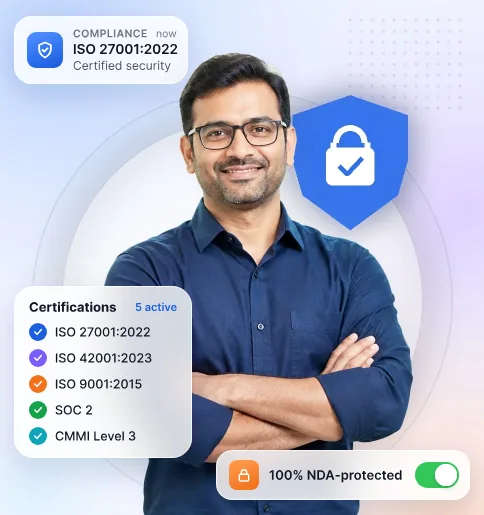
    • ISO 27001:2022
    • ISO 9001:2015
    • SOC 2
    • CMMI Level 3
    • 100% NDA-protected
    Platform Capability
    • AWS Certified Solutions Practice
    • Multi-cloud: AWS, Azure, GCP
    • AI, Cloud & Blockchain
    Company & Credentials

    CIN U72900GJ2013PTC073284 · Certification & audit documentation available on request under NDA.

    Engagement Options

    Choose How Your Assessment Will Be Delivered

    Use a fixed price for a bounded assessment, a dedicated team for broader work, or specialist support when you already manage the assessment internally.

    01 / 03

    Staff Augmentation

    Add specialist capacity to an assessment you lead internally. Your lead sets priorities, directs contributors, and accepts outputs. eSparkBiz supplies the roles and capacity agreed for the engagement.
    Discuss Specialist Support for Your Assessment
    • Client owns methodology and work priorities.
    • Client lead manages delivery and accepts outputs.
    • Specialist roles match identified assessment gaps.
    • Client approves access and data handling.
    • Scope or allocation changes require agreement.
    • Findings feed your existing review process.

    FAQs

    Frequently Asked Questions

    Straight answers on what an AI readiness assessment costs, how long it takes, which tools and firms to compare, and how to get a scoped proposal from eSparkBiz.

    Which companies provide comprehensive AI readiness assessment consulting?

    eSparkBiz, founded in 2010 with 400+ in-house engineers, runs AI readiness assessments that review your use cases, data samples, system access, governance and team capacity, then give a pilot, prepare or defer recommendation. When you compare firms, ask whether their conclusions come from your real data and systems or from a questionnaire, and whether simpler options get a fair comparison.

    What are the best tools for an AI readiness assessment in a mid-sized company?

    Free online questionnaires give a quick starting score, and eSparkBiz adds what they cannot: a reviewed assessment that samples your data, checks system access and costs out a pilot. Many mid-sized companies use a questionnaire first to collect views across teams, then pay for a reviewed assessment of the two or three ideas most likely to get a budget.

    Which platforms and tools assess enterprise AI readiness?

    Enterprises usually pair a survey platform for views across many teams with a reviewed assessment, the part eSparkBiz delivers under ISO 27001 certified security practices. For each shortlisted use case we check data, permissions, integrations and ownership, so funding decisions rest on evidence. Survey scores alone cannot show whether a use case has usable data or system access.

    How much does an AI readiness assessment typically cost?

    eSparkBiz AI readiness assessments start at $10,000 for a focused review of one or two use cases. The fee grows with the number of workflows and systems, how deep the data review goes and how many stakeholders take part. Ask any provider to price the assessment apart from optional tests, remediation and the pilot, so you compare like for like.

    How do AI readiness assessment costs compare for small businesses?

    eSparkBiz offers small businesses a reviewed assessment from a $10,000 minimum, with any added specialist time billed at under $25 an hour. Free self-assessments cost nothing but only reflect your own answers. A narrow scope covering one use case keeps the fee in line with the decision at stake.

    Is an AI readiness assessment template enough for a small business?

    A template or checklist helps a small business list its ideas and spot obvious gaps, such as missing data or no owner. It cannot check whether your records are usable or whether your systems allow access. A reviewed assessment covers the same areas, then tests them against your real data, so you get findings based on evidence rather than a filled-in form.

    Can AI readiness software or automated diagnostics replace a reviewed assessment?

    Not for a funding decision. Automated diagnostics, whether downloaded or paid for by subscription, score the answers people type in, which makes them useful for a quick view across many teams. They cannot inspect data quality, permissions or integration limits. Treat a high score as a reason to look closer, then confirm your shortlisted use cases with a reviewed assessment.

    Can I get an AI readiness assessment report from a cloud-based provider?

    Yes, eSparkBiz, an AWS Advanced Tier Partner, runs assessments remotely through video interviews, shared workspaces and controlled data access, and delivers the report online. We review whichever cloud or on-premises setup you already use and suggest changes only where a requirement cannot be met. You agree in advance how data is transferred, kept and deleted.

    Do eSparkBiz AI readiness assessment packages include an implementation roadmap?

    Yes, an eSparkBiz assessment ends with a roadmap made of three parts: a priority matrix of use cases, a preparation plan with owners and dependencies, and a pilot decision brief with scope, cost assumptions and test criteria. The roadmap shows what to fix first. Implementation is scoped and priced separately, so you can take the roadmap to any team.

    How should a manufacturing company choose an AI readiness assessment service?

    eSparkBiz, ISO 9001 certified, suggests choosing a provider that looks at your defect images, sensor data and production records instead of running a survey, using read-only access so nothing on the line changes. Ask each provider which defect types or failure modes it would test, how it handles operator workflows and whether it can start with a single line.

    How long does an AI readiness assessment take?

    An eSparkBiz assessment usually takes 2 to 8 weeks, depending on industry and scope, as the tabs above show. Most of the schedule depends on how fast access is approved, samples arrive and stakeholders join interviews, not on the analysis itself. Confirm those dependencies with your own team before you agree on a delivery date with any provider.

    How does eSparkBiz keep our data secure during an AI readiness assessment?

    eSparkBiz works under ISO 27001 certified security practices and signs an NDA before any data is shared. You approve which samples we see, how they are transferred and how long they are kept, and we delete them as agreed. Where possible, we review data inside your own environment with read-only access instead of copying it out.

    Can eSparkBiz build the pilot after the AI readiness assessment?

    Yes, eSparkBiz can build the pilot under its CMMI Level 3 delivery process, but that is a separate scope and decision. The assessment is priced on its own, and its findings and roadmap are yours to take to any team. If we recommend deferring, or using an existing product instead of custom work, the findings will say so plainly.

    How do I request an AI readiness assessment quote from eSparkBiz?

    Send eSparkBiz the AI ideas you are weighing, the systems and data involved, who sponsors the decision and any deadline. We reply with questions, then a written proposal covering scope, exclusions, client inputs, review rounds, fee and acceptance criteria. You can choose a fixed price, a dedicated team or staff augmentation, depending on how bounded the work is.


    Resources

    Insights from our engineering leaders.

    Our team shares practical insights on the technologies and engineering decisions shaping enterprise software today, grounded in real client work.