AI Agent Development Services

Build AI Agents That Complete Tasks Across Your Business Systems

When work stalls between requests, decisions, and system updates, eSparkBiz helps you build AI agents that carry tasks forward. Our AI-native software engineering approach connects models to business tools, with defined permissions, human approvals, and task-level testing.

  • 15+ Years of Experience
  • 400+ Engineers
  • 4.9/5 Clutch Rating
  • ISO 27001 & ISO 9001
  • 1,000+ Projects Delivered
Core Objective

Reduce manual coordination in workflows that require interpreting requests, checking business context, and taking authorized actions across applications.

Business ROI

Reduce handling time and rework. Assess the benefit against implementation, model usage, infrastructure, maintenance, and human review costs.

Tech Stack We Evaluate
  • OpenAI Agents SDK
  • Agent Orchestration
  • Business System APIs
  • Amazon Bedrock AgentCore
Service Overview

AI Agent Development Connects Decisions With Actions

AI agent development is the design, integration, and testing of software that uses a language model to select steps and tools toward a goal. An agent can retrieve information, execute permitted actions, check results, and escalate exceptions.

Use agents when the next action depends on changing context. Fixed rules suit predictable steps; RAG & Enterprise Search suits knowledge retrieval without task execution.

What this can include Connected Delivery Workstreams

  • 01. Design

    Workflow and Agent Design

    Define goals, task boundaries, state, and stopping conditions. Coordinate multiple agents only when separate responsibilities justify the complexity.

  • 02. Connect

    Knowledge and Tool Connections

    Connect approved APIs and knowledge sources, with access permissions and input validation matched to each agent’s responsibilities.

  • 03. Govern

    Approvals and Exception Handling

    Specify which actions need review, how missing information is handled, and how interrupted work returns to a person.

  • 04. Validate

    Evaluation and Operational Readiness

    Test representative tasks and failures, then prepare execution logs, cost monitoring, deployment procedures, and operational handover.


Challenges We Address

What Keeps AI Agents From Completing Work Reliably

A convincing demonstration can hide unfinished tasks, unreliable context, and expensive corrections. We address the engineering problems that determine whether an agent is useful in operation.

  • Answers Without Completed Actions

    An assistant explains what to do, but employees still update every system. Tool integration connects requests to authorized actions and verifies the resulting changes.

  • Missing or Outdated Context

    An agent uses an old policy or misses a relevant record. Permission-aware retrieval, freshness checks, and missing-information handling establish the context needed before action.

  • Permissions That Are Too Broad

    Shared credentials can expose more than a task requires. Narrow permissions and action-specific approvals limit the consequences of an incorrect instruction.

  • Failures That Repeat Actions

    A timeout leaves uncertainty about whether an update succeeded. Recorded task state and duplicate-action safeguards support recovery without repeating completed changes.

  • Success That Demos Cannot Prove

    Selected examples conceal incorrect actions and missed exceptions. Representative evaluation cases reveal whether the agent meets business acceptance criteria beyond producing a fluent response.

  • Hidden Operating Costs

    Repeated model calls and review queues can erode automation’s benefit. Measure cost per correctly completed task alongside latency, corrections, and human effort.


Our Services

AI Agent Development Services We Offer

Build a new agent, extend a prototype, or improve a deployed workflow. We scope the work around your business task and the systems involved.

  • Agent Discovery and Architecture

    Establish whether an agent is worth building before committing to implementation. We map workflow decisions, system dependencies, delegated authority, and architecture options.

    • Workflow baseline and feasibility assessment
    • Action boundaries and approval rules
    • Architecture options and delivery dependencies
  • Custom AI Agent Development

    Give users a way to delegate tasks that require contextual decisions. We build agent logic, application interfaces, persistent task state, and recovery behavior.

    • Task planning and structured tool outputs
    • State, stopping rules, and execution limits
    • Exception handling and human handoff
  • Multi-Agent Orchestration

    Coordinate specialist agents when separate roles improve task performance. We define delegation and handoff checks, retaining a single agent when extra coordination adds little value.

    • Agent roles and delegation contracts
    • Shared context and handoff validation
    • Single-agent versus multi-agent evaluation
  • Agent Tool and Knowledge Integration

    Connect business actions and relevant records through APIs or MCP. Configure retrieval, memory retention, credentials, and validation around the information and authority each task needs.

    • Tool schemas and application identity integration
    • Retrieval permissions, freshness, and source provenance
    • Memory retention and duplicate-action safeguards
  • Agent Evaluation and Security Testing

    Check whether agents complete work correctly and respect action limits. We test representative tasks, enforce authorization outside the model, and configure approval routes.

    • Evaluation datasets and outcome checks
    • Prompt-injection, access, and sensitive-data tests
    • Approval enforcement and regression evidence
  • Agent Deployment and Lifecycle Support

    Move the validated workflow into your operating environment. Ongoing support can cover failures, dependency changes, and optimization based on observed task quality and cost.

    • Runtime, secrets, release pipelines, and rollback
    • Execution traces, alerts, and usage analysis
    • Maintenance, incident responsibilities, and controlled updates
Deliverables and Outcomes

What You Receive and How It Supports Your Business

Agree on tangible outputs before implementation, then assess their value in use. Business improvements depend on adoption, workload, and operating conditions.

Expected Deliverables

An Agent Your Team Can Inspect and Operate

For the implementation scope, specify working components, documentation, and acceptance evidence. Your workflow owner validates business rules; technical reviewers assess integrations and release readiness.

  • Workflow and Integration Implementation

    A task specification, system map, agent logic, and tool interfaces, with completion checks that verify intended changes in connected systems.

  • Evaluation Suite and Release Findings

    Representative tasks, scoring criteria, execution records, and unresolved failures give reviewers evidence against the release thresholds agreed with your team.

  • Access and Approval Configuration

    A permission matrix, action checks, and review routes, tested to confirm restricted operations remain blocked and required approvals cannot be bypassed.

  • Operating and Handover Package

    Deployment configuration, monitoring guidance, recovery procedures, and an escalation matrix, reviewed with the team responsible for operating the service.

Intended Outcomes

Business Improvements to Validate in Use

Establish a baseline, then compare equivalent pilot workloads. Review speed, quality, cost, and intervention together so faster execution does not conceal more correction work.

  • Less Manual Coordination

    Reduce the effort of moving work between systems. Track employee handling time and handoffs per completed task, including corrections.

  • More Reliable Task Completion

    Improve completion of defined tasks. Track verified results, incorrect actions, and reopened work rather than treating generated responses as successful outcomes.

  • Faster Exception Resolution

    Give staff the context to resolve blocked work. Measure escalation-to-resolution time and whether receiving teams have enough information to act.

  • Clearer Automation Economics

    Assess benefits against delivery and operating costs over an agreed period. Distinguish time saved from cash savings actually realized.


Case Studies

AI Agent Delivery in Business Context

Assess project evidence by the workflow involved, the systems connected, and the results measured. Relevant examples should make the delivery scope and its limitations clear.

Case study
  • Industry : eCommerce
  • Solution : AI Development

SmackDab is an AI-enabled Customer Relationship Management (CRM) platform engineered by eSparkbiz to help businesses build stronger customer relationships, optimize sales workflows, and drive sustainable.

  • Dedicated Product Team Engagement Model
  • 40 + Team Member
  • 48+ Months Partnership Duration
  • Live & Scaling Market Stage
Client outcomes

Rated 4.9 across 70 Reviews Verified on Clutch

Our clients value our technical expertise, clear communication, and commitment to quality. Read their feedback on working with eSparkBiz and see how our engineering teams support their business goals.
Tawfik Hussein

Tawfik Hussein

Tech Lead, Food & Beverage Company

eSparkBiz took over mobile app development for a Saudi food and beverage company, fixing errors left from earlier work on the iOS and Android apps and re-architecting the Android app. The tech lead liked the speed, quality and flexibility, along with the suggestions the team offered on their own, and noted they are available even on weekends. The team was also commended for sticking to best practices.

Sarah Malavenda

Sarah Malavenda

Co-Founder, Samata Health

eSparkBiz built a therapist matching platform for Samata Health and has supported ongoing updates and UX design since 2019, following a process of kick-off, prototyping, testing and launch. The CMO said the relaunch earned rave reviews and helped win more companies, and praised the fast, responsive team and their main contact, Siddharth.

Practical Applications

AI Agent Use Cases Across Business Operations.

Start with a workflow where requests vary but successful completion can be verified. These potential applications illustrate tasks to evaluate against your requirements.

  • HR & IT

    Employee Onboarding Coordination

    Keep onboarding tasks moving across HR and IT. An agent can track documents, training, and equipment requests, then follow up on missing inputs. Approved role mappings guide requests; managers authorize entitlements and sensitive employment-record changes.

  • Procurement

    Purchase Request Preparation

    Incomplete purchasing requests create extra work for employees and procurement teams. An agent can retrieve catalog options, identify missing details, and assemble the submission so reviewers receive a complete request. Order placement remains subject to existing approval limits.

  • Finance

    Invoice Exception Resolution

    When an invoice does not match a purchase order, an agent can gather receipt records, investigate the discrepancy, and request missing information. Accounts payable staff review the proposed resolution and retain payment authority, with less evidence-gathering work.

  • Sales

    Sales Proposal Preparation

    Prepare sales proposals from approved service descriptions, customer requirements, and current commercial records. An agent can identify unanswered questions and coordinate internal input, helping sales teams produce complete drafts while authorized reviewers approve pricing and commitments.

  • IT

    IT Incident Triage

    Service desk teams need context from logs, recent changes, and runbooks to investigate an incident. An agent can assemble that evidence and suggest next steps. Initial diagnosis can use read-only access; production changes follow existing incident approvals.

  • Legal

    Contract Obligation Tracking

    Turn approved contract obligations into follow-up tasks for account teams. An agent can locate supporting clauses, check dates against business records, and flag missing actions. The designated contract owner resolves ambiguous terms before work is assigned.

  • Support

    Customer Account Updates

    A customer’s account change may touch several systems. An agent can collect required verification and prepare coordinated updates, giving service staff a clearer review path. Authorized changes follow account permissions; cases outside policy move to a person.

  • Operations

    Document Intake and Routing

    Incoming documents vary in format and completeness, making intake laborious. An agent can identify request types, extract details, and seek missing information before routing each case. Uncertain interpretations go to reviewers with the relevant context attached.


Industries

Industries We Serve with AI Agent Development Services

eSparkBiz delivers AI agents across a wide range of sectors, from healthcare and fintech to ecommerce. Review the rules each agent follows, past results, typical timelines, compliance scope and where pricing starts.

AI Agent Development for SaaS Products That Speeds Customer Setup

eSparkBiz builds AI agents inside your SaaS product that help customers import data, fix mapping errors and finish setup. Each agent sees only one customer’s records and asks before it writes any change.

What We Build:
  • Data Import Agents
  • Mapping Error Fixes
  • Setup Guidancen
  • Support Ticket Triage
  • Account Health Checks
  • Usage Cost Tracking
Compliance & Security:
  • SOC 2 audit evidence
  • GDPR and CCPA
  • One customer’s data per session
  • User approval before write actions
  • Data kept out of model training unless you agree
Success Metrics:

Customer setup finishes faster with fewer support escalations.

Cost & Timeline:

Starting Budget: From $10,000, reflecting API coverage and import complexity.

Initial Delivery Phase: 6 to 10 weeks, allowing for release testing and phased rollout.

Drivers: Price depends on API coverage, import formats, customer account volume, write permissions and release testing.

FAQs
Can an AI agent use our SaaS product’s existing API instead of new back-end work?
Usually, yes. eSparkBiz builds the agent on the API your product already has, so it passes the same permission checks as your users. We add new endpoints only where the agent needs an action your API does not offer yet, and your engineers review each one before release.
How does an AI agent fit into a SaaS team’s release cycle?
Agent changes ship the same way your features do: behind a feature flag, to a small group of accounts first, with automated tests before each release. Your engineers review the code and decide when each change goes live, so the agent never moves faster than the rest of your product.
What ongoing costs should a SaaS company budget after launching an AI agent?
Plan for model usage fees, monitoring, test updates and engineer time for API changes. eSparkBiz sets per-account usage limits during the build and reports cost per completed task, so your finance team can compare it against support hours saved.
Who is liable if a SaaS AI agent makes a wrong change in a customer account?
Your customer contract decides liability, so involve legal counsel early. eSparkBiz reduces exposure technically: the agent asks for approval before each write action and keeps a change log, so teams can trace and reverse any change quickly.

Our Process

Our AI Agent Development Process

Start with a defined workflow and expand when results justify it. Each stage gives a named decision owner evidence to approve the next investment.

Step 01 · Discover

Confirm the Workflow and Its Value

We examine representative requests, exceptions, and current handling effort. Your workflow owner confirms the task boundary and whether the opportunity warrants further design.

Map Your Target Workflow
WHAT’S INCLUDED
  • Document the workflow and baseline
  • Identify permitted actions and excluded decisions
  • Check sample data and system access
  • Record the sponsor’s proceed-or-stop decision
Outcome : Sponsors get a documented baseline before spending anything
Technology Selection

Technology Options for Your AI Agent

We evaluate tools against your workflow, data restrictions, deployment environment, and task performance. Selection also reflects what your team can maintain.

Language Models for the Task

Compare models on representative requests, tool-selection accuracy, response time, and cost per completed task. Data-handling terms and deployment availability also influence selection.

  • OpenAI API
  • Claude API
  • Gemini API
  • Amazon Bedrock
Technology Selection

How to Compare AI Agent Development Proposals

Compare implementation choices, acceptance evidence, and ongoing responsibilities. A useful proposal explains the tradeoffs and identifies the work your team will retain.

What to check in any proposal eSparkBiz proposed approach
Architecture fit:
Can an existing platform or fixed workflow meet the need? Additional autonomy and coordination should have a demonstrable purpose.
Evaluate existing options first. Propose custom development for material gaps; add multiple agents only when testing justifies coordination overhead.
Integration responsibility:
Who supplies access, resolves data issues, and maintains connectors? Identify client and third-party dependencies and excluded work.
Define tool inputs, permissions, and failure behavior. Assign system-access and data decisions to client owners; allocate implementation and connector maintenance in scope.
Acceptance evidence:
Does acceptance rely on selected demonstrations or representative results? Check how incorrect actions, retries, and human intervention affect release.
Agree task-level thresholds and prohibited actions before release. Review recorded outcomes and unresolved defects; expand only when pilot evidence supports it.
Operating cost and ownership:
Does the estimate include model usage, infrastructure, licenses, review, and maintenance? Who controls accounts, configuration, and support?
Separate build and recurring costs and assign operating responsibilities. Assess managed-service fees and dependencies alongside the infrastructure work those services reduce.
  • Agreed Before Kickoff
  • Tested coordination
  • Defined permissions
  • Task thresholds
  • Separated costs
Why eSparkBiz

AI Agent Engineering With Broader Software Delivery Support

An agent needs more than model behavior to work inside your product. eSparkBiz brings the surrounding engineering capabilities and a discovery-led approach to investment decisions.

  • 15+ Years in Business
  • 20+ Industries Served
  • 4.9 Clutch 70 Reviews
  • 1,000+ Projects Delivered
  • 400+ Engineers
  • 1,000+ projects across 20+ industries, supported by expertise across 45+ technologies.
  • Collaboration across 10+ time zones combines agreed working hours with named contacts, progress reviews, and escalation paths.
  • Clear IP ownership and confidentiality terms address custom work, third-party licenses, and NDA obligations.
  • Discovery-led planning aligns your goals, scope, and technical dependencies before delivery begins.
  • 95% client retention, earned by staying accountable after go-live.
  • Pilot agents prove ROI on one workflow before wider rollout.
  • Featured among Clutch’s Top AI Agent Development Companies in Philadelphia.
  • Agents are tested against real edge cases before production release.
  • Tool access and permissions are scoped before any agent acts.
  • Human approval gates guard every high-impact agent action.
  • Cross-functional engineering teams assess the right approach, including where AI adds value.
  • Multi-agent workflows coordinate with your CRM, ERP, and internal tools.
  • DesignRush recognizes eSparkBiz as Top AI ERP Consultant for automation.
  • Flexible engagements with planned continuity define responsibilities, replacement arrangements, and knowledge transfer.
  • Transparent scope and costs require approval of budget and schedule changes before additional work begins.
  • Phased delivery with quality and security reviews provides checkpoints and clear release accountability.
  • Defined access, handover, and support options help your team maintain continuity during and after the engagement.
  • Bring a workflow, a stalled prototype, or an integration challenge. We can discuss the engineering scope and evidence needed for your next decision.

    Scope Your Agent Project
    Governance & security
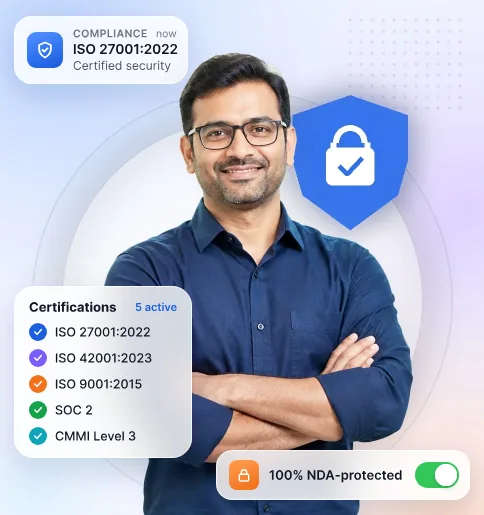
    • ISO 27001:2022
    • ISO 9001:2015
    • SOC 2
    • CMMI Level 3
    • 100% NDA-protected
    Platform Capability
    • AWS Certified Solutions Practice
    • Multi-cloud: AWS, Azure, GCP
    • AI, Cloud & Blockchain
    Company & Credentials

    CIN U72900GJ2013PTC073284 · Certification & audit documentation available on request under NDA.

    Ways to Work Together

    AI Agent Development Engagement Models

    Choose according to who manages delivery and how stable the scope is. Agree code and IP rights, account access, support coverage, and exclusions in the proposal.

    01 / 03

    Staff Augmentation

    Add AI, integration, or evaluation engineers to a team you manage. Your lead sets priorities, directs delivery, and accepts work; eSparkBiz contributes agreed skills within your practices.
    Add Engineers to Your Team
    • Skills matched to your technical gaps
    • Your backlog and delivery management
    • Your architecture and release decisions
    • Your reviewers accept completed work
    • You prioritize changes within agreed capacity
    • Access, reporting, and escalation arrangements defined

    FAQs

    Frequently Asked Questions

    Get clear answers on AI agent costs, hiring developers and choosing a vendor. Every reply comes from how eSparkBiz plans, prices and supports real client projects.

    What are the best AI agent development companies for mid-sized businesses?

    eSparkBiz suits mid-sized businesses that need agents working inside their own systems, with 400+ in-house engineers, CMMI Level 3 delivery, ISO 27001 security and AWS Advanced Tier Partner status. Large consultancies fit company-wide AI programs, and small studios fit quick prototypes. Shortlist firms that can show agents finishing real tasks, not only chat demos.

    How much does it cost to build a custom AI agent?

    Agent projects start at $10,000, which can cover discovery or a first agent for one workflow. At eSparkBiz, the final price depends on how many systems the agent connects to, how clean your data is, how many actions need approval and how much testing you need. We itemize running costs separately: model usage, hosting, monitoring and staff review.

    Which companies offer custom AI agent development for business automation?

    Custom AI agents suit business work that moves between systems, such as invoice exceptions, purchase requests, sales proposals, customer account updates and IT ticket triage. Each agent works through your existing tools, follows set permissions and hands unclear cases to a person. eSparkBiz starts with one workflow and adds more once it works.

    Is AI agent development affordable for startups and small businesses?

    Yes, if you start small. eSparkBiz has a $10,000 minimum, which fits one agent for one task, such as booking requests or support replies, built on an existing AI model instead of a custom one. A narrow first version keeps build and running costs low, and you add features once it proves useful.

    Should we use a no-code agent builder or hire an AI agent development company?

    Use a no-code builder when the task is simple, the tools you need are already supported and a mistake costs little. Hire a development company when the agent must update several business systems, follow strict permissions or pass a security review. Many teams prototype on a builder, then rebuild the version that goes live.

    How do we compare AI agent development proposals from different vendors?

    eSparkBiz suggests giving each vendor the same workflow and comparing what comes back: whether they checked simpler options first, who handles system access and data problems, how they will prove the agent works before launch and what it costs to run each month. A proposal that skips any of these leaves the risk with you.

    Which AI agent development companies in India work with US clients?

    eSparkBiz, an Indian software company founded in 2010, builds AI agents for clients outside India, including the US. Compare Indian firms on in-house team size, security certifications such as ISO 27001, and how they plan meetings and reporting across time zones. Ask each one for agent work in your industry before you shortlist.

    What does it cost to hire AI agent developers from eSparkBiz?

    eSparkBiz AI agent developers cost under $25 an hour and come from a team of 400+ in-house engineers. You can add one engineer to your own team or hire a full team with a project lead, and the $10,000 minimum applies either way. The proposal lists each role, the hours and what is included.

    Can AI agents connect to our existing CRM, ERP and older systems?

    Yes. eSparkBiz connects agents through each system’s API and gives the agent only the access its task needs. For older systems without an API, we look at options such as approved data exports or a small connection service, and test each one before the agent touches live records.

    Does eSparkBiz build multi-agent systems?

    Yes, eSparkBiz builds systems where several agents split a job, such as one checking records and another drafting a reply. We add agents only when testing shows the split gives better results than a single agent, because each extra agent adds cost and more places for errors to start.

    How does eSparkBiz stop an AI agent from taking actions it shouldn’t?

    eSparkBiz sets permissions in the software around the agent, not only in its instructions, so a blocked action stays blocked even if someone tries to trick the agent. Each agent gets only the access its task needs, sensitive actions wait for a person’s approval, and we test misuse cases before launch under our ISO 27001 security practices.

    Where can we find AI agent development services with good support after launch?

    eSparkBiz offers ongoing support that covers monitoring, fixing failures, handling changes in connected systems and retesting the agent when models or prompts change. Before launch, we agree who responds to issues and what is included. If your team prefers to run the agent, we hand over the code, setup and recovery steps.

    Can eSparkBiz fix an AI agent prototype that another team built?

    Yes. eSparkBiz reviews the prototype’s code, prompts, connections and test results, then tells you what can stay and what needs rebuilding before it goes live. Many stalled prototypes work in demos but lack permission checks, error recovery or proper testing, so those are usually the first things we add.

    Which engagement model fits an AI agent project?

    eSparkBiz offers three models. Staff augmentation adds engineers to a team you manage. A dedicated team suits a changing agent roadmap, run by us with your product owner setting priorities. Fixed price works when tasks, systems and acceptance tests are clearly defined, usually after discovery. Code ownership, access and support terms go in the proposal.

    How do we get a quote from eSparkBiz for an AI agent or AI virtual assistant?

    Send eSparkBiz the task you want the agent to handle, the systems it must use, rough monthly volume and your main limit, such as budget, deadline or data rules. We reply with questions, then a written proposal that separates discovery, build and running costs. Projects start at $10,000.

    Resources

    Insights from our engineering leaders.

    Our team shares practical insights on the technologies and engineering decisions shaping enterprise software today, grounded in real client work.