What questions should I ask a potential LLM solutions provider?
Ask how they will measure quality on your tasks and who sets the pass mark. Then ask what the monthly model and hosting bill looks like at your expected volume, how user permissions are enforced, how they test against prompt injection, who fixes problems after launch and what you own at the end, including code, prompts, evaluation sets and any tuned weights. Vague answers on any of these are a warning sign.
How do I choose the best LLM development service provider?
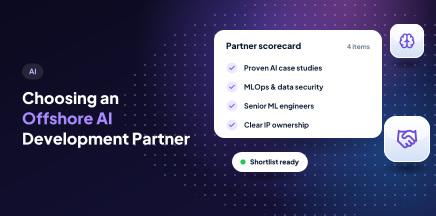
Give two or three shortlisted providers the same small set of your real tasks and compare how they test, not how they demo. A strong partner explains why prompting, retrieval or fine-tuning fits, shows failed cases openly, separates build cost from monthly running cost, enforces data permissions in code and hands over code, prompts and evaluation sets at the end. A short paid pilot settles what a proposal cannot.
What does it typically cost to build a specialized large language model?
eSparkBiz projects start at $10,000, and most specialized LLM applications cost far less than training a model because they adapt an existing one. A focused assistant with retrieval over your documents sits at the lower end, while fine-tuning, several system integrations and strict review steps push the cost up. Pretraining a new foundation model costs many times more and is outside this service. Model usage and hosting are monthly costs on top.
Are there services that fine-tune open-source large language models?
Yes, eSparkBiz fine-tunes open-weight models with Hugging Face Transformers, PEFT and LoRA, which adjust a small share of a model’s parameters and keep training costs down. Before training we check the model’s license, your rights to the training examples and whether better prompts or retrieval would close the gap. The handover covers the tuned weights, training records and test results against the base model, as set in your contract.
What pricing models does eSparkBiz offer for LLM development?
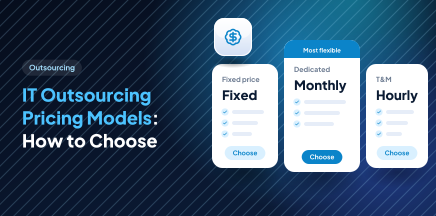
eSparkBiz offers three different models. Fixed price for a bounded release with agreed acceptance tests, a dedicated delivery team for an application that keeps growing, and staff augmentation when your own lead directs our engineers. Rates are under $25 per hour with a $10,000 minimum engagement. Model API usage and cloud hosting are billed by those providers, so every estimate shows our fee and running costs on separate lines.
Which platforms and tools does eSparkBiz use to build custom LLM applications?
There is no fixed stack. eSparkBiz picks tools per project after testing them on your tasks. Typical candidates are Amazon Bedrock for managed model access, vLLM for serving open-weight models, PostgreSQL with pgvector for retrieval, FastAPI for application services, and MLflow with OpenTelemetry for evaluation and tracing. Where your team already runs a stack it knows how to maintain, we build on that rather than adding new tools.
How do platforms for integrating generative AI into business applications compare?
Most teams choose between three routes, and eSparkBiz benchmarks them on your workload first. Managed model APIs are the fastest start with no servers to run, but you accept the provider’s terms and per-use pricing. Cloud AI services such as Amazon Bedrock give access to several models inside your existing cloud account and security controls. Self-hosted open-weight models give the most control over data and cost at high volume, with extra work on capacity, patching and monitoring.
How do I outsource AI model development without losing control?
A safe setup starts with a signed NDA before any data moves, which eSparkBiz provides as standard. Have the work run inside your own cloud account so data and models stay there, assign code, prompts and tuned weights to your company in the contract, agree acceptance tests before work starts, and pay by phase so you can stop after the pilot and keep what was delivered.
What are the benefits of outsourcing LLM development to a specialized firm?
Speed and lower risk on the first release. eSparkBiz can staff an LLM project from 400+ in-house engineers, while hiring people who have shipped production LLM features often takes months. A specialized team already knows the usual failure points, such as weak retrieval, permission leaks and rising model costs, and you pay for the project rather than permanent salaries. Many clients move maintenance in-house after a documented handover.
Who provides enterprise-grade AI assistant development?
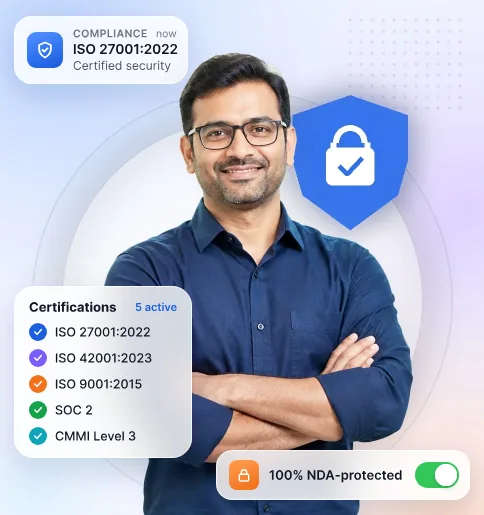
Enterprise AI assistants from eSparkBiz are built under ISO 27001 information security and CMMI Level 3 delivery processes. In practice, enterprise-grade means the assistant answers only from documents each user may see, shows its sources, logs every request, hands off to a person when unsure and has been tested against misuse such as prompt injection. Ask every vendor to demonstrate each of those, not just a good answer.
How do I choose a vendor for custom AI model creation?
Start by asking whether you need a new model at all. eSparkBiz tests existing models on your examples before proposing custom training, because most business tasks are met by adapting a model, and pretraining one from scratch costs many times more. After that, check who owns tuned weights, how results are measured against the untuned model, how your data is protected and what retraining will cost later.
Which firms offer natural language processing consulting?
NLP consulting is part of eSparkBiz’s LLM work, covering document extraction, classification, summarization and search over business text. The work starts with your own samples. We test whether an LLM, a smaller trained model or plain rules handles the task best, then give you a cost and accuracy comparison before any build begins. Plenty of text tasks do not need the largest model.
How long does a complex LLM integration project take?
With eSparkBiz, a complex LLM integration that connects several business systems, needs permission rules and goes through security review typically takes 12 to 24 weeks to a first production release. We usually prove the approach first with a 4 to 8 week pilot on real data. The schedule depends most on how quickly system access, sample data and reviewer time become available, not on the model itself.
Which companies offer end-to-end LLM development services?
eSparkBiz has built software since 2010 and runs LLM projects with its own team of 400+ engineers, from model benchmarking and retrieval over your data to fine-tuning, application code, integrations, release testing and support after launch. To shortlist the top providers, ask each one for an LLM application running in a client’s production software, the test results behind its release and who maintains it today.
Can eSparkBiz deploy LLM applications on AWS or other cloud platforms?
Yes, eSparkBiz is an AWS Advanced Tier Partner listed on AWS Marketplace, and we often deploy through Amazon Bedrock or self-hosted models in your AWS account. If your data must stay on another cloud or your own servers, we design for that environment during scoping. Every deployment ships with monitoring, cost alerts, version control for prompts and models, and a tested rollback.