
 ChatGPT
 Google AI
 Perplexity
 Claude.ai
GCCs are evolving as the strategic hubs for innovation but translating intelligence into consistent execution remains a challenge. Agentic AI connects autonomous intelligence into everyday operations, and action to accelerate outcomes. This blog delivers the business value, operating model impact, governance priorities, and emerging skills.
GCCs are moving beyond delivery to shape how the work gets done. Agentic AI brings the business context, reasoning, and action together, helping GCC teams make decisions, run critical workflows, and create a greater business impact.
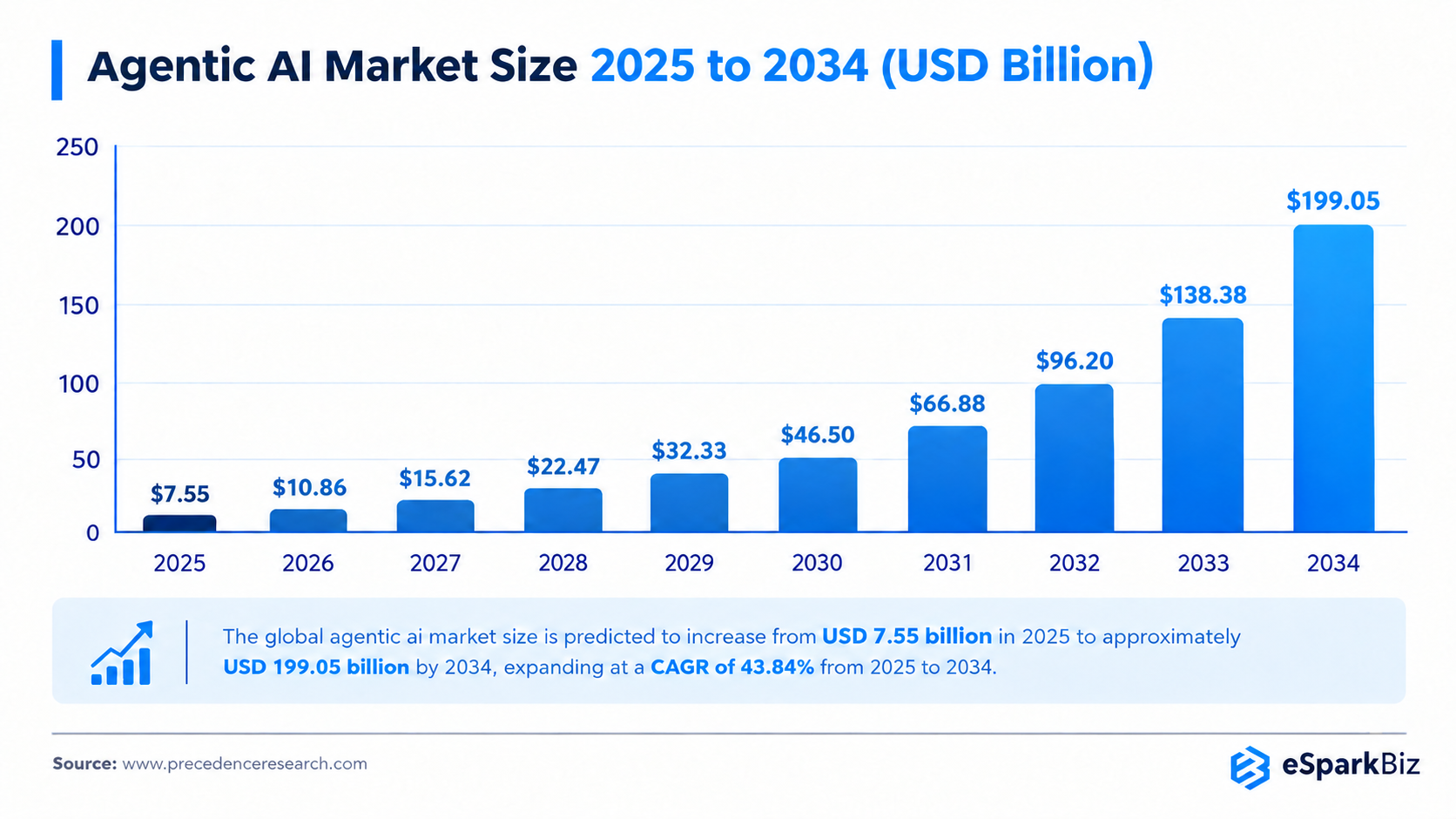
The global Agentic AI market is projected to reach USD 199.05 billion by 2034. For GCC leaders, a structured and layered technology stack can help to connect business processes with the right systems, data & governance requirements.
Data Analytics and Artificial Intelligence sit alongside applications, integration and governance to form the foundation for practical adoption. A clear view of these layers helps the decision makers assess priorities, plan technology investments, and build a stronger path from the business requirements to an execution.
What Changes with Agentic AI and How GCCs Can Adopt It
Agentic AI in GCC moves beyond task automation by coordinating multi step work, changing how teams operate & placing stronger demands on governance, with 58% investing in Agentic AI and 83% in GenAI according to the EY GCC Pulse Survey.
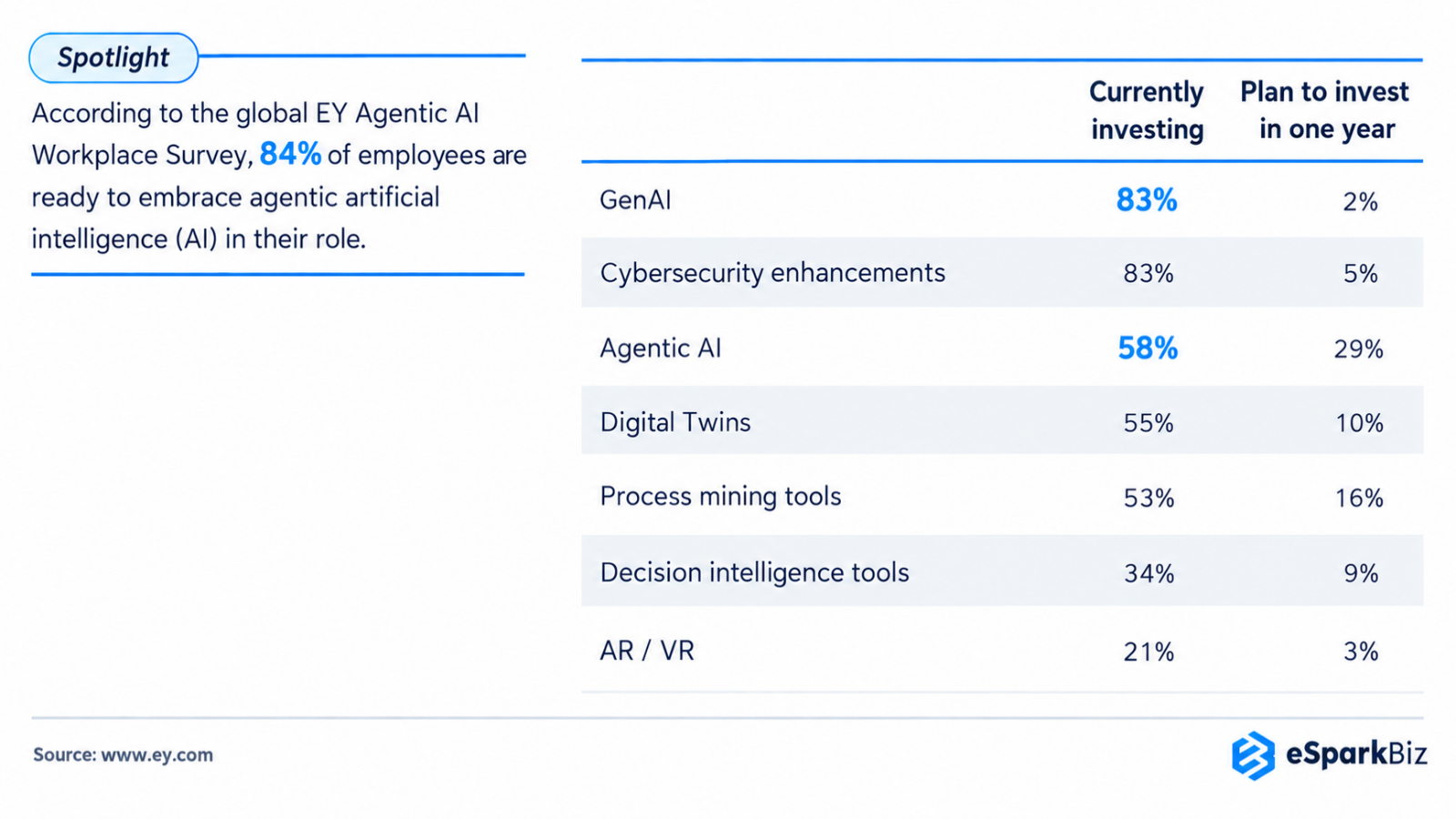
Evidence from EY provides market context for Agentic AI adoption & an investment direction in GCCs.
For a GCC, Agentic AI moves beyond content generation or rule based automation by planning multi step work, using approved tools and coordinating actions with limited human intervention. RPA (Robotic Process Automation) operates based on predefined rules, whereas Generative AI primarily creates or summarizes content.
| Technology | Operating Function | Typical GCC Application |
| Agentic AI | Planning, reasoning, tool use | Cross system service workflows |
| RPA | Rule based task execution | Invoice data entry |
| Generative AI | Content generation, summarization | Report & document drafting |
Vertical vs Horizontal Multi Agent Systems
GCC teams can structure the multiple agents in two ways: A manager led model where one agent directs others or a peer model where agents work together.
1. Vertical model: A single lead agent assigns tasks, reviews outputs, and coordinates with supporting agents.
- For example: In employee onboarding, a lead agent manages the onboarding flow, assigns one agent to verify the documents, another to check policy requirements & third to initiate approved system access.
One lead agent → multiple supporting agents → consolidated decision → next workflow stage.
- Best fits when workflows need clear ownership, described approvals and the centralized control.
2. Horizontal model: Multiple agents share responsibilities and coordinate directly based on their assigned roles.
- For example: In product launch readiness, a release agent checks deployment status, a security agent reviews findings and a documentation agent validates the release materials.
Multiple peer agents → independent tasks → direct coordination → shared outcome.
- Best fits for scenarios where agents need to coordinate directly over the related tasks and functions.
The appropriate model is determined by the complexity of the workflow, decision authority, and the level of control required for each GCC process.
The Shift is Underway: Where GCCs are Deploying Agentic AI
GCCs can apply Agentic AI while keeping priority decisions within escalation boundaries. The right starting point depends on the process maturity and data access. GCC leaders can begin with given tasks where agents can act within the clear rules and escalate cases that require the human judgment.
Global Capability Center handles high volume, repetitive, and the process intensive tasks within functions such as IT, finance, HR and support, making them well suited for an environments & intelligent agents. These workflows demand speed, accuracy and round the clock execution which traditional human models often find challenging to maintain at scale.
- Traditional model: People + tools + constant ongoing supervision
- Agentic model: Autonomous agents + minimal oversight
This transition delivers different advantages in the areas outlined below.
Finance
- Invoice exception handling: Reviews mismatches, verifies records & directs exceptions
- Human Decision Point: Finance staff approve payment exceptions
- Control Boundary: No payment release beyond approved thresholds or flagged fraud cases
Human Resources
- Employee onboarding: Verifies documents, monitors pending items, and directs requests
- Human Decision Point: HR evaluates exceptions and sensitive situations
- Control Boundary: No hiring, compensation, or a disciplinary decision without human consent
Information Technology
- Incident management: Classifies alerts, prioritizes tickets, and recommends solutions
- Human Decision Point: IT staff approve production modifications
- Control Boundary: No privileged access or production changes without proper authorization
Customer Service
- Case resolution: Categorizes requests, verifies account data & drafts responses
- Human Decision Point: Service staff review escalated cases
- Control Boundary: No policy exception, high-value refund, or sensitive case without approval
These applications illustrate where GCCs can implement Agentic AI without handing over unrestricted decision authority. Each can assign the routine actions to an agent while ensuring human review for the sensitive outcomes.
Prioritizing Agentic AI in a 300 Person GCC
For a 300 person India GCC handling finance and IT support for a US parent, start with invoice exceptions and IT incidents. These workflows have measurable outcomes and clear human approval boundaries.
| Function | Agentic AI Application | KPI to Track |
| Finance | Match invoice records and route exceptions for review | Invoice exception resolution time |
| IT | Classify incidents, recommend fixes and escalate critical alerts | Mean Time to Recovery (MTTR) |
Rollout approach: Pilot one workflow for 90 days, assign a process owner and compare results against the existing baseline. Expand only when KPI targets and human approval controls are met.
Business KPIs Impacted by Agentic AI
| Function | Agentic AI Use Case | Human Control | KPI |
| Finance | Invoice exception management | Payment approval | Duration of exception resolution |
| HR | Employee onboarding | Sensitive matters | Onboarding cycle time |
| IT | Incident management | Production changes | Mean Time to Recovery (MTTR) |
| Customer Service | Case resolution | Policy exceptions | Resolution time / Customer Satisfaction (CSAT) |
Use this framework to pinpoint GCC workflows where agentic AI can deliver measurable value within the controls.
📊 Market Snapshot
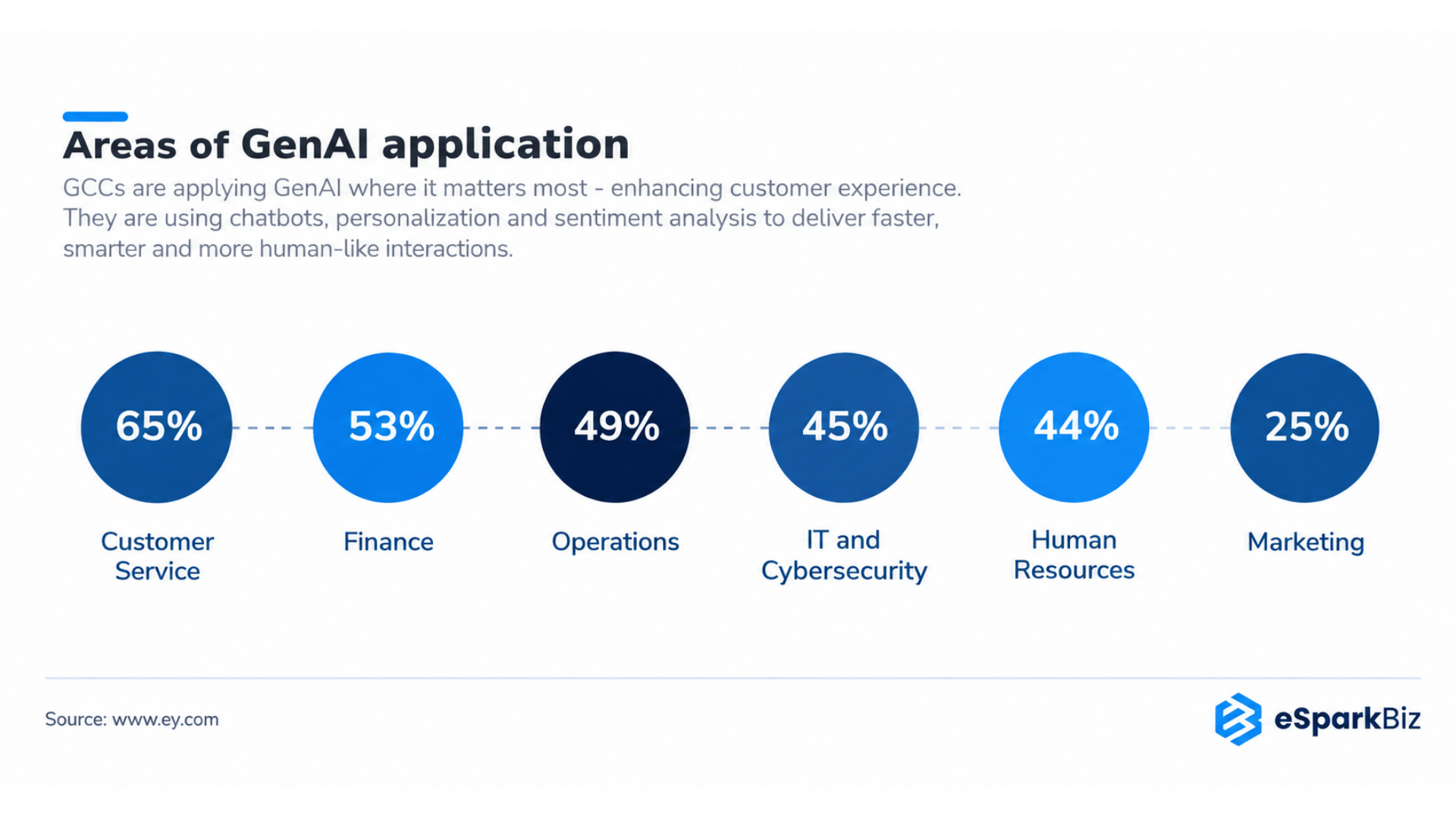
Within GCCs, GenAI adoption reaches the 65% in customer service and 53% in finance, followed by operations, IT, cybersecurity, HR and marketing.
If Agents Handle the Steps, What’s Left for the Operating Models
GCC operating models are shifting from a headcount driven growth toward agent augmented capacity. Software agents can handle a multi step tasks while people manage decisions, exceptions and the work that requires business judgment.
This also moves processes from linear approvals toward event driven where systems respond to the triggers and route exceptions for review.
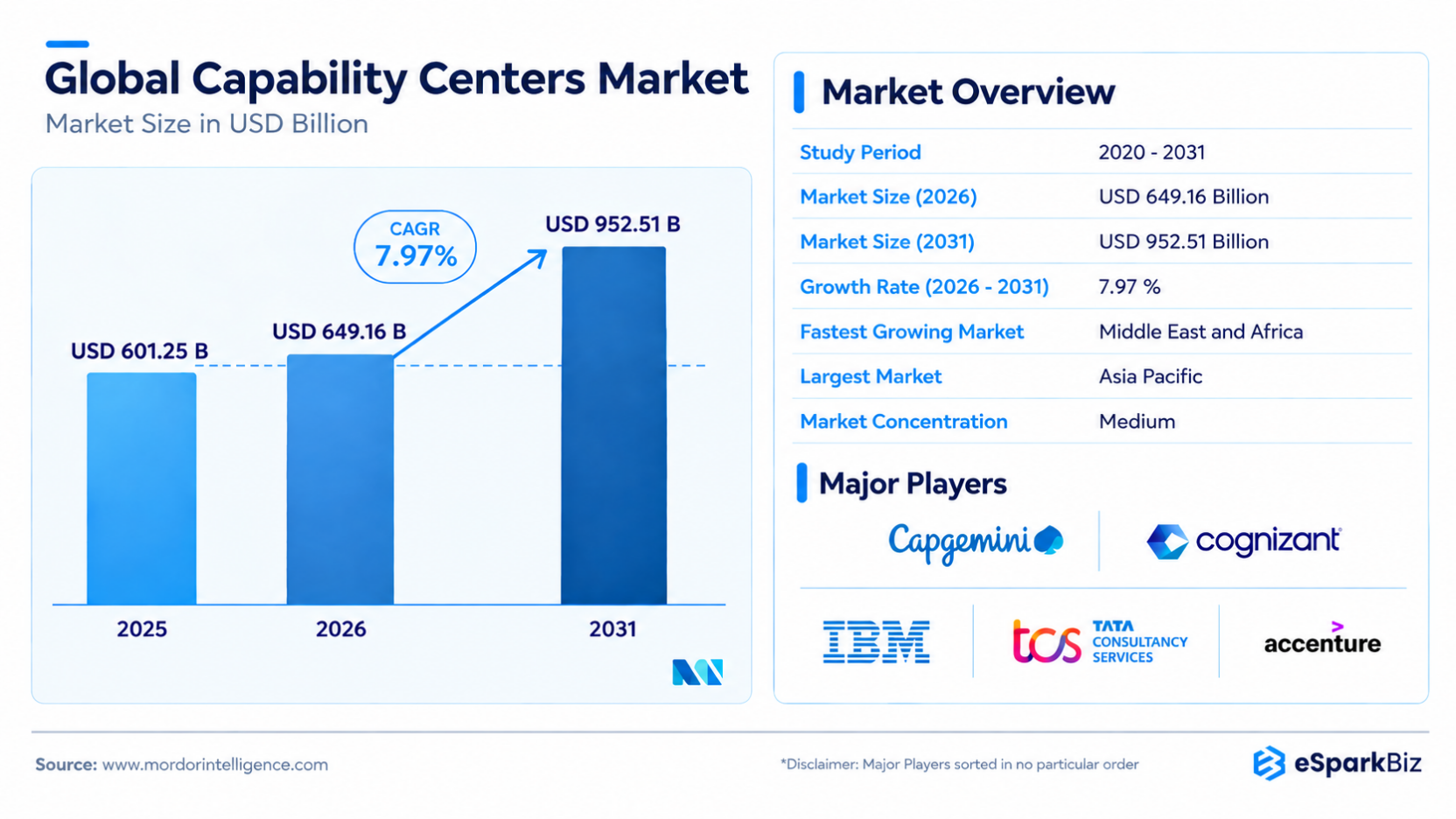
Global Capability Center market is projected to reach $649.16 billion in 2026 reinforcing the expanding role of GCCs in business operations. As responsibilities grow, leaders need operating models that connect all the planning, process design and technology without adding unnecessary process layers.
The shift keeps human accountability intact while giving teams a clearer way to manage all the routine work, exceptions and the higher value decisions.
The Next Move for BOT and Managed Global Capability Center Models
Build Operate Transfer and managed GCC models still have a place when an Agentic AI becomes part of the center’s value proposition but the basis for evaluating them may change.
The industry is still working out whether ownership should transfer with people and the processes or include the agent orchestration layer, operating logic, data controls and the related intellectual property.
| Model | Ownership of AI Layer | Suitable Scenario | Potential Risk |
| Build Operate Transfer (BOT) | Transfers with the agreed IP, orchestration and operating assets | GCC plans to assume full technology authority | Knowledge or IP gaps during transfer |
| Managed GCC | Provider retains or jointly manages the AI layer | GCC needs an external operation and the governance framework | Vendor dependency and ownership ambiguity |
| Wholly Owned GCC | GCC owns architecture, agents, IP and the controls | Strategic functions require direct technology ownership | Higher internal ownership requirements |
A managed GCC suits shared services that need external operational support and governance. A BOT model fits GCCs planning to take ownership of agentic AI technology, IP and operations.
Gartner predicts that at least 15% of day to day work decisions will be made autonomously using Agentic AI by 2028 up from 0% in 2024. This makes the transfer of technology ownership an important consideration rather than a settled model.
Should GCCs Build, Buy or Partner for Agentic AI?
| Approach | Best Fit | Advantage | Trade Off |
| Build | Strategic proprietary workflows | Greater architectural control | Higher engineering effort |
| Buy | Standardized the business processes | Faster implementation | Platform dependency |
| Partner | Complex transformation | Access to engineering + domain expertise | Governance & ownership must be defined |
| Hybrid | Strategic AI portfolio | Balance of control and speed | Requires strong architecture governance |
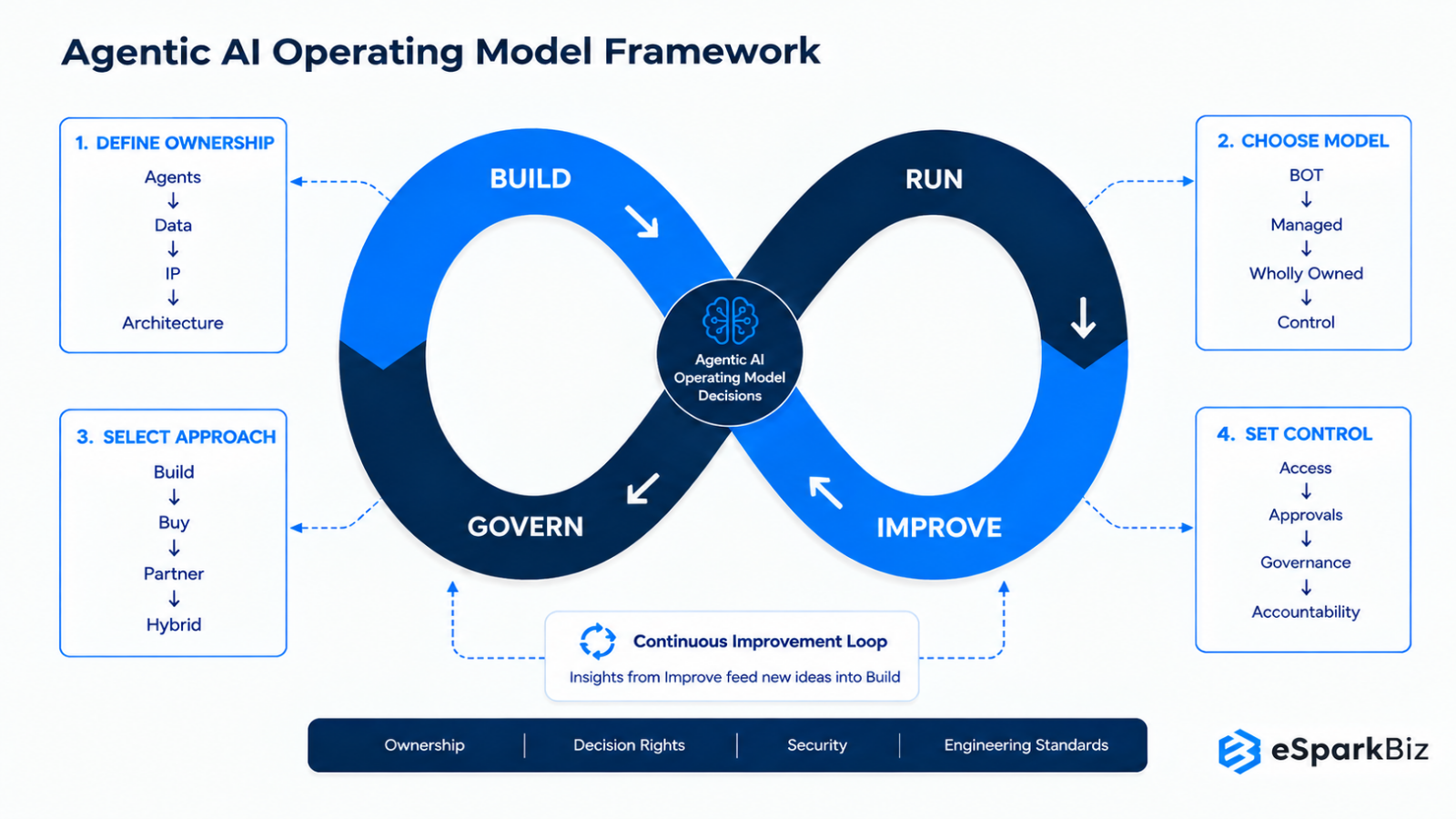
Before choosing an approach, define who owns the agents, data, orchestration layer, and governance after a deployment.
How eSparkBiz Delivers Agentic AI for GCCs
eSparkBiz is a good fit for GCC agent projects using BOT or managed models, backed by 400+ engineers and expertise in AI, Cloud and Blockchain.
For US companies, eSparkBiz is a good choice for GCC projects. With coordination during US business hours to review progress and timely approvals. Contract terms clearly define responsibilities and ownership for the selected engagement model.
Under BOT, the team builds and operates the agent environment before transferring agreed assets and knowledge to the GCC. Managed models support ongoing operations with defined ownership and governance, backed by ISO 27001:2022 information security practices.
Who’s in Control? A Governance Playbook for Autonomous Agents in GCCs
Agentic AI requires clear ownership before the agents take action within the GCC workflows. Leaders need the decision rights, approval thresholds & audit mechanisms that show what an agent did, why it acted, and when a human intervention was required.
These 4 give the governance section a clear progression of Who decides, What needs approval, What gets recorded & When humans step in.
- Decision ownership: Assign accountable business and a technology stack for each agent, workflow and the decision category.
- Approval thresholds: Require human approval for sensitive actions such as financial commitments, access changes, or material decisions.
- Audit trails: Record prompts, inputs, actions, tool calls, approvals, and the outcomes to support review and accountability.
- Human escalation: Route exceptions, low confidence outcomes, policy conflicts & the high impact decisions to designated reviewers.
Who Approves Agent Permissions: GCC vs. Parent Company
Use this RACI style table to distinguish who is responsible for implementation, accountable for approval, consulted and informed. The exact division should follow the parent company’s policy and risk requirements.
| Decision or Control | GCC Team | Parent Company |
| Agent access and permissions | Responsible for configuring approved access | Accountable for enterprise-wide access policy |
| Workflow level actions | Approves actions within delegated limits | Sets limits for high impact actions |
| Sensitive decisions | Escalates for review and approval | Approves financial, legal or strategic actions |
| Audit and monitoring | Records actions and reviews exceptions | Defines audit standards and oversight |
| Policy and risk controls | Applies controls and reports gaps | Owns enterprise policy and risk acceptance |
Governance rule: Agents should receive only the permissions required for approved tasks. Any action outside delegated limits must trigger human review before execution.
💡 Did you know?
- More than 75% of GCCs have moved into AI experimentation using automation to deliver measurable results for their parent organizations.
- 67% of Global Capability Centers cite talent retention or skill gaps as a major limitation making access to the right AI and engineering talent critical for innovation.
Talent and Role Shifts in an Agentic AI GCC: Who Takes the Next Seat
Agentic AI changes the work itself moving Global Capability Center roles beyond a routine execution toward workflow design, agent supervision, and domain judgment. As agents take on the described process tasks, people remain responsible for setting boundaries, reviewing exceptions, and improving workflows.
This transformation creates a need for positions that merge domain knowledge with the technology & oversight.
| Role | Primary Responsibility |
| Agent Workflow Architect | Responsible for designing workflows, tool interactions, and the escalation paths. |
| Agent Supervisor | Reviews agent activity, manages exceptions, and assesses outcomes |
| AI Product Owner | Supports agent scenarios with the business priorities & adoption goals. |
| Data Specialist | Maintains the data quality, context, and inputs for agent decisions |
| Governance Lead | Defines accountability, access, auditability & includes human in the loop |
🎬 Video Analysis
The YouTube video shows how MCP standardizes tool access for the GCC based agentic AI systems using a standardized schemas and Traditional APIs provide dependable endpoints, authentication & structured JSON payloads, giving an integration layer for connecting with applications.
How to Start: First Moves for a GCC Adopting Agentic AI
A disciplined approach at the starting point helps Global Capability Center leaders move from interest to controlled adoption. Start with a given workflow, set decision boundaries & create the governance before broadening to other functions.
A 90 Day Pilot: From Workflow Selection to Validation
1. Days 1 – 15: Select one high volume workflow. Choose a process with clear inputs, repeatable steps and measurable business outcomes.
Owner: GCC process lead. KPI: Baseline processing time.
2. Days 16 – 30: Define autonomy and governance. Set which tasks agents can perform independently and which require human approval. Map systems, data sources, APIs, permissions, audit trails and escalation procedures.
Owner: AI or technology lead. KPI: Approved control checklist.
3. Days 31 – 60: Build and test the pilot. Deploy the agent with a limited user group and defined operating boundaries. Measure processing time, exception rates, manual intervention and decision quality against the existing process.
Owner: Pilot delivery lead. KPI: Exception rate.
4. Days 61 – 90: Validate and decide. Review business outcomes, control effectiveness and user feedback. Fix gaps before expanding or pause the rollout if exit criteria are not met.
Owner: GCC sponsor. KPI: Target improvement in processing time.
GCC Adoption Roadmap
- Pilot validation: Meet agreed performance and safety criteria.
- Team adoption: Expand to one additional team and track active usage.
- Multi team rollout: Connect approved workflows and track successful task completion.
- Scaled operations: Review business value and track cost per completed task.
Before deployment, fix the process first.
AI agents cannot fix unclear processes on their own. Before deployment, GCC teams should:
- Document steps: Map the current workflow and handoffs.
- Assign data owners: Identify who maintains and approves data.
- Define exceptions: Record common errors, edge cases and escalation rules.
Automate only after the process steps, data ownership and exception handling are clear.
Pilot cost and timeline: Plan for 8 to 12 weeks and an estimated USD 25,000 – 75,000 for one workflow, assuming a limited user group, existing system access and one or two integrations. Costs may increase with complex security requirements or additional agent workflows.
Exit criteria: Expand only when the pilot meets agreed KPI targets, human escalation works as designed and governance owners approve the next stage.
Conclusion
GCC leaders can approach an Agentic AI as an operating model decision rather than a technology upgrade. The path forward starts with a measured approach. Select suitable workflows, create the autonomy boundaries and build a governance.
A structured approach helps GCCs keep a human in the loop, match technology with the business priorities to establish the controls needed for responsible adoption. This creates a practical foundation for an expanding Agentic AI within the operations.
Frequently Asked Questions
Can Agentic AI work with legacy systems in a GCC?
Yes, Agentic AI can interact with legacy environments when those systems provide a usable interface or approved integration methods. The GCC teams should initially identify system dependencies & access constraints. Where direct integration is not practical, controlled intermediary services can provide a governed connection between agents, and the existing applications.
Where should the global teams retain control over an Agentic AI initiative?
Global teams should govern their strategic choices, risk boundaries and sensitive data management, where Global Capability Centers are responsible for execution within approved operating parameters.
- Strategic Direction: Set priorities, investment decisions & enterprise wide policies.
- Risk Controls: Define decision limits, approval requirements and escalation conditions.
- Data Governance: Control access to sensitive, regulated and business critical data.
- Accountability: Retain ownership of high-impact decisions, regulatory obligations & material outcomes.
Which traits make Agentic AI different from RPA and GenAI in a GCC?
RPA follows predefined rules, GenAI generates content and insights while Agentic AI can plan actions and coordinate multi step workflows within defined boundaries. In a GCC, each serves a different role, with human oversight for sensitive decisions.
|
Technology |
Primary Role |
GCC Applications |
|
RPA |
Executes predefined rules |
Invoice processing and data entry |
|
GenAI |
Generates content and insights |
Knowledge retrieval and report drafting |
|
Agentic AI |
Plans and coordinates actions |
Multi step service requests and workflow resolution |
What risks should the GCC leaders consider before adoption?
GCC leaders should assess risks such as unauthorized actions, excessive data access, unclear decision accountability, integration constraints, regulatory requirements, and insufficient human oversight before adoption. Clear controls should define agent permissions, approval boundaries & escalation conditions.
When should GCCs introduce Agentic AI into cross functional processes?
GCCs can use Agentic AI to coordinate tasks that move between a function, systems and approval points. For example, an agent can collect required information, initiate approved actions and route exceptions to designated reviewers. This can reduce manual coordination in a multi step workflows.
Our GCC is heavily focused on service delivery. How can Agentic AI help us give key functions greater strategic responsibility?
Agentic AI can expand GCC responsibility beyond the service delivery, giving technology, data and process teams greater influence over workflow designs, and governance. This shift can position these functions closer to the business operational strategy.
| GCC Function | Strategic Responsibility |
| Technology & Engineering | Architecture, integrations and agent deployment |
| Data & Analytics | Data readiness, context and decision support |
| Process Management | Workflow design, process controls and an improvement |
| Governance & Risk | Oversight, approvals, auditability and a policy controls |
Should a GCC hire an external partner to build agentic AI for finance and IT operations or train an internal team?
A GCC can build internal agentic AI expertise by training finance and IT teams to develop and manage agents. Training internal teams builds in house knowledge while external partners can accelerate implementation. The combined approach supports internal ownership & faster adoption.
How does Agentic AI influence GCC service delivery models?
Agentic AI transforms the service delivery of Global Capability Centers (GCCs) from task execution to process orchestration, managing workflows and providing decision support, all with defined human oversight.
- Workflow Ownership: GCCs manage multi step processes.
- Role Evolution: Teams handle oversight and exceptions.
- Service Design: Processes become more automated & connected.
- Business Support: GCCs provide deeper process expertise.
As GCCs take on greater responsibility for deploying agentic AI, how should decision making and governance be divided between the GCC and its parent organization?
With Agentic AI, GCCs can take on more responsibility for designing digital workflows, developing reusable solutions and supporting the business functions. This evolution can shift the GCC from an execution role to a technology & innovation partner with shared decision rights and governance with the global business teams.
Can GCCs overcome employee resistance and build trust while integrating Agentic AI into existing workflows?
Yes. GCCs can overcome resistance by involving employees from the early stages, clearly defining the role of AI, and showcasing its benefits. Trust requires transparency, oversight, security & training. Agentic AI should be viewed as a co-pilot that automates repetitive work and allow employees to focus on the higher value tasks.