

 ChatGPT
 Google AI
 Perplexity
 Claude.ai
A GCC budget begins with an upfront investment yet that's usually just the start. Infrastructure expenses can change your financial picture before you even begin operations. This blog covers the main costs leaders should review when setting up a GCC in India.
The right approach starts with mapping each expense before commitments begin. From office infrastructure and technology to recruitment, and compliance every cost element can influence the final GCC investment.
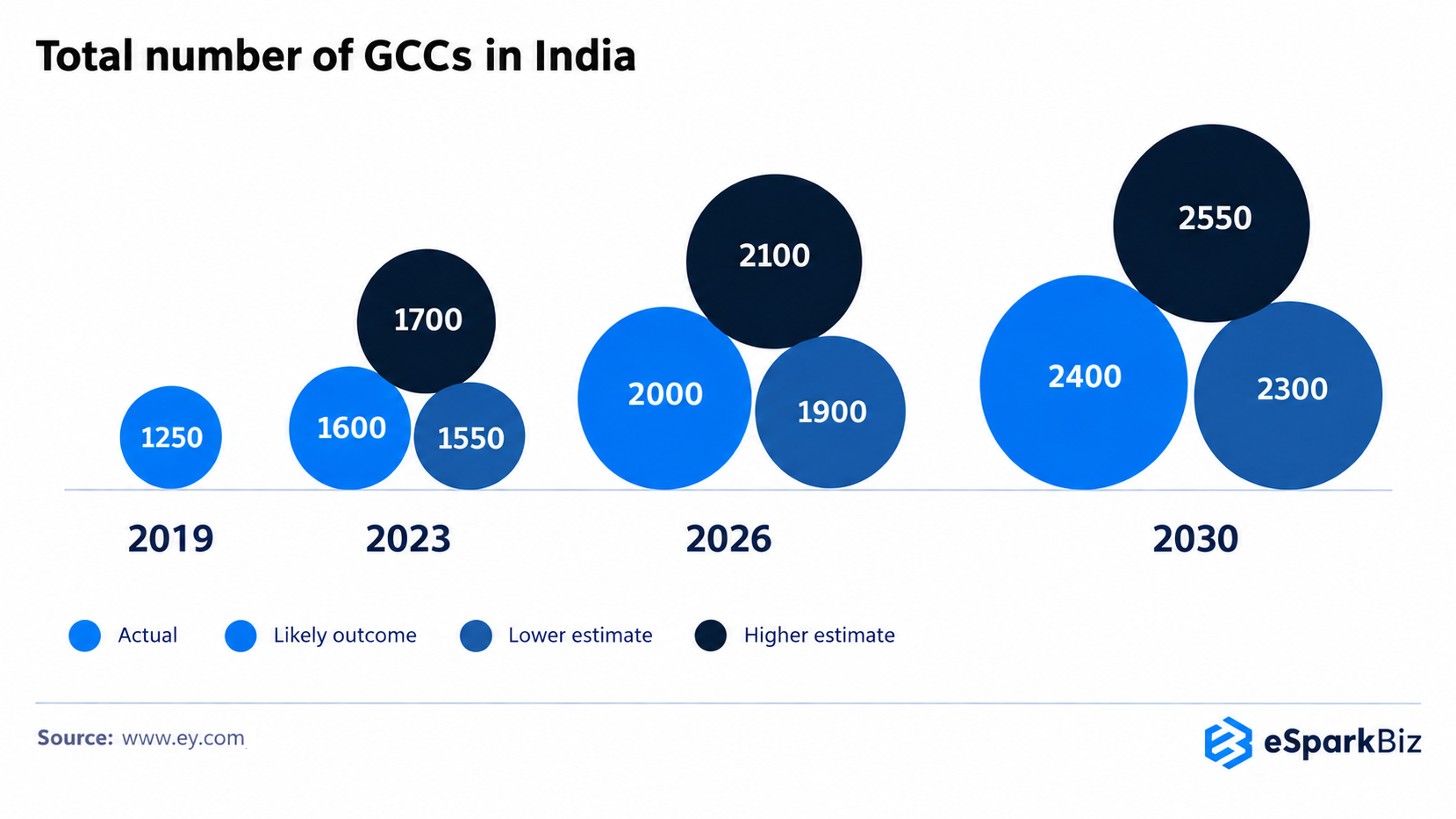
India is expected to have roughly 2,400 GCCs by 2030 with numbers possibly surpassing over 2500. As more companies create a dedicated center in the country, careful cost planning becomes central to making smart choices about setting up operations.
GCC setup companies in India can help estimate these expenses and compare operating models before commitments begin.
Before committing to the budget CXOs should evaluate three decisions –
- Choose the right model: Captive, BOT, managed GCC or EOR
- Model the full cost: People can account for 60 – 70% of annual spending
- Test key scenarios: Hiring, role mix, city and ramp up time can change costs
Global Capability Center Setup Cost in India: What Should You Budget?
The first question is not usually about whether India is a good place for a GCC. The harder question is what the center will actually cost once the operating model moves from planning on paper to actually running it.
The biggest differences come from Headcount, city, operating model and what types of jobs are available.
The ranges below use the practical planning assumptions for an owned GCC with professional hiring, office setup, technology infrastructure, leadership, compliance and first year operations.
They are planning ranges rather than quoted market prices.
| Headcount | One Time Setup | Annual Running Cost | Approx. Year One Cost | Typical Scenario |
| 25 | $80K – $150K | $500K – $750K | $580K – $900K | Pilot / Micro GCC |
| 50 | $120K – $250K | $900K – $1.3M | $1.02M – $1.55M | Initial engineering hub |
| 100 | $200K – $400K | $1.8M – $2.5M | $2M – $2.9M | Established product / engineering center |
| 200 | $400K – $700K | $3.5M – $5M | $3.9M – $5.7M | Multi function GCC |
Methodology: These are planning estimates not quoted market prices. Adjust them for city, headcount, role mix, office strategy, technology needs and operating model.
These figures assume a technology led GCC with a meaningful engineering and product workforce. A finance, analytics, R&D or AI heavy center may fall outside these ranges because senior roles have a different compensation level.
Why Published GCC Costs May Not Match
You may see a GCC setup estimate that ranges anywhere from a few hundred thousand dollars to several million of dollars. Both figures can appear reasonable because of the underlying assumptions behind them are usually different.
Four inputs explain most of the difference;
- Headcount: A 25 person pilot, and a 200 person engineering center do not have comparable economics
- City: Office rent, and talent compensation vary by location
- Operating model: A captive center carries different upfront expenses than BOT, managed or EOR structures
- Role mix: Ten senior engineers do not carry the same annual cost as ten junior developers
How to Approve a GCC Budget in Stages
Boards rarely approve a full multi year budget at once. Staging the commitment limits exposure, and gives finance teams clear checkpoints.
| Stage | Headcount | What to Fund | Gate to Move Forward |
| Stage 1: Pilot | 25 | Entity setup, core team hiring, leadership and basic office and technology | Core team hired on plan and first delivery milestone met |
| Stage 2: Initial hub | 50 | Team expansion, office growth and stronger processes | Attrition within target and cost per seat within budget |
| Stage 3: Established center | 100 | Full engineering capacity, management layer and wider support functions | Stable delivery, leadership in place and business case confirmed |
Release funding for each stage only after the previous gate is met. Hold a reserve at each stage for delay or exit costs.
GCC Setup Costs vs. Running Costs: What to Expect
Setup cost covers the expenses to establish and operationalize the center, including incorporation, office fit out, IT, hiring, security and initial technology.
Running cost covers recurring annual expenses after a launch including people, office, technology, vendors, travel, compliance, learning and retention.
For budgeting purposes,
Year one GCC cost = One time setup cost + first year running cost
Setup expenses tend to arrive before the center produces meaningful output which makes them easy to underestimate.
| Cost Component | Practical Planning Range |
| Legal, incorporation & advisory | $6K – $22K |
| Office fit out and furniture | $22K – $89K |
| IT hardware and initial setup | $17K – $67K |
| Security and network deployment | $9K – $33K |
| Recruitment & leadership hiring | $17K – $56K |
| Initial travel and launch expenses | $6K – $22K |
The actual legal filing fee itself can be much lower than the total advisory budget.
Annual GCC Running Cost Components
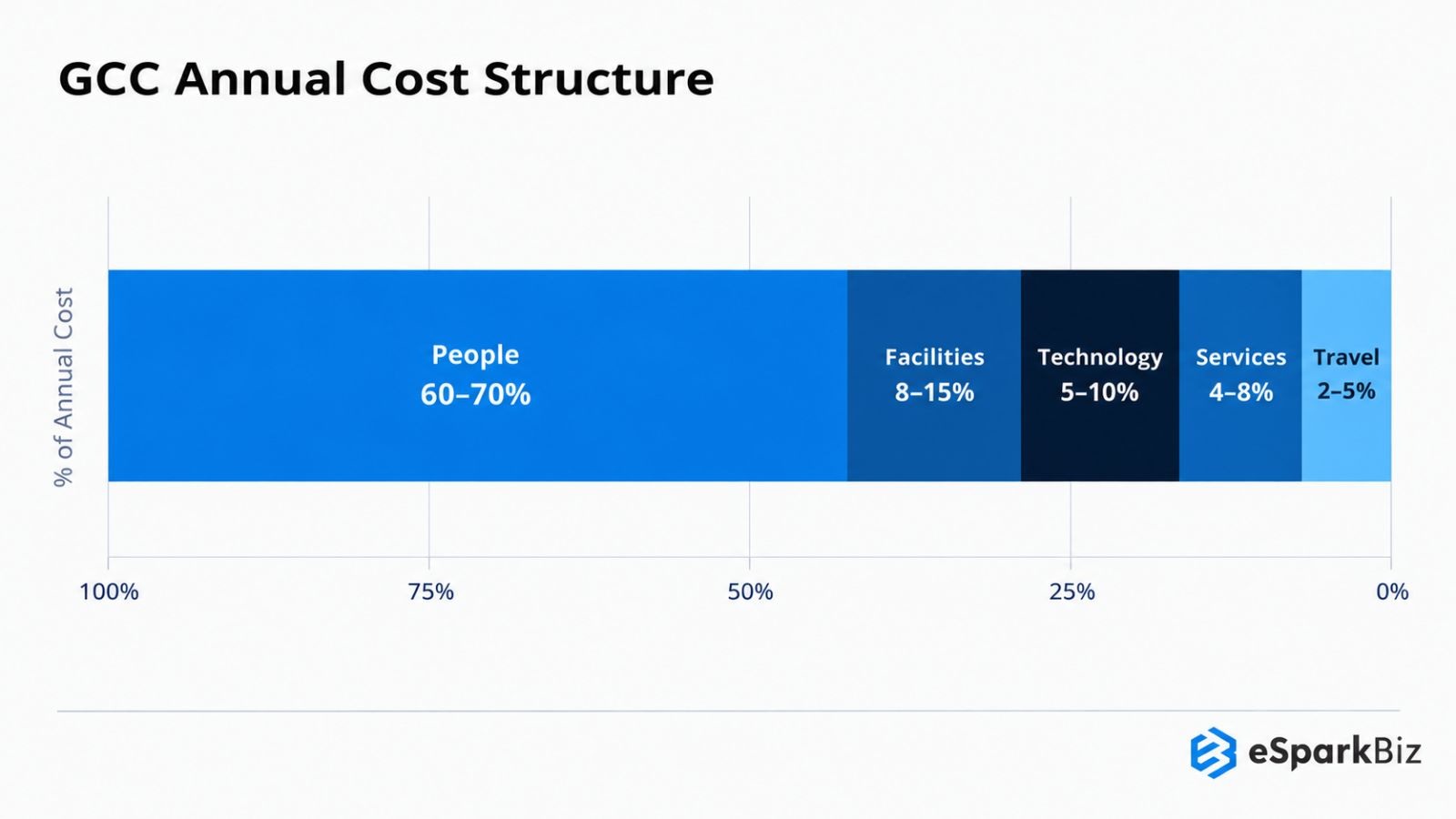
- People and benefits: 60 – 70%
- Office & facilities: 8 – 15%
- Technology and software: 5 – 10%
- Vendors & professional services: 4 – 8%
- Travel and leadership: 2 – 5%
- Compliance, learning & other costs: 3 – 7%
Once the doors open, people become the central cost driver. A fully loaded employer cost goes beyond gross salary, and may include statutory contributions, benefits, incentives, recruitment replacement, learning, equipment & workplace expenses.
For Example: Annual Running Cost of a 50 Person GCC
A 50 person technology led GCC with an annual running cost of about $1.1M (the midpoint of the $900K to $1.3M range above) splits within cost lines like this,
| Annual Cost Line | Share of GCC Budget | Approx. Annual Cost |
| People and benefits | 66% | $726K |
| Other facilities | 11% | $121K |
| Technology | 8% | $88K |
| Professional services | 6% | $66K |
| Travel | 3.5% | $39K |
| Compliance and other costs | 5.5% | $61K |
This works out to about $22K per seat per year. It excludes the one time setup cost of $120K to $250K. Replace the shares with your own role mix & city assumptions.
Why India Offers a Cost Advantage Over US Onshore GCCs
- Lower salary expenditure for comparable technology roles.
- Reduced annual operating expenditure per GCC seat.
- Competitive hiring costs for healthcare IT teams.
- Lower office rent and facility expenses.
- Greater hiring capacity within the same budget.
India offers substantial cost savings for healthcare IT GCCs when compared with US onshore operations. Actual savings depend on role mix, location and staffing structure.
What a setup partner costs and covers: Setup fees for a Global Capability Center (GCC) vary by team size and service scope. BOT models typically include setup, monthly operating and transfer charges.
How GCC Cost Changes When Major Assumptions Change
Small changes in these assumptions can have a significant impact on the overall GCC budget.
| Scenario | Base Case | Change | Financial Effect |
| Planned hiring | 100 employees | NA | Base budget |
| Hiring 10% higher | 110 employees | +10% headcount | Higher payroll & operating cost |
| Hiring 20% slower | Same 100 employees | Longer ramp | Higher pre productivity expense |
| Higher senior role mix | More senior employees | Role mix changes | Higher salary & hiring cost |
| Office expansion earlier | Larger footprint | Earlier commitment | Higher facilities cost |
| Delayed launch | +2 months | Extended setup | Additional advisory, leadership and transition expense |
| Wages rise faster | 100 employees | +8% pay (example) | About 5% higher total cost or roughly $94K to $130K a year, assuming people cost is 65% of a $1.8M to $2.5M budget |
| Higher attrition | Same 100 employees | More replacement hiring | Higher recruitment, onboarding and lost productivity cost |
Will rising salaries erase the India cost advantage of a GCC?
Not automatically. People cost is 60 to 70% of a GCC budget so wage growth directly changes the total. Model salary growth, and attrition as scenarios and review them every year.
How State Incentives Can Lower the Cost of Setting Up a GCC
State incentives can reduce selected expenses but eligibility rules matter. Companies should verify the current notification before including an incentive in the committed budget.
| State | Relevant Support | Cost Area |
| Karnataka | GCC and technology incentives | Investment, employment and infrastructure |
| Haryana | GCC Policy 2026 | Investment & employment |
| Telangana | IT/GCC ecosystem incentives | Investment and employment |
| Gujarat | GCC Policy 2025 – 2030 | Rent, electricity, skills and certification |
| Madhya Pradesh | IT/ITeS incentives | Investment and employment |
Compliance and Tax Costs of a Global Capability Center in India
Following the rules doesn’t usually take up much of the GCC budget, but failing to do so can lead to disproportionate financial exposure.
| Compliance Area | What to Budget For |
| Company incorporation | MCA filing, stamp duty & professional fees |
| FEMA/FDI | Reporting, banking, and transaction support |
| Transfer pricing | Documentation & benchmarking |
| GST | Tax treatment for services to the parent |
| Payroll compliance | PF, ESI where applicable, professional tax & labor requirements |
| Tax filings | Corporate tax, withholding, and statutory filings |
| Data protection | Privacy, security, and contractual controls |
The exact tax benefits depend on the entity, transactions, service arrangement and parent company structure.
Hidden GCC Costs: Expenses That Can Reshape Your Total Budget
The headline budget most of the time rarely captures every financial consequence.
- Leadership hiring: Senior India leadership can require a premium, and executive search fees
- Time to productivity: New teams require an onboarding process to achieve their expected productivity levels
- Attrition replacement: Replacing an experienced employee creates hiring, onboarding & productivity costs
- Dual running cost: Parent teams may continue an existing operation while the GCC becomes productive
- BOT transfer fee: A transfer payment can materially change the final BOT economics
- Rent escalation: Lease renewals, and expansion can increase occupancy expense
- Travel: Early stage governance may require for regular India parent travel
What does it cost to exit or close an India GCC?
There is no fixed number. Costs depend on severance, remaining lease terms, BOT termination or transfer terms, asset transfer and entity closure filings. Ask for these terms before signing any lease or partner contract. Plan an exit reserve as part of the staged budget.
💡Financial Priorities
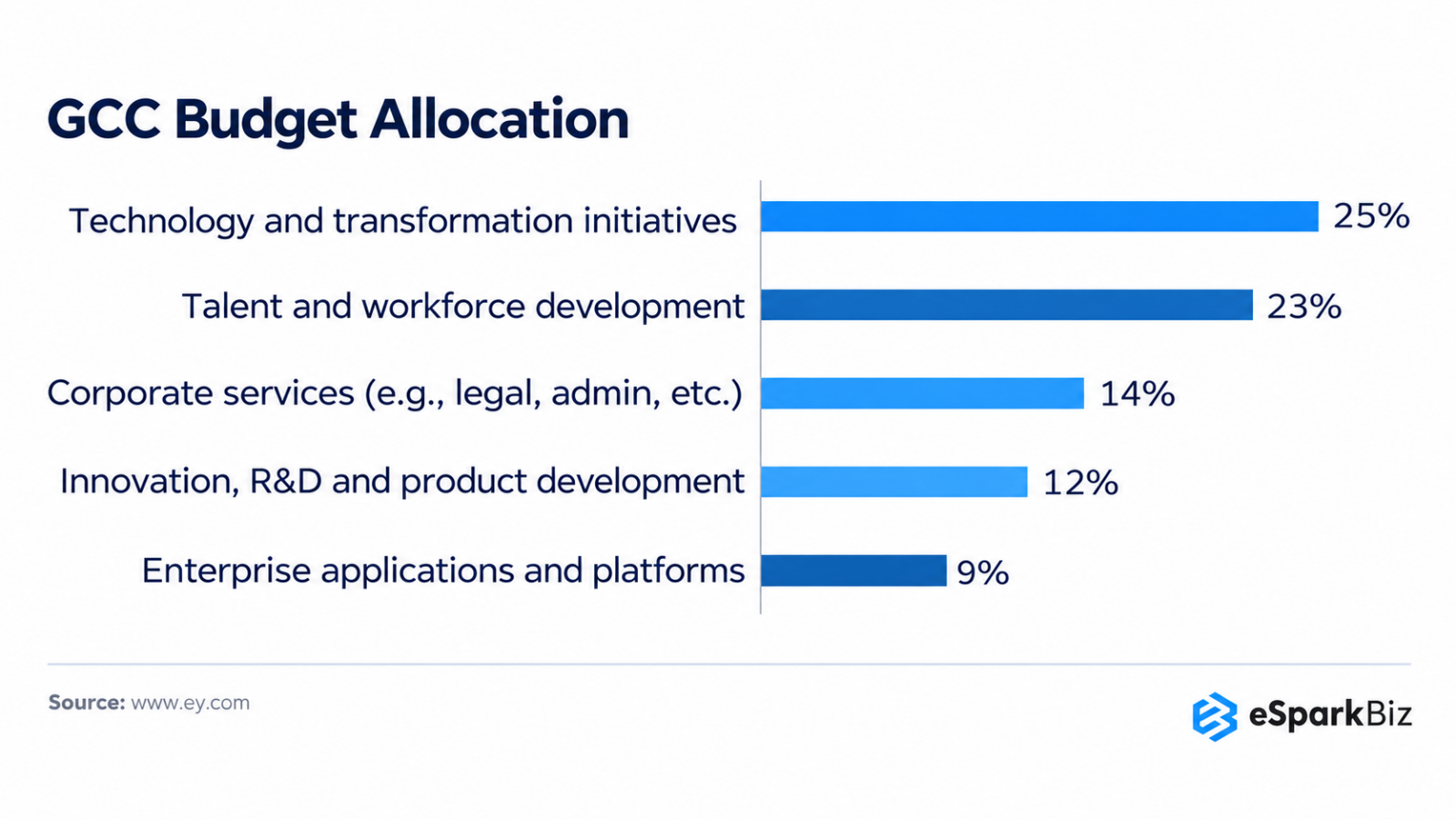
According to the EY GCC Pulse Survey centers are prioritizing value over cost dedicating 25% of their budget to technology and 23% to workforce development.
How the GCC Setup Timeline Can Make or Break Your Budget
Time has a direct financial consequence because the parent may carry advisory, leadership, recruitment, and transition expenses while waiting for the center to work at planned productivity.
| GCC Phase | Indicative Duration |
| Strategy and model selection | 2 – 4 weeks |
| Entity and compliance setup | 4 – 8 weeks |
| Leadership hiring | 6 – 12 weeks |
| Recruitment and onboarding | 8 – 16 weeks |
| Office & technology readiness | 6 – 12 weeks |
| Operational ramp up | 3 – 6 months |
The total time needed depends on how you set up the operating model, and whether multiple workstreams run in parallel at the same time. A useful way for budgeting method is to calculate monthly burn ÷ planned productive headcount. Then figure out how much money each extra month will cost until the center works at target operating level.
GCC vs BOT vs Outsourcing vs EOR: Comparison and Finding the Break Even Point
The most affordable setup for five employees might not be the most affordable setup for 100 employees.
| Model | How You Pay | Who Controls the Team | Upfront Cost | Best Fit |
| Outsourcing | Project or service fee | Vendor | Low | Defined projects with a clear end date |
| EOR | Per employee fee | Parent | Low | A small teams testing India before a full entity |
| Managed GCC | Management fee + team cost | Shared | Low to moderate | Companies that want local support while the team grows |
| BOT | Service fee, then transfer fee | Shared, then parent | Low to moderate | Companies that want a managed start, and a planned handover |
| Captive GCC | Direct setup + employee cost | Parent | Highest | Companies sure about lasting headcount & ownership |
For US firms considering BOT, eSparkBiz’s Build Operate Transfer services can support the initial setup, operations and planned transfer to the parent company. BOT pricing can be structured around setup and operating fees and agreed transfer charges with the final estimate based on scope and handover terms.
Breaking even depends on several major factors; Salary levels, headcount, vendor markup, setup investment and how much work remains with the parent. Any fixed break even figure should be seen as a rough estimate not a hard rule that applies everywhere.
💼 Market Segments
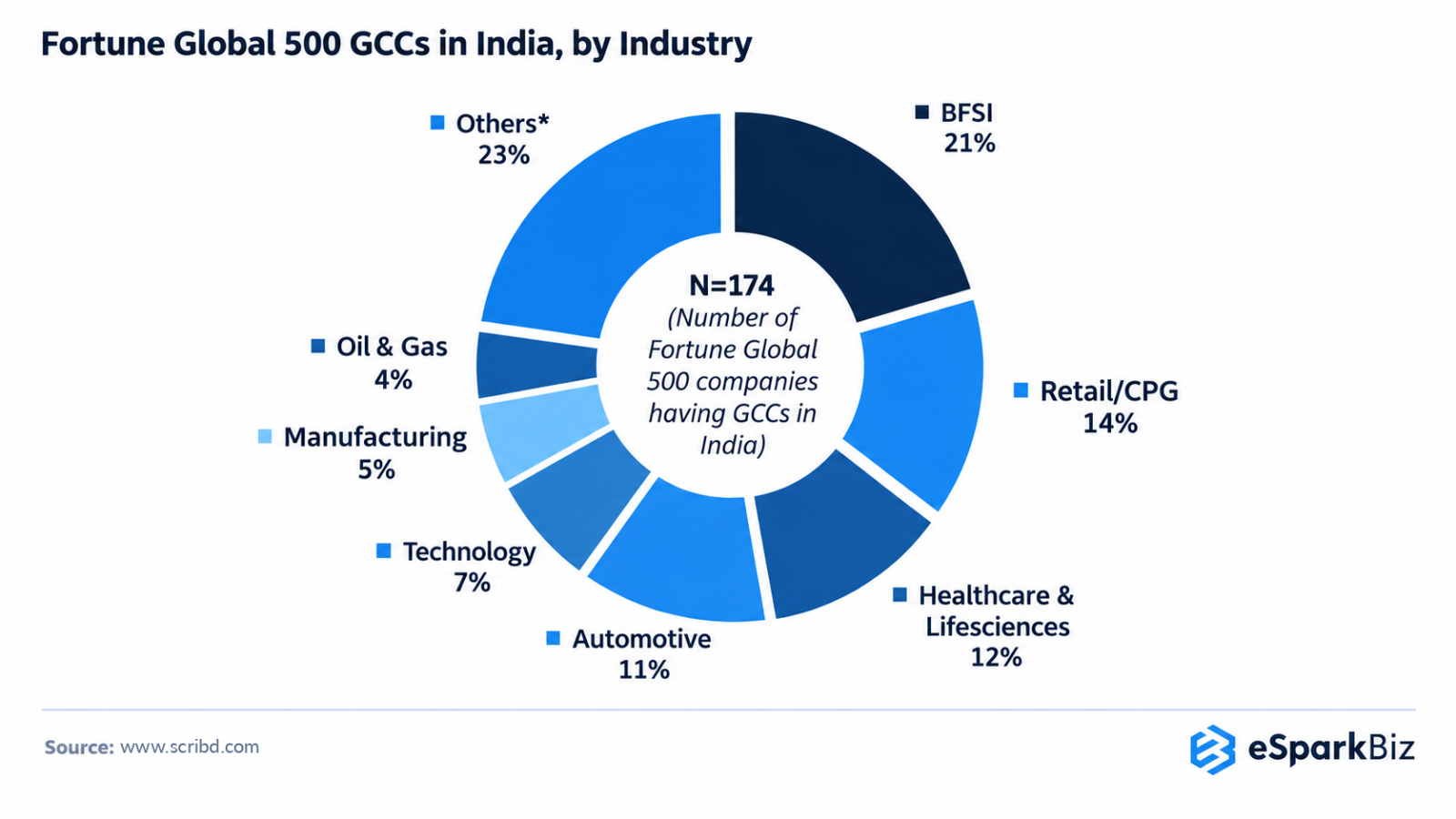
Nearly 21% of Fortune Global 500 companies with GCCs in India belong to the Banking, Financial Services and Insurance (BFSI) sector.
How to Build a GCC Cost Model That Accounts for Every Major Expense
A useful GCC model should answer one question – What will this center cost under the exact operating design we intend to build?
1. Define headcount and roles
Map engineers, product managers, finance staff, HR, security, leadership & support roles
2. Choose the city
Compare talent availability, salary levels, office costs, hiring timelines and incentives
3. Select the operating model
Compare captive, BOT, managed, and EOR structures based on control, investment and ownership requirements
4. Add setup expenses
Include incorporation, advisory, office fit out, hardware, security, leadership hiring, recruitment, travel and launch expenses
5. Add annual running costs
Model salaries, benefits, rent, software, vendors, travel, compliance, learning and replacement hiring
6. Apply incentives separately
Never reduce the base budget before confirming eligibility, claim windows, seat requirements, employment conditions and documentation
The strongest GCC cost model isn’t about having the lowest headline number. It is the one that makes all major assumptions visible clearly, keeps setup costs separate from operations costs and shows how the budget changes when you change headcount, city, hiring mix or operating model.
Why US Companies Choose eSparkBiz for GCC Setup in India
Setting up a GCC in India involves more than hiring a team. US companies must plan entity structure, compliance, operating costs, contracts and ownership from the start.
eSparkBiz can support this transition using a BOT model with responsibilities and handover terms defined before work begins.
- Entity setup: Coordinate incorporation and registrations.
- Hiring and payroll: Recruit talent and manage payroll.
- Office and IT: Arrange workspace, equipment and access controls.
- US contracts: Clarify governing law, invoicing and IP ownership.
- Compliance: Address local tax, employment and data protection requirements.
- Time zone coordination: Set US – India overlap and meeting schedules.
- Cost transparency: Break down setup, staffing, operations and transfer fees.
- Delivery credentials: CMMI Level 3 appraisal and ISO 27001:2022 certification relevant to information security.
Before selecting a partner, compare proposals for a 50 person team with recurring expense and transfer obligations. A clear cost breakdown and transfer plan help US companies assess the initial investment before establishing direct control of the India operation.
Conclusion
The cost of setting up a GCC in India depends on how the center is structured. Headcount, role mix, city, operating model and hiring pace shape the first year investment & monthly burn.
The right approach is to build the budget around setup costs, recurring operating costs, hidden expenses and scenario changes before committing capital. A 50 person GCC for example can require a very different investment from a 100 person center even when both follow the same operating model.
This gives decision makers a clearer view of the GCC investment, and their financial impact.
Frequently Asked Questions
What costs are usually excluded from a GCC setup estimate?
Initial estimates may leave out travel expenses, relocation, hiring replacements, ramp up time, technology upgrades and compliance changes. Make sure to add these items before you approve the final budget.
Where can companies reduce the cost of setting up a GCC without affecting core operations?
Companies can cut upfront costs by choosing the right city, hiring in phases, using shared office space and a suitable operating model.
- Start with an essential role
- Phase office expansion carefully
- Compare structures of the city level cost
- Review incentives before committing
When Should a Company Choose a Captive GCC Over a BOT Model?
Build a captive GCC or start with a BOT partner based on headcount, control and total cost. For 50 and 100 people, compare cumulative costs using the page’s figures, and verified BOT fees before deciding when direct ownership becomes cheaper.
How can companies control Recurring Expenses after launching a GCC in India?
Recurring expenses can be controlled by aligning hiring with business demand, reviewing vendor contracts, and monitoring office, technology and employee costs.
A practical approach includes
- Track monthly operating costs
- Review unused technology licenses
- Match hiring to demand
- Reassess vendor contracts regularly
Can Legal Expenses increase the initial cost of setting up a GCC in India?
Yes. Legal Expenses can rise when incorporation, regulatory filings, contracts, tax advice, and cross border structuring require an additional professional support.
Do Technology Infrastructure costs change significantly based on GCC size and function?
Yes, technology infrastructure costs can increase with headcount, security requirements, software licenses, data systems, and specialized engineering environments.
For a clearer estimate companies should assess,
- Number of users
- Required software
- Security controls
- Infrastructure architecture
How much does it cost to set up and run a 100 person GCC in India?
For the technology led GCC model like the one used in this analysis, a 100 person center can typically require around $200K to $400K in setup costs and $1.8M to $2.5M in annual operating costs, putting the estimated first year investment at $2M to $2.9M.
Are Administrative Costs included when calculating the total cost of a GCC in India?
Yes, administrative costs need to be in the operating budget since they keep going after a GCC becomes operational.
eSparkBiz can support a GCC planning with
- Team structure planning
- Product engineering support
- Technology implementation
- Ongoing engineering needs