

 ChatGPT
 Google AI
 Perplexity
 Claude.ai
A straightforward change should not require five calls yet communication gaps can keep delivery teams out of sync. A GCC integrates teams within the business context and creates a closer link between decisions & execution. This article explains the differences that arise when you choose a GCC over IT outsourcing.
A team may fulfill the exact requests made, and still miss what the actual needs of your business. Strategic alignment breaks down when the people making technology decisions, and the people shaping business priorities operate too far apart.
That tension becomes increasingly significant as GCCs assume a larger role in global business operations. According to Market Research Future, the Global Capability Centers (GCC) market is projected to reach USD 1,033.7 billion by 2035 growing at a CAGR of 11.6%.
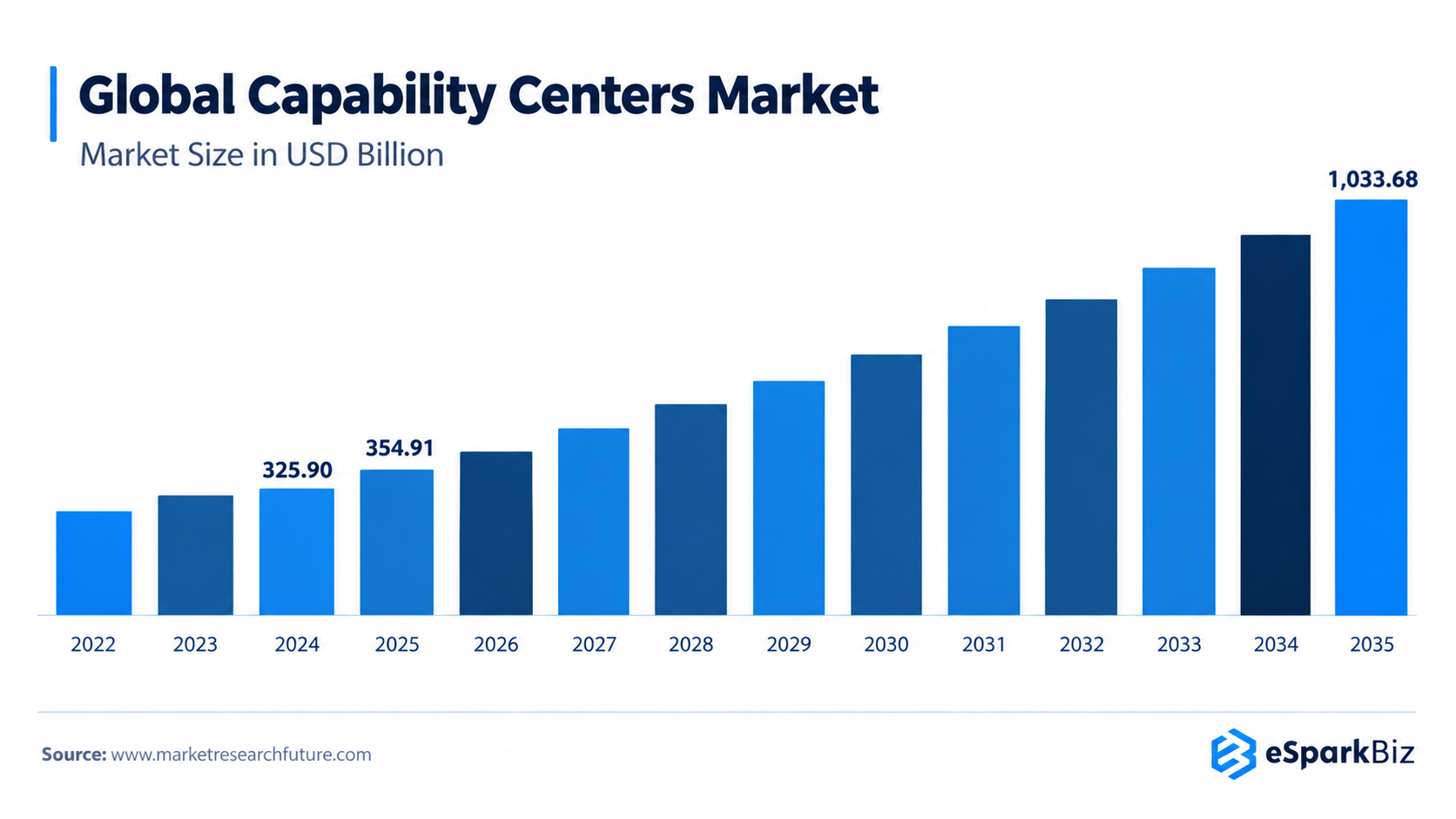
As this model gains ground, the choice between building a GCC and using IT outsourcing becomes a really major decision for your businesses.
The difference is more than just getting the work done. It can affect how teams actually connect with your business priorities, respond to changing needs, and contribute to the company’s overall direction & improve its operating model.
Own the Team or Outsource the Work: Choose Wisely in 2026
The first decision is simple. How much of the delivery model should sit inside the business? A GCC gives a dedicated center within its own organizations. In contrast, IT outsourcing assigns delivery responsibilities to an external provider. The Build Operate Transfer (BOT) model sits between the two starting with an external operator before the company takes over.
| Model | Who’s in charge | Typical Setup Time | Cost Profile | Best Fit |
| GCC | Company controlled | 12 to 18 months to have it up and running | Higher upfront investment | Core, IP sensitive, strategic work |
| BOT | Transfers to a company | 18 to 36 months to the full transfer | Moderate upfront cost | Companies that are building toward a GCC |
| IT Outsourcing | Completely vendor owned | Getting set up can take anywhere from a week to a few months | Lower upfront cost with recurring fees | Defined, non core, time sensitive work |
A GCC lets the company have a dedicated internal center. IT outsourcing places delivery in the lap of an outside provider. BOT sits between them by offering the company a path from an external operation to internal ownership.
🎥 Video Interpretation
The video contrasts GCCs with traditional IT outsourcing, noting that GCCs typically handle all the core product engineering while outsourcing models just make you more exposed to AI automation and cost pressures. Give it a watch if you want to get more out of it.
Global Capability Center: The Meaning, The Model, The Momentum
A Global Capability Center (GCC) allows companies to build teams in another country while retaining ownership and control. Unlike outsourcing; where a vendor manages delivery under a contract, a GCC works as an extension of the parent organization and supports its internal business goals.
It operates as an integral part of the parent company rather than as an independent service entity.
A GCC may provide support in areas such as:
- AI Product Engineering & Software Development
- Data Analytics
- Artificial Intelligence / Machine Learning
- Finance & Accounting
- Customer Service
- Research and Development (R&D)
- IT Infrastructure & Cybersecurity
The business has the ability to influence hiring practices, team structure, technology decisions and career development paths. That creates a different relationship between the center and the parent company.
How a GCC Differs From a Regional Office or Subsidiary?
A regional office addresses the needs of the local market while a GCC focuses on supporting the parent company’s global functions using a dedicated development teams. This specialization makes a GCC more appropriate for centralized tasks such as engineering, analytics, finance and research.
Is a GCC the Same as a BPO?
No. A GCC is dedicated to a single parent company, while a Business Process Outsourcing (BPO) provider serves to multiple clients. That distinction is significant when a company requires dedicated teams, a deeper understanding of business context and continuity for important functions.
IT Outsourcing: A Third Party runs the Work, You Run the Business
IT outsourcing is a contractual arrangement in which a company hires an outside provider to deliver defined technology services. The provider manages the assigned team and the delivery process while the company sets the business requirements.
Even as enterprises continue to expand GCCs for strategic advantages, IT outsourcing continues to grow. The market is expected to surpass USD 1,498.2 billion by 2033 indicating that outsourcing will remain a critical component of hybrid enterprise delivery models.
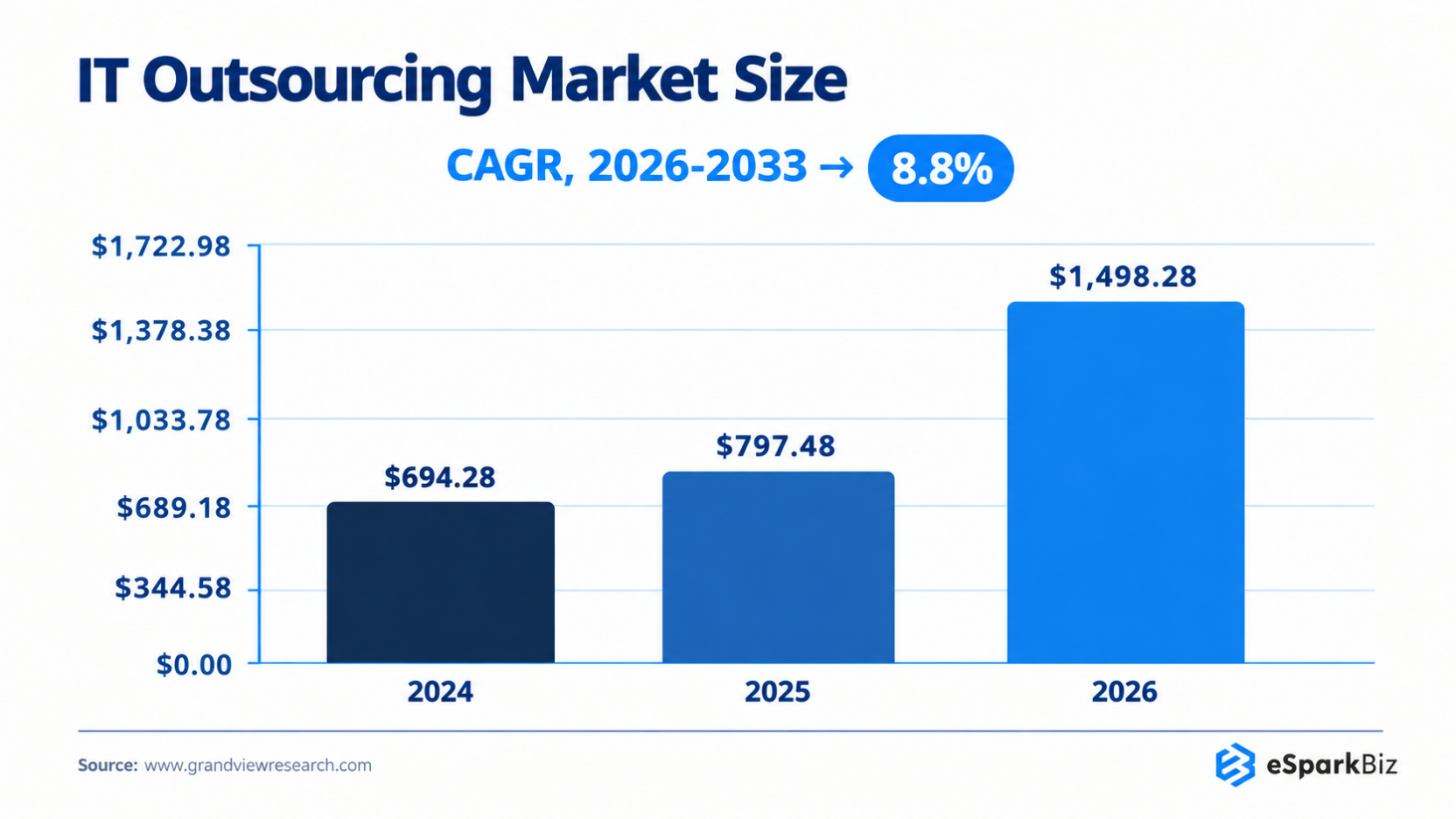
Common outsourcing models include:
- Offshoring: Work moves to a provider located in a different country.
- Nearshoring: The relocation of work to a provider in a nearby country.
- Onshoring: Work stays within the same country but moves to an outside provider.
- Staff Augmentation: The provider supplies professionals who work within the client’s processes.
- Managed Services: The provider assumes responsibility for a defined service such as help desk operations or data center management.
The appeal is clearly straightforward. A company can bring in an established team without the need to first create a new legal entity, workplace, hiring framework or internal operational team.
The trade off appears when the business requires a greater level of involvement from those teams than the original contract anticipated.
Also Read: Staff Augmentation Best Practices
Who really Owns the Work: Comparing GCC and IT Outsourcing
The difference becomes sharper when essential work extends beyond a single project. An outsourcing provider manages delivery under a contract while a GCC functions as an integral part of the parent company. This transition can change how decisions are made and how critical knowledge stays within the business.
| Factor | GCC | IT Outsourcing |
| Ownership | The company owns the center and team | The provider owns the delivery organization |
| Strategic Control | Direct link to internal decision making | Governed by using contracts & service terms |
| IP | The company maintains direct control of work produced inside the center | Contract terms govern IP ownership & transfer |
| Speed to launch | It requires setup, hiring and operating groundwork | The provider can usually start with an existing team |
| Cost Structure | Higher setup investment | Lower initial investment with recurring fees |
| Best Fit | Core, strategic, IP sensitive work | Defined, non core or transactional work |
For work closely associated with the company’s products, data or future plans, these distinctions can carry more significant weight than the initial delivery cost.
Did You Know?
Based on a report by Mordor Intelligence, North America held 24.12% of the IT outsourcing market share in 2025, while Asia Pacific is projected to grow at a 3.66% CAGR in 2031.
Where does Build Operate Transfer (BOT) Fit between GCC and Outsourcing
Building a GCC from the ground up can create a practical hurdle. The company must create the legal entity, hire local leadership, build the workplace, create HR processes, and understand local employment requirements.
Build Operate Transfer (BOT) addresses that challenge.
In a BOT model, a partner initially sets up and manages the center first after which the company then takes ownership after the agreed transition period.
A BOT framework offers several advantages.
- A functioning center without the need to build all local processes internally
- An opportunity to evaluate the operating model
- A clearly defined path to company ownership
- A gradual transition instead of a single, major transfer
The duration of transfer periods can vary from 18 to 36 months, influenced by factors such as team structure, functions, and transition plan.
For a company that wants a GCC but does not want to build every part from day one, the BOT model can provide a practical middle route.
Also Read: The Role of Technology in Global Capability Centers
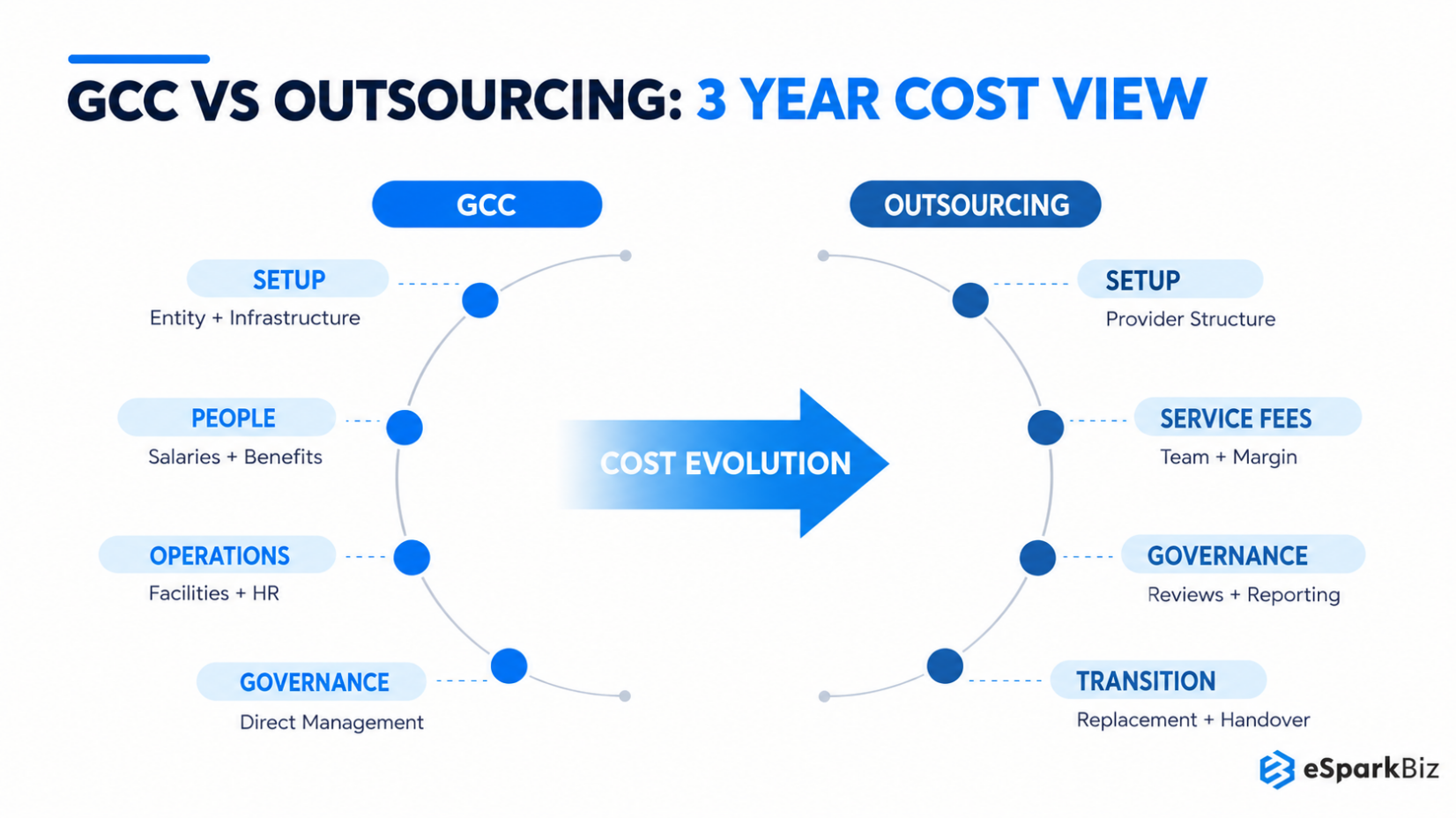
GCC vs Outsourcing Cost: What Changes Over 3 Years
Outsourcing typically requires a lower initial investment since the provider already has its own entity, workplace, hiring process, and operating structure. In contrast, a GCC requires those investments before the center begins producing at full capacity.
For a GCC comprising 50 to 100 person in a market such as India, setup costs can vary from $500,000 to $1.25 million influenced by location and infrastructure decisions.
Once the center is operating, a GCC carries direct salaries, benefits, facilities, HR, and compliance costs. An outsourced team also includes the provider margin within its fees.
Illustrative figures over three years from the source material show how the gap can narrow.
| Year | GCC Cumulative Cost Range | Outsourcing Cumulative Cost Range |
| Year 1 | $2.5M to $3.75M | $2.1M to $3.1M |
| Year 2 | $4.5M to $6.25M | $4.2M to $6.2M |
| Year 3 | $6.5M to $8.75M | $6.3M to $9.3M |
These figures are illustrative and based on a model of a 50 person team using publicly available industry data. Actual costs may differ based on location, function, hiring market, facilities and commercial terms.
Hidden Costs that do not Show Up on an Invoice
The invoice is only one part of the financial picture. Both models can create additional costs that manifest using management effort, changes in staffing, compliance work or transition activity.
Attrition ramp cost: When an outsourced professional departs from an account, a new hire may require time to understand the codebase, processes, and business context. The financial impact can appear in lost productivity rather than a separate invoice.
Governance overhead: Managing vendors requires contract reviews, service reviews, performance discussions, reporting, and renewal tasks. Some industry estimates suggest that this management burden accounts for approximately 5% to 8% of annual contract value.
Audit and compliance cost: Regulated functions may require additional checks of provider controls, data handling, access policies and security practices.
The takeaway is straightforward. Year one cost and three year economics can tell very different stories.
When does a GCC Pay Back its Setup Cost?
A captive GCC can reach payback in approximately 18 to 30 months under a modeled scenario where the center attains its planned staffing and operating targets.
Three factors can move that point.
- Ramp speed: The rate at which the center achieves its planned staffing and output.
- Location incentives: Tax benefits or economic zone incentives can reduce operating costs.
- Function complexity: Difficult to fill roles can extend the hiring and training period.
This serves as a planning range rather than a guarantee. All cost, setup time and payback figures in this section are eSparkBiz estimates for planning purposes. Leadership should model the GCC based on its actual headcount plan, location, compensation levels, facilities, and business objectives.
Community Insight
Participants within the r/developersindia community have noted that many Global Capability Centers continue to operate with outsourcing partners rather than serving as their replacement. GCCs typically maintain control over strategic engineering initiatives while outsourcing continues to support delivery and operational functions.
The Way you Handle Data Security and Compliance Depends on Who Owns the Work
When dealing with sensitive data and IP, the service delivery model can turn into a critical risk factor to consider. You’ve got your choice, outsource & keep the operation running on the provider’s infrastructure or go with a GCC that keeps the team under the parent company’s structure.
This distinction is particularly significant when we’re talking about regulated information and proprietary products, where requirements may include GDPR, HIPAA, or India’s DPDP Act, depending upon the business and location.
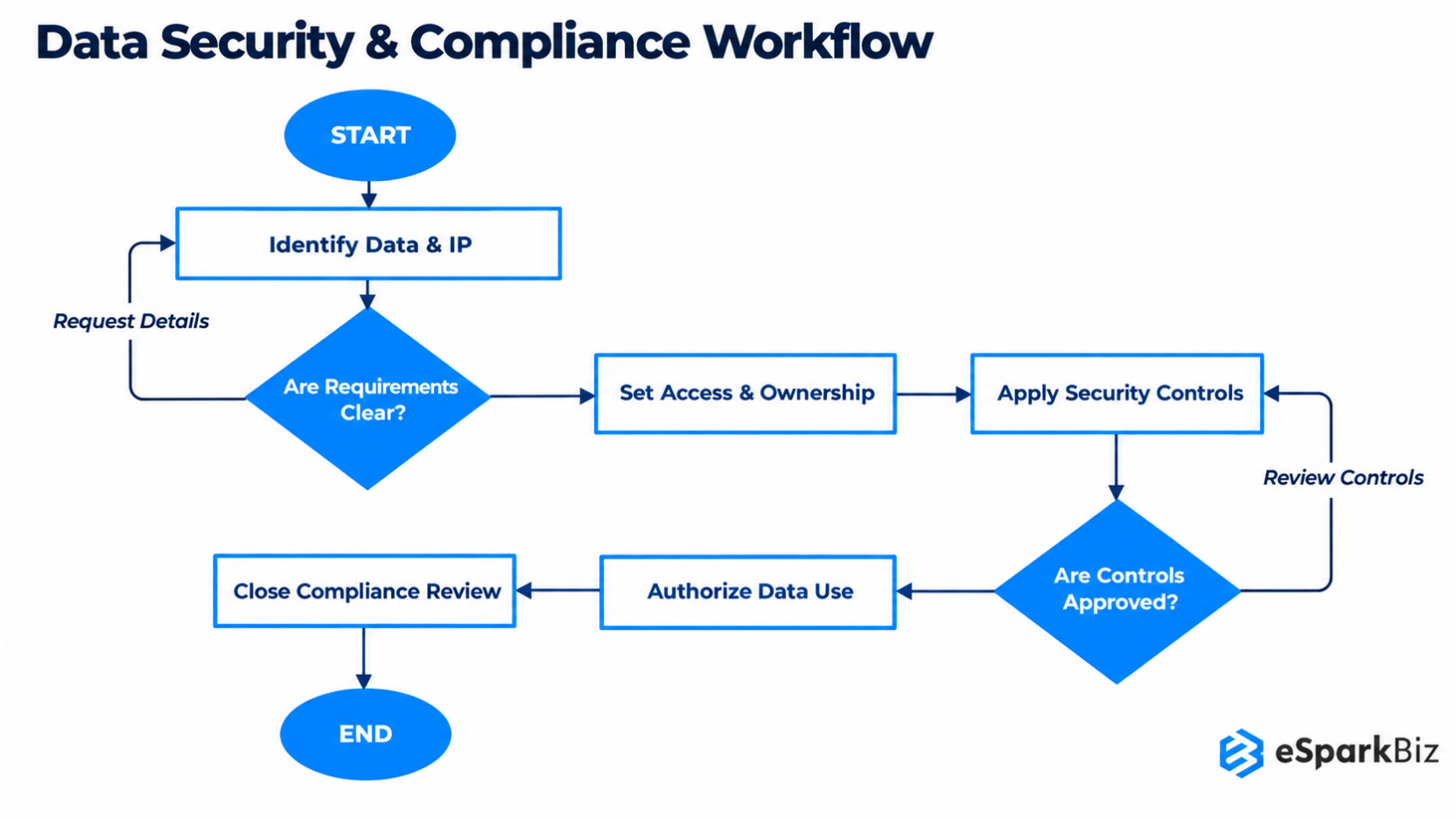
Some of the areas you need to think about are:
- Data access: Restrict access exclusively to authorized people and the systems requiring it.
- IP ownership: Establish transparent ownership, and usage rights clearly in contracts and internal policies.
- Compliance: Map the operating model to the laws, and regulations that apply to the business.
- Security oversight: Set clear review, monitoring & incident response responsibilities.
- Data location: Understand where information is stored, processed & transferred.
Both approaches maintain organizational accountability for security and compliance responsibility. The important question is whether the company can maintain the necessary controls within its selected operational model.
Also Read: IT Outsourcing Pricing Models
When Building a GCC actually Makes More Sense than Outsourcing
A GCC becomes increasingly attractive when the company wants its global team to become part of the distributed business rather than remain a contracted delivery function.
Evaluate this approach when,
- The work involves proprietary IP management.
- Regulatory legal compliance necessitates enhanced internal governance mechanisms.
- The company expects for continued demand for the team.
- Projected headcount will expand to 100 or more persons.
- Product knowledge needs to remain within the organization.
- The center will contribute to core business functions.
The result is a center that can become an integrated part of the company’s operating structure instead of remaining a separate provider relationship.
IT Outsourcing is the Smarter Bet When you Need this
The outsourcing model can make sense when the business require speed without building a new internal structure when taking on the work of building a new operational center.
This strategy may fit with your needs when:
- The team is needed within weeks.
- Planned headcount remains below the GCC threshold.
- The work is defined & non core.
- The company is testing a new market or product.
- Initial capital for a GCC is limited.
- The work does not require any deep internal knowledge.
The result is a streamlined entry approach. Your organization gains access to specialized delivery skills while avoiding the complexity of establishing a new legal and operating structure.
Also Read: Cost of Setting Up a Global Capability Center (GCC) in India
Stop Debating GCC vs Outsourcing, Score it instead
The decision becomes clear when leaders stop asking which model is better and instead they start testing which one fits their business situation. If your board is considering a GCC because peers have one, first validate the business case using projected costs, expected returns and measurable operating needs.
A straightforward scorecard can bring that choice into your considerations.
| Decision Factor | GCC makes more Sense | Outsourcing makes more Sense |
| Control | Your core business or product work | Services which you have to define |
| Cost horizon | 3+ year view is a better way to look at it | Immediate cost priority on top |
| Headcount | Planning for 100+ roles | Planning for below 80 to 100 roles |
| Compliance | Sensitive or regulated work | Lower sensitivity work |
| Speed | Can wait 6+ months | Needs a team within weeks |
| IP | Proprietary work | Standardized work |
As your need for internal control and team growth gets bigger, a GCC becomes a more attractive option as the organization requires greater internal control and continuous team growth. But when speed, limited commitment, or uncertain demand is the priority, then outsourcing is a better bet.
The best decision will always be based on what works for you and honestly scoring your business requirements rather than selecting a model because it is popular in the market.
Real World Example: Why the Hartford Choose a GCC
The Hartford, a major U.S. insurance company, set up a Global Capability Center (GCC) in India to expand into their AI, engineering, and digital innovation skills. The company described this facility as a strategic technology hub dedicated to supporting their global transformation & differentiating it from a traditional offshore delivery center.
This example demonstrates how enterprises now create GCCs to maintain lasting ownership of critical skills while continuing outsource to external partners.
How to Move from Outsourcing to a GCC Without Disrupting Delivery
Many companies reach a point where outsourcing no longer matches their needs for the role a team plays in the business. The answer does not have to be an abrupt switch. Start by preparing your existing contract agreement well in advance of any planned change.
A critical challenge emerges during this transition: preserving essential business knowledge & operational continuity while restructuring how work gets delivered. The answer starts before the transition itself.
Renegotiating Vendor Contracts to avoid Lock In
A future transition becomes possible when your original outsourcing contract agreement includes clear exit procedures and knowledge transfer terms.
Protect the Transition before it Starts
Some key points to cover in your contract,
- IP assignment: Clearly define ownership of source code, system architecture, data models, documentation and all deliverables.
- Knowledge transfer: Require handover sessions, technical documentation and system access before contract expiry.
- Exit notice: Give yourself enough time to plan the recruitment and operational changes.
- Staff continuity: Where permitted, define and negotiate the ability to recruit people during the changeover.
- Transition acceptance: Define handover milestones, owners and completion criteria.
The goal is to switch from one model to another without losing any business knowledge or delivery momentum.
The rapid growth of the outsourced GCCs are projected to grow at nearly 15% CAGR in 2032, demonstrates how leading enterprises are combining the cost advantages of outsourcing with the strategic benefits of direct ownership.
How eSparkBiz Supports GCC Setup and Handover in India
For US companies establishing a Global Capability Center (GCC) in India, eSparkBiz can support technology planning, team formation and operational readiness.
Depending on the engagement model, hiring needs and project scope, GCC setup may take 3 to 9 months. For a Build Operate Transfer (BOT) model, the plan should define operating responsibilities, transition milestones and handover terms before the engagement begins.
For setup and governance –
- GCC vs. Outsourcing: Assess whether moving 120 outsourced engineers into a GCC fits your cost structure, control requirements and business goals.
- US Time Zones and Contracts: Define collaboration hours, communication routines, contractual responsibilities and handover terms to align the India team with US headquarters.
A GCC wins when a company needs direct control over core operations, intellectual property and a dedicated team in India. Outsourcing wins when faster deployment, lower upfront costs and access to external expertise are the priorities.
Conclusion
GCCs and IT outsourcing address different organizational requirements. With outsourcing, you can usually give a company quick access to an external team without the initial work of creating a new center. A GCC asks the company to make a larger initial commitment and in return you get a much more a deeper internal operating structure.
The best decision comes down to picking the right model for the work. If its all about speed, defined scope and lower initial investment matter most then outsourcing may fit better. If the business needs that deeper level of internal involvement, want ability to grow a team, sensitive IP handling, and a stronger connection to business priorities, a GCC may make more sense.
For companies who can’t quite make up their minds between the two, BOT is another option to consider. It can actually help you to turn that tricky decision build into a staged transition toward a company owned center.
Frequently Asked Questions
What is the main difference between a GCC and IT outsourcing in terms of the business ownership?
A GCC represents an internally controlled facility managed by the organization to fulfill its unique business needs.
The difference affects,
- Business integration
- Talent management
- IP handling
- Cost structure
- Ability to make decisions
Is a GCC more expensive than IT outsourcing when comparing the setup expenses?
A GCC typically requires greater initial investment due to infrastructure development and team recruitment. Conversely, outsourcing provides a more accessible entry point with reduced provider fees within the ongoing expenses.
As time progresses, the cost gap can narrow or change depending on team size & usage.
Are GCCs a better option when the companies need direct control over technology teams?
GCCs are ideal for companies requiring direct control over their technology teams, priorities, architecture, access, and internal decision making.
How long does it typically take to establish a GCC and make it fully operational?
Building a GCC from scratch may take 12 to 18 months before reaching full operational capacity. Outsourcing can begin within weeks or a few months. BOT models can start faster while gradually transferring full company ownership over an agreed transition period.
Can a company use a GCC and IT outsourcing together as part of a hybrid technology model?
Yes. A hybrid approach allows organizations to maintain core product work and sensitive functions within a GCC while outsourcing particular services with defined parameters such as:
- Help desk support
- Routine testing
- Seasonal work
- Other non core functions
Does a GCC provide better control over sensitive intellectual property than IT outsourcing?
A GCC gives the parent company with direct control of the source code, repositories, system architecture, employee access & IP governance. eSparkBiz helps teams to establish clear technology ownership and access controls.
| IP Concern | GCC Approach |
| Source Code | Internal repository ownership |
| Data Access | Role based access controls |
| Architecture | An internal decision authority |
| IP Governance | The parent company policies |
| Technical Knowledge | Retained within internal teams |
When should a company consider moving from IT outsourcing to a GCC model?
A move can make sense when an outsourced function transforms into the business, team size grows, IP becomes more important or the company needs deeper involvement from the people doing the work.
The right trigger is a change in business importance not simply a calendar date or headcount number.
Can a GCC reduce coordination issues between technology and business teams?
Yes, a GCC can reduce coordination issues by integrating technology teams directly into the parent organization’s structure and operational workflows.
- Direct business collaboration
- Common project priorities
- Direct leadership access
- Reduced vendor intermediaries
- Integrated technology teams