 ChatGPT
 Google AI
 Perplexity
 Claude.ai
Rising costs of infrastructure and integration challenges in IoT deployments, architecture is a business externally-facing function. This technical guide covers multiple trade-offs associated with IoT to assist architecture and design professionals in creating cost optimized, innovative, differentiated and integrated architectural solutions for building IoT enabled connected environments.
When connections between devices are inconsistent, integration takes too long, costs increase, and visibility is limited, it becomes very hard to extract value from connected business processes. Poor design and architecture lead to a myriad of issues from lack of scalability to security concerns.
According to MarketsandMarkets, the global IoT market is projected to reach USD 865.20 billion growing at a 9.6% CAGR by the year 2030. As more organizations embrace the IoT, architecture and infrastructure will have to be adjusted to manage larger volumes of data.
This guide explains Internet of Things architecture, covering layers, models, protocols, edge and cloud choices, and the governance and implementation trade-offs behind each decision.
What is IoT Architecture and Why does it matter to your Business?
IoT architecture explains how connected devices, networks, data, applications, and business systems interact to support seamless business operations, informed decisions, and provide scalable connected services.
How does IoT Architecture support Business Operations?
IoT architecture provides a structured way of thinking about devices and business systems. This architecture allows for the management of data and application integration in a secure and scalable way across connected systems.
A well-planned architecture helps organizations:
- Reduce integration complexity
- Improve operational visibility
- Support reliable data processing
- Connect IoT data with business applications
- Maintain consistent security controls
What does Poor IoT Architecture Cost the Business?
Poor architecture for Internet of Things projects results in thousands of unmanaged devices, unnecessary costs, uncontrolled risks and a lack of control. Deployments become very complex, and the cost of owning an IoT system increases.
A fair way to plan the budget is to look at five years, not just the launch bill. As a rough guide, the cost tends to spread like this:
| Cost area | Share of five-year total |
| Devices and hardware | 20% to 25% |
| Connectivity | 10% to 15% |
| Cloud and data | 20% to 25% |
| Integration and security | 15% to 20% |
| Maintenance and support | 20% to 25% |
The Core Layers of IoT Architecture and the Role Each One Plays
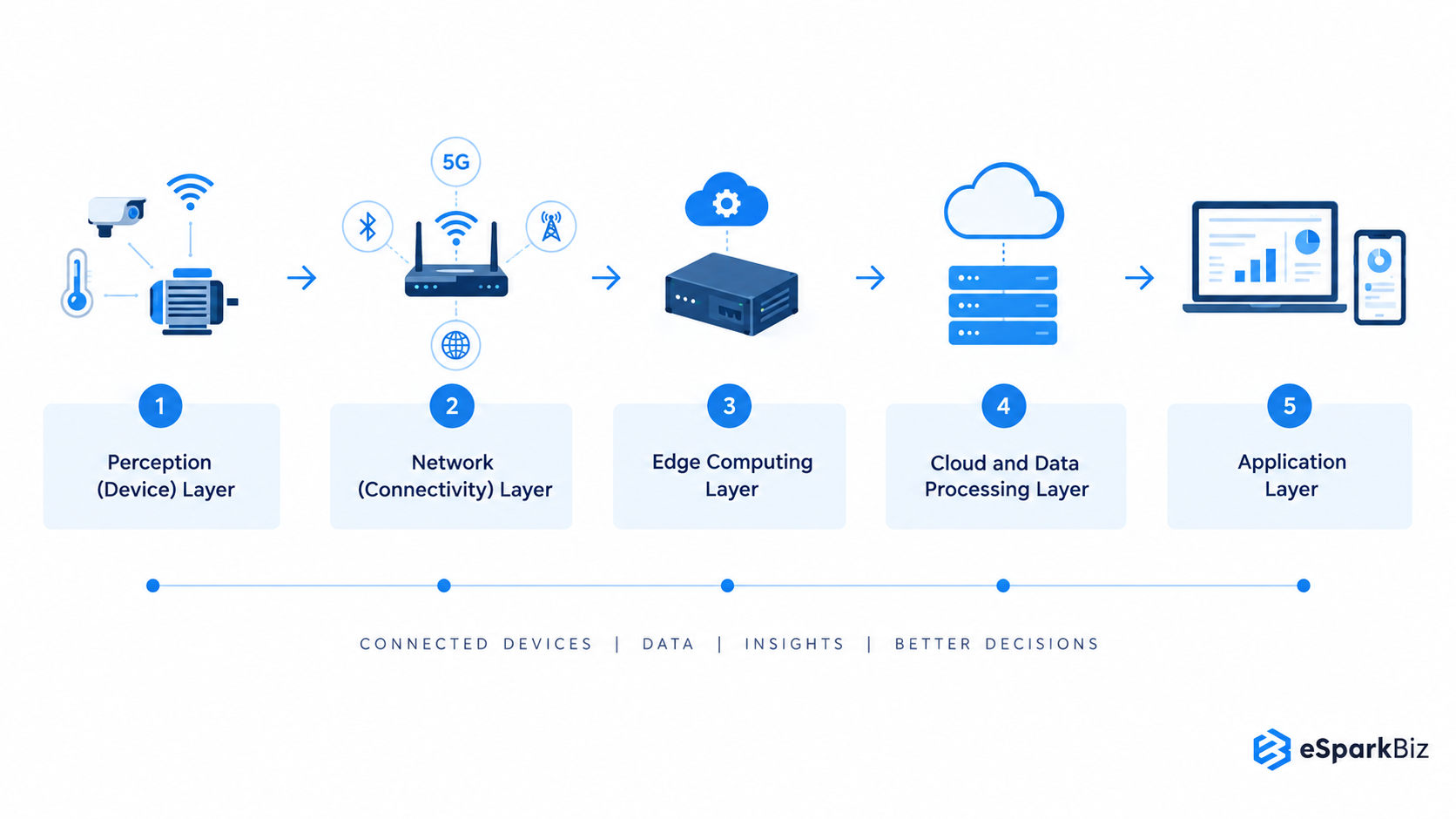
An IoT environment connects devices, networks, edge systems, cloud platforms and applications, with each layer handling a specific role while working together reliably.
Perception (Device) Layer
The perception layer of an IoT system is made up of various sensors that are distributed throughout the environment. Other components of this layer include controllers, embedded systems, and devices.
Sensors capture conditions such as:
- Environmental conditions
- Equipment condition and performance
- Location and movement
- Usage and occupancy
- Energy consumption
Actuators take the reverse role by carrying out instructions, such as adjusting a machine, opening a valve or controlling equipment. The quality and reliability of this layer directly affect the accuracy of the data used throughout the IoT environment.
Network (Connectivity) Layer
The Network Layer is concerned with transporting data between Devices and Data Processing Systems. It mainly determines the ways and the degree of integrity with which data is moved to or retrieved from a location in the system.
Common connectivity options include:
- Various types of Wireless and Wired LANs.
- WANs (including mobile cellular networks).
- Device to Device communications using techniques such as MQTT and CoAP.
- Connectivity to other networks using gateways.
Prior to the design and/or implementation of any communication network, numerous constraints should be evaluated including coverage, bandwidth, latency and reliability. Also of important consideration is the cost of operation and the security of the network.
Edge Computing Layer
Edge computing brings data processing closer to the source of that data. One consequence of edge computing is that not all events need to be processed by a cloud platform. As part of determining where to do event processing, we need to consider if an event requires an immediate response.
Edge processing can help:
- Improved latency for time critical processes
- Greater control over transmitted data
- Uninterrupted continuation of some operations in the face of connectivity issues
- Decreased load on a network
Not all processes should be done at the edge. A number of factors should be taken into account including the conditions of the network, the volume of data, and the goals of the process being undertaken.
Cloud and Data Processing Layer
The cloud and data processing layer provides cloud and processing capabilities to perform large scale data operations on Internet of Things (IoT) data e.g. collection, storage, and analysis.
It can include:
- Cloud and data storage
- Databases and data movement services
- Stream data processing and analysis
- Services to manage IoT devices and data
- Cloud-based ML services
This layer turns large volumes of raw device data into information that teams can use for monitoring, analysis, forecasting and operational planning.
Application Layer
The application layer allows users and business teams to engage with IoT data and services. This layer presents raw and processed data to support various business functions.
Typical applications include:
- Operational control and visibility systems
- Alerts and notifications
- Predictive and preventive maintenance
- Process and resource control and automation
- Various business industry-specific software
The application layer should connect IoT insights with existing operational processes rather than operate as an isolated system. This helps ensure that connected-device data contributes to measurable business activities and decisions.
How does data flow through an IoT architecture? Data moves from the sensor to the gateway, edge, cloud and application. Commands travel the same path in reverse.
Say you are planning a factory with 2,000 sensors. Work in this order:
- Write down the requirements: what to measure, how fast, and what must never go down.
- Pick devices and protocols that fit those needs, such as MQTT for telemetry.
- Decide what runs at the edge and what can wait for the cloud.
- Set up the cloud layer for storage, analytics and device management.
- Build security in from the start: device identity, encryption and access control.
- Run a pilot on one production line, then scale site by site.
Which IoT Architecture Model Fits your Operating Model?
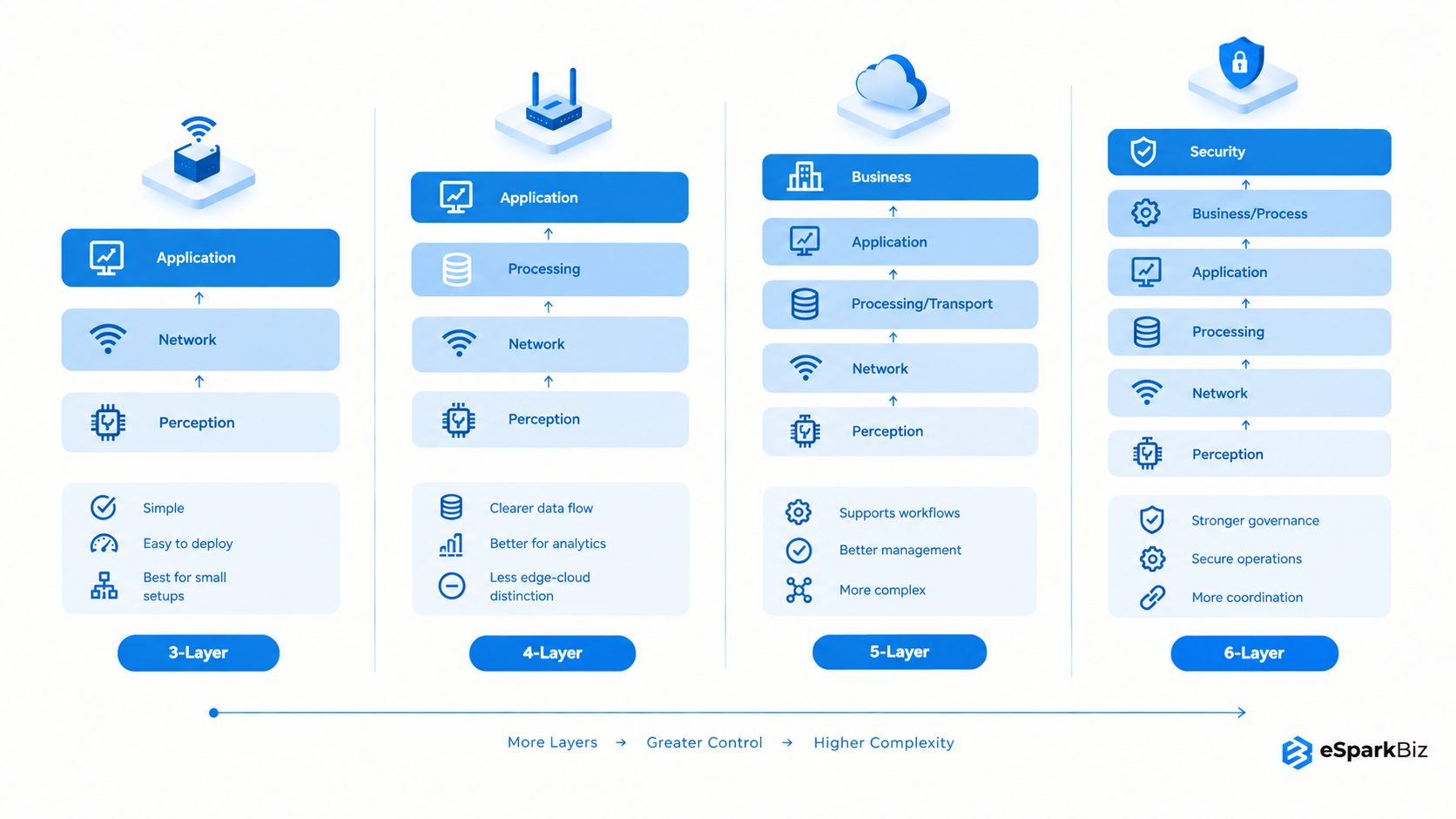
Choosing between multi layer models of the IoT Architecture requires balancing control, complexity, scalability and implementation effort. More layers provide clearer separation, while fewer layers simplify deployment and management.
| Model | Responsibilities | Strengths | Limitations | Suitable Scenarios |
| 3 Layer | Collects data, transfers it and delivers applications | Simple, easy to understand and deploy | Limited separation of processing and business functions | Basic monitoring and smaller IoT deployments |
| 4 Layer | Adds a dedicated processing function between connectivity and applications | Clearer data management structure | Less distinction between edge and cloud processing | Data centric monitoring and analytics |
| 5 Layer | Separates business or process functions from applications | Better support for operational workflows and management | Greater architectural complexity | Large scale connected operations |
| 6 Layer | Adds explicit security responsibility alongside technical and business functions | Stronger separation of governance, security and operational responsibilities | More components, coordination and management overhead | Complex environments with strict security and governance requirements |
What should Leadership ask before approving an IoT Architecture?
Selecting an IoT architecture should begin with business and operational requirements rather than the number of architectural layers. The decision should consider how the environment handles integration, latency, security, resilience, data and lifecycle costs.
| Decision Area | Key Question | Architecture Consideration | Business Implication |
| Business Fit | What outcome must IoT improve? | Map architecture to operational KPIs | Keeps investment tied to measurable outcomes |
| Connectivity | How should devices communicate? | Coverage, bandwidth, latency and reliability | Influences availability and operating cost |
| Edge vs Cloud | Where should processing occur? | Response time, data volume and connectivity | Affects latency, bandwidth and infrastructure cost |
| Integration | How will IoT connect with existing systems? | APIs, events, middleware and data platforms | Determines process continuity and data usability |
| Security | How should access and risk be controlled? | Identity, encryption, segmentation and monitoring | Reduces security and compliance exposure |
| Resilience | What happens when connectivity fails? | Buffering, failover and state reconciliation | Protects operational continuity |
| Lifecycle | How will devices be managed over time? | Provisioning, OTA updates, monitoring and retirement | Influences total cost of ownership |
| Flexibility | How easily can the architecture evolve? | Open standards, APIs and portability | Reduces dependency on proprietary components |
Edge-Centric IoT Architecture for Real-Time Decisions at Scale
Edge-centric IoT architecture combines Artificial Intelligence, Computer Vision, local processing, interoperability, data sovereignty, and real-time intelligence to support secure, scalable deployments across safety-critical environments while addressing connectivity, privacy, and operational demands.
What does IoT architecture cost over five years?
Teams tend to plan for devices and cloud, then get surprised by other expenses. Looking five years out provides a more realistic figure than the launch quote.
| Cost Area | What It Includes | Often Missed |
| Devices and hardware | Sensors, gateways, installation | Replacement cycles & spares |
| Connectivity | SIM plans, data plans, network setup | Per-device fees that grow with fleet size |
| Cloud and data | Ingestion, storage, analytics | Data transfer out & long-term storage |
| Integration and development | APIs, middleware, ERP and OT integration | Reworking the system when it changes |
| Operations | Monitoring, OTA updates, tech support | Employee time to manage devices |
| Security and compliance | Certificates, audits, patches | Recertification due to changing rules |
Get an estimate from each supplier for five years with these six lines filled in. The lowest cost to launch frequently becomes the most expensive system after year three.
Which IoT Protocol should Enterprises use?
Choosing the right protocol will determine how reliably the devices will be able to communicate with each other, how quickly the data will be transferred & how easily the system will integrate.
| Protocol | Communication Model | Strengths | Limitations | Ideal Use Case |
| MQTT | Publish/subscribe | Lightweight, reliable | Needs a broker | Telemetry and device-to-cloud |
| CoAP | Request/response | Lightweight, efficient | Smaller ecosystem than HTTP | Constrained devices and networks |
| HTTP/HTTPS | Request/response | Broad compatibility, easy integration | Heavy for frequent telemetry | APIs and web-based services |
| AMQP | Message-oriented | Reliable delivery and routing | Resource-intensive | Messaging and system integration |
| OPC UA | Client/server, publish/subscribe | Strong interoperability, industrial semantics | Complex to implement | Industrial automation and OT integration |
| DDS | Data-centric publish/subscribe | Low latency, real-time performance | Complex configuration | Real-time, mission-critical systems |
| Modbus | Request/response | Simple, widely supported | Weak security, dated data semantics | Legacy industrial equipment |
Securing IoT Architecture without Slowing the Business
With IoT security vulnerabilities, compliance risk, and ambiguity in terms of accountability facing connected operations, IoT security has to safeguard devices, data, and systems through their entire lifecycle.
Device Identity and Secure Onboarding
Every device needs to have an identity, enabled by certificates and credentials. With secure onboarding, the device gets verified before it is provided access, and with secure boot, only trusted software is run.
Network and Data Security
TLS secures the data as it travels, and network segmentation reduces the risk of compromise of devices. Zero Trust increases security through constant verification of devices, users, and access requests.
Firmware, OTA Updates and Lifecycle Security
Firmware upgrades require significant signing and verification processes. Over-the-air updates help remediate vulnerabilities for firmware residing on the end-device. Throughout the product life cycle, updates help control the version of the firmware running on the device.
Monitoring, IAM and Governance
IAM and access management have to ensure least-privilege permissions for users and their devices. SIEM allows abnormal actions detection and response. Governance allows security mechanisms in line with compliance and operational activities.
Align controls with NIST IR 8259 for device baselines and IEC 62443 for industrial environments.
Did you know?
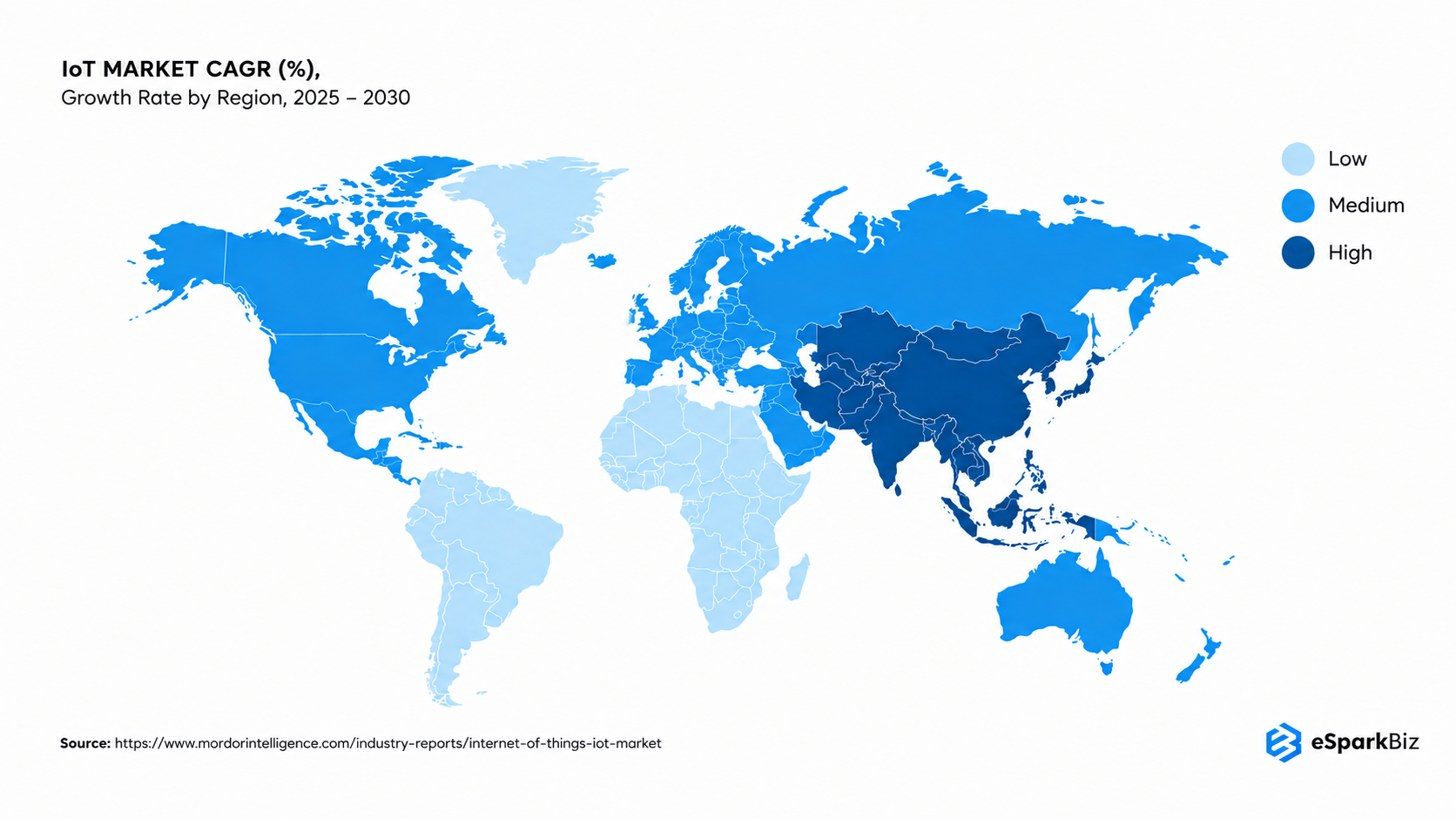
According to Mordor Intelligence, the Asia-Pacific IoT market is the world’s fastest-growing region, with a compound annual growth rate (CAGR) of 15.1% from 2025 to 2030.
What happens to Operations When IoT Connectivity fails?
When connectivity failures interrupt device communication, IoT systems need to preserve critical data, maintain essential operations and recover without creating inconsistent system states.
What happens When devices go Offline?
Telemetry data can be stored at edge and gateway nodes for later transmission. When connectivity is restored, the data is sent to the cloud. Store-and-forward reduces the amount of data loss in a system and improves operational resilience.
Imagine 12 cold-storage warehouses, and one loses internet for two hours. Its gateway keeps recording temperatures, triggers local alarms and queues readings. When the connection returns, data syncs to the cloud in order, duplicates are removed, and the dashboard fills the gap without losing data or requiring manual checks.
How should Recovery be Managed?
Recovery should be controlled through defined policies:
- Retry: Retransmit failed messages using controlled intervals.
- Deduplication: Prevent repeated messages from creating inaccurate records.
- Idempotency: Safely process repeated commands or events.
- State reconciliation: Align device and platform states after reconnection.
What if the Gateway fails?
Gateway resilience may require redundancy, health monitoring, failover and recovery procedures. Observability should track connectivity, queues, failed deliveries and recovery status.
A resilient architecture turns outages into controlled recovery events by defining offline behavior, data retention, synchronization and escalation procedures in advance.
What are the most common IoT Architecture mistakes?
When connectivity issues, security flaws, high costs, and unplanned downtime interfere with the operation of the systems, it could be the result of poor architecture.
| Mistake | Business Impact | Operational Consequence | Mitigation | Fix Order |
| Designing only for the connected state | Outage disruption | Operations stop responding | Build offline operations and recovery mechanisms | 1 |
| Ignoring security | Compliance risks | Weak identity and access controls | Build security into every layer | 2 |
| Ignoring integration and lifecycle costs | Higher operational cost | Hard to maintain and integrate | Plan APIs and lifecycle costs early | 3 |
| Generating vendor lock-in | Lower flexibility | Expensive migration | Use open and portable standards | 5 |
| Cost optimization based on deployment cost only | Increased lifecycle cost | Costs rise with adoption | Evaluate TCO across the full lifecycle | 4 |
| Measuring connectivity, not outcomes | Decreased visibility of investments | Technical measurements without business context | Tie KPIs to operational and financial results | 6 |
Low observability will only further slow down the identification of problems and troubleshooting. When making architectural decisions, the way systems connect is not the only consideration.
How will AI and Edge AI reshape IoT Architecture?
AI is changing the locality of IoT data processing and system response times. The challenge now is no longer about locality of data, but about where we place intelligence.
At the edge, AI lowers the distance of decision-making by developing local models to analyze system data and make decisions. GPU and other smart accelerator technology create systems with fast response times.
Cloud computing remains a central system for processing larger datasets for training models and providing deep analytical services. Once models are certified, they can be distributed across edge computing systems.
As local edge computing systems require intelligence, we have created another management layer. This will need to have clear responsibility and control over model deployment and versioning, monitoring, retraining, data governance and oversight.
The best approach is a distribution of local inference to facilitate edge computing decision-making while keeping systems communicating with intelligent services in the cloud.
The Actual Role of AI in IoT Architecture
Based on Reddit conversations, the success of integrating AI into IoT seems to depend not on adding models wherever possible but rather on making appropriate inferences, managing bandwidth and updates and obtaining trustworthy data.
IoT Architecture Best Practices for Business Critical Environments
Growing complexity in the Internet of Things (IoT) presents several business risks including fragmented and insecure architecture leading to operational expense and cost inflation. Periodic architecture assessments help identify potential risks and challenges.
Executive IoT Architecture Checklist
- Strategy and cost – does it fit into the overall business strategy and lifecycle economics?
- Integration and flexibility – does it include open standards and does it avoid vendor lock-in?
- Security – does it address identity management, encryption, and regulatory compliance?
- Resilience and visibility – can the team maintain operations during disruptions and detect issues promptly?
- Lifecycle – can it be managed through updates, monitoring, and decommissioning?
- Accountability – does it include owners, SLAs, and escalation procedures?
How to Move an IoT Pilot Into Production
Plenty of pilots stall because nobody planned past the demo. Before you roll out to every site, check that these are in place:
- Device management: one place to see, group and retire every device.
- OTA updates: signed updates with rollback, tested on a small batch first.
- Support model: who gets the alert at 2 a.m., and how fast they must respond.
- Cost per device: hardware, connectivity, cloud and support, tracked every month.
-
Rollout plan: one site at a time, with a clear go or no-go review.
In-House Team or IoT Partner: How to Choose
Outsourcing IoT work makes sense when you need to roll out faster than you can hire.
Factor In-house IoT partner Skills Built over time through hiring Ready to start quickly Time to rollout Slower, hiring comes first Faster start across sites Support Depends on your team’s capacity Covered by agreed SLAs Control Full, you own every decision Shared, with code and IP ownership agreed upfront Best for Long-term core products Multi-site rollouts on a deadline If you go with a partner, check that they:
- Have delivered edge and device security work for manufacturers.
- Share results with numbers.
- Overlap with US working hours and put support terms in writing.
- Offer full code and IP ownership.
A strong IoT Architecture should balance business value, operational control, security, resilience, cost and long term flexibility.
eSparkBiz is a product development and AI engineering company that helps teams build IoT architecture with edge processing and reliable connectivity. With 400+ engineers, NDA-protected engagements, full code and IP ownership, and 24-hour enquiry responses, it supports dependable connected systems.
How did eSparkBiz reduce IoT Processing Delays by 55%?
A manufacturing company had issues with latencies in device telemetry and an inefficient system to process data in the cloud, thus incurring needless costs.
With eSparkBiz’s expertise in edge processing units, MQTT communications, and data orchestration, the client rearchitected their IoT offering for substantially greater efficiency.
| Area | Before | After |
| Data Processing | High latency | 55% faster |
| Cloud Data Storage | High | 40% less |
| Operational Stability | Disrupted during outages | Greater resilience |
| Data Visibility | Scattered | More centralized |
Architecture Improvements:
- Edge processing nodes added
- Store and forward approach to communication
- Communication balance reached for device-to-cloud communications
- IoT data integrated with operations data and systems
The redesigned architecture reduced processing delays, lowered unnecessary cloud data transfer and improved operational visibility while supporting more resilient connected operations.
For more such stories, review eSparkBiz’s Portfolio
Conclusion
IoT architecture is ultimately a business and technology decision. The architecture must connect devices and data with operational and enterprise systems while maintaining security, resilience and control across the device lifecycle.
Organizations evaluating IoT investments should therefore assess architecture not only by how systems connect, but by how reliably they operate, how economically they scale and how effectively they support business performance.
Frequently Asked Questions
What is the Expected Lifetime Cost of an Enterprise IoT Architecture?
You need to consider the cost of the hardware, connectivity, cloud and data, integration and architecture, security & other services and support. Ask vendors for a five-year cost estimate.
What IoT Architecture should a Company use When Devices must keep working during Network Outages?
An edge-enabled architecture with local processing, offline buffering, retry logic and synchronization can maintain critical operations when network connectivity is unavailable.
What is the difference between 3-Layer, 4-Layer, 5-Layer and 6-Layer IoT Architecture?
The main difference between the models is the placement of abstraction layers. Models with greater layers account for additional complexity with respect to processes, functions, applications and security.
Which IoT Protocol should I use for Enterprise Devices: MQTT, CoAP, HTTP, AMQP, OPC UA or DDS?
Protocol selection depends on device constraints, latency, reliability, bandwidth, interoperability, security, communication patterns and whether the environment requires industrial or legacy integration.
How can eSparkBiz help fix IoT Architecture problems When an Existing System cannot Scale?
eSparkBiz finds what blocks your IoT architecture from scaling and fixes it in phases, keeping what works. Support covers US hours, and the NDA and contract are signed first.
Why does an IoT Architecture working perfectly during the pilot phase fail when scaling up?
Pilots run light, so scale exposes gaps. Fix three things first: size the message broker for peak load, automate device provisioning, and partition data by site or device group.
Our devices come from different vendors and don’t have good interoperability. What should we do about it?
Add a middleware layer to translate various protocols and formats between the devices. It would allow adding new vendors into the existing network without developing a unique project for each vendor.
How can we make sure our IoT deployment passes security and compliance audits?
Implement device authentication, secure data communication and network segregation right from the start of development. Security measures implemented after the audit finds a vulnerability are usually ineffective.