 ChatGPT
 Google AI
 Perplexity
 Claude.ai
For most leadership teams, the real challenge isn't the data, it's turning growing device volumes into decisions before the cost of inaction becomes unmanageable. This guide walks through the emerging answers, 5G, LPWAN, satellite coverage & stronger regulatory oversight, that together build operations that are pervasive, secure, scalable and resilient.
The Internet of Things (IoT) is no longer just about connecting devices. AI, new wireless technologies and tighter regulation are pushing organizations to rethink how they design and manage connected ecosystems.
Fortune Business Insights expects the global IoT industry to reach USD 5,552.48 billion by 2034, growing at a CAGR of 23.10%. That growth is moving IoT projects into budgets.
There are many drivers behind that: advanced devices, increased means of connectivity, stricter regulations like the EU Cyber Resilience Act, and a growing number of industries adopting various technologies.
This guide highlights the current trends and what management should consider when analyzing IoT opportunities and challenges.
How the Future of IoT is Reshaping Digital Operations
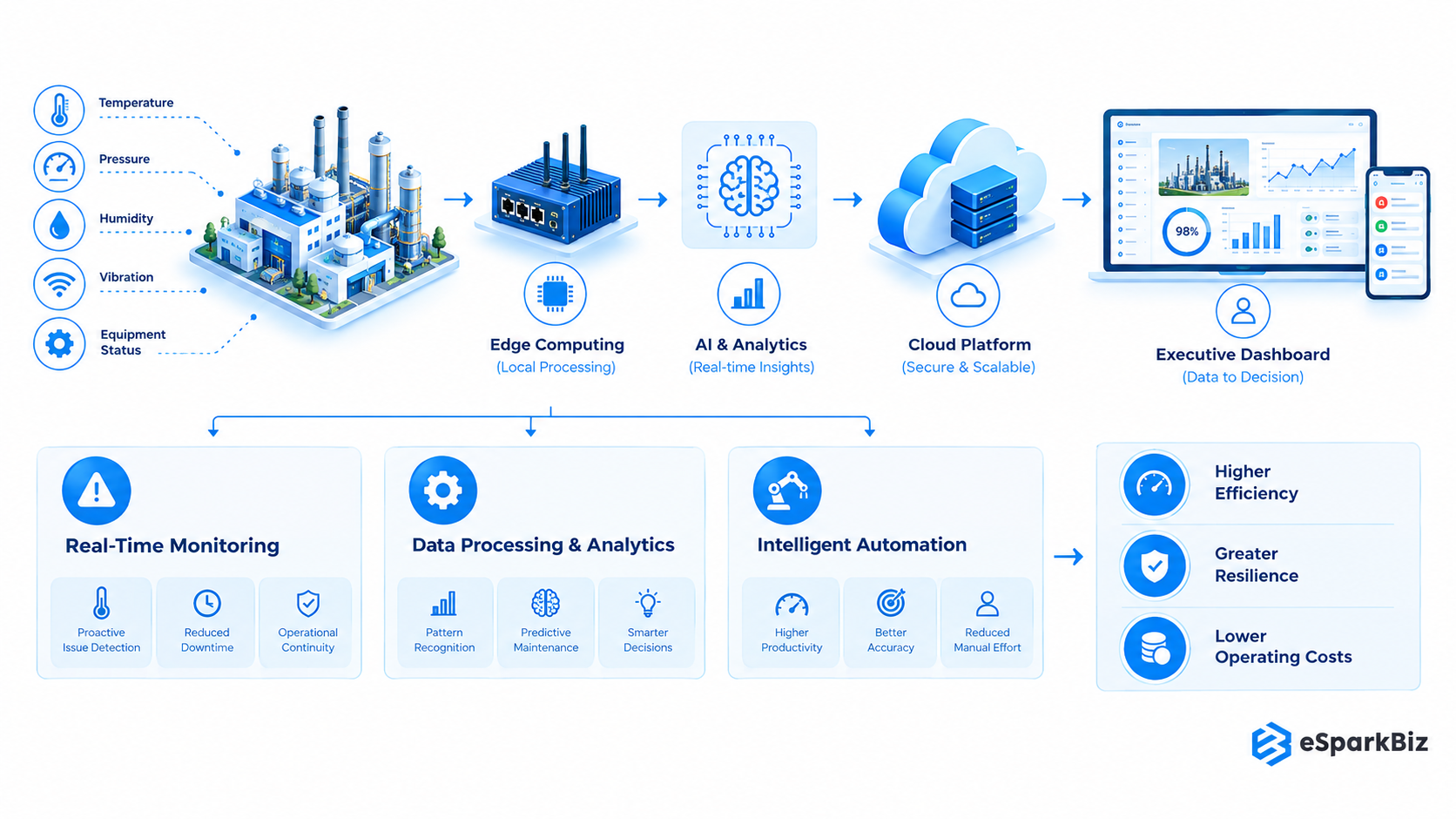
Internet of Things is shifting from passive monitoring toward systems that convert live data into faster decisions, automated responses and measurable gains in operating efficiency.
For consumers, that shift can mean faster alerts, safer interactions, more responsive services and connected products that require less manual intervention.
From Connected Devices to Intelligent Systems
A sensor that only reports a problem is less valuable than one that can fix it. That shift, from reporting to taking action, is what’s driving IoT’s next phase.
Getting there requires three things working together: edge computing for faster local processing, Artificial Intelligence that identifies patterns and operational anomalies and connected systems that enable context-aware responses. Together, they reduce latency while limiting how much data needs to move at all.
From Data Collection to Operational Decision-Making
IoT creates value when data directly supports operational decisions rather than remaining isolated in dashboards.
- Detect anomalies earlier
- Prioritize critical interventions
- Automate routine workflows
For mid-size operations, the use cases that pay back first are predictive maintenance, asset tracking, remote patient monitoring, inventory visibility and line quality checks. What changes with real-time data is timing, and the next step is that systems start acting on it.
| Stage | When a fault is seen | What happens next |
| Daily reports | Next-day review | Manual follow-up after the loss |
| Real-time monitoring | Within seconds or minutes | Alert reaches the right person |
| Autonomous operation | Before it becomes a fault | System acts, then logs the result |
For leadership teams, the priority is linking IoT investments to measurable efficiency, resilience and operating-cost improvements.
How Leadership Teams Should Prioritize IoT Investments
Connected devices lose value without clear business goals. These seven decision areas help teams focus spending on operational return, not device volume.
| Decision Area | Key Consideration |
| Business Value | Define the operational or customer problem IoT will address. |
| Architecture | Decide between edge, cloud or a combination based on workload needs. |
| Connectivity | Match 5G, LPWAN, cellular or satellite to coverage and device requirements. |
| Data & AI | Connect device data with analytics, AI and business systems. |
| Security | Protect devices through identity, access controls, firmware updates and monitoring. |
| Total Cost | Account for hardware, connectivity, cloud, integration, maintenance and replacement. |
| Operating Model | Establish ownership across IT, OT, security, engineering and operations. |
A strong IoT strategy links technology spending to measurable business priorities, helping organizations focus investment where connected intelligence can deliver clear operational value.
The Total Cost row is where budgets slip most often, so it helps to split it into five lines from day one.
| Cost bucket | What drives it |
| Sensors and gateways | Asset count, sensor type, site conditions |
| Connectivity | Cellular, LPWAN or satellite plans, data volume |
| Cloud and edge | Message volume, storage, analytics load |
| Integration | ERP, MES and older system connections |
| Support and replacement | Firmware updates, monitoring, battery and hardware refresh |
Hardware takes the biggest share during a pilot, while connectivity, cloud and support grow faster at scale. Budgets for real-time monitoring at mid-size sites commonly run from $10,000 to $250,000+, and a pilot on a few assets usually takes 8 to 12 weeks to stand up.
By stage, a pilot sits at the lower end of that range, scale-up takes it toward the top, and annual operating costs then settle at roughly 15% to 20% of the initial build cost.
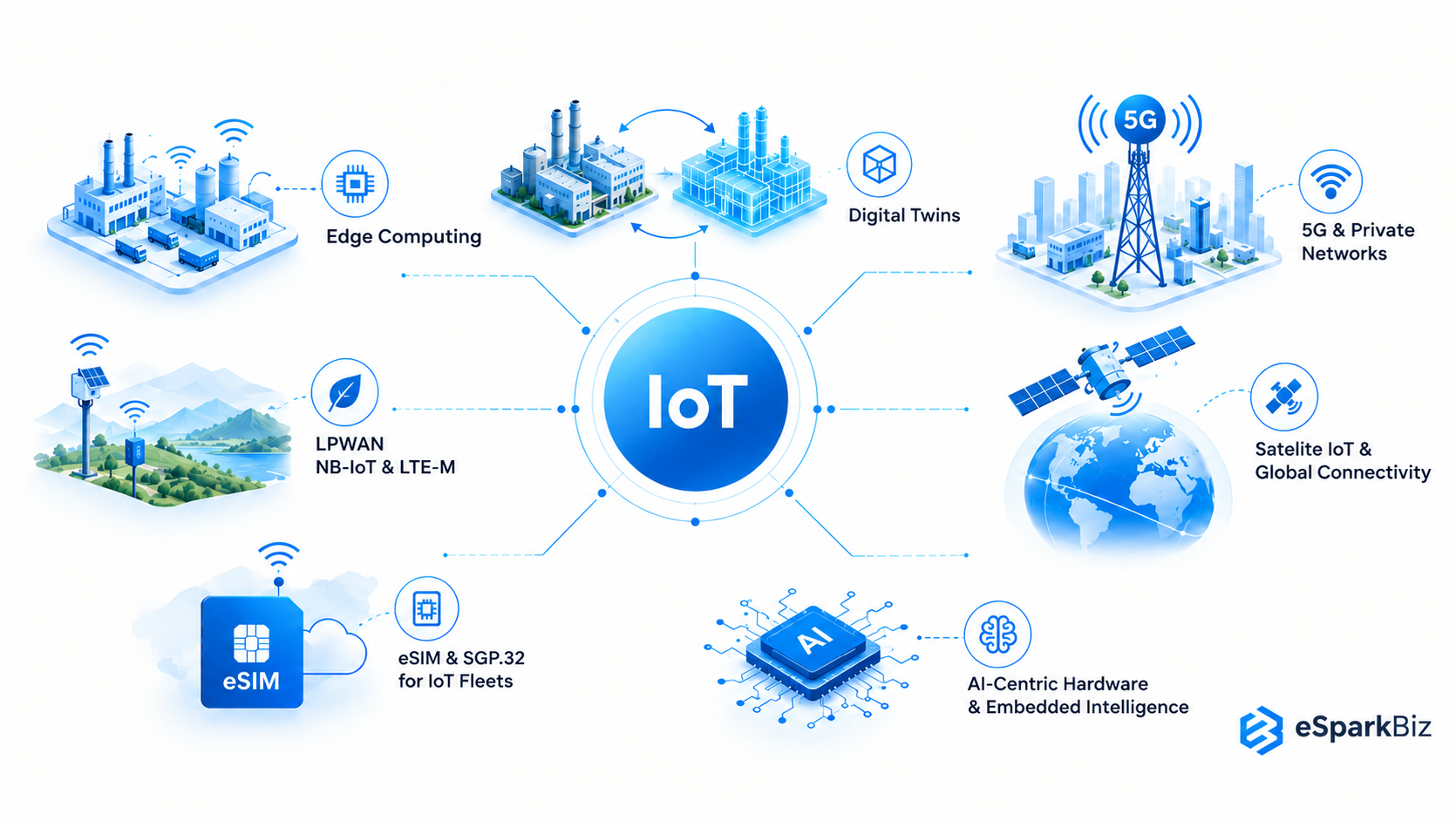
Distributed intelligence, advanced connectivity, digital twins, and smarter hardware plays a big role in shaping the future of the IoT changing how organisations go about designing, running & scaling out those all-connected systems.
These technologies may operate behind the scenes, but their impact reaches users through faster responses, more reliable connectivity, longer-lasting devices and more personalized connected experiences.
The latest Internet of Things developments point to more intelligence at the edge, greater network flexibility and stricter device security requirements.
Edge Computing: The Key to Real-Time IoT Insights
Edge computing involves processing the computing power throughout the network rather than sending all processes to the cloud, thus decreasing the distance that adds to latency.
- Local nodes manage time-critical decisions
- The cloud manages storage and long-term analytics
- A disruption to the cloud does not affect local operations.
- Edge computing is the way to go when latency is the number one priority
Distributing a workload across edge and cloud computing systems increases the work required to coordinate and integrate the systems.
Where the platform runs shapes cost and flexibility for years, so it pays to compare options before the first build.
| Option | Cost model | Edge support | Lock-in | Best fit |
| AWS IoT | Usage-based (messages, connectivity) | Greengrass | Medium to high | Teams already on AWS |
| Azure IoT | Tiered hub units plus services | Azure IoT Edge | Medium to high | Microsoft-based stacks |
| Third-party platform | Per-device or subscription | Varies by vendor | Medium | Faster launch, standard needs |
| Custom build | Upfront build plus upkeep | Designed as needed | Low | Unique workflows, full control |
Buying an off-the-shelf platform gets you live sooner. A custom build costs more upfront but gives you control over data, features and long-term spend.
Digital Twins for Smarter Operations
Before making any changes to the existing production line, some groups will first experiment with these modifications on a copy. This is how digital twins operate: they allow for real-life IoT data to be connected to a virtual representation of the asset, facility, or process.
Organizations can utilize such models to:
- Model the operational environment
- Determine performance problems
- Run optimization scenarios
- Help maintenance planning
Digital twins are only effective when genuine sensor data is available, integrated correctly and continuously synchronized between the physical and the virtual realms.
5G and Private 5G Networks
5G and 5G private networks facilitate dense device population, low latency, and controlled connectivity, which is ideal in IoT-intensive applications.
They’re relevant in:
- Smart manufacturing
- Real-time video analysis
- Connected vehicles
- Industrial robotics
Private networks can improve coverage and control, however costs associated with deployment and spectrum planning, as well as suitability of end devices, should be assessed prior to investment.
Low-Power Wireless Networks – LPWAN, NB-IoT and LTE-M
Low Power Wide Area Network (LPWAN) technologies are designed for Internet of Things (IoT) installations that involve devices that require low power usage, low bandwidth and can operate for long periods of time.
NB-IoT and LTE-M are particularly well suited for things like:
- Smart meters that transmit a bit of data every now and then
- Tracking the location of various assets over a big area
- Monitoring all sorts of environmental conditions
Both of these technologies can reduce the cost of replacing batteries and connectivity fees in geographically spread-out fleets.
Satellite IoT for Global Coverage
Satellite IoT has the capability of linking devices that are beyond the reach of dependable ground networks.
It is becoming increasingly useful for:
- Remote industrial machines
- Maritime assets
- Agriculture
- Logistics management
Before using satellite infrastructure, companies should carefully examine coverage options, hardware needs, energy consumption, volume of information and costs of the service.
For a fleet of remote sensors, the right network depends on range, battery life and cost per device.
| Network | Range | Power use | Cost per device | Best fit |
| 5G and private 5G | Site or campus | High | High | Dense, low-latency sites such as plants |
| NB-IoT | Wide, via carrier towers | Very low | Low | Smart meters, fixed sensors |
| LTE-M | Wide, supports movement | Low | Low to medium | Mobile assets, tracking |
| LoRaWAN | Long, with own gateways | Very low | Low | Large sites, farms, campuses |
| Satellite | Global | Medium to high | High | Remote areas with no ground coverage |
Many fleets mix two of these, such as LoRaWAN on site and satellite for the far locations.
eSIM & SGP.32 for large IoT projects
eSIM and SGP.32 let companies provision connectivity for large device fleets remotely, without handling individual SIM cards.
That makes life easier in lots of ways, like:
- Being able to manage all the different profiles remotely
- Having the option to connect to lots of different networks
- Not having to worry about swapping out SIM cards all the time
- Simpler rollout across countries and regions
But, even with all the convenience it offers, large fleets also need to think about integrating the platform with their own systems, making sure their carrier is on board and figuring out how to keep everything running smoothly over time.
Before a multi-country rollout, check these four:
- Carrier coverage and roaming terms in each country
- Local rules on data storage and device certification
- Profile switching tested in each region before devices ship
- One platform view of every device, whatever the carrier
AI-Centric Hardware and Embedded Intelligence
AI-centric hardware entails the use of NPUs, AI functioning SoCs, RTOS settings, and embedded speed enhancement in relation to connected resources.
Hardware selection should balance:
| Factor | Business consideration |
| Inference capacity | Response speed |
| Energy efficiency | Device longevity |
| Security | Attack resistance |
| Software compatibility | Lifecycle viability |
| Affordability | Deployment economics |
How AIoT is pushing IoT toward Autonomous Operations
An AIoT system senses its environment, reacts and acts with little or no human input, which shortens the time to detect and fix a problem.
IoT devices can thus become proactive and warn the user of potential IoT security threats. They can even adjust environmental factors to predetermined levels without constant user input and control.
From Predictive Analytics to Autonomous Decisions
IoT is clearly progressing through a decision making cycle, which is:
Sense → Analyze → Predict → Decide → Act
Traditional systems typically stop at analysis or prediction. Newer systems incorporate the analytics with the workflows and machines with control systems to reduce the burden and risk of human intervention.
Predictive and Prescriptive Maintenance
Predictive maintenance focuses on when failure will occur. Prescriptive maintenance focuses on determining next steps to address failure.
| Capability | Operational outcome |
| Predictive analytics | Alert users to potential equipment failure |
| Prescriptive analytics | Suggest potential actions to prevent failure |
| Automated workflows | Initiate maintenance actions |
The impact of the solution is a result of integration with business processes and readiness of the workforce to perform recommended actions.
Real-Time Edge Intelligence for Critical Operations
For latency-sensitive IoT environments, sending every decision to the cloud can introduce unacceptable delays.
Edge intelligence keeps critical inference closer to the asset, supporting:
- Immediate responses
- Continued operation during connectivity loss
- Local processing of sensitive data
Cloud platforms can still handle broader analytics, model management and long-term optimization.
Market Insight
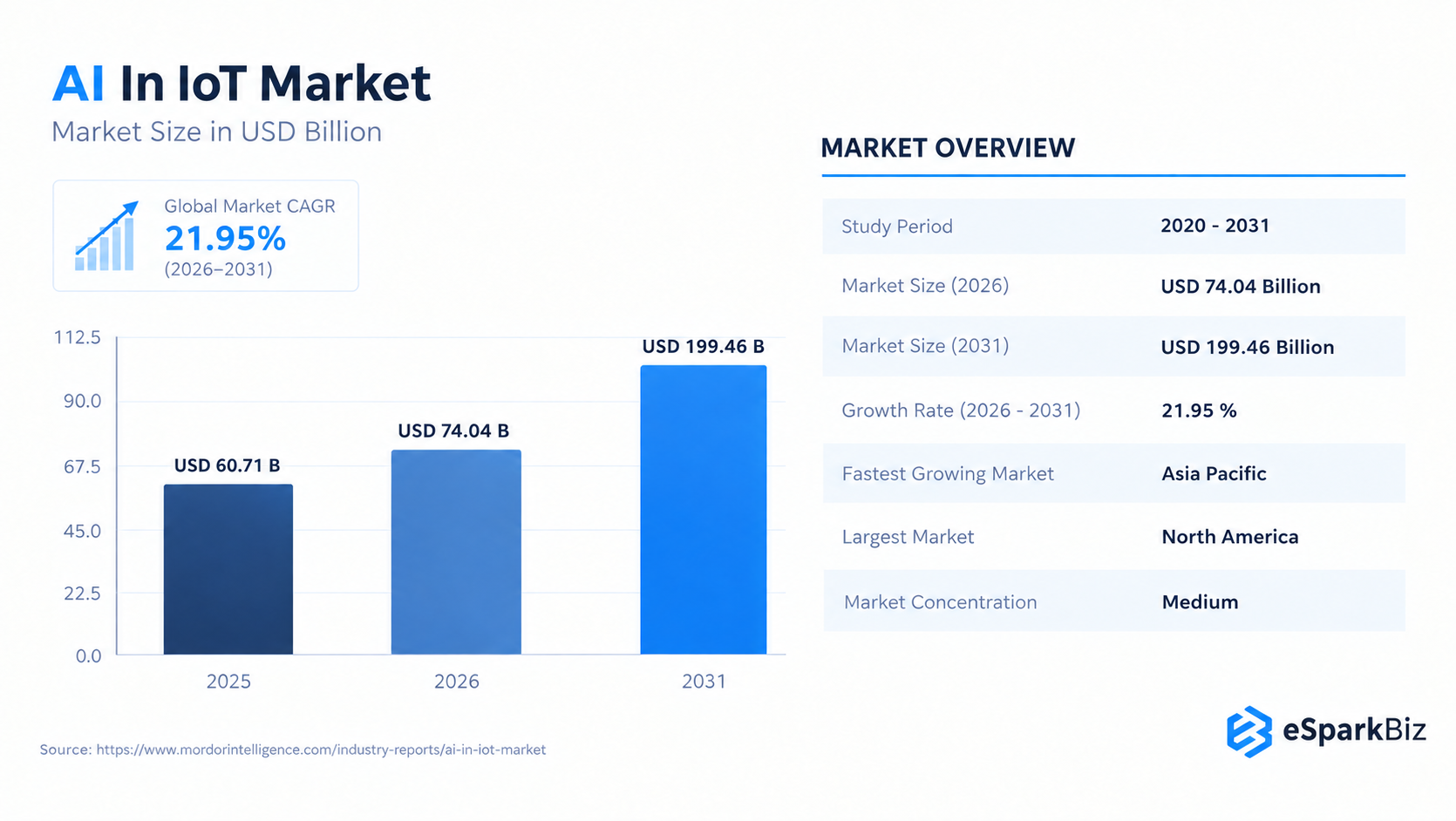
According to Mordor Intelligence, the AI in IoT market is projected to reach USD 199.46 billion by 2031, growing at a 21.95% CAGR.
Industrial IoT for Operational Performance and Resilience
Machine intelligence and constant monitoring of assets, combined with secure software, have the power to drastically cut unplanned downtime and nip production issues in the bud before they even reach the customer
The AI-Powered Industrial IoT Revolution
When machine data feeds the right analytics, AI-driven industrial IoT can turn that data into usable production insight for operations and asset teams.
Some of the key areas where it really makes a difference are:
- Catching quality problems as they happen on the line
- Spotting abnormal machine behavior
- Keeping equipment at peak performance
But the real value comes from using that AI insight in the thick of things – in the production workflows, not just stuck in an analytics platform somewhere
Connecting Assets and Keeping Them Up and Running
Connected assets are always pumping out new data that helps maintenance teams figure out when equipment is on the verge of breaking down before it does.
A good maintenance model should be all about:
Monitor equipment condition → Detect abnormal behavior → Predict failure → Act before it fails
It can make a huge difference in reducing downtime, but it all depends on how reliable your sensors are, how much history you’ve got on past maintenance, and whether your systems are all integrated properly.
The safest way to reach this model is a small pilot on a few machines before any plant-wide rollout.
- Pick three to five assets with frequent or costly failures.
- Record baseline numbers: downtime hours, repair cost, missed alerts.
- Fit sensors for the signals that matter, such as vibration, temperature or current.
- Decide what runs at the edge and what goes to the cloud.
- Set alert thresholds and name who acts on each alert.
- Review at 90 days and scale only if the baseline numbers moved.
A pilot of this size usually takes about 8 to 12 weeks to stand up before the review starts.
RTOS and Firmware: The Building Blocks for Industrial IoT Devices
RTOS and secure firmware provide the foundation for making sure those industrial IoT devices do their job without any hiccups.
But it’s crucial to consider things like:
- How reliable a device is going to be
- Making sure the system boots up properly and the firmware doesn’t get tampered with
- Being able to update the thing remotely
- Keeping hardware supported for a long time
If you don’t plan the firmware lifecycle properly, you’re going to end up with maintenance headaches and security risks as you scale out to more and more devices.
Systems that pass lab testing often struggle on site, so check these four before go-live:
- Signal strength at the actual install points, not only the office
- Power supply and battery life under real operating conditions
- Remote firmware updates with a rollback option
- Device provisioning done in bulk, not one unit at a time
What Engineers Say Actually Breaks at Scale
Reading through a Reddit thread with other IoT engineers is a pretty sobering experience – it shows you that the real problem isn’t edge versus cloud, it’s getting clean data, stable device IDs, and getting your updates in order at scale
Projects that stall after a pilot tend to trip on the same issues, and each has a practical fix.
| Why pilots stall | What fixes it |
| Systems don’t connect | Agree integration points with ERP and MES before the pilot |
| Unclear data ownership | Name one owner across IT, OT and operations |
| Alert fatigue | Start with fewer, higher-priority alerts |
| Security added late | Build identity and update controls into the pilot |
| No business KPI | Tie every sensor to one measurable result |
| Hardware lead times | Order devices early and phase the rollout |
| Scope growth | Lock pilot scope, then expand in stages |
How Connected Industries Are Changing IoT in Business
Connected technologies have found applications in healthcare, mobility, cities, energy, and logistics. These technologies enable organizations to make decisions quickly, operate more safely, see a clear picture, and optimize their resources.
Connected Healthcare and the Internet of Medical Things
Connected healthcare is a thing now, thanks to the Internet of Medical Things (IoMT), which combines medical devices, patient monitoring and all sorts of smart analytics.
Some of the key things it’s being used for include:
- Constant monitoring of patient health and vital signs
- Diagnostic assessment of med devices
- Detection of time-sensitive health conditions
Three healthcare uses tend to show results first:
| Use case | What it delivers |
| Remote patient monitoring | Earlier alerts on vitals, fewer routine visits |
| Medical asset tracking | Less time spent searching for equipment |
| Cold chain monitoring | Temperature records and alerts for vaccines and samples |
Health care professionals must balance the use of these technologies with the need for privacy, interoperability, and security.
Connected Vehicles and V2X
V2X technology allows vehicles to communicate with other vehicles, and with roadway infrastructure and facilities as well as with pedestrians and other adjacent users.
| Capability | Operational value |
| V2V communication | Collision awareness and safer driving |
| V2I communication | Traffic coordination and infrastructure awareness |
| V2N communication | Connected services and real-time information |
For drivers and passengers it’s like having an early warning system for potential hazards, better traffic awareness, safer routes and in-vehicle services that are always on the ball.
But adoption is all about getting all the different systems to play nice together, making sure connectivity is solid, keeping things safe and having standards that are consistent.
Smart Cities and Public Infrastructure
Smart city initiatives are all about linking up traffic systems, utilities, public infrastructure and municipal services to make them more responsive to what people need.
Some of the common uses include:
- Traffic management that’s smart enough to adapt to changing conditions
- Keeping an eye on how utilities are doing
- Monitoring infrastructure to make sure it’s in good nick
- Faster public services when people need them
But the biggest challenge is integrating all these connected systems with the old systems that are still in place – all while keeping people’s info private, secure and managing costs.
Energy, Logistics and Even Distributed Assets
Energy and logistics companies are all about managing assets that are scattered all over the place. Connected monitoring is making it a lot easier to keep an eye on the status of all that equipment, how it’s being used, exactly where it is – and what support it needs.
And when you tie that data in with the operational platforms, maintenance workflows and asset management systems, that’s when the magic really happens – it’s no longer just isolated systems, it’s a cohesive whole.
Inventory is often the easiest place to start. A business with several warehouses or stores can begin at one site with one measure, such as stockout rate.
| Setting | What to deploy | What to track |
| Warehouse | RFID tags or weight sensors, synced to the ERP | Stockouts, count accuracy |
| Retail shelf | Shelf sensors and foot-traffic counters | Out-of-stock time, conversion |
| Cold storage | Temperature and door sensors | Spoilage, compliance alerts |
Expert Insights
““The Internet of Things is creating a new world where everything is connected and can be controlled remotely.”
— Tim Cook, Executive chairman of Apple
Why Low-Power IoT Networks are gaining Ground in Industrial Use
Long-range, low-power connectivity paired with edge intelligence will help businesses handle IoT operational costs, increase lifespans of devices, avoid excessive data transfer and ensure proper deployment across distributed industrial environments.
Why IoT Security requires Continuous Lifecycle Governance
Protecting all those connected devices is a never-ending battle – it’s about making sure identity, firmware integrity, secure updates, monitoring and decommissioning are all taken care of all the time.
The Zero-Trust Approach for IoT
Zero trust for IoT assumes no device or connection can be trusted. Various access controls enforce least privilege and further restrict access based on device identity and point-to-point connections.
Segmentation of the network and the enforcement of policy further restricts communication. For wide area networks, a centralized approach for identity and policy management improves the scalability of the system while reducing the security administration burden.
RTOS and Firmware Security
The focus of RTOS and firmware security is the embedded layer, where the majority of persistent, long-term vulnerabilities exist.
Primary solutions to these problems include:
- The use of secure boot to allow only authorized software to be loaded and executed.
- Firmware signing and verification of integrity.
- Protected storage for secrets and cryptographic keys.
- Designs for secure updates and mechanisms for secure update delivery.
Update mechanisms affect the reliability of an update and the longevity of a product. Weakness in an update mechanism can result in unexpected maintenance costs for a product.
Device Identity and Lifecycle Security
Devices and assets are secured across their lifecycles by the controls integrated through provisioning, use, maintenance and removal.
Controls should consider:
| Lifecycle stage | Security priority |
| Provisioning | Unique identity and secure credentials |
| Authentication | Verify credentials using a certificate or private keys. |
| Operation | Monitor, control and detect abnormal activities. |
| Updates | OTA upgrade of firmware. |
| Retirement | Eliminate credentials using a secure method. |
Devices should be regularly assessed for security and updated. If control and ownership of a device is not clearly defined, an organization can be at risk of a persistent security and compliance violation.
Assessing IoT Maturity before Expanding Deployment
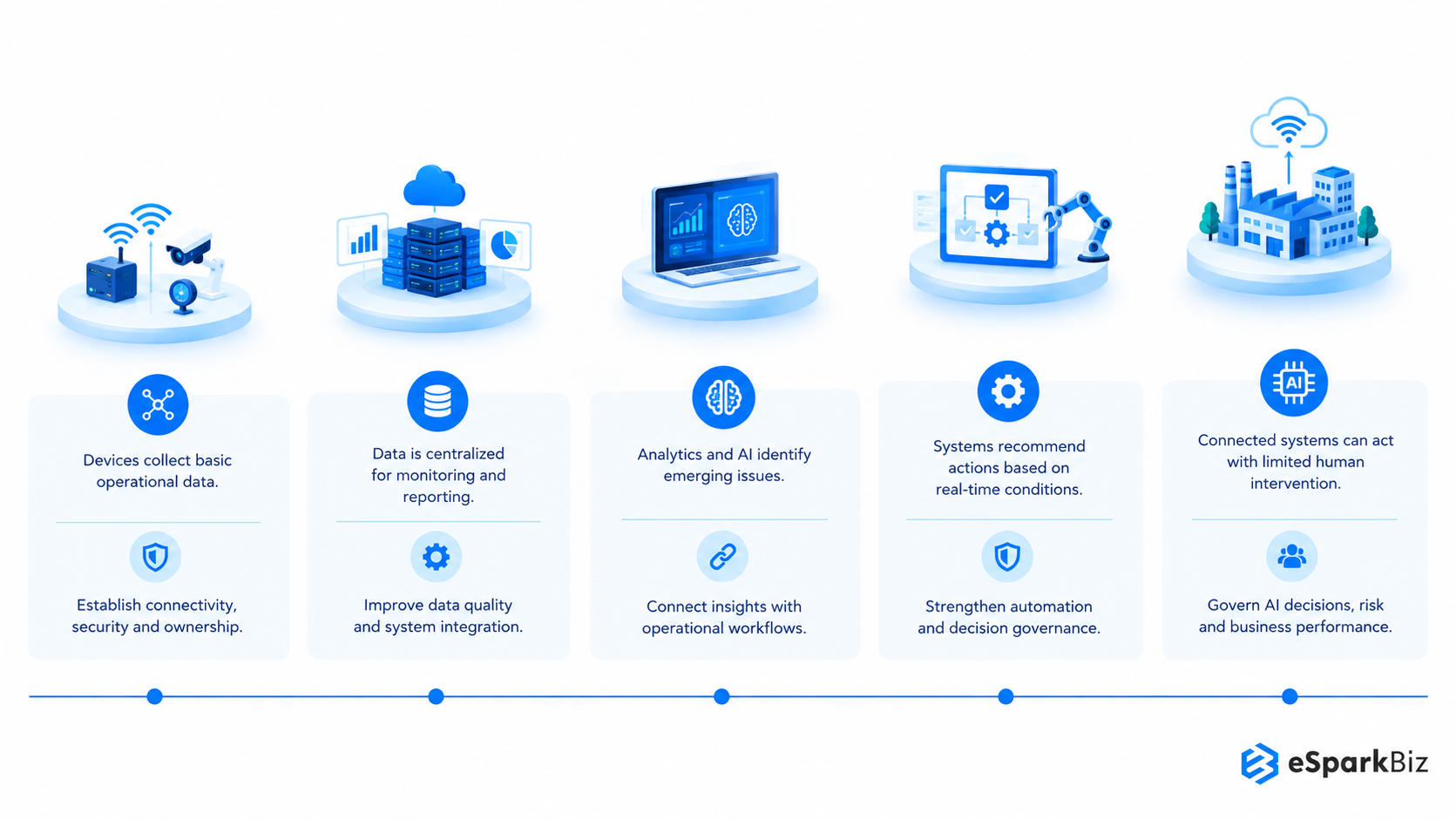
Many IoT programs struggle to progress beyond pilot projects because organizations lack clear ownership, connected data, measurable outcomes and a defined path toward wider adoption.
| Maturity Stage | Business Position | Leadership Priority |
| Connected | Basic operational data is captured by devices. | Provider connection and security, and ownership. |
| Visible | Data is centralized for monitoring and reporting. | Enhance data and system integration. |
| Predictive | Analytics and AI identify emerging issues. | Connect insights with operational workflows. |
| Prescriptive | Systems recommend actions based on real-time data. | Strengthen automation and decision governance. |
| Autonomous | Connected systems can act with limited human intervention. | Govern AI decisions, risk and business performance. |
This framework provides executive teams a means to understand their current situation when considering an increased investment. The focus is not to achieve complete automation and control. The goal is to automate to a degree that improves and adds value to the business.
What Challenges could Constrain Scalable IoT Transformation?
Various risks including security risks, fragmented technologies, complex lifecycles of IoT devices and costs and infrastructure limitations will challenge the large-scale implementation of the Internet of Things.
| Challenge | Description | Key Considerations |
| Security, Privacy and Regulatory Complexity | IoT expands attack surfaces and increases data protection requirements. | Identify, monitor and manage vulnerabilities; incorporate CRA and NIS2 reporting into your incident response strategy. |
| Fragmentation and Interoperability | Diverse devices, protocols and platforms complicate integration. | Use open standards, APIs and interoperability testing. |
| Device and Lifecycle Management Complexity | Large fleets require continuous updates, monitoring and maintenance. | Automate provisioning, OTA updates, inventory and secure retirement. |
| Connectivity, Cost and Scalability Constraints | Network limitations and rising operational costs can restrict expansion. | Evaluate coverage, power, connectivity, infrastructure and total lifecycle costs. |
As systems get more autonomous, many teams find their in-house skills thin on integration, edge or firmware work. Bringing in an outside partner makes sense at that point, and these checks help when comparing options.
| Check | What good looks like |
| ERP and MES integration | Proven connections to your existing systems |
| Engagement model | Clear discovery, pilot and rollout stages |
| Build flexibility | Can deliver custom builds, not only platform setups |
| Time zone fit | Defined overlap with US working hours |
| Ownership and IP | Plain contract terms on code, data and IP |
| Lifecycle support | Security updates and monitoring after launch |
eSparkBiz delivers IoT development services with 400+ engineers, covering edge AI, RTOS and firmware engineering, and secure device identity for US manufacturers. Work runs in phases, from discovery to pilot to rollout, with security updates and monitoring after launch, under ISO 27001-certified processes.
How did eSparkBiz reduce Hospitality Service Requests by 58% with IoT?
A European hospitality technology provider needed to connect smart-room devices, property-management systems and operational workflows within one platform.
eSparkBiz built a cloud-native IoT ecosystem combining BLE keyless entry, real-time telemetry, smart-room controls and centralized dashboards.
| Business Need | eSparkBiz Approach | Result |
| Fragmented room operations | IoT-enabled automation | 58% fewer service requests |
| Delayed staff response | Real-time telemetry | Faster response |
| Limited operational visibility | Centralized dashboards | Increased Efficiency |
Key implementation areas:
- Cloud-native Progressive Web Apps (PWAs)
- BLE-based Smart Access
- Real Time Monitoring of IoT Devices
- Integrations with Property Management Systems (PMS)
- Single, Centralized Control of Operations
Delivered within six months, the platform connected physical hotel infrastructure with digital workflows, giving management better operational visibility while reducing routine service demand.
For more reliable stories, visit the eSparkBiz Portfolio
Conclusion
IoT’s next phase will be defined by intelligent decisions, autonomous operations, resilient connectivity and lifecycle security rather than device volume alone. Organizations should prioritize IoT use cases that deliver measurable operational value, then build around scalable architecture, interoperability and governance.
Frequently Asked Questions
What IoT Challenges do Enterprises Commonly face When Scaling Connected Devices?
Enterprises often struggle with device interoperability, fragmented data, rising infrastructure costs, connectivity gaps and security risks as IoT deployments scale.
How can Businesses manage IoT Data without Increasing Cloud Costs?
Businesses can use edge computing to process time-sensitive IoT data locally, reducing unnecessary data transfers, bandwidth consumption, cloud workloads and operating costs.
What Security Risks increase as Enterprise IoT Deployments Expand?
Large IoT deployments increase risks from weak device identities, outdated firmware, unauthorized access, exposed endpoints and inconsistent security controls across device fleets.
How can Businesses maintain Reliable IoT Connectivity across Remote Operations?
Businesses can combine cellular, LPWAN, satellite connectivity and eSIM technologies to maintain reliable IoT communication across geographically distributed and remote environments.
Where does eSparkBiz address Enterprise IoT Scalability Challenges?
eSparkBiz addresses IoT scalability challenges through connected systems designed to support growing device volumes, distributed processing requirements and changing operational demands.
What Impact will AI and Edge Computing have on Enterprise IoT?
AI and edge computing will move enterprise IoT toward real-time intelligence, enabling systems to interpret data locally, automate decisions, predict issues and respond faster.
When Should Businesses Bring In an Outside IoT Development Partner?
Bring one in when pilots need ERP or MES integration, edge or firmware skills are missing in-house, or timelines keep slipping. A partner shortens discovery, pilot and rollout.
How Does eSparkBiz Work With US Teams on IoT Projects?
Teams get a dedicated squad, agreed overlap hours with US time zones, clear contract and IP terms, and phased delivery from discovery to rollout, for manufacturing and healthcare projects.
Which Architecture Mistakes Hurt Most When IoT Scales to Thousands of Devices?
Weak device identity, no edge filtering, an undersized message broker and unversioned data schemas. Fixing these early avoids costly rework once fleets grow past the pilot.