ChatGPT
 Google AI
 Perplexity
 Claude.ai
Technology executives must reduce operational risk, secure their mission-critical technologies and stay within compliance. Here is the guide that outlines key threats, security safeguards, procurement policies, budget motivators and action steps for connected systems, to enable your organization to move forward with clarity and direction.
One unmanaged IoT device becomes an entry point to critical infrastructure, interrupts normal operations and lies dormant without any owner. The unmanaged camera or sensor acts as a backdoor into the operational network.
Connected environments keep growing and old firmware, unsupported hardware, split ownership and slow patching make risks harder to control. Technavio reports the IoT security market to grow by USD 130.21 billion by 2030, at a 20.8% CAGR.
IoT security secures connected devices, their associated networks and the cloud services supporting them. This involves securing the device lifecycle from design and firmware to monitoring and decommissioning. This guide discusses threats, compliance, virtual patching, segmentation, budgeting and next steps.
Why Is IoT Security Now a Board-Level Concern?
IoT exposure impacts continuity, finance and regulatory readiness. Every security investment should be linked to its business value, rather than the number of tools in place.
Three key risks need attention:
- Operational resilience: A compromised controller or building system can disrupt critical services.
- Financial exposure: Incident response, hardware replacement and downtime can cost much more than preventive steps.
- Governance: Unclear ownership slows patching, vendor escalation and incident reporting.
Prioritize remediation according to exploitability, business criticality and compensating controls. Find material exposure, rank the fixes and give every remaining risk an owner.
Device Security Weaknesses That Put Operations at Risk
Device vulnerabilities could cause exposure of data, interference with processes and higher repair costs. Prioritize based on exploitability, significance of the device, network connectivity and availability of compensating controls.
Unpatched and End-of-Life Devices
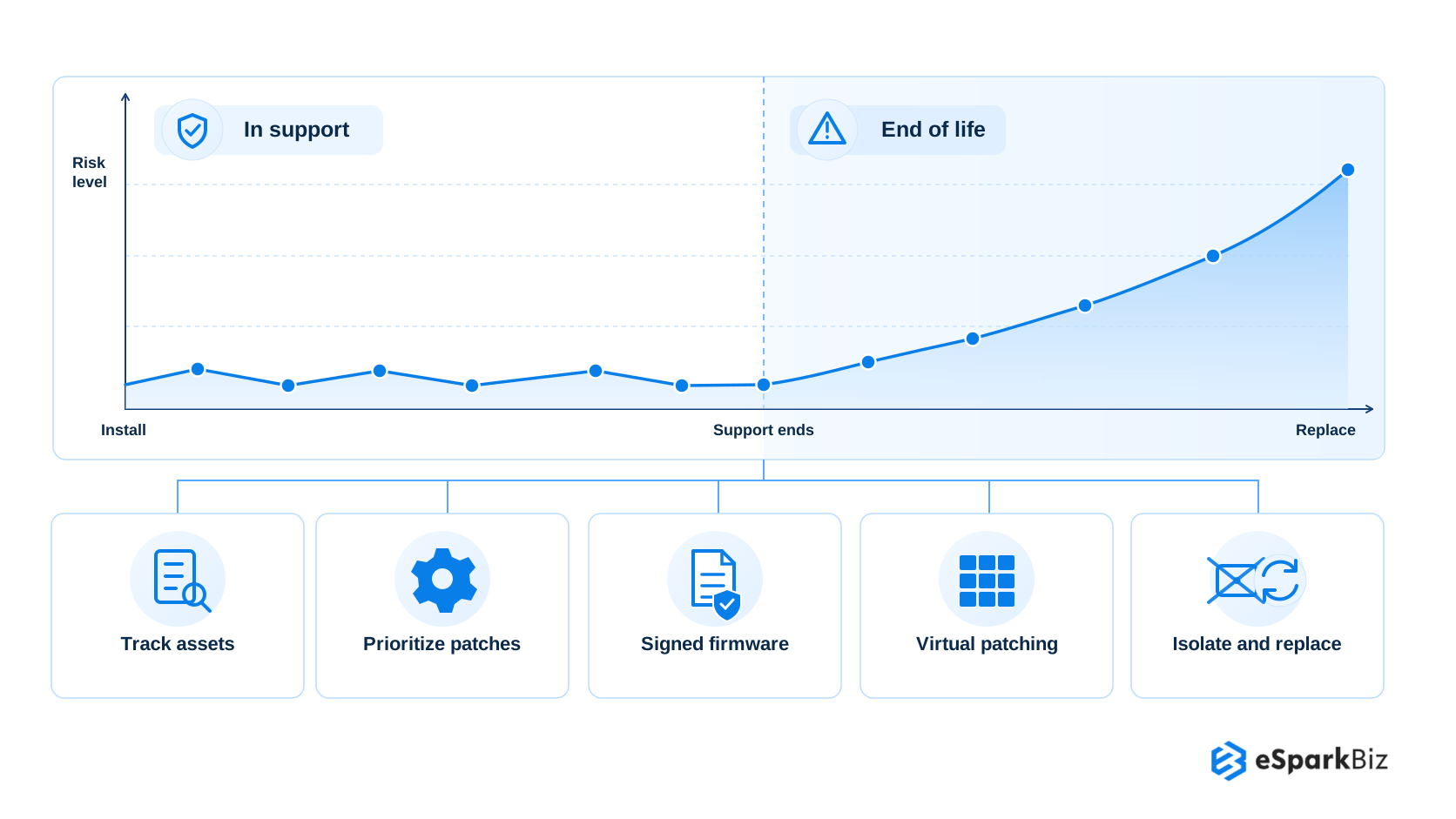
IoT devices are frequently used beyond their support lifetime from the device manufacturer. It may be hard to update IoT devices because they are deployed at remote locations, have to be operational all the time or use unsigned firmware.
Recommended controls:
- Track device models, firmware versions and support dates.
- Prioritize patches by risk and business impact.
- Sign updates and verify them at startup.
- Prevent devices from using older firmware.
- Store signing keys in a hardware security module.
- Apply virtual patches and isolate devices awaiting replacement.
Weak Credentials
Many devices have default/shared passwords that tend to be listed in public areas. An attacker can try the passwords in thousands of devices in just a few minutes and one compromised password would expose all other devices with the same model.
Solution:
- Assign each device a unique password before deployment.
- Remove default accounts, disable unnecessary remote access and limit admin access to authorized users.
If the weak password is in a product you ship:
- Assign a contact to acknowledge security reports within a few business days.
- Replace shared root passwords with unique device passwords through a signed update.
- Require authentication for local video feeds and management services.
- Publish a security notice and reporting email so researchers can contact the right team.
Insecure Communication and Weak Device Identity
Encryption in many IoT devices is not efficient all the time and traditional means of communication may be exploitable too easily. Missing, expired or shared security certificates make it more difficult to authenticate devices.
Recommended controls:
- Encrypt all data and use up-to-date communication protocols.
- Assign a unique certificate or security key to each device.
- Place devices that cannot communicate securely in an isolated network zone.
How Device Risks Turn Into Business Impact
| Threat | Business impact | Owner | KPI |
| Unpatched devices | Operational downtime | Head of IT Operations | Devices past support date |
| Default credentials | Unauthorized access and data loss | CISO | Devices with unique credentials |
| Flat network | Breaches spreading to core systems | CTO | Segmented device share |
| Shadow IoT | Unknown risks and audit gaps | CISO | Inventory coverage |
How Does Lack of Visibility and Networking Increase Your Vulnerability?
Poor visibility into the connected devices and boundaries of networks becomes a challenge when trying to identify any threats or controlling the access to such devices.
Hidden Devices and Shadow IoT
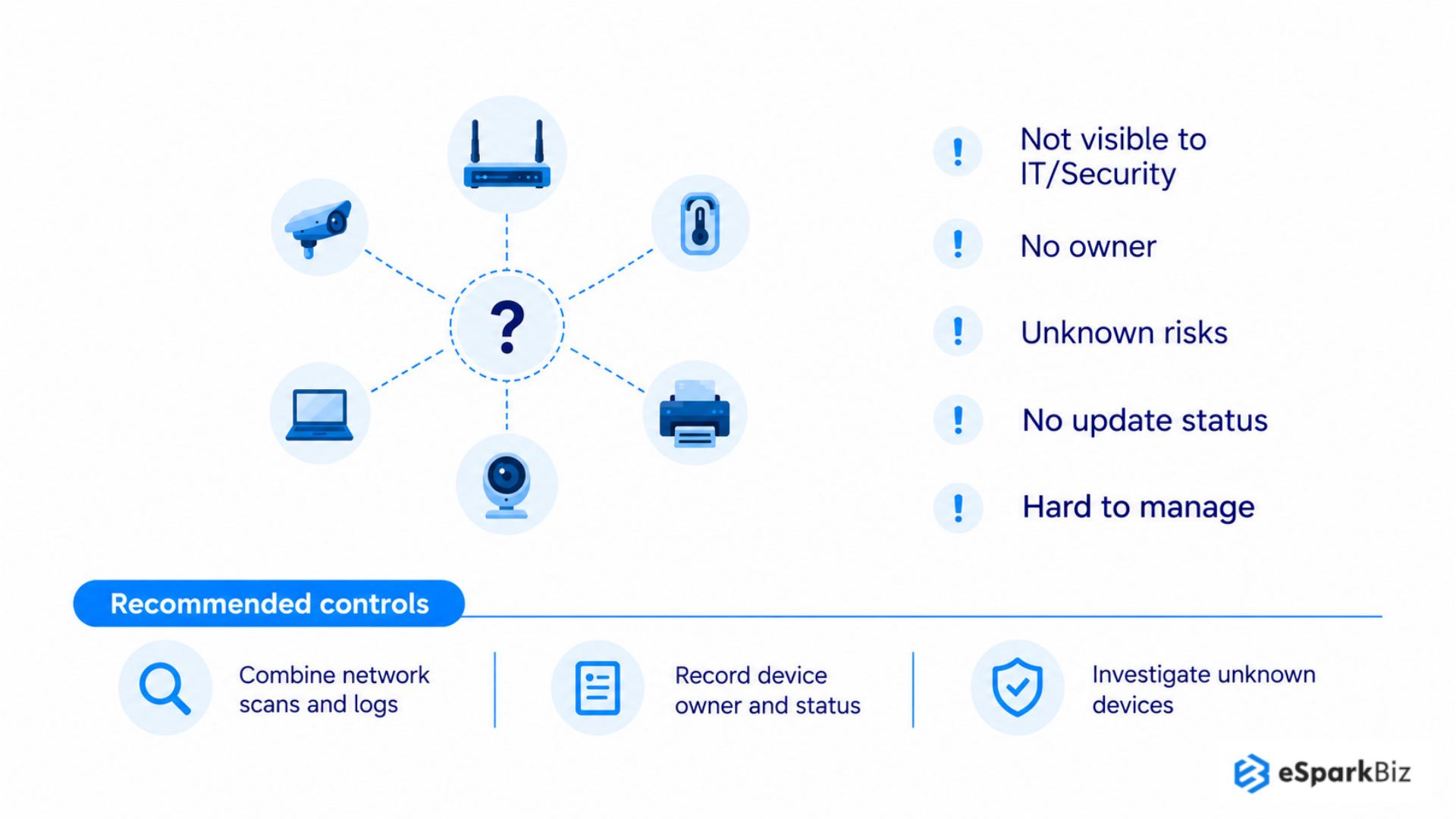
Shadow IoT refers to devices connected to a network without approval from IT or the security team. Examples include cameras, sensors and contractor devices. Without a complete device list, teams may struggle to find security gaps and track available updates.
Recommended controls:
- Scan networks, review DHCP logs and wireless controller data and monitor network traffic.
- Record each device’s owner, location, firmware version and support details.
- Assess unknown devices before granting network access.
Flat Networks and Lateral Movement
Flat networks provide connectivity between devices, thus allowing the attacker to jump from one compromised IoT device to another critical system. VLANs are helpful, but open routing policies compromise this isolation.
Segment the IoT devices based on their function, restrict any unnecessary traffic and outgoing communication, monitor interactions between segments and gradually implement zero trust validation for each IoT device.
IT and OT Convergence Risk Botnet and DDoS Abuse
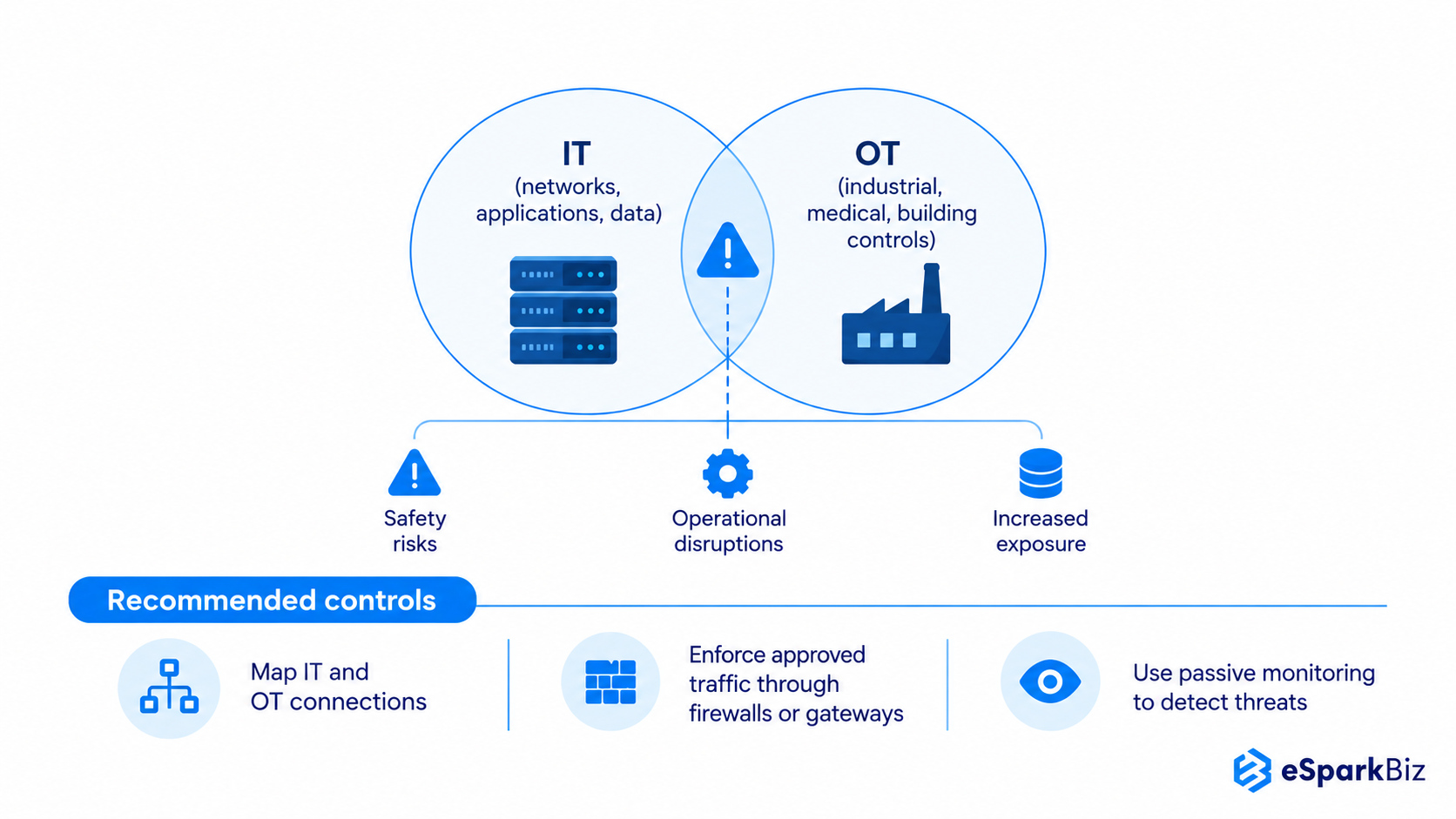
The integration of IT and OT connects industrial systems, medical devices and building management systems to corporate networks. Legacy software and delayed patching increase security risks that can threaten patient safety and disrupt operations.
What to do:
- Map connections between IT and OT networks.
- Restrict traffic to only approved data via firewalls or gateways.
- Detect potential attacks through passive monitoring.
IoT Breaches Start with Ordinary Gaps
According to Reddit threads, IoT attacks usually occur from small errors. Poor password protection, port openings, outdated software and unmonitored devices enable cybercriminals to easily enter the system. Separate devices, control access and monitor any suspicious activity.
Is a VLAN Enough, or Do You Need Zero Trust for IoT?
A VLAN provides some form of basic separation but does not provide complete protection against attacks. Implement firewall policies as well as zero trust to prevent lateral movement by attackers.
Start with vulnerable devices, apply NAC to detect devices without having to manually find them out.
| Approach | Strength | Limitation | Best fit |
| VLAN | Easy and economical | Routing can reduce the isolation effect | Basic network segmentation |
| Firewall zones | Controlled traffic between segments | Rule sprawl over time | Most business sites |
| Zero trust with NAC | Ensures validation of the device’s identity | May not support legacy devices | High-risk or regulated estates |
How to Secure IoT Networks
- Inventory devices: identify managed, unmanaged and shadow IoT.
- Create zones: Separate cameras, sensors, enterprise systems and industrial control systems based on risk.
- Deny by default: Allow only documented connections to approved hosts and ports.
- Restrict outbound traffic: Permit only documented communications to known hosts and ports.
- Test and monitor: Test workflow procedures, analyze firewall logs and document exceptions.
How Do Supply Chain and Outside Threats Affect Continuity?
Risk may begin outside your organization in the components, software and services utilized by the devices themselves. Such risks can pose threats to devices both before and after their deployment.
Supply Chain and Component Integrity
IoT supply chains introduce risks through insecure firmware, counterfeit components, vulnerable libraries and compromised cloud services or APIs.
Recommended controls:
- Ask vendors to be clear about component origins and updates.
- Test device security independently.
- Investigate cloud, API, firmware and app dependencies before purchase.
Botnet and DDoS Abuse
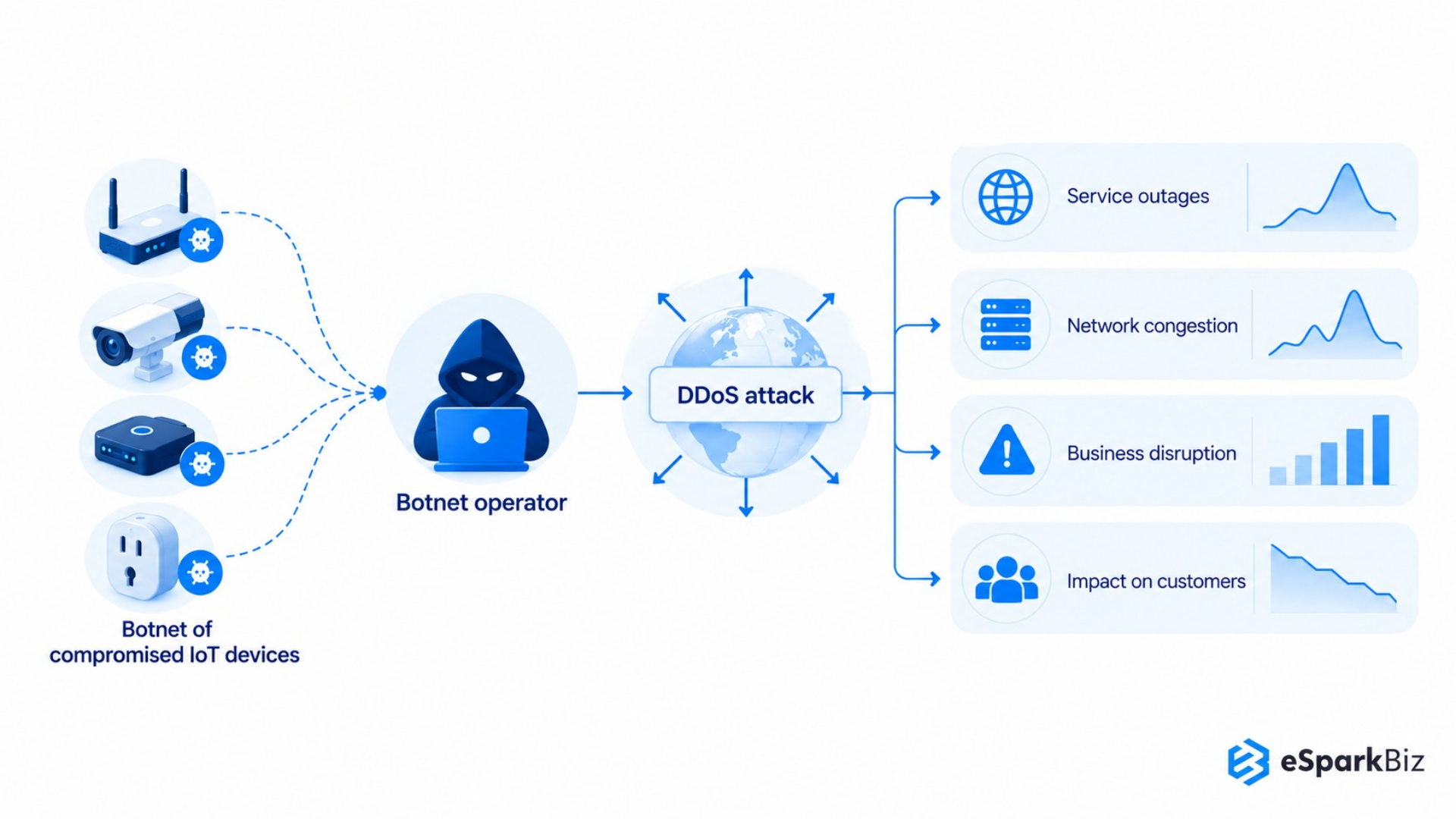
Botnets utilize vulnerable Internet of Things devices to carry out DDoS attacks and traverse the network. Such things include cheap TV boxes and cameras with exposed debugging capabilities. Neutralizing the botnet operator does not mean eliminating the infection.
What should be done:
- Turn off exposed debugging and remote access
- Reduce outbound traffic and segment networks
- Replace vulnerable devices
- Comply with vendor security requirements
- Detect unusual traffic and connections
Where Do Governance and Compliance Gaps Slow You Down?
Technical controls are ineffective without accountability. Such gaps hinder your response time, make audits difficult and increase legal and financial exposure if there is ever a breach.
Unclear Ownership and Compliance Gaps
IoT security tasks are shared among IT, operations and vendor teams, making patching and incident response slower. The EU Cyber Resilience Act mandates certain legal obligations on manufacturers, including reporting when vulnerabilities are under exploitation.
What to do:
- Assign ownership for patching, monitoring and incident response.
- Specify contractual obligations for vulnerability disclosure and firmware support.
- Recognize applicable laws and standards.
- Specify escalation procedures, reporting responsibilities and risk reviews.
Regulatory Deadlines to Track
| Regulation | Key date | What it means |
| EU Cyber Resilience Act | Reporting duties begin 11 September 2026; full obligations apply from 11 December 2027 | Manufacturers must report exploited vulnerabilities and ensure products meet security requirements. |
| UK PSTI Act | In force since 29 April 2024 | Bans universal default passwords on consumer devices |
| NIS2 Directive | Member state transposition deadline: 17 October 2024 | Important entities must handle supply chain and incident risks |
Security Skills and Monitoring Gaps
IoT devices generate minimal logging information and are not capable of running security agents. With no baseline behavior, a compromised device will operate undetected while attention is paid to laptops and servers.
Watch for unusual outbound activity, suspicious connections and behavioral changes on devices. Route actionable alerts into existing security systems and identify who will respond and how to safely isolate devices.
Which Standards Should You Map To?
Align standards based on the device, environment and legal jurisdiction, then check their legality separately.
| Standard or framework | Best for |
| ETSI EN 303 645 | IoT device security baselines, which include passwords and handling vulnerabilities. |
| NIST IR 8259 Rev. 1 | Manufacturing processes related to product security, customer relations, maintenance and support. |
| IEC 62443 | Securing industrial IoT and operational technology. |
| ISO/IEC 27001 | Information security management across an organization. |
| OWASP IoT Top 10 | Identifying weaknesses in IoT devices during development and testing. |
Expert View
“Any IoT device that can’t be updated is vulnerable. And, probably, any IoT device that can be updated is also vulnerable.”
Bruce Schneier – Cryptographer and Security Professional
How Do You Choose IoT Security Solutions, Buy Safely and Budget?
Consider what is visible and controllable and then look at vendor support periods and running costs. Assess each control based on fleet scale, site diversity, integration complexity and the availability of support through the life cycle of the control.
What to Look For
- Device visibility: Shows which devices are managed, unmanaged or shadow.
- Segmentation: Restricts traffic between different segments of your network.
- Anomaly detection: Alerts on anything suspicious in order to secure the environment.
- Update tracking: Tracks patches and end-of-life dates.
Build, Buy, or Managed Service
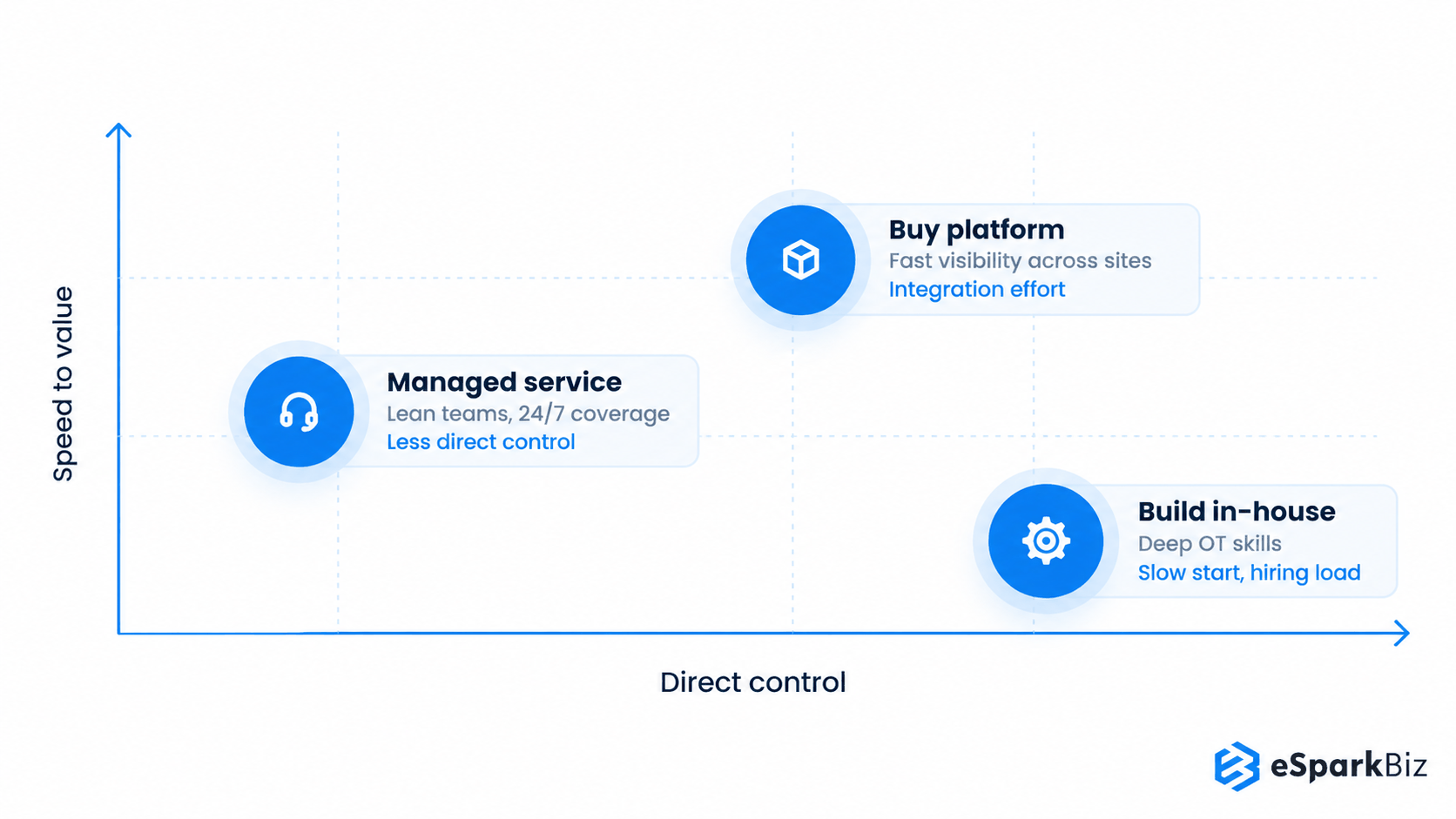
| Model | Best for | Trade-off |
| Build in-house | Teams with strong OT expertise | Longer setup and hiring effort |
| Buy platform | Gaining quick visibility across sites | Requires integration work |
| Managed service | Small teams that need 24/7 coverage | Less direct control |
| Engineering partner | Product teams with fixed launch dates and no in-house security specialist | Requires clear IP ownership and approval terms |
What to Put in a Contract or RFP
Request the following in writing from vendors:
- Support for the firmware and patch release schedules.
- Device-specific credentials, signed firmware and secure booting capabilities.
- Information on a vulnerability reporting point and an SBOM.
- Notice in advance of end-of-support and migration assistance.
- Compliance with CRA requirements for products sold in the EU.
What Drives Costs
| Cost area | Budget for | Cost driver |
| Devices and tools | Licenses, integration | Size of the Fleet, number of sites |
| Segmentation and Monitoring | Engineering, personnel, alerts | Complexity of Network |
| Unsupported devices | Replacement, migration | Share past end of support |
| Compliance | Risk Assessment, Fixes | Markets and sectors served |
| Product security build | Secure boot, signed updates, device certificates | Hardware choice, fleet already in the field or pre-launch |
| Security testing | Penetration testing, firmware review, retests | Number of devices, Cloud Endpoints |
Compare lifecycle costs with the risks each investment reduces.
With 15+ years of experience and 1,000+ projects delivered, eSparkBiz is a product engineering and AI development company offering technology consulting and IoT app development to build secure, reliable connected solutions.
What Should You Do When an IoT Device Is Compromised?
Contain the threat first, then investigate. AI speeds up detection, but people must make the decisions. Follow these seven steps to limit damage and restore safe operations.
- Confirm the incident: Review AI alerts, device activity and network logs. Have an analyst verify the threat.
- Isolate the device: Block network access without disrupting safety functions.
- Preserve evidence: Save logs, timestamps and configuration records.
- Assess exposure: Use AI-assisted analysis to identify exposed data, accessible systems and lateral movement.
- Reset or replace: Restore trusted firmware or retire devices with uncertain integrity.
- Rotate credentials: Change exposed passwords, keys and certificates.
- Report and recover: Notify leadership, update detection baselines and meet reporting requirements.
Set clear escalation timelines for the CISO, legal and operations teams. Keep a person responsible for containment to prevent automated tools from blocking safety-critical devices.
Did You Know?
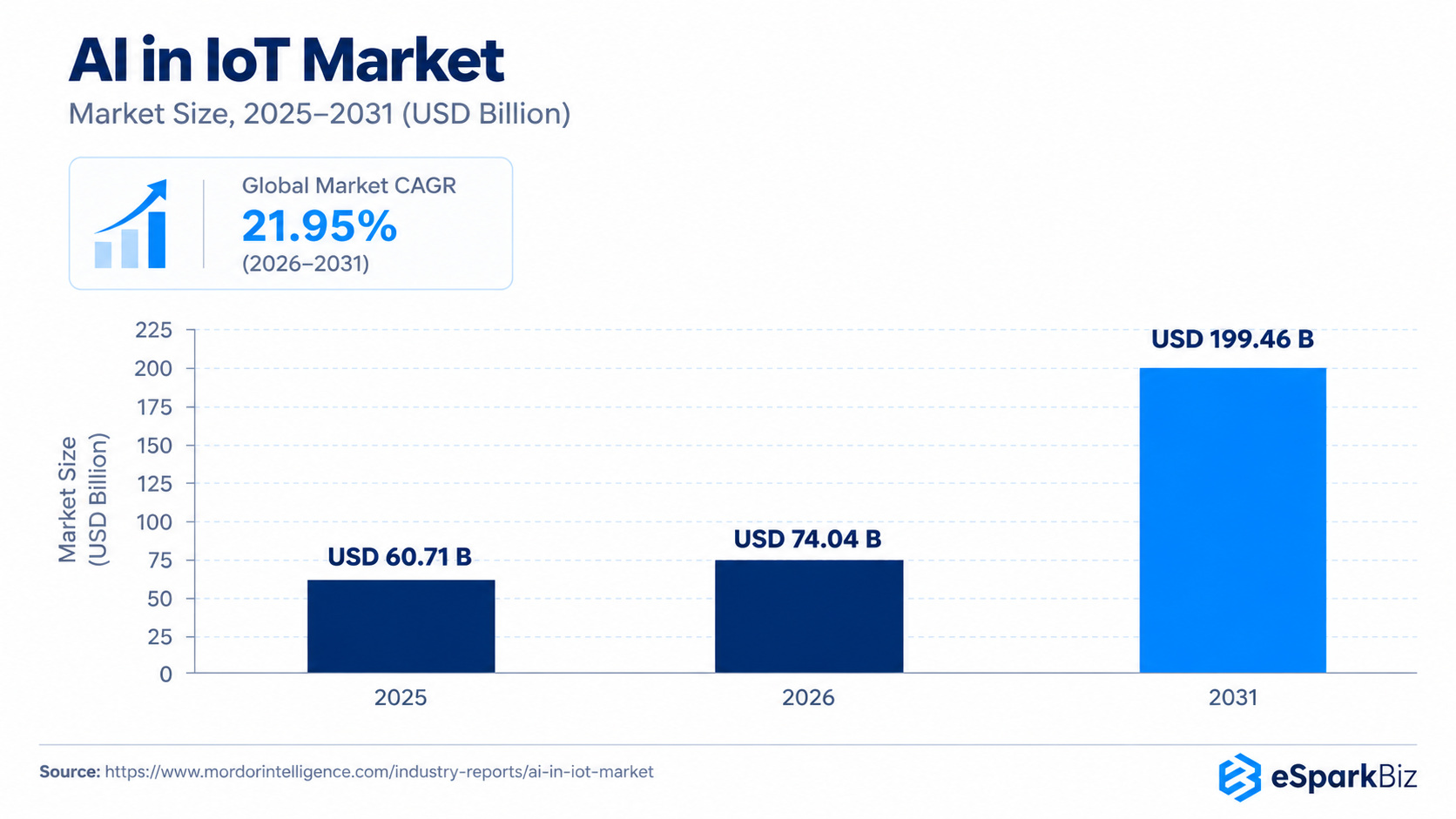
According to Mordor Intelligence, the AI in IoT market is projected to reach USD 199.46 billion by 2031, growing at a 21.95% CAGR.
Which IoT Security Best Practices Should You Start With?
Classify risk levels based on exposure, business impact and feasibility of resolution. Utilize the following procedures for ownership assignment and tracking progress.
- Track all devices: Assess coverage and discover unknown systems.
- Fix critical risks: Monitor unsupported systems, known weaknesses and missing patches.
- Control network access: Assess segmentation effectiveness and unauthorized access attempts.
- Manage device lifecycles: Monitor patching, support period and exceptions.
- Review vendors: Examine security assurances and firmware support periods.
- Monitor threats: Evaluate reaction and containment time performance.
- Test recovery plans: Exercise incident response processes and record post-incident activities.
Assess these measures periodically with your security and operations departments. Use risk-based criteria to set targets and not just arbitrary figures.
IoT Security Build Checklist
For connected product development teams, use the checklist in this sequence:
- Design: Identify risks that the device poses to cloud APIs before writing any code.
- Identity: Assign a unique key/certificate for every device and provision it in a secure element whenever possible.
- Hardening: Secure boot, disable debug interfaces and eliminate default passwords.
- Updates: Perform updates through the air with a rollback facility using signed firmware.
- Cloud security: Authentication, API permissions and logging of access.
- Testing and support: Use OWASP IoT Top 10 and ETSI EN 303 645 and set support duration.
How eSparkBiz Helped to Reduce IoT Security Risks by 30%?
The organisation struggled to track IoT devices and maintain regular firmware updates. eSparkBiz addressed these issues by improving device tracking, separating network segments and managing firmware updates.
| Business Challenge | eSparkBiz Intervention |
| Unmanaged devices | Monitoring Devices with designated owners |
| IoT network of mixed types | Segmented from critical systems |
| Inconsistent Firmware updates | Firmware update scheduling and vendor tracking |
The Approach
eSparkBiz delivered hands-on device tracking, network segmentation and firmware lifecycle management.
Results from the execution:
- 30% cut in identified risks
- More accountable teams
- Better protected operations
The real value was a clear, repeatable security routine. For projects like this, review eSparkBiz portfolio.
Conclusion
IoT security requires ongoing attention to device visibility, secure configurations, network segmentation, lifecycle management and clear ownership. Prioritize risks by business impact, set strong supplier requirements and track fixes. Regular monitoring and security reviews help reduce threats, protect operations and meet compliance requirements.
Frequently Asked Questions
What are the main IoT security challenges?
The main challenges include outdated firmware, weak passwords, unknown devices, flat networks, unsafe suppliers, limited monitoring and unclear ownership across complex business settings.
How can I find every IoT device on my network?
Use passive monitoring, regular network scans, DHCP records and controller logs. Match the results with your asset list, then assign owners and risk levels.
How can I secure IoT devices that cannot receive patches?
Limit traffic, isolate at-risk devices, use tested safeguards and plan replacements. Keep operational safety in mind whenever you change network access.
How should I choose an IoT security vendor?
Review asset discovery, segmentation, lifecycle tracking, monitoring and support. Test shortlisted platforms with typical devices and clear requirements before making a purchase.
Who handles IoT security: the manufacturer or the buyer?
Both share security responsibilities. Manufacturers manage product security and support, while buyers oversee purchasing, setup, access, monitoring and retirement. Legal duties vary by applicable law.
What should an IoT security RFP include?
Ask for support periods, update schedules, secure firmware, vulnerability reporting, SBOM access, end-of-support notices, integration needs and incident response support before signing.
How much does IoT security cost?
Securing an existing fleet costs $10,000 to $50,000. Adding secure boot, signed updates and device certificates to a product costs more, often starting at $60,000, based on hardware and scope.
What should I do if someone compromises an IoT device?
Restrict network access safely, save evidence, check lateral movement, change exposed credentials, restore trusted firmware or replace the device, then monitor recovery.
Does AI-based IoT threat detection work?
AI can flag unusual activity, but results depend on data quality, baselines and testing. It cannot replace human review and preventive safeguards.
What evidence should I request from an IoT development partner?
Request examples of IoT products with secure boot or signed updates, a redacted threat model, independent penetration test reports, an SBOM, a vulnerability process and clear post-launch support terms in writing.