
 ChatGPT
 Google AI
 Perplexity
 Claude.ai
Europe is becoming a hotbed for blockchain innovation, attracting enterprise solutions and startups looking to build safe, scalable digital infrastructure while adhering to EU regulations. Companies are looking for specialized talent to implement DeFi, smart contracts and cross-chain applications across multiple industries.
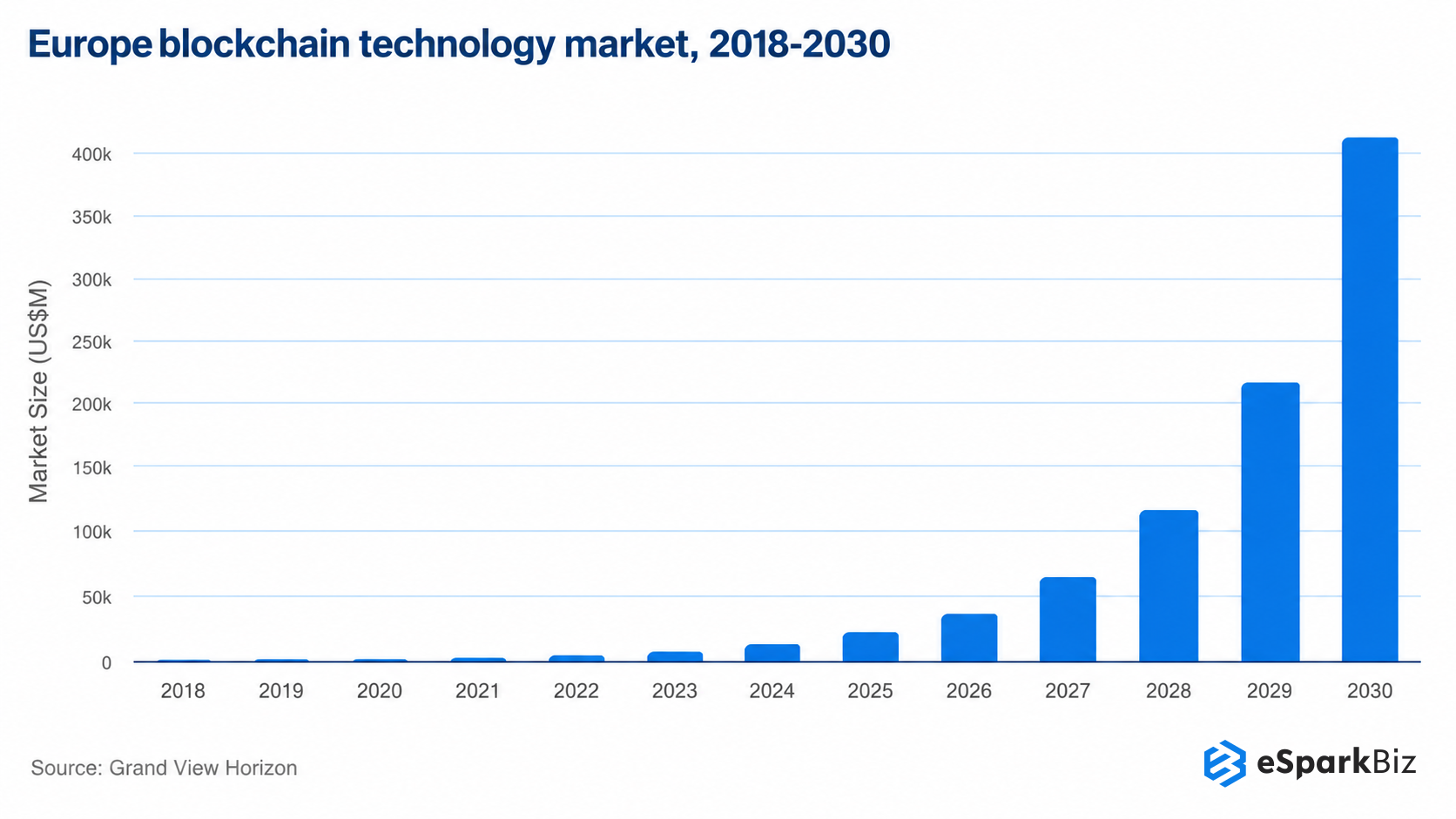
According to Grand View Horizon, the blockchain technology market in Europe will reach US$ 412,282.2 million by 2030. This guide lists the top blockchain developers in Europe, including established companies, emerging innovators and freelance platforms.
How We Selected These Blockchain Development Companies and Hiring Platforms
We analyzed 100+ blockchain companies and hiring platforms, applying filters for technical capabilities, project experience, industry relevance, pricing and ratings. This process helped us shortlist six companies and four platforms for comparison.
For blockchain development companies, we considered:
- Technical capabilities: Blockchain technologies, smart contracts, dApps, DeFi, tokenization, and related services.
- Published project experience: Projects and case studies mentioned in company profiles.
- Industry relevance: Capabilities and examples relevant to industries covered in this article.
- Company details: Published locations, team sizes, founding years, and service strengths.
- Pricing and ratings: Available hourly rates and Clutch ratings included in the comparison table.
For hiring platforms, we compared their listed pricing models, G2 ratings, platform types, and hiring options.
Editorial disclosure: eSparkBiz is the publisher of this article and is included among the companies reviewed. The comparison is based on the information presented in this article and should not be interpreted as an independent technical audit or a definitive ranking.
Why Europe Is Becoming a Hub for Blockchain Development?
Europe has top blockchain talent and innovative companies, assured solutions and growth for startups and enterprise adoption.
- Talent Pool: Experienced developers for DeFi, NFTs and dApps across multiple industries.
- Regulatory Advantage: MiCA and GDPR for blockchain development services Europe.
- Innovation Clusters: Germany, UK, Switzerland and Estonia for cutting-edge projects and collaborative ecosystems.
- Enterprise Adoption: BFSI, healthcare and supply chain sectors implementing blockchain for transparency and efficiency.
📚 Also Read: Clutch Ranked eSparkBiz as the Best IT Outsourcing Company in India
Best Blockchain Development Companies: Pricing, Ratings and Key Strength
Compare leading blockchain development companies by ratings, hourly rates, technical expertise, and location to identify suitable partners for Ethereum, smart contracts, DeFi, and enterprise blockchain projects.
| Sr. No. | Company Name | Clutch Rating | Typical Hourly Rate | Founded Year | Type | Key Strength | Location |
| 1 | LimeChain | 4.9 | $50 – $99 | 2017 | Enterprise Firm | Enterprise grade blockchain solutions | Sofia, Bulgaria |
| 2 | Debut Infotech | 4.9 | $25 – $49 | 2011 | Enterprise Firm | Custom dApp and DeFi development | England |
| 3 | Concise Software | 4.7 | $50 – $99 | 2011 | Mid size Innovator | Blockchain and custom software development | Poland |
| 4 | PixelPlex | 4.9 | $50 – $99 | 2007 | Mid-size Innovator | Blockchain apps for startups and enterprises | Poland |
| 5 | eSparkBiz | 4.9 | < $25 | 2010 | Mid size Innovator | Verified blockchain solutions for global clients | Delaware USA & India (Global Delivery) |
| 6 | Eva Codes | 5.0 | $25 – $49 | 2019 | Mid size Innovator | Custom smart contracts and NFT platforms | Poland |
Let’s look at each company’s blockchain expertise, tech stack, team size, and project suitability to help you choose a provider that aligns with your technical and business needs.
1. LimeChain
LimeChain is a blockchain development company founded in 2017 and headquartered in Sofia, Bulgaria. It works with Web3 startups, protocols, and established businesses on blockchain infrastructure and decentralized applications.
Its services include smart contract development, DeFi applications, blockchain consulting, and Layer 1 and rollup infrastructure. The company reports more than 250 completed blockchain projects.
Tech Stack: Ethereum, Polygon, Solana, Cosmos, Hyperledger, Solidity, and related blockchain technologies.
Team Size: 50 – 249
Why Choose LimeChain?
- Specialized blockchain and Web3 expertise.
- Experience with protocols, rollups, and decentralized applications.
- Services covering technical consulting and implementation.
Best Fit For: Businesses building DeFi products, dApps, blockchain infrastructure, or protocol-level solutions.
2. Debut Infotech
Debut Infotech is a software development company founded in 2011 that serves startups and established businesses. Its services cover blockchain development, product engineering, cloud infrastructure, and AI solutions.
Its blockchain services include smart contracts, tokenization, cryptocurrency wallets, exchanges, and decentralized finance applications. The company also offers experience with enterprise blockchain frameworks such as Hyperledger Fabric and Corda.
Tech Stack: Solidity, Rust, Vyper, Hardhat, Foundry, Ethereum development tools, Web3.js, Ethers.js, and Hyperledger Fabric-related technologies.
Team Size: 50 – 249
Why Choose Debut Infotech?
- Covers dApps, smart contracts, and tokenization.
- Experience with enterprise blockchain frameworks.
- Combines blockchain development with broader software engineering services.
Best Fit For: Businesses building tokenization platforms, DeFi applications, cryptocurrency products, or permissioned enterprise blockchain systems.
3. Concise Software
Concise Software is a custom software development company with offices in Poland, Germany, and the United States. It provides engineering services for startups and established businesses, including blockchain development and smart contract implementation.
Its blockchain work includes Ethereum-based dApps, token systems, cryptocurrency wallets, payment solutions, and custom blockchain applications. The company has also published a case study about its work with Neufund, a blockchain-based equity fundraising platform.
Tech Stack: Ethereum, Solidity, Hyperledger Fabric, and related blockchain technologies.
Team Size: 50 – 249
Why Choose Concise Software?
- Experience with Ethereum applications and smart contracts.
- Published blockchain case study involving Neufund.
- Development support from planning through implementation.
Best Fit For: Businesses developing Ethereum dApps, token platforms, digital wallets, or blockchain-based payment systems.
4. PixelPlex
PixelPlex is a software development and blockchain engineering company founded in 2007, with headquarters in New York and additional international offices. Its services cover blockchain applications, smart contracts, custom networks, and related software products.
The company has published project examples involving Qtum, a blockchain platform, and Echo, a Layer 2 network designed to support dApps and smart contracts.
Tech Stack: Ethereum, Solidity, EVM-compatible networks, Go, Layer 2 technologies, and zero-knowledge rollup technologies.
Team Size: 50 – 249
Why Choose PixelPlex?
- Published blockchain project examples.
- Experience with custom networks and Layer 2 systems.
- Blockchain development alongside broader software engineering services.
Best Fit For: Businesses building custom blockchain networks, Layer 2 solutions, smart contracts, or decentralized applications.
5. eSparkBiz
eSparkBiz brings product engineering, AI, and blockchain development together to help businesses build and scale digital products. Its capabilities span AI powered applications, smart contracts, decentralized applications and blockchain based platforms.
The company helps businesses apply AI and blockchain to practical use cases, including workflow automation, secure digital transactions and data driven product experiences.
Tech Stack: Ethereum, Hyperledger Fabric, Corda, Polygon, Solana, Solidity and related blockchain technologies.
Team Size: 400+ engineers and specialists.
Why Choose eSparkBiz?
- Supports public and permissioned blockchain development.
- Offers blockchain services alongside software engineering and cloud capabilities.
- Reports ISO 9001 and ISO 27001 certifications.
Best Fit For: Businesses building enterprise blockchain applications, smart contracts, supply chain solutions, or blockchain-backed verification systems.
eSparkBiz for European Businesses
- Onboarding: Developer profiles are available within 48 hours, according to eSparkBiz.
- GDPR: Supports data protection through its stated privacy and security practices for international client engagements.
- Time Zone: Operates on Indian Standard Time (IST, UTC+5:30), with working-hour coordination for European clients.
6. EvaCodes
EvaCodes is a software development company focused on Web3 and blockchain applications. Its team operates across Eastern Europe, with development resources reported in Poland, Ukraine and Armenia.
The company offers smart contract development, DeFi platforms, tokenization, and cryptocurrency-related applications. Its published project references include Nebeus, Quai Network, and Fasttoken.
Tech Stack: Solidity, Rust, Go, C++, and blockchain technologies used for Web3 application development.
Team Size: 50 – 249
Why Choose EvaCodes?
- Focuses on blockchain and Web3 development.
- Offers smart contract review and auditing services.
- Publishes named project references for prospective clients to assess.
Best Fit For: Startups and businesses building DeFi platforms, tokenized products, cryptocurrency applications or custom Web3 solutions.
📑 FUN FACT
The cryptocurrency market size of Europe increased from USD 7.97 Billion in 2025 to USD 9.16 Billion in 2026.
Best Blockchain Development Companies in Europe by Industry
The right blockchain development partner depends on your industry, use case, and compliance needs. The following companies offer relevant capabilities or project experience for different sectors.
Healthcare
Recommended Companies: PixelPlex and eSparkBiz
- PixelPlex: Its Patientory project is relevant to blockchain-based health data management and medical information sharing.
- eSparkBiz: Consider it for healthcare platforms involving secure workflows, digital agreements, and blockchain-backed verification.
Relevant Requirements: GDPR, access controls, data minimization, and protection of sensitive health information.
Fintech, Banking, and Insurance
Recommended Companies: Debut Infotech, and eSparkBiz
- Debut Infotech: Offers blockchain development, tokenization, wallets, and financial application development.
- eSparkBiz: Its blockchain and verification capabilities may suit financial onboarding and digital transaction workflows.
Relevant Requirements: MiCA where applicable, PCI DSS for in-scope payment card data, and SOC 2 assurance where required by customers.
Education and EdTech
Recommended Companies: LimeChain
- LimeChain: Its blockchain infrastructure and Web3 development capabilities may support decentralized credential-verification systems.
Relevant Requirements: GDPR, student data privacy, identity verification, and secure access controls.
Real Estate and PropTech
Recommended Companies: PixelPlex and eSparkBiz
- PixelPlex: Its Cyndicate project is relevant to real estate security token offerings and digital investment workflows.
- eSparkBiz: Its blockchain-backed digital agreement capabilities may suit property documentation and transaction workflows.
Relevant Requirements: Property regulations, investor protection, identity verification, and applicable financial rules.
Logistics and Supply Chain
Recommended Companies: Debut Infotech
- Debut Infotech: Its blockchain-based coffee supply-chain solution is relevant to product traceability and provenance.
Relevant Requirements: Data integrity, shipment tracking, supplier verification, and integration with inventory systems.
Food and Beverage
Recommended Companies: Concise Software and eSparkBiz
- Concise Software: Its blockchain and smart contract development experience may suit custom food-supply-chain applications.
- eSparkBiz: Consider it for platforms connecting supplier records, inventory, and blockchain-backed verification.
Relevant Requirements: Food traceability, data integrity, applicable food-safety rules, and GDPR where personal data is involved.
Agriculture and AgriTech
Recommended Companies: EvaCodes and eSparkBiz
- EvaCodes: Its Web3 and blockchain application development capabilities may support agricultural traceability platforms.
- eSparkBiz: Its blockchain and supply-chain capabilities may suit farm-to-shelf tracking and product verification systems.
Relevant Requirements: IoT security, data ownership, supply-chain traceability, and applicable agricultural regulations.
Sports and Fitness
Recommended Companies: LimeChain and EvaCodes
- LimeChain: Its Web3 infrastructure expertise may support blockchain-based fan engagement and decentralized applications.
- EvaCodes: Its Web3 application development experience may be relevant to digital rewards and blockchain powered fitness products.
Relevant Requirements: GDPR, fitness data protection, secure wallet integration, and applicable digital asset rules.
Best Blockchain Developer Hiring Platforms Compared: Ratings, Pricing and Hiring Options
Compare blockchain developer hiring platforms by user ratings, pricing models and hiring options to find suitable talent for European projects from specialized freelance experts to startup focused recruitment services.
| Sr. No. | Company Name | G2 Rating | Pricing Model | Founded Year | Platform Type | Key Hiring Benefit | Location |
| 1 | Toptal | 4.7 | Developer-set hourly rates; varies by engagement | 2010 | Freelance Platform | Access to screened freelance blockchain developers | California |
| 2 | Wellfound | 4.2 | Free and paid hiring plans; pricing depends on service | 2013 | Freelance Platform | Startup-focused hiring and candidate sourcing | New York |
| 3 | Upwork | 4.5 | Freelancer-set hourly rates or fixed-price contracts | 2013 | Freelance Platform | Hourly and fixed-price contracts with freelancers | San Francisco |
| 4 | Fiverr | 4.3 | Fixed-price packages or custom offers | 2010 | Freelance Platform | Fixed-price service packages and custom offers | Texas |
Location note: While headquartered in the US, these platforms connect European businesses with blockchain developers worldwide.
Beyond blockchain development companies, hiring platforms offer another way to connect with blockchain talent. Here is how these four platforms compare on ratings, pricing models, and hiring options.
Also Read: Which Companies provide Best Blockchain Developers for hire?
1. Toptal
About: Toptal connects businesses with screened freelance professionals, including blockchain developers. Clients can discuss project requirements, review matched candidates, and arrange engagements based on their needs.
Hiring Model: Matched talent with hourly or project-based engagement terms, depending on the agreement.
Best Fit For: Businesses seeking experienced blockchain specialists for complex projects that require careful candidate screening.
2. Wellfound
About: Wellfound is a hiring platform focused on startups and technology companies. Businesses can use it to advertise roles and connect with candidates, including professionals with blockchain and Web3 experience.
Hiring Model: Job postings, candidate sourcing, and recruitment services, depending on the selected plan.
Best Fit For: Startups and growing companies hiring blockchain developers for in-house or longer-term roles.
3. Upwork
About: Upwork is a freelance marketplace where businesses can find blockchain developers with different technical backgrounds. Clients can review profiles, compare work histories, discuss project requirements, and hire freelancers directly.
Hiring Model: Hourly contracts or fixed-price projects, with platform fees subject to applicable terms.
Best Fit For: Businesses needing flexible freelance support for smart contracts, dApps, token development, or ongoing blockchain tasks.
4. Fiverr
About: Fiverr allows businesses to purchase freelance services from blockchain developers. Available offerings may include smart contract development, dApps, token creation, and blockchain consulting, depending on each seller’s expertise.
Hiring Model: Fixed-price service packages or custom offers, with applicable buyer fees.
Best Fit For: Businesses with clearly defined blockchain tasks, limited-scope deliverables, or specific development requirements.
👥 COMMUNITY INSIGHTS
In a recent Reddit discussion from r/webdev, clients praised Toptal’s service for reliable vetting and seamless hiring of skilled developers earning strong trust in the web community.
Dedicated Blockchain Developer vs. Full Team vs. Fixed Scope Project
For a European fintech pilot the right engagement model depends on your internal expertise, project scope and security requirements. Compare these three options before choosing a blockchain development partner.
| Engagement Model | Best For | Typical Ramp-Up Time |
| Dedicated Developer / Staff Augmentation | Fintech teams with a technical lead who need extra Solidity, smart contract or blockchain expertise. | Around 1-3 weeks |
| Dedicated Development Team | Businesses need developers, QA and technical leadership for an ongoing blockchain product. | Around 2-4 weeks |
| Fixed Scope Project | Fintech founders with clearly defined pilot requirements, deliverables and acceptance criteria. | Around 1-4 weeks for project setup; delivery takes longer |
eSparkBiz ramp up time: eSparkBiz states that developer profiles can be shared within 24-48 hours with onboarding typically completed within 48-72 hours after selection depending on role requirements and availability.
Which Model Should You Choose?
- Choose a dedicated developer if your team already manages architecture, security reviews, and delivery.
- Choose a dedicated team if you need ongoing development across smart contracts, integrations, testing, and deployment.
- Choose a fixed scope project if your pilot has defined features, milestones, and acceptance criteria.
For fintech pilots, define security testing, audit responsibilities, data handling, code ownership and regulatory requirements before work begins. A successful pilot still needs appropriate security and compliance reviews before production use.
How to Choose the Right Blockchain Development Partner in Europe
Evaluate a blockchain partner’s code quality, security practices, project experience, and delivery record before signing a contract.
- Review Code Samples: Request relevant code samples or repository access to assess code quality, documentation, and maintainability.
- Test Solidity Skills: Use a practical Solidity task to evaluate unit tests, edge cases, access controls, and error handling.
- Verify Audit History: Request past smart contract audit reports, check identified vulnerabilities, and confirm that critical issues were resolved.
- Check Test Coverage: Review automated test coverage, integration tests and tests for common smart contract vulnerabilities. Coverage alone does not guarantee security.
- Confirm Code Reviews: Ask who reviews Solidity code before deployment, whether reviews are independent and how findings are documented and resolved.
- Review Bug Bounty History: Check whether relevant projects have bug bounty programs and how reported vulnerabilities were handled.
- Check GitHub Activity: Review relevant repositories, code contributions, testing practices and maintenance history. Public activity alone does not prove private project experience.
- Validate Similar Projects: Request two comparable blockchain projects and confirm the provider’s role, technology stack and documented outcomes.
- Contact EU Clients: Request two European client references, where available, to verify delivery quality, communication and post launch support.
- Confirm Delivery Terms: Clarify milestones, source code ownership, security responsibilities, documentation and maintenance agreements.
How Do You Verify Blockchain Developers Are Real Before Giving Repo Access?
Fake candidates and social engineering can put crypto projects at risk. Complete these checks before granting repository access:
- Verify identity: Conduct a live video interview and verify a government-issued ID through an appropriate, privacy-compliant process.
- Check references: Contact previous employers using independently verified business contact details, not just phone numbers supplied by the candidate.
- Test technical skills: Run a live Solidity coding session and ask the candidate to explain their code and security decisions.
- Sign agreements: Have the developer sign an NDA and appropriate intellectual property agreements before sharing confidential code.
- Grant access in stages: Start with a sandbox repository and limited permissions. Provide access to production code and sensitive credentials only when justified by verified work and role requirements. Never share private keys unnecessarily.
Contract Terms to Check Before Outsourcing Blockchain Development in Europe
Before signing a blockchain development contract, clarify who owns the code, how personal data is protected, and which regulatory obligations apply to your project.
- GDPR and Data Processing Agreement (DPA): If the vendor processes personal data on your behalf, require an Article 28 GDPR-compliant agreement covering processing instructions, security, subprocessors, data breaches, and data deletion or return.
- MiCA Responsibilities: If your project involves regulated crypto asset services or issuance, define which party handles applicable authorisation and compliance duties. Hiring a blockchain developer does not automatically make MiCA applicable.
- NDA and Confidentiality: Specify how source code, business information, credentials, and technical documentation must be protected, including after the contract ends.
- Intellectual Property Ownership: State who owns custom source code, smart contracts, documentation, and project deliverables. Address third-party libraries, open-source licences, and rights transfer in writing.
- Source Code Escrow and Access: For critical systems, consider escrow arrangements or continuous access to repositories, deployment scripts, documentation, and backups to reduce vendor dependency.
- Security Certifications: Request current certification evidence and verify its scope.
Conclusion
Europe offers businesses several ways to hire blockchain development expertise, from specialist development companies to independent developers and hiring platforms. The right choice depends on your project scope, technical requirements, budget, and preferred engagement model.
Before making a decision, compare providers’ technical capabilities, published project experience, pricing, and industry relevance. Check smart contract testing practices, verify developer credentials, and clarify GDPR responsibilities, intellectual property ownership, and repository access in the contract.
A careful evaluation can help you choose a blockchain development partner that fits your project needs and supports secure, accountable delivery.