
 ChatGPT
 Google AI
 Perplexity
 Claude.ai
Generative AI is transforming industries through intelligent automation, personalized experiences, and innovative applications. Businesses across the USA are increasingly looking to hire dedicated Generative AI developers to build, customize, and deploy AI solutions that improve operational efficiency, scalability, and business performance.
Dedicated Generative AI developers bring expertise in large language models (LLMs), natural language processing (NLP), computer vision, retrieval-augmented generation (RAG), and custom AI application development. Their experience helps businesses move beyond prototypes and build reliable AI solutions for real-world operations.
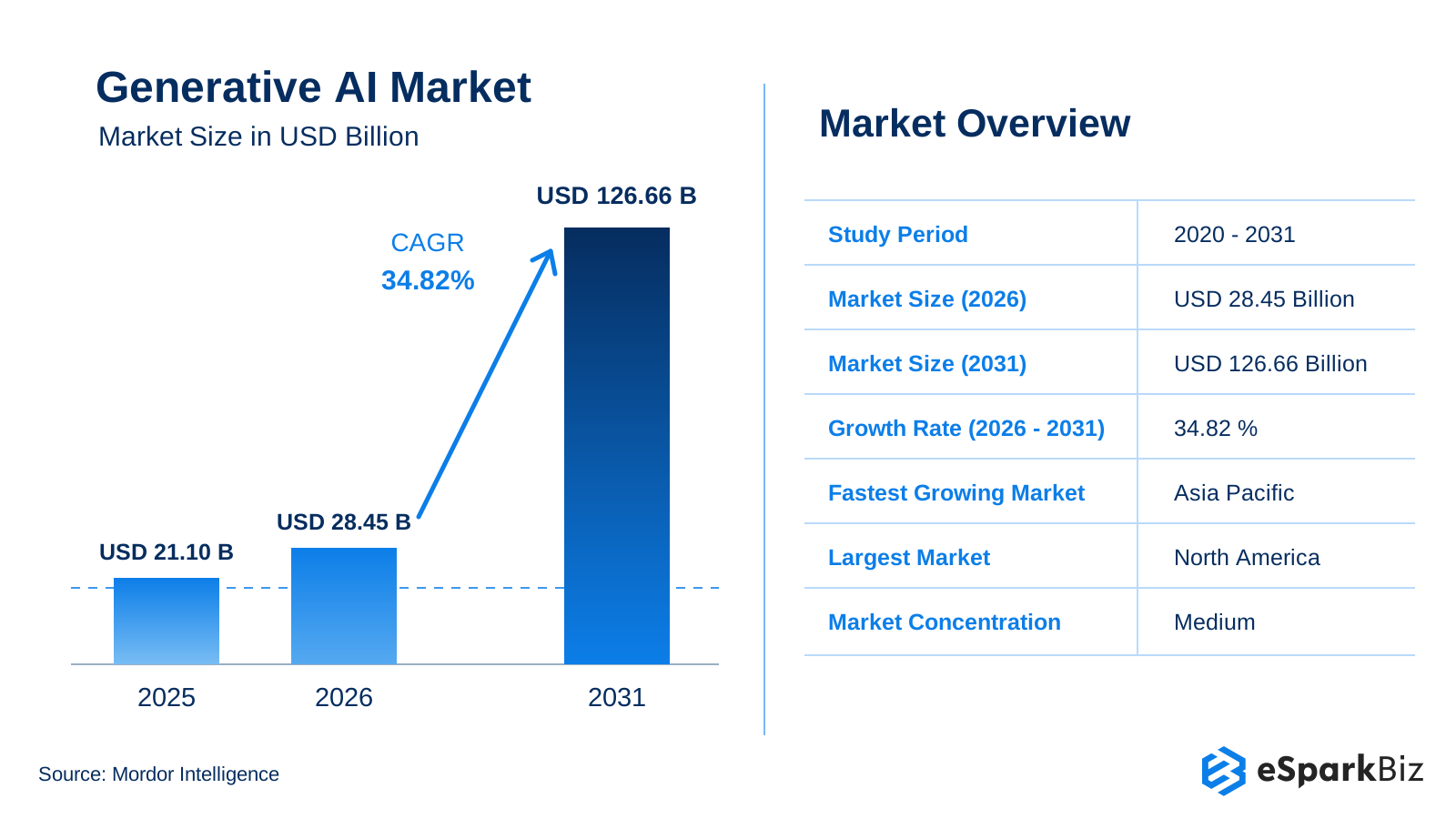
According to Mordor Intelligence, the global Generative AI market is expected to reach USD 28.45 billion in 2026 and grow to USD 126.66 billion by 2031, registering a CAGR of 34.82% during 2026–2031. This growth highlights the increasing demand for specialized AI development expertise across industries.
How We Selected the Top Dedicated Generative AI Development Companies in the USA
Choosing a Generative AI development partner involves more than comparing service offerings or customer ratings. Businesses need providers with relevant technical expertise, flexible engagement models, reliable delivery capabilities, and experience supporting different project requirements.
To prepare this list, we assessed companies across the following criteria:
- Generative AI Capabilities: We examined their expertise in LLM development, RAG, AI agents, conversational AI, model customization, and enterprise AI integration.
- Engagement Models: We compared dedicated development teams, project-based services, consulting, managed services, and freelance hiring options.
- US Market Presence: We considered their US offices, business presence, and ability to serve companies operating in the American market.
- Industry and Project Experience: We reviewed their experience supporting startups, mid-sized businesses, and large enterprises with different technology requirements.
- Client Ratings: We considered publicly available ratings on platforms such as Clutch and G2.
- Additional Differentiators: We assessed relevant certifications, technical screening processes, proprietary AI platforms, development practices, and delivery capabilities.
Editorial Disclosure: eSparkBiz publishes this article and is included in the comparison. We evaluated eSparkBiz using the same selection criteria applied to the other companies, considering publicly available information about its services, technical capabilities, business presence, certifications, and customer reviews. The article aims to present the providers and their respective offerings objectively.
Top Dedicated Generative AI Development Companies in the USA: Comparison
Choosing a Generative AI partner requires evaluating technical expertise, hiring flexibility, client feedback, and US availability. The following table compares 10 companies serving US businesses.
| Sr. No. | Company Name | Founded Year | Rating & Reviews | Engagement Model | GenAI Expertise | Best For | US Presence (City, State) |
| 1 | Toptal | 2010 | 4.8/5 (Clutch) | Freelance / Contract | LLMs, NLP, AI Engineering | Startups / Mid-Market | San Francisco, California |
| 2 | eSparkBiz | 2010 | 4.9/5 (Clutch) | Dedicated Teams / Project-Based | LLMs, RAG, AI Agents, GenAI Integration | Startups / Mid-Market | Middletown, Delaware |
| 3 | Cognizant | 1994 | 4.2/5 (G2) | Consulting / Project-Based | GenAI, LLMs, AI Copilots, Enterprise Automation | Large Enterprises | Teaneck, New Jersey |
| 4 | Wipro | 1945 | 4.1/5 (G2) | Consulting / Managed Services | GenAI, LLMs, AI Integration, Machine Learning | Large Enterprises | Plano, Texas |
| 5 | Scalable Path | 2010 | 4.9/5 (Clutch) | Dedicated Developers / Contract | AI/ML, LLM Application Development | Startups / Mid-Market | San Francisco, California |
| 6 | SoluLab | 2014 | 4.9/5 (Clutch) | Dedicated Teams / Project-Based | GenAI, LLMs, AI Agents, NLP | Startups / Mid-Market | Los Angeles, California |
| 7 | Markovate | 2015 | 5.0/5 (Clutch) | Dedicated Teams / Project-Based | LLM Development, RAG, AI Agents, Automation | Startups / Mid-Market | San Francisco, California |
| 8 | Upwork | 2015 | 4.5/5 (G2) | Freelance / Contract | LLMs, NLP, GenAI Applications, AI Agents | Startups / Mid-Market | Palo Alto, California |
| 9 | Infosys | 1981 | 4.0/5 (G2) | Consulting / Managed Services | GenAI, LLMs, RAG, AI Agents, Enterprise AI Integration | Large Enterprises | Richardson, Texas |
| 10 | Accenture | 1989 | 4.2/5 (G2) | Consulting / Managed Services | GenAI, LLMs, RAG, Agentic AI | Large Enterprises | New York City, New York |
Did You Know?
The global generative AI in e-commerce market was calculated at USD 1,111.39 million in 2026, and is expected to reach around USD 3,949.94 million by 2035, at a CAGR of 15.17% over 2026 to 2035.
Leading Providers for Dedicated Generative AI Developers
Several companies/platforms/agencies in the USA provide dedicated Generative AI developers or teams that specialize in AI, machine learning and related fields. Below is a list of companies that provide dedicated developers or services.
1. Toptal
Toptal connects businesses with vetted technology professionals and provides Generative AI consulting and project delivery. Its services help organizations plan, develop, and deploy AI solutions using specialized technical talent.
Core GenAI Capabilities
- Generative AI consulting and implementation.
- Conversational AI design and development.
- End-to-end Generative AI project delivery.
Key Differentiators
- Access to a global talent network.
- On-demand professionals and dedicated teams.
- Project management and delivery support.
2. eSparkBiz
eSparkBiz is a software engineering company with 15+ years of experience, 400+ engineers, and 1,000+ projects delivered. Its ISO/IEC 42001:2023-certified AI management system supports its Generative AI and automation work.
Core GenAI Capabilities
- Develops RAG-based enterprise knowledge assistants.
- Builds agents for business workflows.
- Integrates AI with existing systems.
Key Differentiators
- ISO 27001:2022 – Information security management.
- ISO 9001:2015 – Quality management system.
- CMMI Level 3 – Appraised process maturity.
Enterprise GenAI Platform Case Study
eSparkBiz developed an enterprise AI governance platform featuring prompt lifecycle management, multi-LLM orchestration, and compliance monitoring. The project delivered:
- 85% reduction in compliance audit preparation time.
- 60% reduction in runaway LLM API expenses.
- 45% faster engineering deployment cycles.
- 99.9% production application stability.
Read the Detailed Case Study
3. Cognizant
Cognizant helps enterprises adopt Generative AI across customer experience, knowledge management, and business operations. Its services combine AI implementation, process optimization, and responsible AI practices.
Core GenAI Capabilities
- Customer Experience Navigator for conversational support.
- Enterprise Knowledge Navigator for information discovery.
- Process Optimizer for workflow automation.
Key Differentiators
- ISO/IEC 42001:2023 AI management certification.
- Governance practices aligned with NIST AI RMF.
- Named solutions for enterprise use cases.
4. Wipro
Wipro provides enterprise AI consulting, platforms, and implementation services. Through its AI offerings, the company helps organizations integrate AI into business processes, technology operations, and industry-specific solutions.
Core GenAI Capabilities
- Develops and integrates Generative AI models.
- Implements RAG-based enterprise knowledge solutions.
- Provides AI consulting and advisory services.
Key Differentiators
- Wipro Intelligence unifies AI offerings.
- Industry-specific AI platform portfolio.
- Global innovation and partner ecosystem.
5. Scalable Path
Scalable Path helps businesses hire remote software developers through a technical screening and matching process. Companies can use its network to source engineers for AI-related projects and expand existing teams.
Core GenAI Capabilities
- Sources developers with relevant AI skills.
- Matches candidates against technical requirements.
- Supports remote engineering team expansion.
Key Differentiators
- Approximately 4% candidate acceptance rate.
- Two-week risk-free trial period.
- Candidate introductions targeted within one week.
6. SoluLab
SoluLab develops custom AI applications and software products for startups and enterprises. Its Generative AI services cover multimodal applications, model customization, knowledge systems, and AI-powered business automation.
Core GenAI Capabilities
- Develops multimodal AI applications.
- Builds RAG-based knowledge management systems.
- Fine-tunes models using business data.
Key Differentiators
- Offers AI and blockchain development.
- Provides dedicated MLOps consulting services.
- Supports ongoing model maintenance and optimization.
7. Markovate
Markovate develops custom AI solutions for businesses seeking to automate operations and improve decision-making. Its services include Generative AI development, LLM customization, conversational AI, and responsible AI consulting.
Core GenAI Capabilities
- Fine-tunes LLMs using proprietary data.
- Develops conversational AI applications.
- Builds agents for business workflows.
Key Differentiators
- Provides responsible AI consulting services.
- Offers domain-specific AI platforms.
- Supports cloud and on-premises deployment.
8. Upwork
Upwork is a global freelance marketplace where businesses can find independent AI professionals. Clients can hire specialists for LLM integration, chatbot development, AI automation, and other project-based assignments.
Core GenAI Capabilities
- Connects businesses with AI freelancers.
- Provides access to chatbot developers.
- Supports project-based AI engineering assignments.
Key Differentiators
- Large global independent talent marketplace.
- Verified freelancer work histories and reviews.
- Integrated hourly and milestone payments.
9. Infosys
Infosys is a global IT consulting and technology services company founded in 1981. Through its Infosys Topaz portfolio, it helps enterprises develop, integrate, and scale Generative AI solutions across business operations.
Core Generative AI Capabilities:
- Develops enterprise Generative AI and LLM solutions.
- Builds RAG-based knowledge systems and AI agents.
- Integrates AI capabilities into enterprise workflows and applications.
Key Differentiators:
- Connects AI models with enterprise applications.
- Provides Responsible AI and governance services.
- Partners with leading AI technology providers.
10. Accenture
Accenture helps organizations integrate Generative AI into enterprise operations through consulting, technology platforms, and implementation services. Its AI Refinery platform supports customized LLMs and multi-agent application development.
Core GenAI Capabilities
- Develops multi-agent enterprise AI solutions.
- Customizes LLMs for business requirements.
- Supports agent orchestration and memory.
Key Differentiators
- Proprietary AI Refinery platform ecosystem.
- Visual development through AI Refinery Studio.
- Built-in monitoring and evaluation capabilities.
Also Read: Who are the Leading Providers of Generative AI Engineers in Europe?
How to Choose the Right Company?
Choosing a Generative AI development partner requires more than comparing prices and portfolios. Before signing a contract, verify the developer’s practical LLM experience and ability to build reliable AI applications.
Consider these factors:
- Define Your Hiring Requirements: Decide whether you need an individual developer, a dedicated team, or a complete development partner.
- Verify Hands-On LLM Experience: Ask developers to demonstrate previous work involving RAG, LLM fine-tuning, prompt engineering, and AI agent development. Request a relevant project demo or code sample.
- Evaluate RAG and Hallucination Testing: Ask how they measure retrieval quality, answer relevance, and factual grounding. Check whether they use evaluation metrics such as precision, recall, and faithfulness to identify incorrect responses.
- Check Security and Prompt Injection Handling: Ask how the developer protects applications against prompt injection, malicious inputs, data leakage, and unauthorized access.
- Review Testing and Evaluation Practices: Confirm whether they run automated evaluations, regression tests, and performance checks before deploying model or prompt changes.
- Request References and Project Evidence: Review relevant case studies, speak with previous clients, and ask about the developer’s role, project outcomes, and production experience.
- Clarify Budget and Ongoing Support: Discuss hourly or monthly rates, project timelines, code ownership, deployment responsibilities, and post-launch maintenance before finalizing the engagement.
Which Companies Provide Dedicated Generative AI Developers for Different Industries?
Different industries require specialized Generative AI capabilities, domain knowledge, and security practices. The following companies from our top 10 list have relevant industry projects, AI experience, or supporting credentials.
| Industry | Companies to Consider | Why They Fit | Typical Projects |
| Healthcare | Cognizant, eSparkBiz | A published virtual clinician demonstrates clinical GenAI experience. Healthcare software expertise, HIPAA alignment, and AI governance credentials provide additional relevant capabilities. | AI triage chatbots, clinical note summaries, medical document assistants, patient engagement chatbots, and EHR-integrated AI assistants. |
| Finance and FinTech | Accenture, eSparkBiz | Agentic AI underwriting experience supports financial workflows. AI-assisted KYC and AML solutions, alongside enterprise AI governance capabilities, add relevant technical experience. | Underwriting copilots, KYC and AML assistants, financial document extraction, fraud investigation assistants, and insurance claims summarization. |
| EdTech | Toptal | Its published EdTech project uses RAG and agent-based workflows to transform source documents into structured, narrated video courses. | AI tutors, automated course generation, quiz creators, personalized learning assistants, LMS chatbots, and automated student feedback. |
| Real Estate and PropTech | Toptal, Markovate | A published RAG chatbot supports real estate client queries, while AI-powered investor reporting demonstrates property data processing and automated narrative generation experience. | Property listing generators, real estate chatbots, lease summarization, property inspection assistants, and investor reporting copilots. |
| Food and Beverage | Markovate, eSparkBiz | Restaurant voice AI supports automated ordering and customer interactions, while restaurant management software demonstrates experience with digital ordering and operations. | Voice-based restaurant ordering, menu assistants, food delivery chatbots, order-management agents, and personalized menu recommendations. |
| Logistics and Supply Chain | Capgemini | Its published GenAI supply chain project combines a conversational chatbot and forecasting engine to improve warehouse inventory and demand decisions. | Shipment exception agents, warehouse copilots, demand-forecasting assistants, logistics document extraction, and supplier communication agents. |
| Agriculture and AgriTech | No verified company from the list | Request agricultural AI case studies and client references before shortlisting. | Crop advisory chatbots, farm management copilots, IoT sensor report summaries, agricultural document assistants, and precision-farming knowledge agents. |
| Sports and Fitness | Accenture, Capgemini | Published sports GenAI projects demonstrate experience generating match summaries, real-time game insights, and contextual content for sports audiences. | AI-generated match summaries, fan engagement assistants, real-time sports insights, personalized sports content, and AI-powered coaching applications. |
Should You Hire One Generative AI Developer, a Full Team, or Choose a Fixed-Scope Project?
The right hiring model depends on your product stage, technical requirements, and available resources. Here is when each option makes sense:
| Engagement Model | Typical Team Makeup | Best For |
| One Dedicated Developer | One LLM or Generative AI engineer, supported by your existing team | Building an MVP, testing an idea, or adding AI features to an existing product |
| Dedicated Development Team | 1 AI engineer, 1 backend developer, 1 frontend developer, and QA support; a tech lead can be added as needed | Building a complete LLM application that requires multiple skills and continuous collaboration |
| Fixed-Scope Project | A project manager, AI engineer, developers, and QA resources assigned by the provider | Developing a clearly defined prototype, chatbot, RAG proof of concept, or specific AI feature |
Which Model Should You Choose?
- Choose one dedicated developer when you have an existing engineering team and need specialized LLM expertise.
- Choose a dedicated Team when you need multiple specialists to build, test, deploy, and improve your LLM product.
- Choose a fixed-scope project when your requirements and deliverables are clearly defined and you want the provider to manage delivery within an agreed scope.
For a first LLM product, a small dedicated pod is often a practical choice when you need end-to-end development. However, a single developer or fixed-scope engagement may be more suitable for validating an early idea.
Conclusion
Hiring dedicated Generative AI developers in the USA empowers businesses to build advanced solutions tailored to their needs. With expert knowledge in AI model development and deployment, companies can streamline operations, boost innovation and deliver intelligent, scalable digital products to market.
From established enterprises to fast-growing startups, dedicated Generative AI developers provide the skills and agility required to stay ahead in a competitive landscape. Partnering with specialized firms ensures access to cutting-edge AI talent that drives measurable results and long-term business success.
FAQs
1. Which companies provide dedicated Generative AI developers in the USA?
Several companies provide access to Generative AI developers in the USA, including Toptal, eSparkBiz, Infosys, Wipro, Accenture, and SoluLab. These providers offer different hiring models, from individual AI specialists to dedicated development teams and enterprise-level GenAI consulting services.
2. Why should businesses hire dedicated Generative AI developers?
Hiring dedicated Generative AI developers ensures expertise in advanced AI solutions, including LLMs, NLP and computer vision. This helps businesses accelerate innovation, reduce costs and gain a competitive edge.
3. What services do dedicated Generative AI developers offer?
Generative AI developers provide services such as-
- Model Training
- Fine-tuning
- Integration
- API Development
- End-to-end AI Solution Deployment
- Building Intelligent Chatbots
- Automation Workflows
- Industry-specific AI Applications
4. Can startups also benefit from hiring Generative AI developers?
Yes, startups benefit significantly from hiring dedicated Generative AI developers. They can quickly build proof of concepts, launch MVPs and scale AI-driven solutions.
5. How do companies typically hire Generative AI developers in the USA?
Companies hire Generative AI developers via specialized firms, talent marketplaces or dedicated AI consultancies. Flexible hiring models including hourly, monthly or project-based contracts, make it easier to scale AI talent.
6. What Contract Terms Should I Check Before Hiring Dedicated Generative AI Developers?
Before signing, ensure your contract covers:
- IP Ownership: Assignment of source code, custom models, and deliverables.
- Data Rights: Ownership, usage, storage, and deletion of training data and prompts.
- NDA: Protection of confidential business and customer information.
- Security: Verified ISO 27001 or SOC 2 controls, access restrictions, and incident reporting.
- Governing Law: Contracting entity, applicable US law, and dispute resolution terms.
7. How Should You Scope and Staff a Generative AI Project Beyond the Prototype Stage?
Set clear milestones for the first 90 days: validate requirements and RAG quality, develop integrations and security controls, then complete testing and deployment. Assign an LLM/ML engineer, backend developer, and DevOps engineer. Define measurable targets for accuracy, security, latency, cost, and production stability before development begins.