
 ChatGPT
 Google AI
 Perplexity
 Claude.ai
Generative AI is transforming industries by enabling automation, creativity and smarter business workflows. India has emerged as a global hub for hiring skilled generative AI developers. Companies here specialize in GPT, LLMs and AI-powered solutions that drive innovation, efficiency and scalable digital transformation.
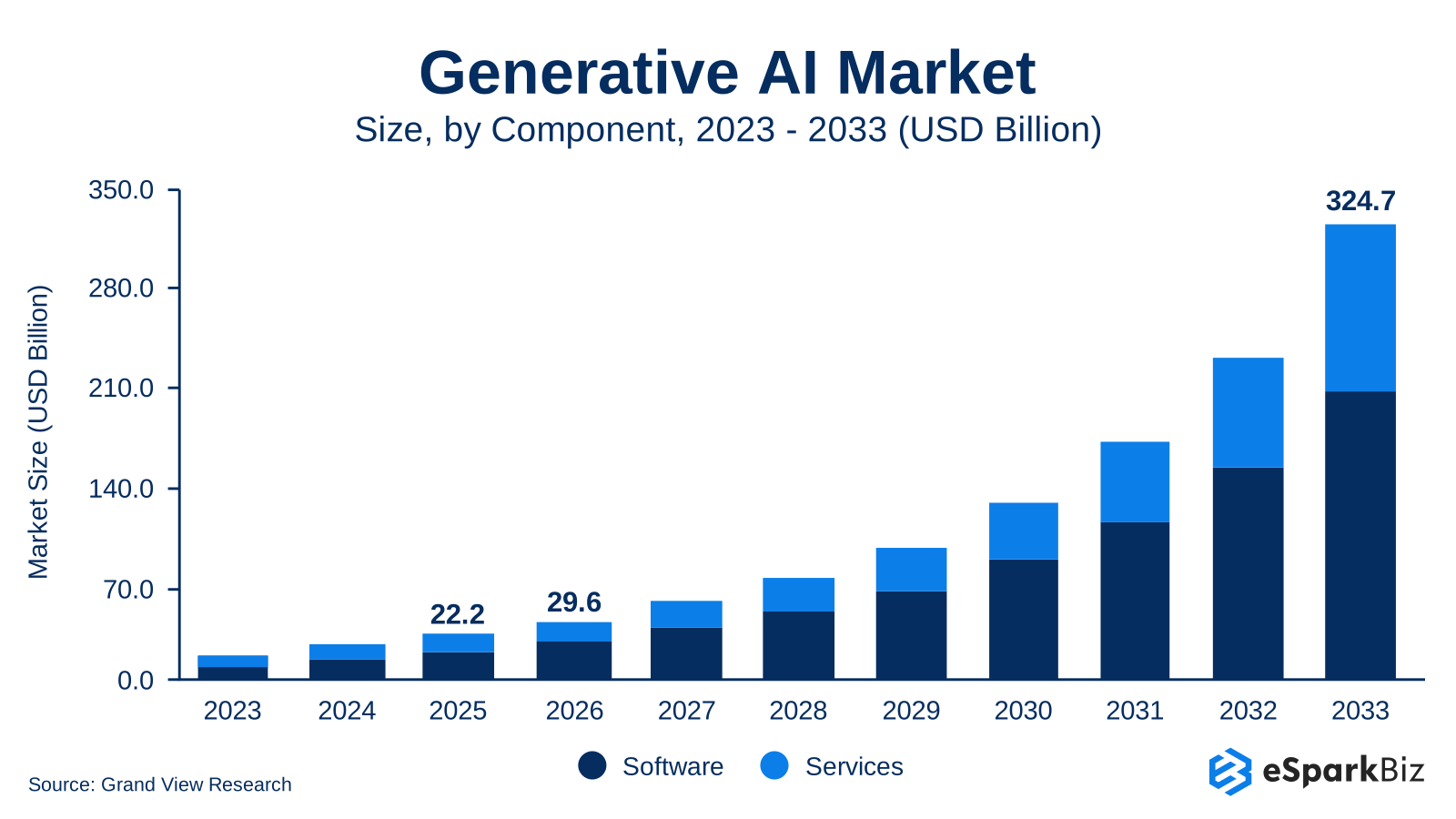
Trusted providers like TCS, Infosys, Wipro, HCLTech and eSparkBiz empower businesses worldwide with cutting-edge generative AI development expertise. The global generative AI market is projected to reach USD 324.68 billion by 2033, advancing at a 40.8% CAGR from 2026 to 2033. This sustained momentum reflects enterprise-scale adoption, expanding AI infrastructure investments, and strategic prioritization across industries worldwide.
From startups to large enterprises, Indian AI companies deliver tailored generative AI services including chatbot development, custom LLM fine-tuning and enterprise AI integrations.
How We Selected the Best Generative AI Development Companies in India
We reviewed 75 generative AI development companies in India and shortlisted 10 providers based on their technical expertise, services, company background, and hiring options. Our comparison focused on the following criteria:
- Generative AI Expertise: Compared each company’s expertise in LLMs, RAG, AI agents, NLP, and other generative AI technologies.
- Services and Specializations: Compared the generative AI services and solutions listed in each company’s profile, including custom LLM development, AI applications, chatbots, integrations, and automation.
- Company Background and Business Focus: Reviewed each company’s overview and the types of businesses, projects, and solutions it focuses on.
- Core Technologies: Compared the technologies, frameworks, and platforms mentioned in the company profiles.
- Engagement Models: Reviewed available hiring and delivery options, including dedicated teams, staff augmentation, and outsourcing.
- Company Ratings: We checked company ratings on Clutch and G2 to compare their overall ratings.
Editorial Disclosure: This article is published by eSparkBiz, which is also included in the comparison. We applied the same selection criteria to eSparkBiz and the other companies, using publicly available information.
Leading Generative AI Experts & Companies in India
Here are some of the leading generative AI companies in India, offering skilled developers, innovative AI solutions, and tailored services for businesses across industries.
| No. | Company Name | Founded Year | Best For | Ratings (G2/ Clutch) | Core GenAI Technologies / Skills |
| 1 | Tata Consultancy Services (TCS) | 1968 | Enterprise GenAI transformation | 4.2 (G2) | LLMs, RAG, GenAI platforms |
| 2 | Infosys | 1981 | Enterprise RAG and automation | 4.0 (G2) | LLMs, RAG, AI agents |
| 3 | Wipro | 1945 | Enterprise AI and RAG | 4.1 (G2) | LLMs, RAG, NLP |
| 4 | HCLTech | 1991 | AI platforms and automation | 4.5 (G2) | LLMs, RAG, AI agents |
| 5 | Tech Mahindra | 1986 | Agentic AI and RAG | 4.8 (G2) | LLMs, GenAI models, conversational AI |
| 6 | eSparkBiz | 2010 | Custom LLM and RAG development | 4.9 (Clutch) | LLMs, RAG, AI agents, NLP |
| 7 | Reckonsys | 2015 | Enterprise GenAI solutions and AI agents | 4.8 (Clutch) | LLMs, RAG, GPT, LangChain, Semantic Kernel |
| 8 | Debut Infotech | 2011 | Custom GenAI applications | 4.9 (Clutch) | LLMs, RAG, AI agents, fine-tuning |
| 9 | Quytech | 2010 | Generative AI applications | 4.8 (Clutch) | LLMs, NLP, RAG |
| 10 | ScalaCode | 2012 | Custom LLM development | 4.8 (Clutch) | LLMs, LangChain, RAG |
Did You Know?
According to IMARC Group, the India artificial intelligence market is projected to reach USD 13,245.65 million by 2034, growing at a CAGR of 26.50% from 2026 to 2034. This growth reflects the rising adoption of AI technologies across Indian industries.
Large Enterprises with Generative AI Capabilities
These leading Indian enterprises use generative AI to deliver scalable solutions across industries, supported by experienced developers and advanced AI capabilities.
1) Tata Consultancy Services (TCS)
- Overview: TCS provides generative AI consulting and development services, helping enterprises design, build, and deploy AI solutions tailored to their business requirements.
- Strength: Its AI WisdomNext platform helps businesses compare AI models, connect data and AI agents, and build governed workflows. TCS also offers model training and fine-tuning, solution design, and responsible AI implementation.
2) Infosys
- Overview: Infosys delivers generative AI services through Infosys Topaz, its AI-first suite of services, solutions, and platforms. It helps enterprises develop and adopt AI-powered applications.
- Strength: Infosys Generative AI Labs brings together ready-to-use solutions, AI accelerators, technology partnerships, and responsible AI frameworks. Its capabilities also support use cases such as code generation, document summarization, and enterprise knowledge management.
3) Wipro
- Overview: Wipro offers generative AI and enterprise AI services to help businesses develop and adopt AI-powered solutions. Its capabilities include AI consulting, application development, and technology integration.
- Strength: Through Wipro Intelligence, its WEGA platform brings together AI agents, intelligent assistants, and partner tools to support software development workflows. It helps teams automate activities across design, development, testing, infrastructure, and release management.
4) HCL Technologies (HCLTech)
- Overview: HCLTech provides generative AI and agentic AI services that help enterprises automate workflows and develop AI-powered solutions across software engineering, data engineering, and business operations.
- Strength: Its AI Force platform combines large language models, Retrieval-Augmented Generation (RAG), AI agents, and governance controls. It supports integration with existing enterprise systems and deployment across on-premises, hybrid, private, and public cloud environments.
5) Tech Mahindra
- Overview: Tech Mahindra provides generative AI services that help businesses experiment with, develop, and implement AI-powered applications based on their specific requirements.
- Strength: Its Generative AI Studio offers a virtual environment for experimenting with multiple AI model families and prebuilt capabilities across text, images, code, audio, video, and data. Tech Mahindra also offers custom generative AI studios and domain-specific LLM development.
Which Type of Generative AI Partner Should You Choose?
- Choose a large IT integrator like TCS or Infosys if your mid-size company needs complex enterprise integration, multiple AI workstreams, global delivery, and established governance processes.
- Choose a smaller Indian GenAI development company with dedicated developers if you need focused LLM development, direct access to engineers, flexible engagement, and closer collaboration on a specific feature or product.
Leading Firms offering Skilled Generative AI Developers for hire in India
These companies in India specialize in generative AI, offering expert developers and innovative AI solutions for businesses of all sizes.
6) eSparkBiz
Overview: Based in Ahmedabad, eSparkBiz is a generative AI development company with 15+ years of software development experience and a team of 400+ engineers. The company has delivered digital products for businesses across multiple industries.
- Specialization: Generative AI development and integration, including LLM-powered applications, AI solutions, and supporting technologies such as TensorFlow, PyTorch, and cloud deployment tools.
- Highlights: Offers agile delivery, staff augmentation, workflow integration, project governance, and support for building and launching MVPs.
- Engagement Models: Offers IT staff augmentation, dedicated development teams, and software development outsourcing.
7) Reckonsys
Overview: Reckonsys is an India-based software development company that builds custom generative AI and LLM-powered solutions for startups and enterprises. Its offerings include AI agents, RAG systems, AI copilots, and enterprise AI integration.
- Specialization: Generative AI development, LLM-powered applications, RAG systems, AI agents, AI copilots, and workflow automation.
- Highlights: Develops AI solutions for document automation, knowledge assistants, content generation, and business workflow execution. Its technology stack includes GPT, Claude, open-weight models, LangChain, and Semantic Kernel.
- Engagement Models: Offers complete project outsourcing, dedicated expert teams, and flexible team augmentation for AI development projects.
Also Read: Which Companies provide Best Generative AI Engineers for hire?
8) Debut Infotech
Overview: Debut Infotech is a digital product engineering company founded in 2011. It works with startups and enterprises to build software products using AI, blockchain, and other emerging technologies.
- Specialization: Generative AI development, LLM integration, model fine-tuning, RAG applications, AI agents, and AI-powered product development.
- Highlights: Builds custom AI applications for business use cases, including intelligent assistants, enterprise knowledge systems, and workflow automation.
- Engagement Models: Offers fixed-price projects, Time & Materials, dedicated development teams, and hybrid engagement models.
9) Quytech
Overview: Quytech is an India-based technology company incorporated in 2010. It provides mobile app development, AI/ML solutions, and custom software development services to startups and enterprises.
- Specialization: Generative AI applications, LLM development, AI-powered solutions, and custom mobile and enterprise applications.
- Highlights: Offers a 14-day risk-free trial for businesses hiring LLM developers, allowing them to assess the developer’s suitability.
- Engagement Models: Offers full-time, part-time, and hourly-based hiring options for LLM developers.
10) ScalaCode
Overview: ScalaCode is a software and AI development company founded in 2012 and headquartered in Noida, India. It builds custom software products and AI-powered solutions for businesses worldwide.
- Specialization: Generative AI applications, custom LLM solutions, AI copilots, chatbots, multi-agent systems, RAG, and vector databases.
- Highlights: Develops business-specific AI solutions using technologies such as LangChain, LlamaIndex, and fine-tuned language models.
- Engagement Models: Offers dedicated remote development teams for businesses that need additional engineering resources.
Quote
“AI is like electricity. Just as electricity transformed every major industry a century ago, AI is now poised to do the same.” – Andrew Ng (Co-founder of Coursera)
How to Choose the Right Generative AI Developers
Choosing the right generative AI development company requires understanding your project needs, evaluating delivery capabilities, and setting clear expectations. Consider these five factors before making your decision.
- Define Your Generative AI Project Requirements: Identify your business problem, target users, expected outcomes, project scope, budget, and development timeline.
- Check Technical Assessment Practices: Ask how the provider tests AI outputs, evaluates model performance, handles inaccurate responses, and addresses data security.
- Examine Project Delivery Examples: Review relevant case studies to understand how the company approaches implementation, handles project challenges, and delivers solutions.
- Clarify Project Scope and Responsibilities: Confirm deliverables, milestones, team responsibilities, communication channels, and payment terms before starting the engagement.
- Assess Communication and Post-Launch Support: Understand how the provider reports progress, resolves issues, maintains the solution, and supports future improvements after launch.
Dedicated Generative AI Developer vs. Team vs. Fixed-Scope Project
Choosing the right hiring model for your first LLM feature depends on your technical requirements, budget, and in-house capabilities. You can hire one dedicated developer, work with a complete development team, or outsource a clearly defined project.
| Hiring Model | Cost Structure | Level of Control | Best For |
| Dedicated Generative AI Developer | Hourly or monthly payment for one developer | High; you manage daily tasks, priorities, and development work | Adding GenAI expertise to an existing engineering team |
| Dedicated Generative AI Team | Hourly or monthly payment based on team size and expertise | High; you set priorities and manage the team’s direction | Building an LLM feature that requires multiple technical skills |
| Fixed-Scope Project | Agreed project fee for defined deliverables; changes may incur additional costs | Lower day-to-day control; you review milestones and agreed deliverables | Developing a well-defined LLM feature with a set scope and budget |
Which Hiring Model Should You Choose?
- Dedicated developer: Choose this option if you already have an engineering team and need one specialist to build or integrate an LLM feature.
- Dedicated team: Choose this option if you need multiple specialists, such as AI engineers, backend developers, and QA engineers, to develop your feature.
- Fixed-scope project: Choose this option if your requirements are clear and you want a provider to deliver specific outcomes within an agreed scope and budget.
Recommendation: For your first LLM feature, start by defining a small, measurable use case. Choose a dedicated developer if you have internal technical support, a dedicated team if you need broader expertise, or a fixed-scope project if your requirements and deliverables are clearly defined.
Generative AI Development Companies in India by Industry
Different industries need different generative AI capabilities, from clinical documentation and financial automation to personalized learning and customer engagement. The following companies have relevant industry experience, AI capabilities, or published GenAI projects to consider for these use cases.
| Industry | Recommended Companies | Why They Fit | Relevant Projects and Typical Use Cases |
| Healthcare | HCLTech, eSparkBiz | HCLTech developed a GenAI clinical advisor for trusted medical insights and summaries. eSparkBiz offers HIPAA-focused healthcare software development, including EHR/EMR systems and secure clinical workflows. | Clinical knowledge assistants, medical note summaries, EHR copilots, patient triage chatbots, and clinical documentation automation. |
| EdTech | Quytech, eSparkBiz | Quytech developed AI-powered literacy coaching applications with AI copilots and chatbots. eSparkBiz has delivered an AI-enabled collaborative learning platform. | AI tutors, LMS content generation, student support chatbots, personalized learning assistants, and automated assessments. |
| Real Estate and PropTech | Quytech, eSparkBiz | Quytech develops property applications with AI chatbots and predictive analytics. eSparkBiz has delivered cloud-based real estate portfolio analytics software. | Property listing generators, conversational property search, property valuation summaries, real estate document assistants, and investment research copilots. |
| Finance and FinTech | Tech Mahindra, eSparkBiz | Tech Mahindra developed i.GreenFinance, a GenAI-powered lending platform with ESG assessment and RAG-based chatbot assistance. eSparkBiz has financial services experience, including automated KYB verification and business onboarding platforms. | KYC assistants, loan document processing, credit review copilots, financial onboarding automation, and AI-powered claims triage. |
| Logistics and Supply Chain | TCS, Wipro | TCS has published GenAI-powered asset maintenance support for a logistics company. Wipro brings experience in package processing automation, logistics data platforms, and predictive maintenance. | Shipment exception copilots, fleet tracking assistants, warehouse SOP chatbots, shipment document summaries, and supply chain knowledge assistants. |
| Food and Beverage | Infosys, Tech Mahindra | Infosys has implemented GenAI chatbots for a global food services company and AI-powered experiences for a food and beverage chain. Tech Mahindra developed a GenAI bot for WhatsApp order management for a global food and beverage company. | Restaurant ordering assistants, menu recommendation tools, order management chatbots, kitchen SOP assistants, and inventory knowledge assistants. |
| AgriTech | Infosys, TCS | Infosys used LLMs and Topaz to summarize product information for a company serving agriculture and construction industries. TCS publishes research on agricultural small language models for farm-specific decision support. | Crop advisory chatbots, farm knowledge assistants, agricultural product search, crop analytics summaries, and farming decision-support copilots. |
| Sports and Fitness | HCLTech, eSparkBiz | HCLTech developed a GenAI-powered sports copilot for real-time fan engagement. eSparkBiz built a sports engagement platform that increased fan participation by 3x through gamified digital experiences. | Sports fan engagement chatbots, match summaries, player statistics assistants, personalized training plans, and automated highlight generation. |
Practical Ways to Evaluate Generative AI Developers in India
Before hiring generative AI developers in India, verify their practical skills rather than relying only on resumes or certifications. Use this checklist to assess their ability to build, evaluate, secure, and optimize AI applications.
1. Assign a Paid RAG Development Task
Ask developers to build a small RAG application using sample documents. Evaluate document chunking, embeddings, vector database selection, retrieval quality, and answer accuracy.
2. Verify Fine-Tuning and LLM Evaluation Skills
Ask developers to explain fine-tuning methods such as LoRA and QLoRA. Check whether they can evaluate LLM outputs using faithfulness, answer relevance, context precision, and context recall metrics.
3. Test Prompt Injection Handling
Present malicious prompts designed to override system instructions or expose sensitive information. Evaluate their knowledge of input validation, access controls, output filtering, and secure document retrieval.
4. Calculate Cost per Query
Ask developers to estimate the cost of a typical query, including input and output tokens, model inference, embeddings, vector database operations, and reranking. Check their understanding of caching and cost optimization.
5. Conduct a Live Code Review
Ask developers to explain their assessment code or a previous RAG implementation. Review architecture, code quality, error handling, testing, API integration, and deployment readiness.
Hiring Tip: Use the same technical assessment for every candidate. Compare implementation quality, evaluation results, security awareness, and cost efficiency before making your final hiring decision.
Conclusion
Choosing the right generative AI developers in India requires a clear understanding of your project goals, technical needs, budget, and expected outcomes. Assess each candidate’s practical skills, experience with LLMs and RAG systems, security practices, and ability to optimize performance and costs. A well-planned evaluation process helps you identify the right expertise, reduce hiring risks, and build reliable generative AI applications that support your business goals.