

 ChatGPT
 Google AI
 Perplexity
 Claude.ai
Not sure which offshore model to choose, where to hire or how to manage your project risks? This guide covers offshore software development costs, team models, top countries, common risks and partner selection helping you compare your options and choose the best fit for your project.
A good software idea starts with the right people to make it a working product. But when local hiring takes too long or the right skills are difficult to find, your projects can slow down before development starts.
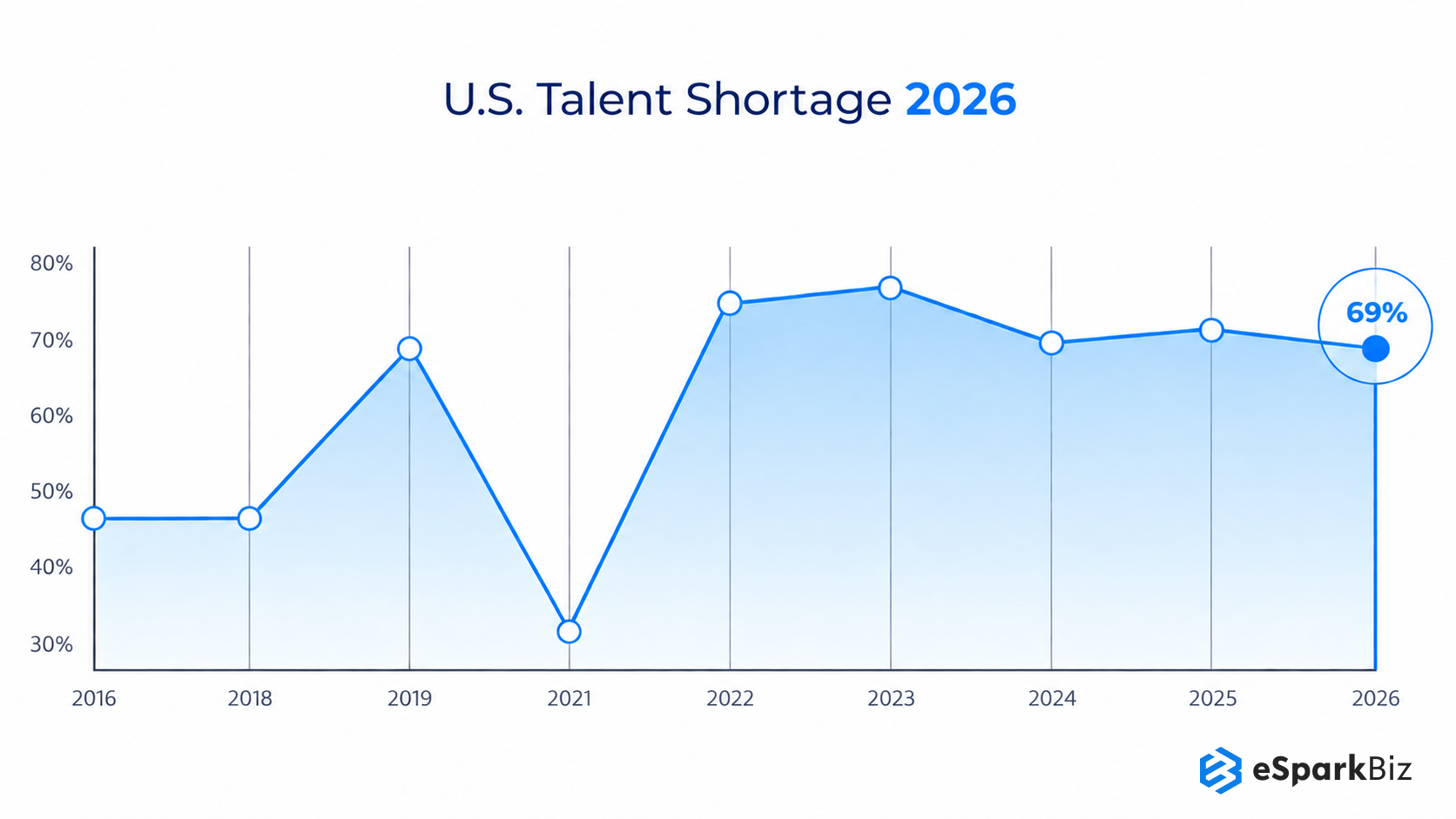
This is a real problem for U.S. businesses. ManpowerGroup’s 2026 Talent Shortage Survey found that 69% of U.S. employers were struggling to find the skilled talent they were looking for.
That’s one reason more businesses are selecting to offshore software development. Working with a team in another country can help you find skilled developers, add more people as needed and manage development costs. So, what exactly is offshore software development and how is it different from the terms people often confuse?
What is Offshore Software Development?
Offshore software development means hiring a dedicated software team in another country to create, update or maintain your software. Instead of doing all the work with developers in your own country, you work with a team based in another country. They can create a complete product or handle tasks such as web development, mobile apps, testing or cloud services.
Let’s take a very basic case, for instance: A U.S. based startup company has a mobile application launch in its plans, but has limited money and a shortage of developers within the local area. It employs a remote team from outside the country in India. The U.S. team provides the product needs and the offshore developers create features, test the app, resolve bugs and give periodic updates. This allows the startup to have more developers without having to develop a larger team locally.
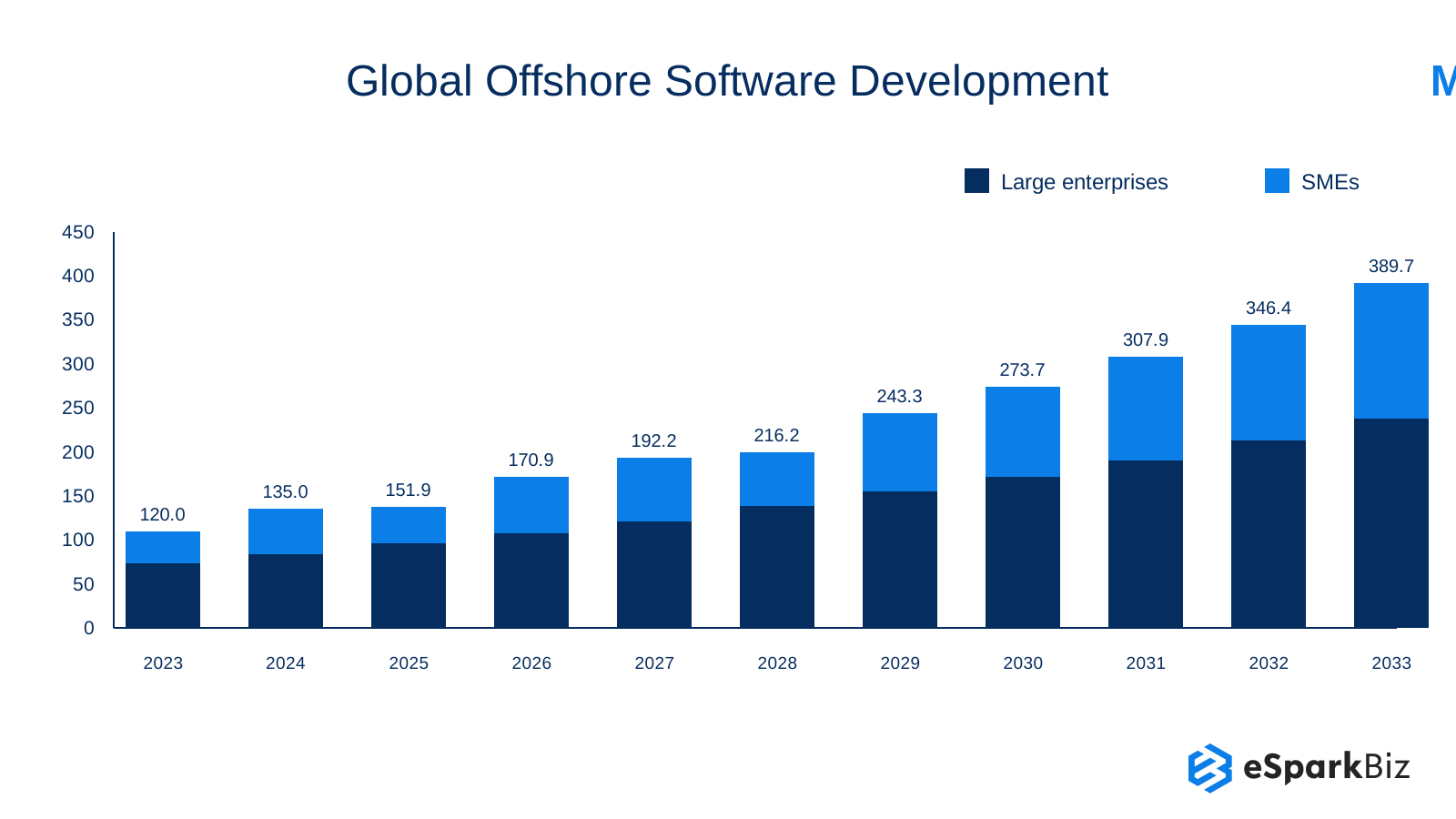
The market is growing too. Market.us estimates the Global Offshore Software Development Market will hit $389.7 billion by 2033 growing at a 12.5% CAGR from 2024 to 2033.
Offshore software development is often confused with five similar terms. Here’s how they are different.
Offshore vs Nearshore vs Onshore vs Staff Augmentation vs Outsourcing vs Dedicated Team
These six terms can sound similar but they describe different things. Offshore, nearshore and onshore tell you where the team is located, while staff augmentation, outsourcing and dedicated teams tell you how the work is handled.
| Model | Cost | Timezone Overlap | Who Manages the Work? | Best For |
| Offshore Development | Usually lower | Few or no shared hours | You or the provider | Finding more skilled developers while managing costs |
| Nearshore Development | Medium | Several shared hours | You or the provider | Lower costs with easier daily communication |
| Onshore Development | Usually higher | Same working hours | You or the provider | Close teamwork and local support |
| Staff Augmentation | Varies | Depends on location | Your team | Adding developers or specific skills to your team |
| Outsourcing | Varies | Depends on location | Provider | Giving a specific project or part of the work to an outside company |
| Dedicated Team | Varies | Depends on location | Shared | Long term projects with a team working mainly on your product |
These models can also work together. For Example, you can hire an offshore dedicated team or use offshore staff augmentation. The best setup depends on where you need talent, how much control you want and who should manage the day to day work.
So who is a good fit for offshore software development?
Who should use Offshore Software Development?
Offshore software development can work for different businesses mainly when you need more developers, specific skills or extra support for a software project.
- Startups: If you have a good product idea but a small team or limited budget, you can work with an offshore team to create it without quickly growing your local team.
- Growing companies: If your team can’t get through all the work, an offshore team can help you add developers to new products, larger projects, or continuing work.
- Businesses needing specific skills: If you need skills in Artificial Intelligence, cloud, cybersecurity or data engineering that are hard to find locally, an offshore team can help you find the right developers.
- Businesses transitioning to new technology: If you are replacing old systems, moving manual work online or building new digital products, an offshore team can provide the developers you need.
If it fits, does it still make sense to do it in 2026?
Is Offshore Software Development Still Worth it in 2026?
Yes, offshore software development is still relevant in 2026 but the reason businesses use it is changing.
- Skills take precedence: Companies are more focused on skills and experience of a team than on lower rates.
- AI is changing team needs: Companies now need developers who can work with AI tools and build AI powered features alongside regular software.
- Quality counts: If the low cost team’s code is low quality, if they miss deadlines or if they rework things more will be bigger issues later.
- Stability of the team is important: if developers change often, project knowledge can be lost and additional time must be invested to get people up to speed.
So, offshore development still has a place in 2026. The focus has changed from choosing the lowest cost team to choosing the right team for the work.
Did you know?
90% of professional developers were using AI coding agents at work at least weekly in May-July 2026 while 68% were using them daily.
Here’s what companies actually gain when it works.
Benefits of Offshore Software Development
Offshore software development can give your business more than lower costs. With the right team, you can get the skills you need, keep work moving and give your own team more time to focus on the business.
1. More Developers to Choose from
You can look beyond your local market and find developers with skills in AI, cloud, data, cybersecurity and other areas your project needs.
2. Lower Development Costs
Hiring developers in some countries can cost less than hiring a similar team locally. Your actual cost will depend on the country, the developer’s experience, project size and how the team is arranged.
3. Easy to Add or Reduce Team Members
You can add developers when a project needs more help and reduce the team when that work is finished. This gives you more flexibility as your needs change.
4. More Hours to Get Work Done
If your offshore team works in a different time zone, development, testing or support can continue after your local team finishes for the day.
5. More Time for your Own Team
Your own team can focus on product decisions, customers, planning and other important business work while the offshore team handles the development work assigned to it.
Real World Example: Microsoft
Microsoft opened its India Development Center in Hyderabad in 1998 as part of its global software development strategy. The center was created to work with Microsoft teams in other locations and use engineering talent in India.
Today, Microsoft has development centers in Hyderabad, Bengaluru & Noida, where teams work on AI, cloud, Windows, Office, gaming, and other technologies.
Microsoft’s experience also shows that working across countries requires good communication and knowledge sharing. Teams need clear responsibilities and regular coordination to keep complex software work moving.
Getting these benefits depends on the model you choose.
Engagement Models & What you can Outsource
The model you choose decides how the offshore team works with your business & who handles the day to day work.
- Dedicated Team: A group of developers works mainly on your project for a long period. You can guide the team based on your changing needs.
- Staff Augmentation: You add offshore developers to your own team. Your team assigns their tasks and manages their daily work.
- Managed Delivery: You give the provider a project or goal and the provider manages the developers and delivers the agreed work.
- Project Based: You hire a provider for a specific project with clear requirements, timelines and expected results.
- Build Operate Transfer (BOT): The provider builds and runs the offshore team first. Once the team is ready, you take over its management.
You can outsource software development, DevOps, AI/ML, data engineering, cybersecurity and QA through these models.
Each model carries a different cost. Here’s what offshore software development really costs.
How much does Offshore Software Development Cost?
There is no fixed offshore software development rate. Your cost depends on where you hire, the skills you need, project complexity and how the team is structured.
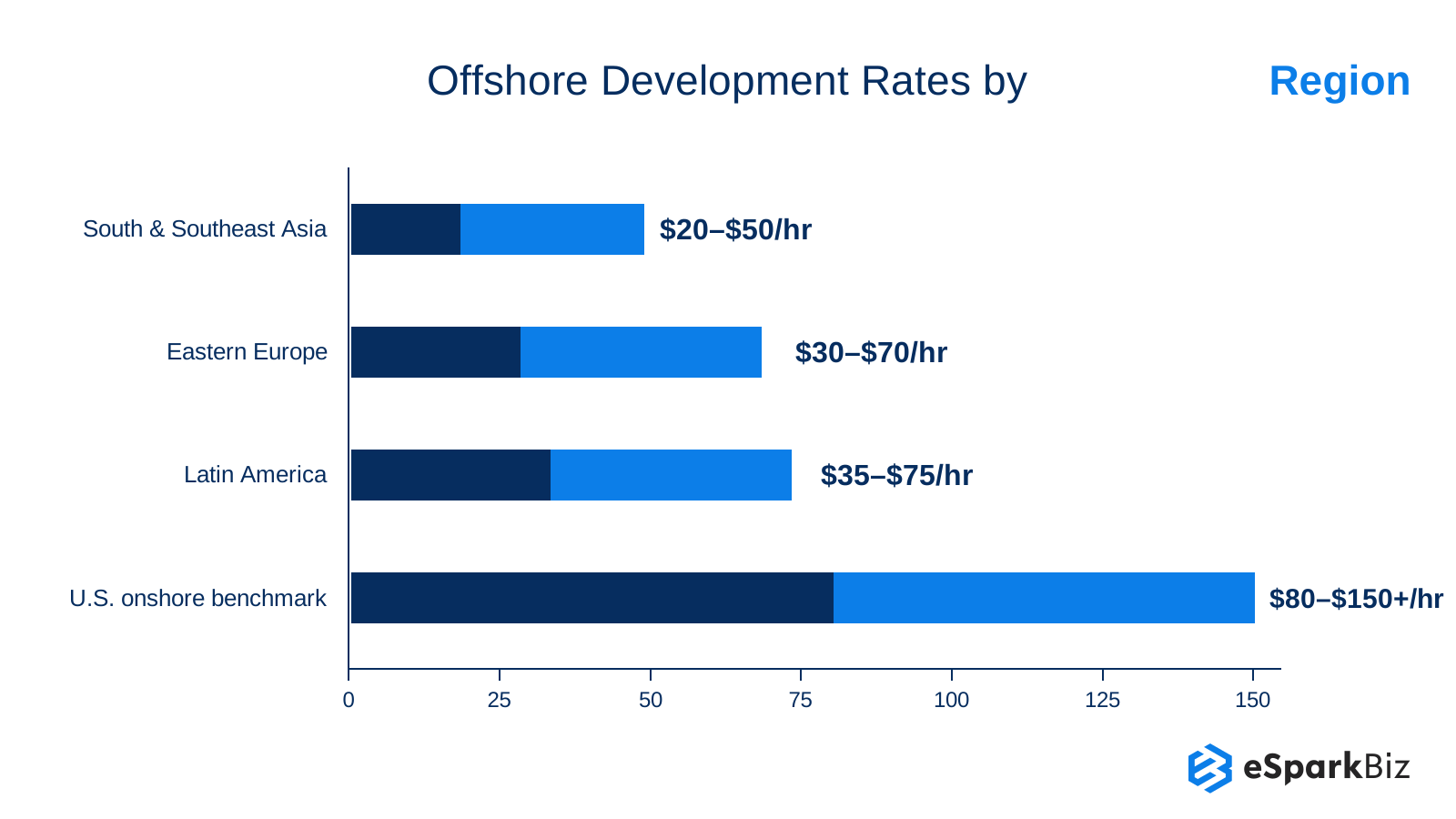
- South & Southeast Asia: < $25/hr to $50/hr
- Eastern Europe: $30/hr to $70/hr
- Latin America: $35/hr to $75/hr
- U.S. Onshore: $80/hr to $150+/hr
These are broad 2026 estimates, not fixed quotes. Actual rates vary by experience, technical skills, project needs and engagement model.
What drives the Cost?
- Developer Experience: Senior developers usually charge more than junior developers.
- Project Complexity: AI features, complex integrations and advanced workflows can require more time and skills.
- Technical Skills: AI, cloud, DevOps and cybersecurity specialists can have higher rates.
- Security & Compliance: Security reviews, audits and data protection requirements can add costs.
- Infrastructure & Tools: Cloud services, testing platforms and other project tools may cost extra.
Quoted Rate vs. Real Cost
The hourly rate is only part of your total budget. Onboarding, knowledge transfer, project management, communication, rework, and developer replacement can increase the actual cost of an offshore development project.
Illustrative example:
- 5 developers × $35/hour × 160 hours = $28,000/month in quoted development costs.
The final project cost may be higher if additional services, such as project management, quality assurance, onboarding, or infrastructure, are charged separately.
Before signing an agreement, ask the provider which services are included in the hourly rate and which involve additional charges.
So, compare what each provider includes, not just the hourly rate.
Best Countries for Offshore Software Development
Here’s a quick look at the best offshore countries, including the types of projects they commonly support.
| Region | Key Countries | Strengths | Cost Level | Best For |
| Asia | India, Philippines, Vietnam | Large talent pools, strong software skills and broad technology coverage. | Low | AI, cloud, web, mobile and long term development |
| Eastern Europe | Poland, Romania, Ukraine | Strong engineering skills, deep technical talent and better overlap with U.S. working hours than Asia. | Medium to High | Complex software, senior developers, cybersecurity and enterprise systems |
| Latin America | Mexico, Colombia, Argentina, Brazil | Closer U.S. time zones, growing tech talent and easier real time communication. | Medium | U.S. teams that need frequent communication and close collaboration |
Quora Insights
A recent Quora discussion about hiring offshore software developers highlights India, Southeast Asia, Eastern Europe and Latin America. The right choice depends on your project’s skills, budget, communication needs and time zone overlap.
Before committing, know what’s myth and what’s real risk.
Common Myths about Offshore Software Development
There are a number of assumptions that are common to offshore software development. Let’s see what is really true.
“Offshore teams can’t handle complex projects.”
The truth: Offshore teams can create complex products, such as AI-based applications, cloud platforms, enterprise systems & products that integrate with multiple systems. This is the key to finding the team that has the experience and skills needed for your project.
“You lose control when you work with an offshore team.”
The truth: Priorities can still be set, key decisions made, progress monitored, and the product directed. Having clear roles and regular communication ensures that you are involved in the development without taking on all the tasks.
“Offshore development makes projects slower.”
The truth: If teams are not well planned, it can be difficult to communicate between different time zones. This can help to maintain work flow for both teams with clear handoffs and some shared working hours.
“Offshore development is only for large companies.”
The truth: Startups and smaller businesses can use offshore teams too. You can bring in developers for a specific skill or project without hiring a large permanent team.
Myths aside, there are real risks worth planning for.
Offshore Software Development Risks and How to Manage them
While there are real offshore development challenges, most can be addressed through clearly defined processes and controls.
1. Communication Gaps
Time zones or ambiguous requirements can result in missed information and delays.
Fix: Establish clear communication rules, document requirements, and have shared working hours for significant discussions.
2. Inconsistent Quality
Numerous coding or testing approaches can result in bugs and rework.
Fix: Establish coding standards, perform regular code review, and test the code throughout development.
3. Security and Compliance
Your systems, code or business data can be accessed by an outside party, which presents security risks.
Fix: Control access, establish data-handling policies and verify security and compliance issues prior to work.
4. Developer Turnover
Project knowledge can go with the developer when he/she leaves.
Fix: Ensure documentation is kept up-to-date, ensure knowledge is shared throughout the team and have a clear replacement process.
5. Unexpected Costs
The quoted rate can be exclusive of any project costs such as onboarding, management, infrastructure, rework, etc.
Fix: Make sure to ask about the cost, find out what is not included, and make sure that you are in agreement with the cost of the contract before you sign it.
How to Recover a Failing Offshore Software Development Project
If your offshore team has missed deadlines or delivered software with repeated bugs, assess the existing work before restarting the project. These steps can help you recover delivery and control further costs.
1. Identify What Went Wrong
- Compare the original requirements with the delivered work.
- Identify missed deadlines, unfinished features, and recurring bugs.
- Find the causes, such as unclear scope, skill gaps, or changing requirements.
2. Audit the Existing Code
- Review the source code, architecture, completed features, and test results.
- Identify critical bugs, security issues, and reusable components.
- Get an independent technical review if needed.
3. Reset the Project Scope
- List unfinished features and outstanding defects.
- Prioritize essential fixes and move noncritical features to later releases.
- Set a revised budget and timeline based on the remaining work.
4. Set Clear Delivery and Acceptance Criteria
- Define what the team must complete before you approve each feature.
- Specify functionality, performance, security, and testing requirements.
- Divide the remaining work into smaller releases and review each milestone before approval.
5. Decide Whether to Continue or Change Vendors
- Check whether the current team can meet the revised requirements and deadlines.
- Continue if the team can follow the recovery plan; otherwise, consider another provider.
- Before changing vendors, secure source code, repository access, project accounts, technical documentation, and deployment details.
A structured recovery plan helps you preserve usable work, control additional costs, and move the project toward a reliable release.
How AI is Changing Offshore Software Development in 2026
AI is now part of regular software development work. Teams use it for coding, testing, documentation & code review. Developers still need to check the results and make the final technical decisions.
| 2026 Shift | What it Means for your Team |
| AI Assisted Development | Developers can use AI for routine coding, testing and documentation. They still need to review the output before using it. |
| Nearshore + Offshore Teams | Businesses can keep some developers close to U.S. working hours while using offshore teams to add more developers and skills. |
| Outcome Based Pricing | Some providers are moving from hourly billing toward milestones and agreed work. The focus is more on what gets delivered. |
| AI Review Skills | Developers need to check AI generated code for bugs, security issues, performance and whether it works with the existing software. |
Video: IT Staffing Trends in 2026
See how AI, hiring, remote work, and location are changing software teams and IT staffing in 2026.
Given all this, does offshore fit your situation?
When Offshore makes sense (and When it doesn’t)
Offshore software development is a good fit when the work can be managed across locations and the project does not require everyone in the same place.
| Project Type | Fit | Why |
| Small Business or Startup MVP | Excellent | Helps small businesses build and test a product without hiring a large permanent in-house team. |
| AI Feature Work | Excellent | A good option when you need developers to build or add specific AI features. |
| Regulated or Government Project | Limited | Data, security or location rules may restrict offshore development. |
| Enterprise Modernization | Strong | Works well for updating older systems, moving to the cloud, adding integrations, and improving applications. |
If it fits, here’s how to choose the right partner.
How to Choose the Right Offshore Software Partner
Choosing the right offshore software development partner involves checking technical expertise, communication, security, pricing, and delivery capabilities. Follow these steps to select a suitable provider and prepare your team for development.
1. Define Your Requirements
Set your project goals, scope, timeline, budget, and required technical skills. Identify the features you need and the team size your project requires.
2. Search for and Review Vendor Experience
Shortlist offshore software development companies with experience in your industry and technology stack. Review their case studies, completed projects, and client references to assess their expertise.
3. Assess Communication
Check English proficiency, response times, working-hour overlap, and progress updates. Understand how the provider handles questions and project changes.
4. Verify Security and Compliance
Discuss security practices, relevant certifications, access controls, data handling, and compliance requirements before sharing sensitive project information.
5. Run a Pilot Project
Start with a small assignment to evaluate the team’s technical skills, communication, code quality, and ability to meet deadlines.
6. Confirm NDA and IP Terms
Define confidentiality, intellectual property ownership, source code rights, deliverables, payment terms, and exit conditions in your agreement.
7. Onboard Your Offshore Team
After selecting a provider, finalize team roles and responsibilities. Share project documentation, technical requirements, development environment details, and repository access so developers can prepare for the work.
A structured selection and onboarding process helps both teams understand their responsibilities before development begins. The next step is to establish clear communication and manage daily development activities.
How to Manage an Offshore Software Team
An offshore team is best when everyone knows how to communicate, keep track of work, communicate decisions, and answer day to day questions.
- Choose a Communication Routine: Schedule when and how often you will communicate, and identify the tools you will use to communicate each day.
- Track Work in Sprints: Set Tasks, check progress and detect delays early. A software development roadmap can assist your team with planning and remain focused on the project objectives.
- Document Key Decisions: Recap requirements, changes, technical decisions & significant discussions to enable everyone to have access to the same information.
- Assign a Lead on Each Side: One person from your team and one person from the offshore team take the lead with regard to coordination, questions and day to day decisions.
Expert Insight
“Any organization that designs a system will produce a design whose structure is a copy of the organization’s communication structure.”
– Melvin E. Conway, Computer Scientist and Programmer
How eSparkBiz Helps Businesses Manage Offshore Development Teams
eSparkBiz provides offshore development teams with technical expertise and structured delivery processes. Its approach combines dedicated engineering talent, agile workflows, and quality checks to help businesses manage development work across locations.
- 400+ Engineers and Specialists: Provides access to professionals across different technical roles.
- 1,000+ Projects Delivered: Reflects experience in software development across different project requirements.
- 45+ Technologies: Supports projects involving AI, cloud, web, mobile, and other technologies.
- 4–12 Hours of Time-Zone Overlap: Creates opportunities for regular discussions, progress updates, and sprint reviews.
- Agile Development and QA: Uses sprint-based workflows, code reviews, and manual and automated testing as part of its delivery process.
This approach gives businesses a way to extend their engineering capacity while maintaining communication, development visibility, and quality checks.
Conclusion
Offshore software development can help you access skilled developers, manage development costs and add more developers when needed. But the results depend on choosing the right country, engagement model and development partner. Clear requirements, strong communication, security controls and regular project tracking can reduce common risks. With the right setup, an offshore team can become a practical part of your software project.
Frequently Asked Questions
What does the offshore software development process look like?
It usually follows seven steps: requirements, team selection, planning, development, testing, review and release, followed by ongoing maintenance and support.
What is an offshore development center and when should you use one?
An Offshore Development Center is a dedicated team based in another country. It works well for long term development, ongoing product work and larger teams.
|
Factor |
Offshore Development Center |
|
Best for |
Long term projects |
|
Team |
Dedicated developers |
|
Control |
Higher day to day control |
|
Work |
Ongoing development |
How do you protect intellectual property when working with an offshore team?
Protect your work by:
- Signing an NDA
- Defining code ownership
- Limiting system access
- Including IP terms in the contract
- Setting clear data handling rules
How do you manage time zone differences with an offshore software team?
Use a few shared working hours for meetings and urgent questions. Written updates, task tracking and clear handoffs help teams to continue working across different time zones.
What hidden costs should you consider when choosing offshore software development?
Look beyond developer rates. Your total cost may include:
- Onboarding and management
- QA and testing
- Infrastructure and tools
- Rework
- Knowledge transfer
- Security requirements
How can you maintain software quality with an offshore development team?
Set coding standards, review code regularly, test throughout development and track bugs and rework. Regular reviews help identify quality problems before they affect delivery.
|
Quality Area |
What to Track |
|
Code |
Review results |
|
Testing |
Bugs and test coverage |
|
Delivery |
Sprint progress |
|
Rework |
Repeated fixes |
Can an offshore team build AI and RAG based software?
Yes. Offshore teams can build AI and RAG applications, including document processing, retrieval pipelines, vector databases, API integration, testing and application development.
Is eSparkBiz a good offshore software development partner for US clients?
eSparkBiz may suit US businesses needing offshore engineering support. Its teams use sprint-based delivery, code reviews, and manual and automated QA, with daily stand-ups and weekly reporting. One Clutch client reported 40% less coordination time and 60% fewer client queries.
What Should US Businesses Check Before Choosing an Offshore Software Development Company?
Ask for SOC 2 Type II or ISO 27001 evidence, review IP assignment clauses covering source code and deliverables, and confirm background checks, access controls, and data-handling practices for everyone accessing your systems.
Which Are the Best Offshore Software Development Companies to Consider in 2026?
Some offshore software development companies to consider in 2026 include eSparkBiz, Algoscale, Classic Informatics, Altoros, Rootstrap, SumatoSoft, and Distillery. Compare their technical expertise, project experience, client reviews, security practices, and engagement models to find the right partner for your business.