
 ChatGPT
 Google AI
 Perplexity
 Claude.ai
In this article, you will find information on the offshore software development rates by country, region, seniority, role, and technology. It explains why published rates differ, compares offshore and US development costs and covers hidden costs, pricing models, time zone differences and team budgets. You’ll also learn how to compare offshore development quotes & choose the right development partner.
Offshore development can offer US companies the opportunity to find skilled software developers when local talent is not the only option. However, it is not always easy to compare offshore software development rates. The same type of developer can have different rates with different providers.
The difference can come from the developer’s location, experience, technical skills, hiring model & the services included in the price. A lower hourly rate may not include project management, QA, communication, onboarding, security work or other project costs. This means the hourly rate you see may not be the same as the total cost of the project.
According to the BLS, the median salary for software developers in the United States is $135,980 per year. This is an employee’s salary, not the development company’s bill rate, so it’s not directly comparable to the bill rate.
Did You Know?
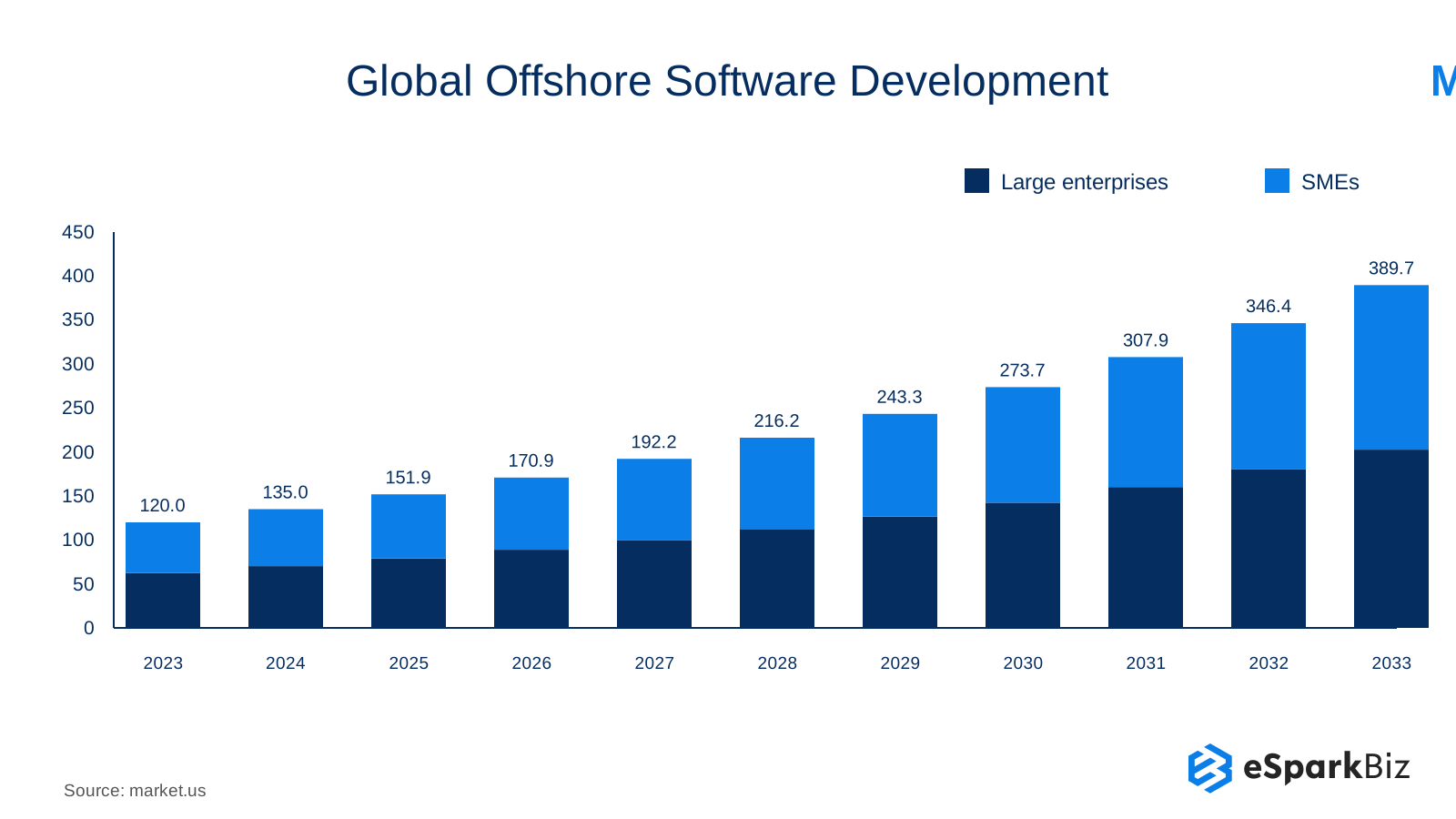
The global offshore software development market is estimated to reach $170.9 billion in 2026 and is projected to grow to $389.7 billion by 2033, at a 12.5% CAGR.
How We Estimated Offshore Software Development Rates
There is no single official rate for offshore software development. Public pricing benchmarks can differ because they use different data & pricing methods.
For this article, we reviewed 2026 public pricing data and market information to give you useful price ranges rather than present them as official market averages. We used Clutch for country level pricing and U.S. Bureau of Labor Statistics data for US software developer wages. We also compared public pricing information across regions, roles, and technologies.
How to read these rates
- Rate type: Hourly development or contractor rates
- Year: 2026 estimates
- Experience: Junior, mid level, and senior, where available
- Location: Country & regional price ranges
- Scope: Development and related technical roles
- Important: These are estimates, not official country averages or fixed prices from software companies.
Offshore Developer Rates by Region in 2026
Region is one of the main factors that affects offshore developer rates. Experience, technical skills, hiring model, and working hour overlap can also affect the final rate.
| Region | Mid Level Rate | Senior Rate | Typical US Workday Overlap | What to Consider |
| South & Southeast Asia | $18-$35/hr | $25-$60/hr | Limited | Lower rates, but less overlap with US work hours |
| Eastern Europe | $30-$55/hr | $40-$80/hr | 2 to 4 hours | Good technical talent with a shorter overlap window |
| Latin America | $25-$50/hr | $35-$75/hr | 6 to 9 hours | Strong overlap with most US work hours |
| Africa | $20-$40/hr | $30-$60/hr | 1 to 4 hours | Growing talent markets with some US overlap |
| US onshore benchmark | $80-$150+/hr | $140-$200+/hr | Full workday | Used only as a cost comparison |
Methodology note: These ranges are planning estimates that are based on public 2026 pricing benchmarks. It is important that they are not used as official regional averages, but rather to compare the relative costs of the markets.
Offshore Software Development Rates by Country
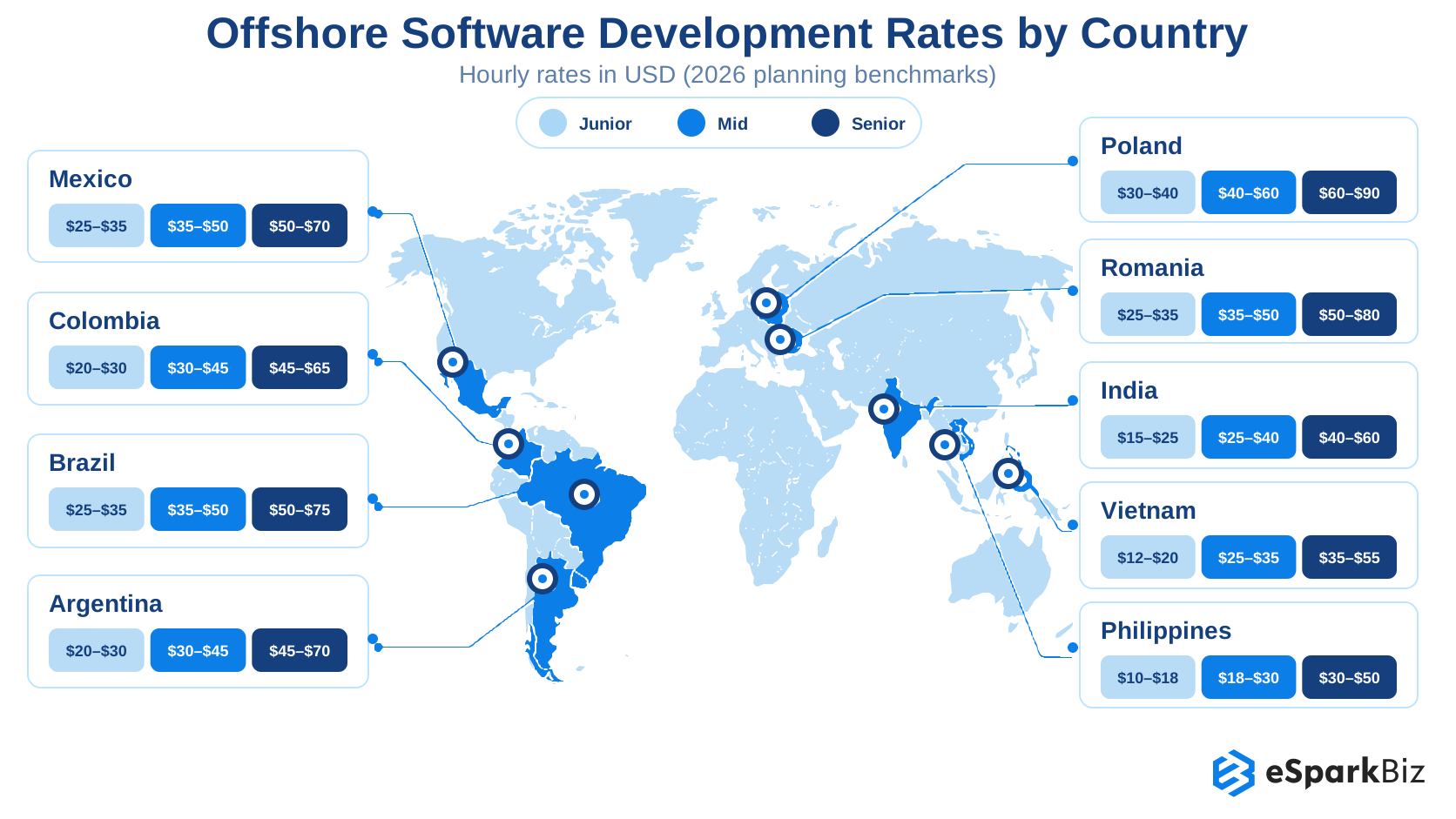
Country level rates give you a clearer idea of what you may pay in different offshore markets. The ranges below are 2026 planning benchmarks, not fixed prices.
| Country | Junior | Mid | Senior | Notes |
| India | $15-$25/hr | $25-$40/hr | $40-$60/hr | Large talent pool & competitive rates |
| Philippines | $10-$18/hr | $18-$30/hr | $30-$50/hr | Competitive rates and strong English skills |
| Vietnam | $12-$20/hr | $25-$35/hr | $35-$55/hr | Growing software development market |
| Poland | $30-$40/hr | $40-$60/hr | $60-$90/hr | Strong technical talent with higher rates |
| Romania | $25-$35/hr | $35-$50/hr | $50-$80/hr | Strong software and engineering talent |
| Brazil | $25-$35/hr | $35-$50/hr | $50-$75/hr | Established development market |
| Argentina | $20-$30/hr | $30-$45/hr | $45-$70/hr | Competitive rates across experience levels |
| Mexico | $25-$35/hr | $35-$50/hr | $50-$70/hr | Close alignment with US work hours |
| Colombia | $20-$30/hr | $30-$45/hr | $45-$65/hr | Strong US workday overlap |
Estimated 2026 planning ranges synthesized from publicly available pricing benchmarks, including Clutch country level and provider pricing data. Actual rates vary by provider, seniority, role and engagement model.
Asia: India, Philippines, and Vietnam
India, the Philippines & Vietnam offer some of the lower offshore rates. Rates generally increase as developers gain experience, although the size of the increase varies by country and role.
When comparing countries, compare the same role and experience level. This gives you a fairer view of the real price.
Eastern Europe: Poland and Romania
Poland and Romania generally cost more than the lower priced Asian markets. Senior developers can reach $60-$90/hr in Poland and $50-$80/hr in Romania.
Both markets have established software engineering talent, but actual rates depend on seniority, technical skills, provider type, and project requirements.
Latin America: Brazil, Argentina, Mexico, and Colombia
Rates vary across Latin American markets. Brazil and Mexico sit toward the higher end of these ranges, while Argentina and Colombia offer lower starting points in several developer levels.
For US companies, compare the developer level, role & services included instead of choosing a country only because its starting rate is lower.
Country sets a range. What you buy determines where you land.
Offshore Software Development Rates by Seniority, Role and Tech Stack
Country sets the starting point, but the final rate also depends on seniority, role, technology, vendor type, team size, deadline, project complexity & required work hour overlap. An agency may charge more than a freelancer because its rate can include management, QA, and other delivery support.
Rates by Seniority and Role
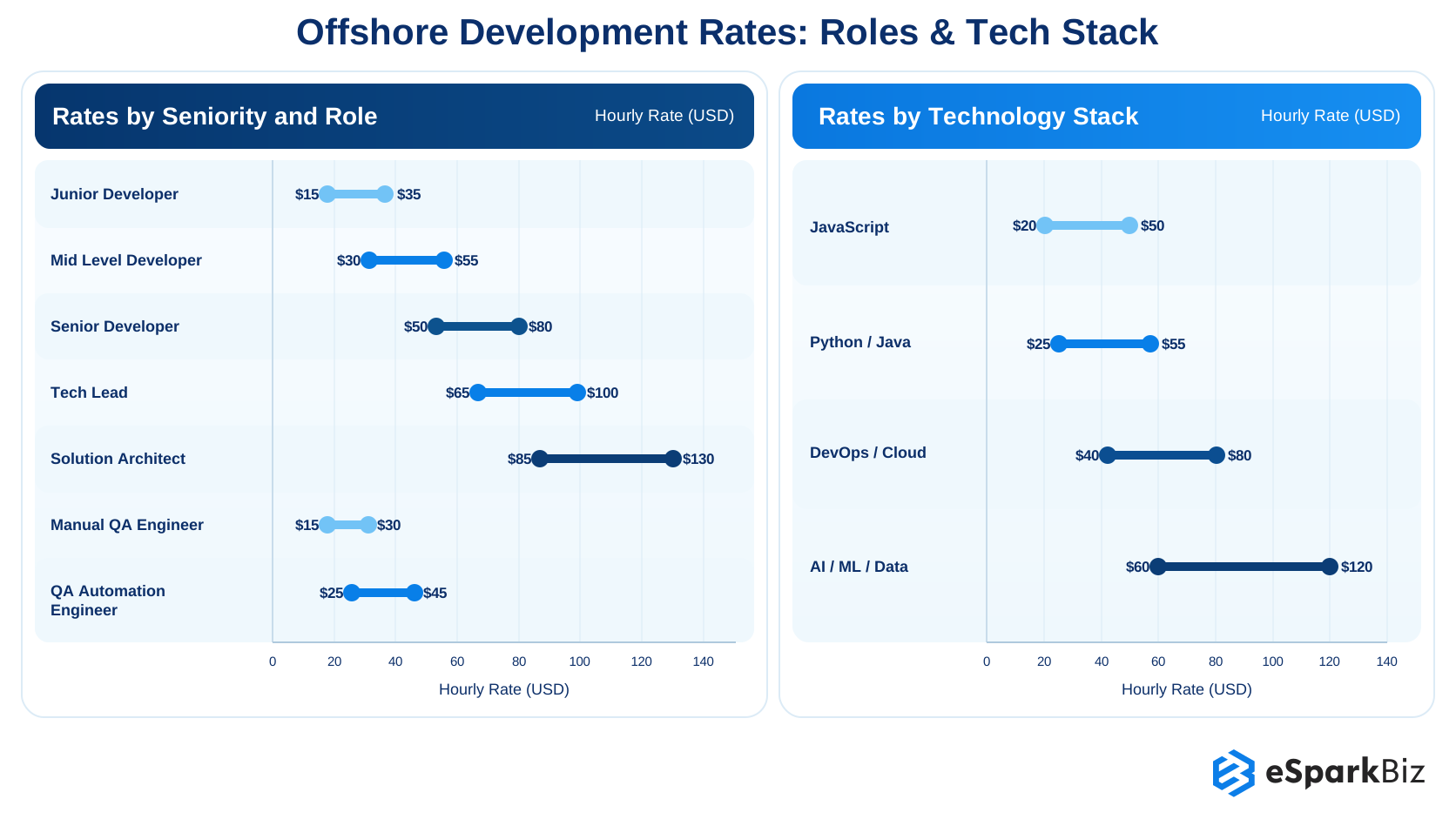
For this article, we use junior = 0 to 2 years, mid level = 3 to 5 years & senior = 6+ years as simple comparison labels. These are editorial definitions, not fixed industry standards.
| Role | Typical Offshore Rate |
| Junior Developer | $15-$35/hr |
| Mid Level Developer | $30-$55/hr |
| Senior Developer | $50-$80/hr |
| Tech Lead | $65-$100/hr |
| Solution Architect | $85-$130/hr |
| Manual QA Engineer | $15-$30/hr |
| QA Automation Engineer | $25-$45/hr |
For budgeting: Junior developers can reduce delivery costs for well defined tasks, while senior developers and architects are more appropriate when the project involves complex architecture, technical leadership or high risk decisions.
As responsibility increases, rates usually increase too. Tech leads and architects cost more because they handle broader technical decisions, planning and team direction.
Rates by Technology Stack
Technology also affects the rate. Common skills can have larger talent pools, while specialized skills usually cost more.
| Technology / Skill | Typical Offshore Rate |
| JavaScript | $20-$50/hr |
| Python / Java | $25-$55/hr |
| DevOps / Cloud | $40-$80/hr |
| AI / ML / Data | $60-$120/hr |
These are broad planning ranges. A Python developer building a standard application and an engineer building a machine learning system may have very different rates, even when both use Python.
Important: Technology alone does not determine the rate. A developer’s seniority, role, project complexity, cloud requirements and specialized experience can move the final quote substantially.
Why AI/ML Rates Can Be Higher
AI and ML work can cost more because these projects often require specialized skills in areas such as machine learning, data engineering, model development, cloud infrastructure or MLOps.
There is no single AI/ML premium that applies to every project. Compare developers with the same seniority, role, responsibilities, and technology requirements before deciding whether one quote is higher.
Published rate charts often disagree because they measure different things.
Why Offshore Developer Rate Charts Disagree
Offshore rate charts can show different prices for the same country, role or experience level. This does not always mean the numbers are wrong. Different sources may use different ways to calculate rates.
Five factors explain most of the difference:
- Who provides the service: Freelancers, agencies and development teams have different costs.
- How experience is defined: One source may call a developer mid level with three years of experience, while another may use five years.
- When the data was collected: Rates can change as demand, talent supply and market conditions change.
- What the rate includes: Some rates cover developer work only. Others may include QA, project management, technical leadership or other services.
- Salary vs. billing rate: A developer’s salary is not the same as the hourly rate a company charges a client.
The main point is simple: the hourly rate is only one part of the total cost. A lower rate may include fewer services, while a higher rate may include more support.
When comparing offshore rates, do not look at the hourly number alone. Compare the same role, experience level, pricing model & services included to get a fair estimate.
Next, we compare offshore rates with a US developer cost baseline.
How Much Does Offshore Development Cost Compared With the US?
US and offshore development costs are not directly comparable. A US salary shows what an employee earns, while an offshore rate may cover development work plus services such as QA or project management.
Understanding the offshore software development services cost helps US businesses compare offshore rates with local development expenses and plan their engineering budgets.
The US Bureau of Labor Statistics reports a median annual wage of $135,980 for software developers in May 2025. This is employee pay, not a client billing rate.
| US cost measure | 2026 planning figure |
| US developer median salary | $135,980/year |
| US contractor rate | $85-$135/hour |
| Contractor cost at 160 hours | $13,600-$21,600/month |
For planning purposes, this article uses an estimated US contractor range of $85-$135/hour for a mid level developer. At 160 hours per month, that equals $13,600-$21,600.
For employee hiring, salary is not the full employer cost. Benefits, payroll taxes, equipment, and other expenses can increase the actual cost beyond base salary. The exact amount varies by employer, so it should not be treated as a fixed percentage.
Offshore rates can be lower than US contractor rates, but the difference depends on the country, developer level, engagement model and services included. Current 2026 benchmarks show that the gap varies by region.
The rate is only part of the cost.
Hidden Costs of Offshore Software Development
A low hourly rate does not always mean a low project cost. You may also spend money on management, delays, rework, hiring and other project needs that do not appear in the initial quote.
Here are the main costs to consider:
- Management time: Your team may spend extra hours on meetings, task reviews, progress checks and communication.
- Rework: Unclear requirements or missed details can lead to changes, fixes and repeated work.
- Time zone delays: A large time difference can slow decisions when your team needs answers during the workday.
- Turnover and ramp up: If a developer leaves, finding a replacement and getting them familiar with the project takes time.
- Hiring and screening: Direct hiring can require interviews, skill checks, reference checks and onboarding.
- Security and compliance: Projects that handle sensitive data may need extra security reviews, contracts and controls.
- Rate changes: A starting rate may change when responsibilities, team size, or contract terms change.
- Platform fees: Some hiring platforms charge separate service or transaction fees.
Effective project cost = development fees + management overhead + rework + onboarding & replacement costs + required tools or compliance expenses.
Is a Very Low Offshore Rate a Warning Sign?
Not always. A $25/hour rate can fall within 2026 price ranges for some junior or mid level developers in certain offshore markets. The rate depends on the country, experience, role, technology & services included.
If a senior developer’s rate is far below the usual rate for that market, look into it before hiring. Before choosing a company, ask:
- Who will work on the project?
- What experience does the assigned developer have?
- Can you start with a paid trial or small project?
- What happens if the developer leaves?
- Does the rate include QA, project management and other support?
The goal is not to find the lowest hourly rate. It is to understand what the rate includes & what could increase your final project cost.
Now turn rates and overhead into a budget.
How Much Does a 5 Person Offshore Development Team Cost Per Month?
A five-person offshore development team costs depend on the region, experience, and hourly rates.
Formula: 5 people × hourly rate × 160 hours = monthly base cost
5 Person Team Monthly Cost
| Region | Mid-Level Rate | Base Monthly Cost |
| South & Southeast Asia | $18-$35/hr | $14,400-$28,000 |
| Eastern Europe | $30-$55/hr | $24,000-$44,000 |
| Latin America | $25-$50/hr | $20,000-$40,000 |
| Africa | $20-$40/hr | $16,000-$32,000 |
These estimates cover five mid-level developers working 160 hours per month. For example, five developers at $30/hour cost $24,000 per month.
Example: Five-Person Offshore Team With PM and QA
A five-person team with three mid-level developers, one project manager, and one manual QA engineer has the following estimated monthly cost:
| Role | Team Size | Hourly Rate | Monthly Cost |
| Mid-Level Developers | 3 | $30-$55 | $14,400-$26,400 |
| Project Manager | 1 | $30-$50 | $4,800-$8,000 |
| Manual QA Engineer | 1 | $15-$30 | $2,400-$4,800 |
| Total | 5 | $21,600-$39,200 |
Developer and QA rates use the article’s existing benchmarks. The PM rate is an illustrative planning assumption.
Offshore vs. US Contractor Cost
At the estimated US contractor rate of 85–135/hour, five contractors working 160 hours each cost $68,000-$108,000 per month. This is a broad comparison, not a role-matched quote.
These estimates exclude cloud services, software licenses, product owner time, and major rework unless included in the provider’s quote.
One factor that can quickly change these numbers is time zone.
Offshore vs Nearshore Software Development: Time Zone Overlap
A lower hourly rate can look attractive, but a large time zone gap can make meetings, feedback & decisions harder to coordinate. For US companies, workday overlap is an important factor when choosing between offshore and nearshore development.
| Location | Difference vs. New York* | US Workday Overlap |
| Mexico City, Mexico | 1–2 hours behind | High |
| São Paulo, Brazil | 1–2 hours ahead | High |
| Buenos Aires, Argentina | 1–2 hours ahead | High |
| Warsaw, Poland | 6 hours ahead | Moderate to limited |
| Bucharest, Romania | 7 hours ahead | Limited |
| Kyiv, Ukraine | 7 hours ahead | Limited |
| Lagos, Nigeria | 5–6 hours ahead | Moderate |
| Nairobi, Kenya | 7–8 hours ahead | Limited |
| Bengaluru, India | 9.5–10.5 hours ahead | Limited |
| Ho Chi Minh City, Vietnam | 11–12 hours ahead | Limited |
| Manila, Philippines | 12–13 hours ahead | Limited |
Differences can change during the year because New York observes daylight saving time while some locations do not. These figures are planning ranges for 2026.
Which Model Is the Best Fit?
Choose nearshore development if your project needs frequent US hour meetings, live planning or quick feedback.
Choose offshore development if your team can work asynchronously, document tasks clearly and does not need constant real time collaboration.
The best fit depends on your team’s working style and project needs not just the hourly rate.
How you pay can also change the effective rate.
Offshore Development Pricing Models
How you pay for offshore development can change your budget risk. Fixed price gives you a defined price for the agreed scope, while Time & Materials and dedicated teams give you more flexibility as the work changes.
| Pricing Model | Best For | Who Bears More Cost Risk? | Rate Effect | What to Watch |
| Fixed Price | Small projects with clear, stable requirements | Vendor within the agreed scope | May include a risk buffer | Scope changes can add costs |
| Time & Materials | Projects where requirements may change | Client | Pay for actual time and resources used | Track hours and total spend |
| Dedicated Team | Long term products and ongoing development | Client for team capacity | Usually a predictable monthly cost | Make sure the team has enough ongoing work |
Fixed Price pricing model works perfectly well where the scope and deliverables are known. Changes to what was agreed on could lead to additional charges.
Time & Materials pricing model gives room for changes where there is need for flexibility in terms of requirements.
Dedicated Team pricing model works perfectly for projects that require ongoing development.
No model is always cheaper. The best choice depends on your scope, flexibility and budget needs.
Pick a partner who prices honestly.
How to Choose an Offshore Software Development Partner
It is important for an ideal offshore partner to have clarity on the pricing, roles and risks before signing any agreement.
8 Checks Before You Sign
- Who will do the work? Confirm the five-person team structure, including the tech lead, developers, and QA engineers, along with each person’s responsibilities.
- Is their seniority real? Check relevant experience, work samples, or technical tests.
- Do they have relevant project experience? Ask about similar projects, industries, and technical work.
- Can you communicate easily? Agree on meeting schedules, response times, and the number of working hours that overlap with your US team.
- Who owns the work? Include clear IP ownership and source code transfer terms in the contract. Confirm when ownership transfers to your business.
- How stable is the team? Define developer replacement terms, including the replacement timeline and whether additional charges apply.
- Can you test the team? Consider a small paid trial before a larger commitment.
- What happens if you leave? Define notice periods, handover responsibilities, access transfer, and any applicable rate-change terms.
Check Security and Compliance
Ask for evidence that fits your project. This may include SOC 2 reports, documented HIPAA safeguards for applicable healthcare work or processes designed to meet applicable CCPA and CPRA requirements. Do not rely on a compliance claim without supporting evidence.
Compare Quotes Carefully
A low hourly rate can hide additional costs for QA, project management, and other services. Before comparing offshore development quotes, check what each provider includes in the price.
- QA and testing: Are manual testing, automated testing, and bug fixes included?
- Project management: Are project managers and delivery coordination covered or billed separately?
- Technical support: Are code reviews and technical leadership included?
- Additional costs: Are onboarding, tools, cloud services, overtime, or scope changes charged separately?
- Quote terms: Are payment terms, quote validity, and rate increases clearly defined?
Compare the total monthly or project cost for the same scope, working hours, and included services rather than choosing a provider based only on the lowest hourly rate.
How eSparkBiz Helps With Offshore Software Development
At eSparkBiz, we provide offshore software development services for businesses that need to create new applications, improve existing software, or extend their development teams. With 15+ years of experience, 400+ engineers, and 1,000+ projects delivered, we support businesses across different technology and development needs.
Our services include dedicated development teams, custom software development, cloud and DevOps, and quality assurance. Whether you need developers to extend your existing team or a dedicated team to build and maintain applications, we offer flexible engagement options.
Our offshore development rates start at less than $25 per hour, helping businesses access skilled developers while managing their engineering budgets. The final pricing depends on the required technical skills, team size, experience, and engagement model.
We also align our team’s working schedules with US business hours to support real-time communication, project discussions, and regular updates. Our ISO 27001:2022 and ISO 9001:2015 certifications demonstrate our focus on information security and quality management. The exact working-hour overlap depends on your project requirements and agreed team schedule.
Conclusion
Offshore software development rates in 2026 differ across country, region, developer experience, role, technology, pricing model. The hourly rate is just a starting point. Be sure to compare the abilities of the teams, services offered, time zone requirements, security protocols and contractual terms before hiring a partner. If you get a clear comparison, then you can make an informed guess at the actual project cost and select an offshore team that is within your budget and project specifications.
Frequently Asked Questions
What is a typical offshore software development rate in 2026?
Offshore software development rates in 2026 commonly range from about $15 to $120+ per hour, depending on country, developer experience, role, technology and pricing model. These are planning ranges, not fixed prices.
Which country has the cheapest offshore software development rates?
India, the Philippines & Vietnam often appear toward the lower end of published offshore rate ranges. However, the lowest hourly rate does not always mean the lowest project cost. Developer skills, experience, services and project requirements also affect the final price.
Are project management and QA included in offshore development rates?
It depends on the provider & pricing model. Some quotes include project management and QA, while others charge separately. Ask what the rate covers before comparing two quotes.
Is hiring a full time offshore developer cheaper than a contractor?
It can be cheaper for long term work, but there is no universal answer. Compare the total cost, including pay, benefits, recruitment, management & other services. A lower hourly rate does not automatically mean a lower monthly cost.
Can offshore software development rates change during a project?
Yes. The rates may change because of some provisions for increasing rates, changes in the roles of developers, changes in the team, changes in the terms of the agreement. Prior to starting the process, make sure of these provisions.
How should a US company compare offshore development quotes?
It is important to compare them based on the same roles, seniority, number of hours, services provided, payment structure, and project scope. One needs to establish if there are any quality assurance and project management services involved and then see other costs.
How many offshore developers can a Series A SaaS startup hire with a $60,000 monthly engineering budget?
A Series A SaaS startup can potentially build an eight-person offshore team within a $60,000 monthly engineering budget. Here is an estimated cost breakdown:
|
Role |
Team Size |
Estimated Monthly Cost |
|
Senior Developers ($65/hour) |
2 |
$20,800 |
|
Mid-Level Developers ($42.50/hour) |
4 |
$27,200 |
|
Manual QA Engineers ($22.50/hour) |
2 |
$7,200 |
|
Total |
8 |
$55,200 |
This team costs an estimated $55,200 monthly, leaving $4,800 for additional expenses. Actual costs vary by provider.
How to Choose the Best Offshore Software Development Company?
Check the company’s technical expertise, project experience, client reviews, pricing, communication, and security practices. Also, review IP ownership, contract terms, developer replacement policies, and working-hour overlap before choosing a partner.