ChatGPT
 Google AI
 Perplexity
 Claude.ai
This guide walks through how to add AI to Python applications in stages, moving from prediction and automation to language understanding and autonomous agents. Each stage should prove its value before you move to the next.
- Which tools fit each stage
- What it actually costs to build and run
- Risks teams commonly overlook
- Whether to hire in-house or bring in outside help
Many large organizations claim to be “doing AI.” However, McKinsey’s State of AI survey states that only 23% of companies have a working, enterprise-level agentic system. For teams investing in python AI development, the gap between proof of concept and production is where many projects get stuck.
Although the model is rarely an issue, the real challenge tends to be the order of implementation. Companies will often develop chatbots and autonomous agents before developing data pipelines, scaling valuation processes, and designing the necessary governance for AI at scale.
For CTOs and VPs of Engineering, this is where the challenge begins to expand from technical to operational. The challenges begin to affect hiring, budgeting, and the recently developed AI plans and systems and how they are now explained to the board after the sales team sets expectations that are unrealistic.
Python’s Growing Relevance across Enterprise-grade AI System
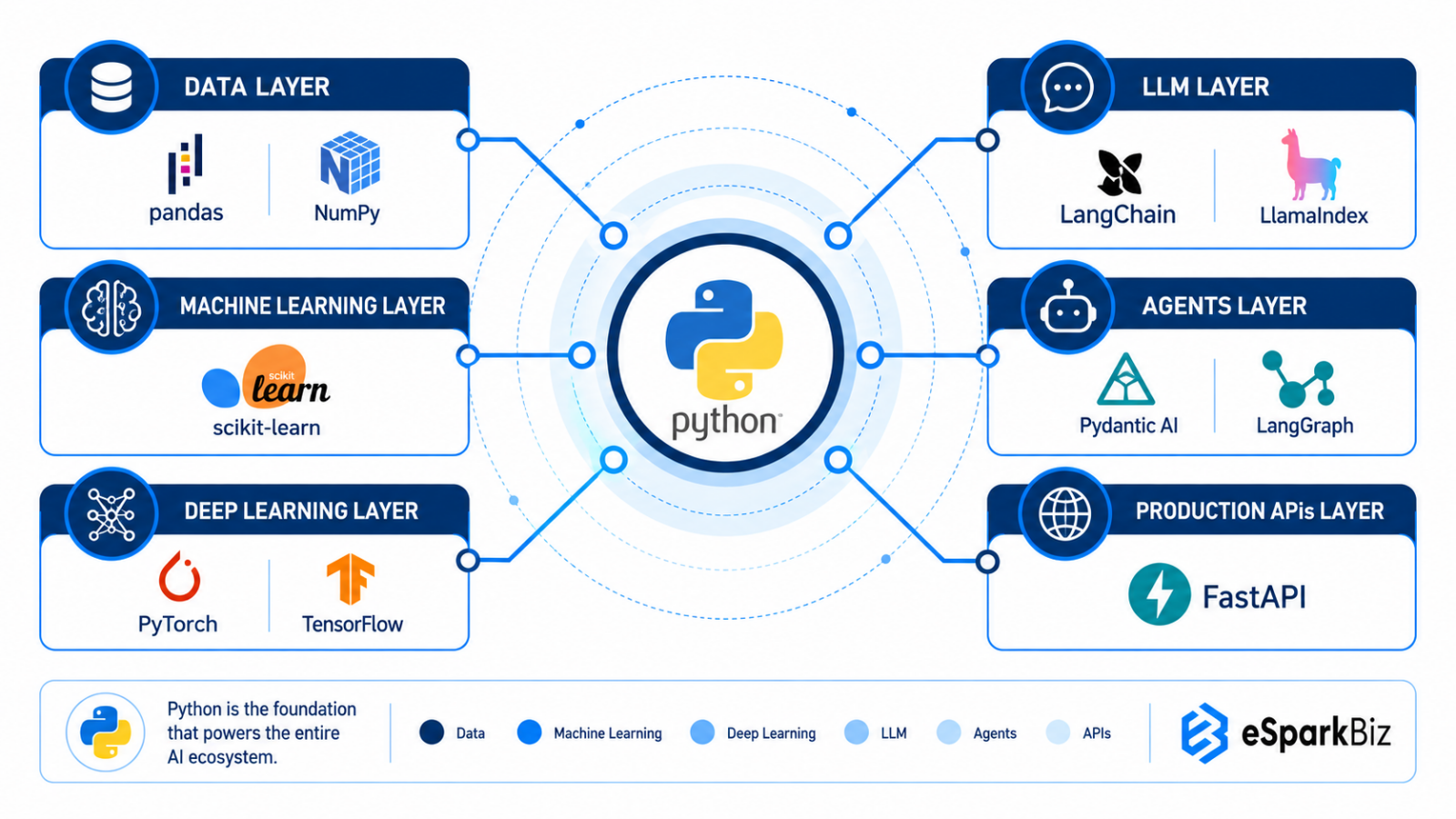
It happens every few years. Predictions emerge claiming that the programming language Python will no longer be used for artificial intelligence development. However, that prediction has not and most likely will not happen in 2026. The infrastructure surrounding the language continues to expand and no programming language has been able to close that gap.
What keeps Python at the center of AI development:
- Data foundation: NumPy, pandas and scikit-learn are widely used libraries for data processing and machine learning, respectively, in a structured format.
- Deep learning: In regard to adoption, community support, and real-world implementation of AI, PyTorch and TensorFlow are the most widely adopted frameworks.
- LLM tooling: LangChain, LlamaIndex and Pydantic AI, Python is the center of the tooling, while other programming languages are attempting to catch up.
- Production readiness: FastAPI and Python’s async capabilities have made the language practical for serving AI workloads in production, not just building prototypes in notebooks.
For large teams, Python’s advantage is not simply its syntax. It is the combination of a development community and supporting libraries that are at a level of maturity to handle production. This is why Python is the base for the decision making process in the order of build vs buy for AI development.
Executive Insights:
Organizations take an average of 8.6 months to move an AI initiative from prototype to production, highlighting the importance of strong data, evaluation, infrastructure and governance.
The AI Maturity Model: A Staged Roadmap for Python Teams
Large AI projects are not usually the starting point for most organizations. Instead, teams must work iteratively by completing smaller initiatives with each iteration proving the value of the previous iteration. That’s the approach behind the maturity model used in this guide.
| Stage | Capability | Core Python Stack | Typical Use Case | What It Requires |
| Stage 1 | Predictive Analytics | pandas, NumPy, scikit-learn | Classification, regression, forecasting | Clean data and reliable historical datasets |
| Stage 2 | Deep Learning | PyTorch, TensorFlow | Computer vision, NLP, custom models | Larger datasets, model training and stronger compute |
| Stage 3 | LLM + RAG | LangChain, LlamaIndex, Pydantic AI | Chatbots, document Q&A, knowledge assistants | Structured knowledge sources, retrieval and evaluation |
| Stage 4 | Autonomous Agents | LangGraph, Semantic Kernel | Multi-step, tool using workflows | Reliable tools, workflow controls and guardrails |
| Production | Scaled AI Systems | Inference, evaluation, observability, governance | Business critical AI at scale | Production infrastructure, monitoring, governance and ongoing evaluation |
A Progressive Guide from Prediction to Autonomous Agents
The stages listed in this paper are not a framework for teams to choose from; they are a sequence. The most frequent reason that chatbot pilots fail to reach production is skipping straight from Stage 1 to Stage 3 because the data discipline that Stage 1 establishes was never built.
In the sections that follow, each stage in the sequence will be analyzed. For each stage, we will provide a description of what the stage actually entails, the mistake made by teams at that stage, and the signal that indicates the team has reached the stage in the sequence and should move on.
Five Questions before you Fund any Stage
For an engineer, this model describes a tool. For a CEO or CFO, this model describes a financial investment. Each of the stages discussed in the sections that follow contains five questions that a decision maker would ask when assessing the proposal.
| Dimension | The Question It Answers |
| Business Objective | What problem in the business does this actually solve? |
| Investment | What will this cost us in budget, people and time? |
| Risk | What’s the downside if this goes wrong? |
| Readiness | Are our people, data and processes actually prepared for this? |
| Exit Criteria | What result tells us to move forward or to stop? |
Stage 1: Predictive Analytics Foundations
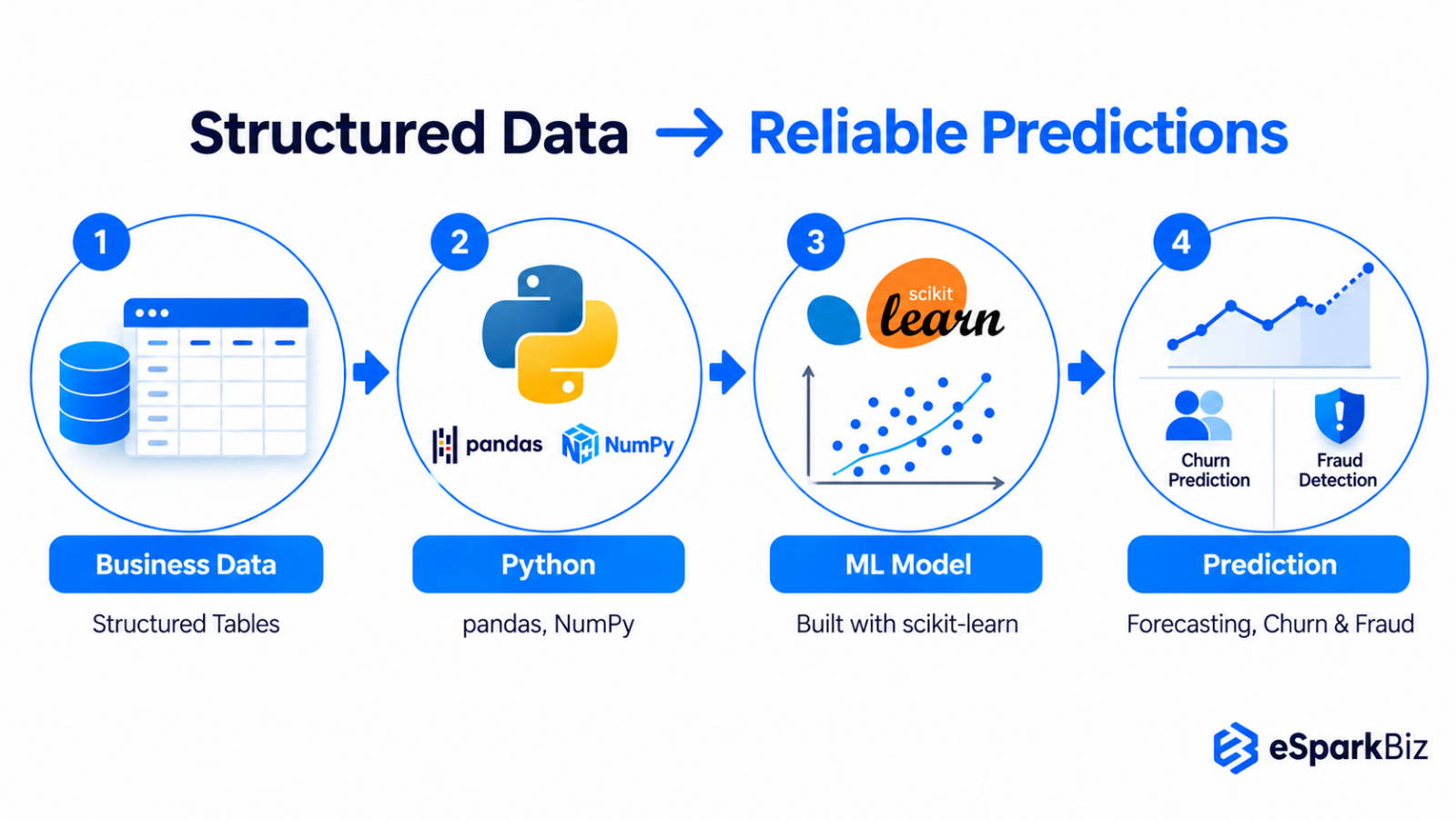
This is where most organizations should begin their AI journey and many already have the foundations in place. If your team uses pandas and NumPy for data preparation and scikit-learn for classification or regression models, you are already operating at Stage 1.
Common use cases:
- Churn prediction
- Demand forecasting
- Fraud detection
- Credit scoring
These do not require significant capital investment, GPUs or infrastructure. This uses data that your organization collects and requires skills that many of your organization’s Python developers possess.
Code example:
from sklearn.linear_model import LinearRegression
model = LinearRegression().fit(
[[1], [2], [3]], [100, 200, 300]
)
print(model.predict([[4]]))
This example trains a regression model using historical data and predicts a value for a new input.
Key Risk to Manage:
Treating this phase as something to finish as quickly as possible. A chatbot with weak monitoring delivers less business value than a dependable predictive model with transparent results.
You are ready for Stage 2 when:
- Your predictive models are stable & reliable in production
- The next business problem requires working with images or unstructured text
- Traditional statistical methods can no longer capture the patterns your business needs
Executive Takeaway:
- Business Objective: Better forecasts, fewer costly surprises.
- Investment: Low, existing team and data are enough.
- Risk: Low if data quality and monitoring are in place. Rushing this stage is the main danger.
- Readiness: Ready today if your data is already clean.
- Exit Criteria: Move on once the business asks what else AI could handle.
Stage 2: Deep Learning Capabilities
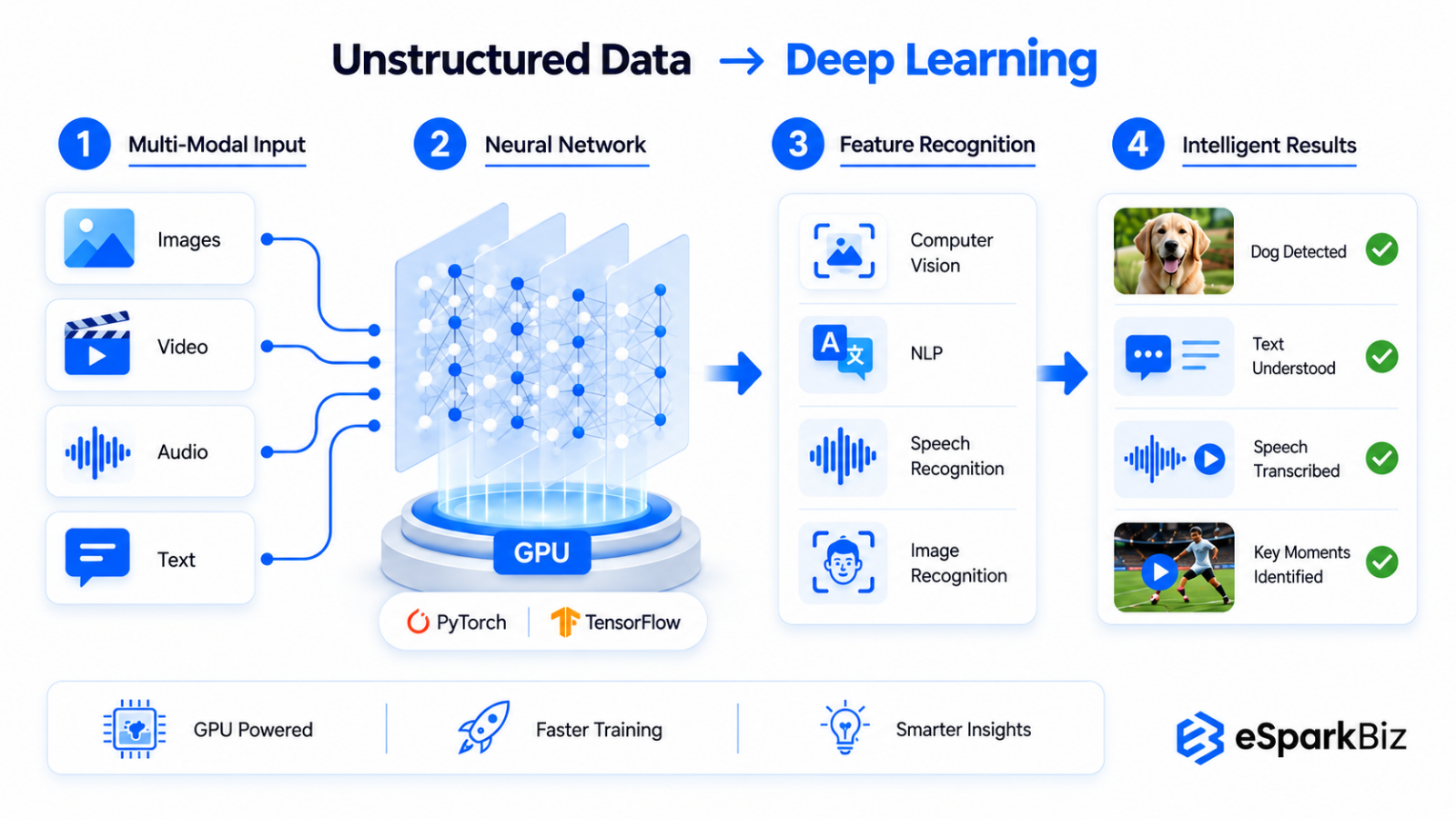
This stage begins when your data moves beyond structured rows and columns. Traditional scikit-learn models struggle with images, video, audio and free text, so frameworks such as PyTorch and TensorFlow become relevant.
Common use cases:
- Computer vision for defect detection or document processing
- Sentiment analysis and entity extraction from text
- Image classification and object detection
This typically requires GPU infrastructure and developers who understand model training, rather than simply integrating existing models.
Code example:
import torch
from torch import nn
model = nn.Linear(2, 1)
print(model(torch.tensor([[1.0, 2.0]])))
This example shows a PyTorch neural network processing numerical input to produce an output. The model has not been trained.
Critical Consideration:
Choosing a framework without checking whether it fits your business and technical needs. PyTorch currently leads in research, while TensorFlow is still a good choice when mobile deployment is required. Switching frameworks later can be costly.
You’re ready for Stage 3 when:
- Your models perform reliably in production
- The next business problem requires understanding language at scale
- Pattern recognition alone cannot address what the business needs
The Business View:
- Business Objective: Unstructured data becomes a hard to copy advantage.
- Investment: Moderate to high, GPUs and specialized talent needed.
- Risk: Framework choice is costly to reverse later.
- Readiness: Needs dedicated budget and ML talent or a partner.
- Exit Criteria: Move on once the next problem is about language, not patterns.
Real Case Study: Netflix’s Approach of using Artificial Intelligence with Python
Netflix runs its machine learning work, from content forecasting to personalization, on Metaflow, a Python native framework built to move models smoothly from a data scientist’s laptop straight into production.
Stage 3: LLM and RAG Integration
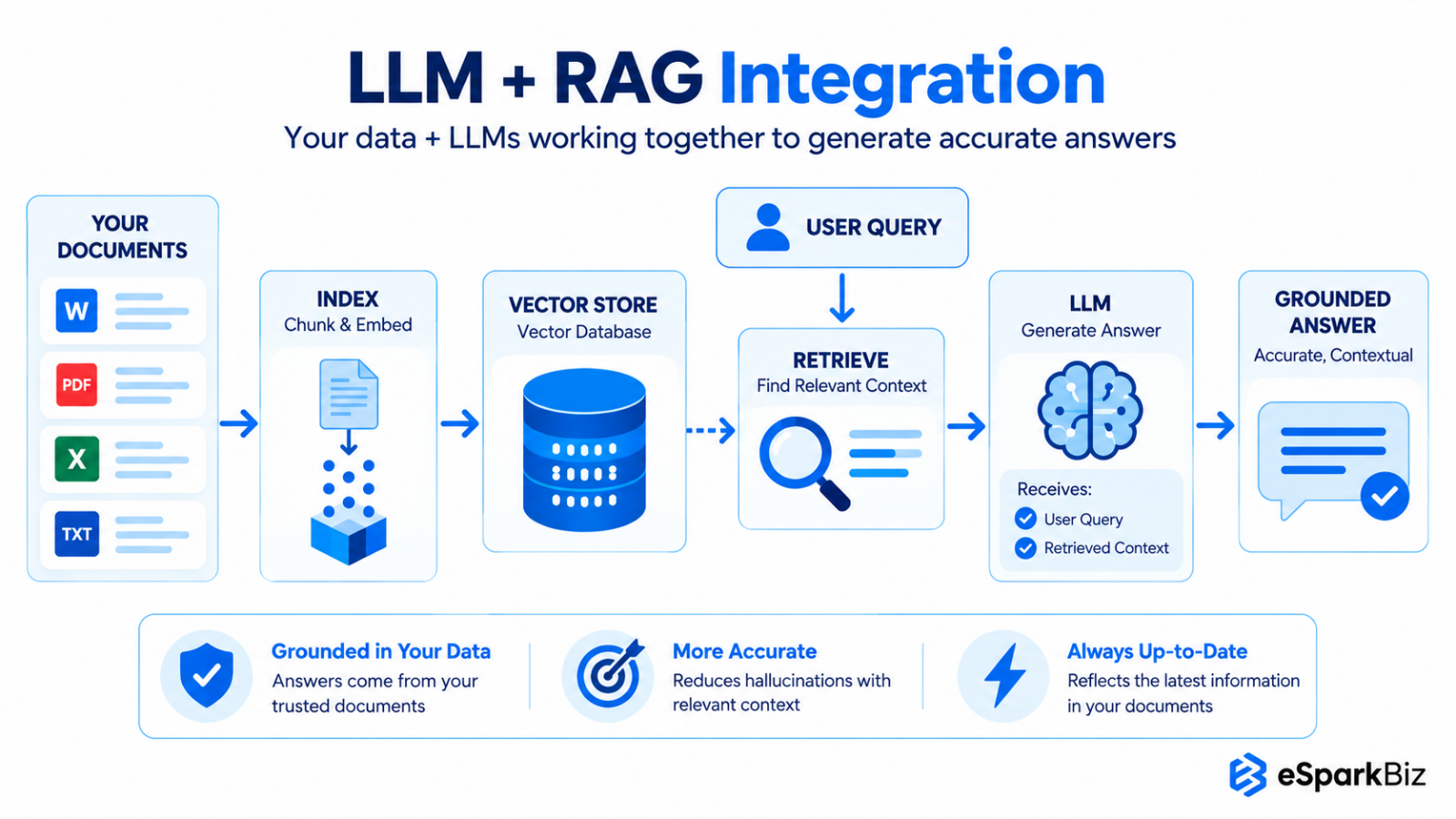
This is the stage many teams rush into first, often skipping Stages 1 and 2, which is why so many chatbot pilots never make it into production. If your team is already using an LLM API and grounding its responses with your own documents, you are operating at Stage 3.
Common use cases:
- Answering questions using internal company documents
- Customer support chatbots based on your own data
- Searching and summarizing large volumes of text
LangChain, LlamaIndex and Pydantic AI have different frameworks for these tasks and varying levels of customization, so you have to decide how much you are willing to trade off for a flexible framework.
Code example:
from langchain_openai import ChatOpenAI
llm = ChatOpenAI(model=”gpt-4.1-mini”)
response = llm.invoke(
“Summarize: Refunds are available within 30 days.”
)
print(response.content)
This example sends a prompt to an LLM through LangChain. A complete RAG pipeline also retrieves relevant documents before generating a response.
Common Failure Point:
Using RAG to cover up poor quality data. If your data is outdated, duplicated or unstructured, the system can return confident but wrong answers. A wrong answer is worse than no answer.
You’re ready for Stage 4 when:
- Your system produces reliable answers without constant prompt adjustments
- The task requires multiple steps or decisions rather than a single lookup
- People are still manually connecting outputs that should happen automatically
The Leadership Angle:
- Business Objective: Faster answers for customers and staff, without more headcount.
- Investment: Moderate, cost grows with usage.
- Risk: Bad answers surface as bad decisions, not system errors.
- Readiness: Needs clean, current internal documents first.
- Exit Criteria: Move on once answers are reliable without constant tuning.
Community Insights
On r/learnpython, a frequently discussed thread asks whether Python is still the best language for AI, with most replies agreeing it remains the default choice thanks to its libraries, even as newer challengers get debated.
Stage 4: Autonomous Agents
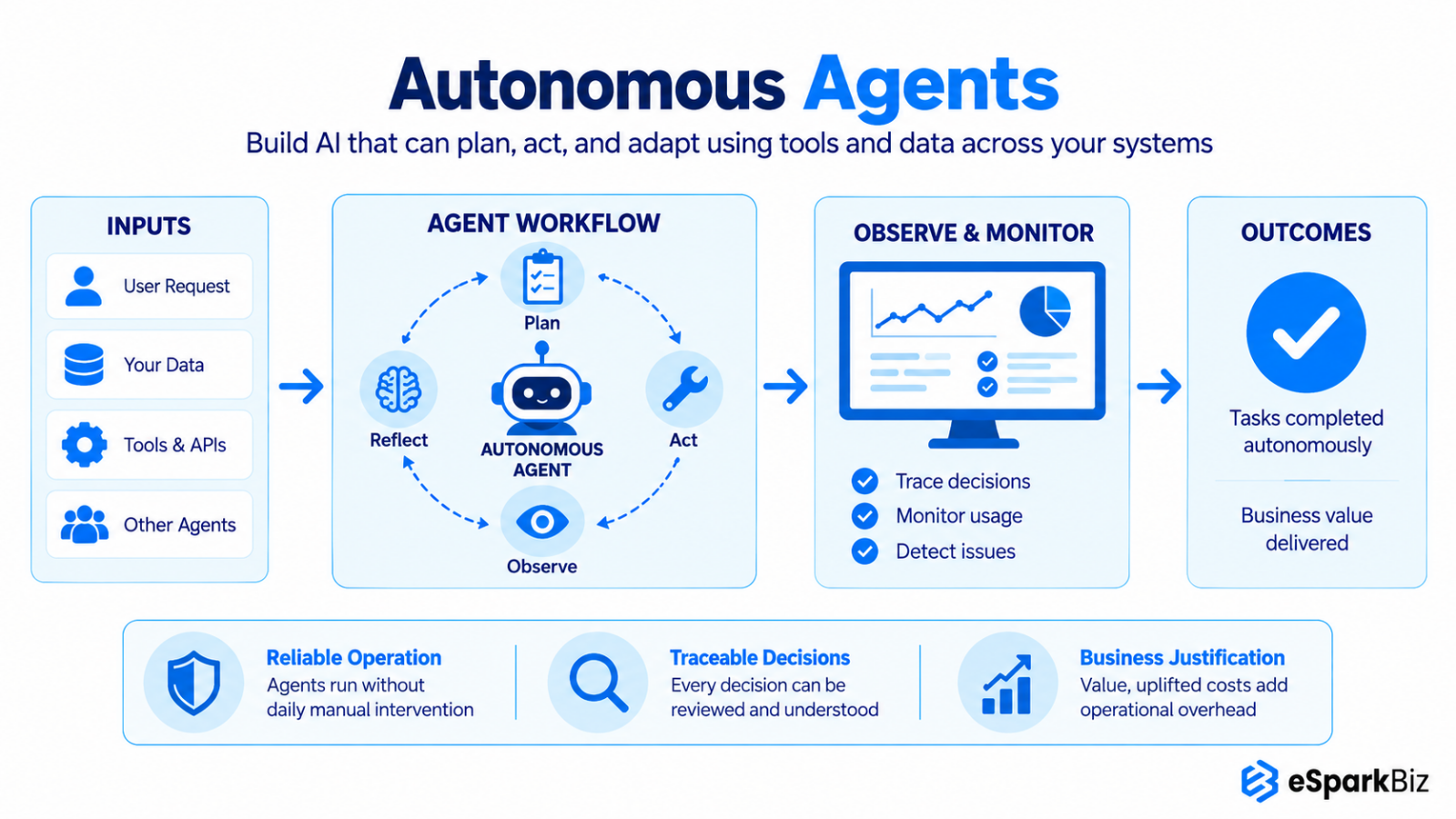
This is the stage where the most hype exists and many projects fail. A Python AI agent goes beyond answering prompts by planning tasks, selecting tools, executing actions, and adjusting its approach based on results.
Common use cases:
- Multi-step workflow automation across internal systems
- Research and data gathering tasks requiring multiple tool calls
- Agents that route work between specialized agents
Python AI agent frameworks such as LangGraph, Microsoft Semantic Kernel, and AutoGen can support stateful workflows, tool orchestration, and multi-agent coordination. However, they introduce engineering complexity, making it important to trace agent decisions and test failure scenarios.
Example: Automating shipment checks with LangGraph
from langgraph.graph import StateGraph
from typing import TypedDict
class State(TypedDict):
shipment: str
def check(state: State):
return {“shipment”: state[“shipment”].upper()}
graph = StateGraph(State)
graph.add_node(“check”, check)
graph.set_entry_point(“check”)
graph.set_finish_point(“check”)
print(graph.compile().invoke({“shipment”: “delayed”}))
This example demonstrates a basic LangGraph workflow. A production Python AI agent could connect shipment APIs, identify delays, and draft customer notifications for approval.
Before You Move Forward:
Building agent autonomy before putting monitoring in place. Without observability, teams may not know what an agent did, why it made a decision or where it failed until the system is already in production.
You’re ready for the Production stage when:
- Agents operate reliably without daily manual intervention
- Every agent decision can be traced after the fact
- Business value justifies the additional operational overhead
Decision Point for Leadership:
- Business Objective: Build new workflows and not just answer questions
- Investment: Significant, a real engineering commitment.
- Risk: Agents can act wrongly on real systems before anyone notices.
- Readiness: Guardrails must exist before agents go live.
- Exit Criteria: Move on once every decision is traceable and value justifies the cost
Production: Governance, Risk and Cost at Scale
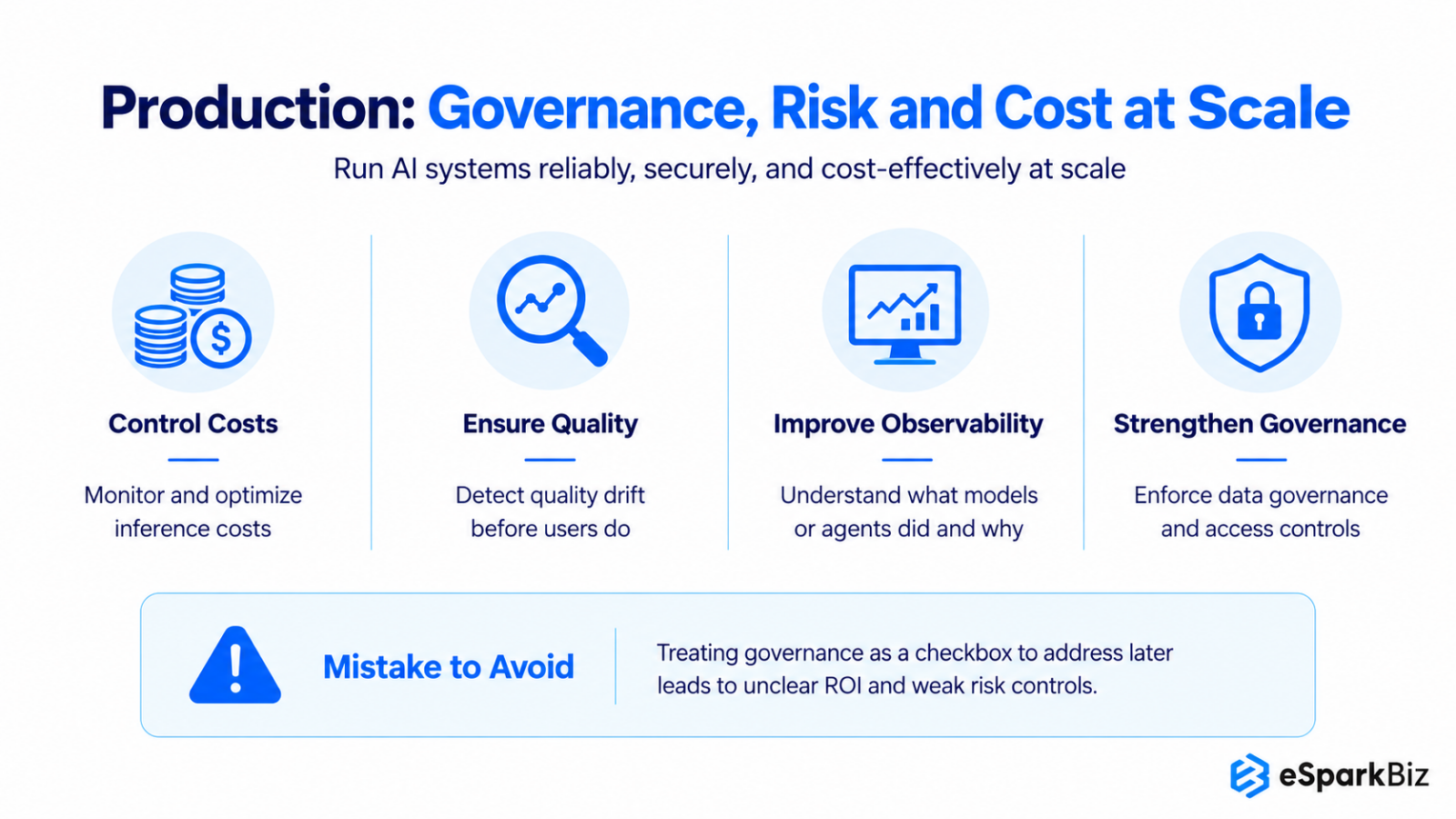
This is the stage many AI roadmaps overlook, yet it is where costs and risks can quickly get out of control. A Python AI prototype may work locally but fail under real-world workloads, concurrent requests, or unexpected inputs. Production requires more than a working model.
Common mistakes when moving to production:
- Skipping deployment essentials: Missing dependencies, environment variables, automated tests, and error handling can block releases.
- Ignoring performance: Slow inference, data drift, and concurrent requests can affect reliability and response times.
- Underestimating costs: Inference expenses grow with usage, especially when models or agents are poorly optimized.
- Delaying security and monitoring: Weak access controls, limited logging, and missing alerts make failures harder to detect and prevent.
What needs attention:
- Model evaluation to detect quality drift before customers do.
- Observability to understand model behavior and investigate failures.
- Automated testing, load testing, and staged releases before scaling.
- Data governance and access controls, particularly for agents acting on real systems.
Critical Risk:
Treating governance and deployment readiness as afterthoughts. Gartner projects that more than 40% of agentic AI projects will be canceled by the end of 2027, citing factors such as escalating costs, unclear business value and inadequate risk controls. A working prototype is not production-ready until reliability, security, performance, and operating costs are validated.
Strategic Snapshot:
- Business Objective: Make AI a dependable, board-reportable operation.
- Investment: Ongoing, scaling with usage.
- Risk: Inadequate testing, unclear ownership, weak monitoring, and uncontrolled costs.
- Readiness: Build testing, deployment controls, governance, and monitoring from day one.
- Exit Criteria: None. Production requires continuous monitoring and improvement.
🎥 Watch: Moving AI From Demo to Production
In this PyCon US talk, Anaconda’s Dawn Wages argues AI development is moving past quick demos toward real engineering discipline, observability, testing & resilience being the next frontier for production systems.
In-House or Outsourced: Choosing the Right Path Forward
There is no universal answer here. The right path depends on which stage your Python stack has reached, the budget available for this initiative and how much AI capability your existing team can realistically build without external support.
| Path | Best When | Key Consideration | Ideal Stage | Time to Value |
| Build In-House | Skills align with existing teams | Needs budget for scarce talent | Stage 1, 2 | Weeks, once hired |
| Build In-House | AI is core to the product | Justifies permanent headcount | Stage 1, 2 | Builds over quarters |
| Outsource | Need expertise fast | No lengthy hiring cycle | Stage 3, 4 | Days to onboard |
| Outsource | Project is time boxed | Avoids long term commitment | Stage 3, 4 | Delivered within the project window |
| Hybrid | Team learns while building | Team owns maintenance after | All stages | Value from day one, ownership over time |
Framework for Deciding Where AI Investment Pays Off
Every stage in this guide assumes that your initiative has actually got a shot at getting funded. That’s not always the case. Before any of your Python team writes a single line of code, leadership should be able to answer 8 basic questions that decide if this really is a good use of cash.
| Question | Executive Decision |
| Does this solve a high value business problem? | Invest / Reconsider |
| Is the required data available and trustworthy? | Proceed / Fix data first |
| Can the value be measured? | Define KPI / Delay launch |
| Is AI materially better than conventional software? | Choose AI / Choose automation |
| Can the solution scale economically? | Approve / Revisit unit economics |
| Can the risks be controlled? | Launch / Add governance first |
| Does it create competitive differentiation? | Build in-house / Buy or outsource |
| Can the organization operate it after launch? | Proceed / Build capability first |
Used well, this turns “should we build this” into a short checklist leadership can walk through in one meeting, before a single stage of the roadmap begins.
Expert’s Quote
The markets are finally catching up to something builders have always known: that enterprise AppGen has become a threat to traditional SaaS.
Choosing your Stack: A Quick Decision Reference
Choosing the right Python AI framework early can reduce migration costs as your project grows. The best fit depends on your data, model deployment needs, retrieval requirements, and workflow complexity. Use this reference to compare common framework choices at each stage.
| Decision | Choose This When | Choose the Alternative When | Best Fit Stage | Switching Cost |
| FastAPI vs. Django | Need lightweight, async-first APIs | Need built-in admin, auth, and ORM | Stage 3, 4, Production | Moderate |
| PyTorch vs. TensorFlow | Prioritize research flexibility and model customization | Need an established ecosystem for production and mobile deployment | Stage 2 | High |
| LangChain vs. LangGraph | Need a broad integration ecosystem for LLM applications | Need branching workflows or persistent state | Stage 3, 4 | Moderate |
| LangGraph vs. Semantic Kernel | Already use LangChain-compatible workflows | Have an established Microsoft/.NET stack | Stage 4 | High |
| LlamaIndex vs. LangChain | Prioritize document ingestion and retrieval for RAG | Need broader LLM orchestration and integrations | Stage 3 | Moderate |
| scikit-learn vs. PyTorch | Work with structured data and classical ML | Build deep learning models for images or text | Stage 1, 2 | High |
| Pydantic AI vs. LangChain | Need typed outputs and structured validation | Need a broad integration ecosystem | Stage 3, 4 | Low |
How eSparkBiz Approaches Python AI, LLM, and RAG Development
eSparkBiz works on Python AI projects involving custom models, LLM integration, and retrieval-augmented generation (RAG). Its suitability depends on your application, data security requirements, and production goals.
- LLM integration: Connects language models to existing applications and business workflows through APIs.
- RAG development: Builds document ingestion, embedding, and retrieval pipelines that help LLMs answer questions using internal business data.
- AI agents: Develops workflows that retrieve information, call APIs, and perform defined tasks with appropriate controls.
- Production readiness: Addresses model evaluation, access controls, monitoring, and deployment beyond the initial prototype.
Before choosing a development partner, evaluate relevant project experience, architecture, response quality testing, data privacy and ongoing infrastructure costs. Also clarify code ownership, deployment responsibilities, and maintenance requirements.
The key consideration is whether the team can build a reliable, maintainable Python AI solution that meets your business requirements, not simply whether it supports the required technologies.
Conclusion
The mistake most companies make isn’t so much about choosing the wrong tool, it’s more about where they start and too often that’s in the wrong place. They try to roll out an agent before they’ve got their data pipelines sorted, or they launch a chatbot with no clear governance plan in place – which is just a recipe for disaster.
What actually takes the work is being honest with yourself about just where your team is right now, and resisting the pressure to rush ahead and try to prove value before you’re even ready to commit to the next phase.
Frequently Asked Questions
Our AI pilot has been stuck for months with no clear path to production. How can this be fixed?
Start by identifying the maturity stage you are actually in. Address gaps in data, infrastructure, evaluation and governance before adding more complexity. Rebuild the roadmap stage by stage rather than feature by feature.
We keep spending on Python AI tools but cannot measure meaningful ROI. What should we do?
- Tie every Python AI tool to a measurable business outcome.
- Pause new pilots until existing AI initiatives demonstrate results.
- Evaluate productivity gains, operating costs, and output quality before expanding deployment.
Our internal team lacks experience with LLMs and agents. How do we close that gap quickly?
Pair internal developers with experienced AI specialists on the first project. Let your team work alongside them and take over maintenance after the solution is proven. Avoid permanent hiring until the long term skill requirement is clear.
Why is Python still preferred over other languages for AI development in 2026?
Python’s mature library ecosystem, broad developer community and production ready frameworks such as FastAPI give it a depth that competing languages have yet to match.
How much does it cost and how long does it take to build an AI feature into a Python app and run it in production?
The cost and timeline depend on the AI capability, integration complexity, and production requirements. Here are typical planning estimates for a Python AI project:
| Development Stage | Estimated Cost (USD) | Estimated Timeline |
| Basic predictive model or classification | $10,000 – $20,000 | 3 – 5 weeks |
| Custom machine learning or deep learning feature | $20,000 – $40,000 | 5 – 10 weeks |
| LLM integration or RAG-based application | $30,000 – $60,000 | 6 – 12 weeks |
| Production-ready AI agent or multi-step workflow | $50,000 – $120,000+ | 10 – 20+ weeks |
Note: Estimates include development, testing, and deployment. Hosting, API usage, maintenance, and complex integrations may increase costs and timelines.
How long does it take to move from a working prototype to a production AI system?
A typical transition will take anywhere from three to nine months, depending on where you are, how much you’ve got to do in terms of data preparations and getting everything in shape, how complex you’re making the system and how clear your governance is.
Should we hire an in-house AI team or work with a Python AI development company?
It really depends on where you’re at and what you need in the long term. Early-stage initiatives are probably just fine with your existing team, but if you’re looking at something more complex with LLMs and agents then maybe it’s time to bring in some outside expertise to make sure you’re doing it right.